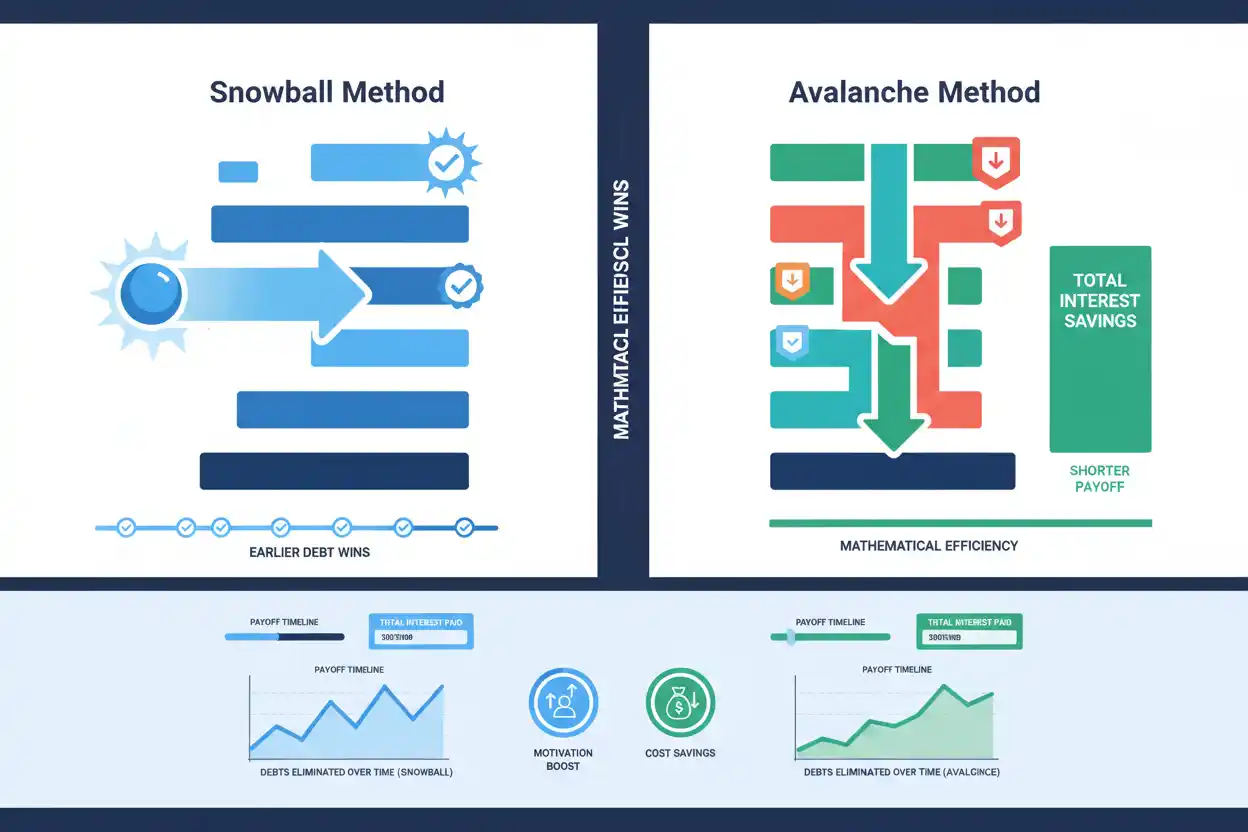

A debt payoff strategy determines the order in which extra repayment money is applied when you owe more than one debt.
Two of the most common approaches are the debt snowball and debt avalanche.
The distinction is simple:
Debt Snowball = Smallest Balance First
Debt Avalanche = Highest Interest Rate First
Both methods require you to keep making required payments on the other debts.
What changes is the destination of your extra payoff money.
The avalanche generally has the mathematical advantage when the objective is minimizing interest. The snowball can provide faster account-payoff milestones, which some borrowers find easier to sustain.
The right strategy therefore depends on both arithmetic and behavior.
What Is a Debt Payoff Strategy?
A debt payoff strategy is a structured plan for eliminating multiple debts with a limited monthly repayment budget.
Suppose your required payments total $600 per month, but you can afford $900.
Your extra payoff amount is:
Extra Debt Payment = Total Debt Budget − Required Minimum Payments
Extra Debt Payment = $900 − $600
Extra Debt Payment = $300
The question is where that $300 should go.
A debt snowball sends it to the smallest balance.
A debt avalanche sends it to the highest-rate balance.
Debt Payoff Strategy Example
Suppose you have:
| Debt | Balance | APR | Minimum |
|---|---|---|---|
| Card A | $1,000 | 18% | $50 |
| Card B | $5,000 | 29% | $150 |
| Personal Loan | $8,000 | 12% | $200 |
Total required payments:
Minimum Payments = $50 + $150 + $200
Minimum Payments = $400
Available debt budget:
Debt Budget = $700
Extra payment:
Extra Payment = $700 − $400
Extra Payment = $300
Now the two strategies diverge.
Snowball Order
The smallest balance is Card A at $1,000.
Therefore:
Card A receives:
$50 Minimum + $300 Extra = $350
Card B receives $150.
Personal Loan receives $200.
Once Card A disappears, its $350 payment becomes available to the next-smallest balance.
Avalanche Order
The highest interest rate is Card B at 29%.
Therefore:
Card B receives:
$150 Minimum + $300 Extra = $450
Card A receives $50.
Personal Loan receives $200.
Once Card B is paid off, its $450 payment rolls into the next-highest-rate debt.
Why the Avalanche Usually Saves More Interest
The avalanche attacks the most expensive debt first.
Consider $1,000 of debt at two rates.
At 29%:
Annualized Interest Illustration = $1,000 × 29% = $290
At 12%:
Annualized Interest Illustration = $1,000 × 12% = $120
Difference:
$290 − $120 = $170
Every $1,000 removed from the 29% balance avoids more future interest than $1,000 removed from the 12% balance, assuming comparable time and balance behavior.
That is the mathematical logic behind the avalanche.
Why the Snowball Can Still Work
The snowball attacks the smallest account.
Suppose Card A is only $1,000.
At $350 per month, it can disappear quickly.
That creates an immediate milestone:
one account eliminated, one due date removed, one minimum payment freed.
For some borrowers, that progress makes the plan easier to maintain.
A mathematically optimal plan is not useful if it is abandoned.
Snowball vs Avalanche Comparison
| Feature | Snowball | Avalanche |
|---|---|---|
| Priority | Smallest balance | Highest interest rate |
| Main advantage | Faster account wins | Lower interest cost |
| Main tradeoff | Can cost more interest | First payoff may take longer |
| Best for | Motivation and simplicity | Mathematical efficiency |
| Required payments | Continue on all debts | Continue on all debts |
Neither method involves deliberately missing payments on non-target debts.
What Happens When a Debt Is Paid Off?
The payment is rolled forward.
Suppose your target debt receives:
Minimum = $150
Extra = $300
Total:
Target Payment = $450
When that debt reaches zero, the $450 is not absorbed back into spending.
It becomes the additional payment on the next debt.
If the next debt already required $200:
New Payment = $200 + $450
New Payment = $650
This rolling payment is what creates momentum in both systems.
Debt Payoff Strategy and Credit Card Minimum Payments
The credit card minimum payment is the required payment floor.
It should be included in the plan for every card.
Suppose:
Card A minimum = $75
Card B minimum = $120
Card C minimum = $60
Required card payments:
Total Minimums = $75 + $120 + $60
Total Minimums = $255
Only money above $255 is truly available for strategic targeting.
Debt Payoff Strategy and Credit Card APR
The credit card APR is central to the avalanche because the strategy ranks debt by borrowing cost.
For example:
Card A = 18%
Card B = 24%
Card C = 30%
Avalanche order:
Card C → Card B → Card A
The snowball may produce a completely different sequence if Card A has the smallest balance.
Debt Payoff Strategy and Credit Card Payoff
A credit card payoff calculation answers how much must be paid to eliminate one balance within a specified period.
A debt payoff strategy answers which balance should receive additional money first.
You can combine them.
For example:
strategy identifies Card B as the target, while the payoff calculation shows that $600 per month will eliminate Card B in approximately 11 months.
Debt Payoff Strategy and Daily Simple Interest
A daily simple interest loan generates interest according to principal and elapsed days.
If the loan has the highest rate, an avalanche may prioritize it.
Paying principal earlier then reduces the balance used for future daily-interest calculations.
Debt Payoff Strategy and Debt Consolidation
Debt consolidation can replace several debts with one financing arrangement.
That changes the need for snowball or avalanche sequencing.
Instead of managing three cards separately, the borrower may have one consolidation loan.
However, consolidation should be used only when the new rate, fees, term, and repayment structure improve the plan.
Debt Consolidation Loan vs Payoff Strategy
A debt consolidation loan is a financial product.
A debt payoff strategy is a method.
You can follow a payoff strategy without obtaining new financing.
Likewise, obtaining a consolidation loan does not automatically create a disciplined payoff strategy.
The borrower still needs to avoid rebuilding the old balances.
Debt Service Coverage and Business Debt
For business obligations, the debt service coverage ratio can help determine whether operating cash flow is sufficient to support required debt payments.
A business debt-reduction strategy should not direct so much cash toward early repayment that it creates a working-capital shortage.
Debt reduction must remain compatible with operating liquidity.
Debt-to-Income Ratio
For household borrowing, the debt-to-income ratio compares monthly debt payments with gross monthly income.
As debts disappear, required monthly payments can decline.
Suppose:
Gross monthly income = $6,000
Debt payments = $2,400
DTI = $2,400 ÷ $6,000 × 100 = 40%
After eliminating a $400 monthly obligation:
New DTI = $2,000 ÷ $6,000 × 100
New DTI ≈ 33.3%
The payoff strategy therefore changes both total debt and monthly debt burden.
Credit Utilization and Payoff Order
The credit utilization ratio creates another possible priority.
Suppose Card A is nearly maxed out but has a lower APR than Card B.
An avalanche prioritizes Card B because of its rate.
Someone focused specifically on revolving utilization might choose to reduce Card A sooner.
That becomes a hybrid strategy rather than a pure avalanche.
Credit Score Factors
The broader credit score factors should not replace sound payoff economics.
Trying to optimize a score by maintaining unnecessary interest-bearing balances is counterproductive.
A good payoff strategy primarily seeks to reduce:
principal, interest, and financial risk.
Credit-profile improvements can follow from lower revolving balances and consistent payment history.
Balance Transfers as a Payoff Tool
A balance transfer fee can be worthwhile if expensive revolving debt is moved to a sufficiently long promotional APR period.
Suppose:
Transfer balance = $6,000
Fee = 3%
Transfer Fee = $6,000 × 3% = $180
New balance:
$6,180
If the rate is 0% for 12 months:
Monthly Payoff Target = $6,180 ÷ 12
Monthly Payoff Target = $515
The transfer becomes a payoff tool only if the borrower uses the promotional window to reduce principal.
Fixed vs Variable Rates
A fixed vs variable interest rate structure can change avalanche rankings.
Suppose:
Debt A = 14% fixed
Debt B = 12% variable
If Debt B adjusts to 16%, the priority changes.
A debt plan should therefore be reviewed after material rate changes.
Prepayment Penalties
Before directing large extra payments to installment debt, check for a prepayment penalty.
A nominally higher-rate loan may not be the economically best first target when early repayment creates a material contractual cost.
Most ordinary credit-card balances do not work like fixed-term loans with conventional prepayment penalties, but installment contracts can.
Debt Payoff Budget Formula
A practical payoff budget is:
Debt Payoff Budget = Required Minimum Payments + Sustainable Extra Payment
Suppose required payments total $600 and sustainable extra cash is $500.
Debt Payoff Budget = $600 + $500
Debt Payoff Budget = $1,100 per Month
The strategy works best when the $1,100 remains constant after debts begin disappearing.
Should You Use Every Dollar for Debt?
Not necessarily.
Sending all cash reserves to debt can leave you unable to handle an emergency.
If a necessary $1,000 expense then goes directly back onto a high-rate credit card, the plan can reverse.
The appropriate balance between cash reserves and accelerated debt repayment depends on income stability, expenses, insurance, available liquidity, and interest rates.
Hybrid Debt Payoff Strategy
A borrower does not have to follow one method rigidly.
A hybrid might:
- eliminate one very small balance for momentum;
- switch to highest-APR debt afterward;
- prioritize a promotional balance before its 0% period expires.
This is no longer a pure snowball or avalanche, but it can fit the borrower’s actual circumstances better.
When the Snowball May Be More Practical
The snowball can be useful when:
- several very small balances create administrative burden;
- quick wins make the borrower more likely to continue;
- rates are relatively similar;
- eliminating one payment quickly would improve monthly cash flow.
When the Avalanche May Be More Practical
The avalanche can be preferable when:
- interest rates differ substantially;
- the borrower is highly disciplined;
- minimizing total interest is the dominant goal;
- expensive credit-card balances are generating significant finance charges.
Common Debt Payoff Strategy Mistakes
One mistake is sending extra money to one debt while missing required payments on another.
Another is changing strategy every month based on emotion.
A third is continuing to create new debt while trying to pay old debt off.
Borrowers can also ignore promotional-rate expiration dates.
Finally, aggressively repaying low-rate debt while carrying extremely expensive revolving debt can increase total financing cost.
Frequently Asked Questions
What is a debt payoff strategy?
It is a structured method for deciding how available repayment money should be allocated among multiple debts.
What is the debt snowball?
It pays extra money toward the smallest balance first.
What is the debt avalanche?
It pays extra money toward the highest-interest debt first.
Which method saves more interest?
The avalanche generally minimizes interest when other assumptions remain equal.
Why would anyone choose the snowball?
The snowball provides faster balance-elimination milestones, which can make the strategy easier for some people to maintain.
Do I still make minimum payments on other debts?
Yes. Required payments should continue on every debt.
What happens when one debt is paid off?
Its former payment is redirected to the next target.
Should I prioritize credit score or interest cost?
For debt repayment, reducing expensive debt and maintaining on-time payments generally provides a stronger financial foundation than optimizing one scoring metric.
Can a balance transfer be part of a payoff strategy?
Yes, when the fee and promotional rate create savings and the borrower can repay the balance within the favorable period.
Can I combine snowball and avalanche methods?
Yes. A hybrid strategy can be appropriate when it improves consistency or accounts for promotional rates and other constraints.
Should I consolidate instead?
Consolidation can help when a new loan materially lowers cost and creates a sustainable repayment schedule.
How much should I pay toward debt each month?
Use the largest amount that can be sustained after required living expenses, minimum payments, and an appropriate liquidity reserve.
Final Takeaway
A debt payoff strategy answers one central question:
Where should the next extra dollar go?
The two most common answers are:
Debt Snowball = Smallest Balance First
Debt Avalanche = Highest Interest Rate First
If required payments total $400 and your debt budget is $700, you have:
$700 − $400 = $300
of extra money to target.
The avalanche normally produces the lower interest cost.
The snowball can provide faster account wins.
Whichever method you choose, the most important mechanics are the same: maintain every required payment, stop creating unnecessary new debt, and roll each eliminated debt’s full payment into the next target until the entire repayment budget is working on the final balance.