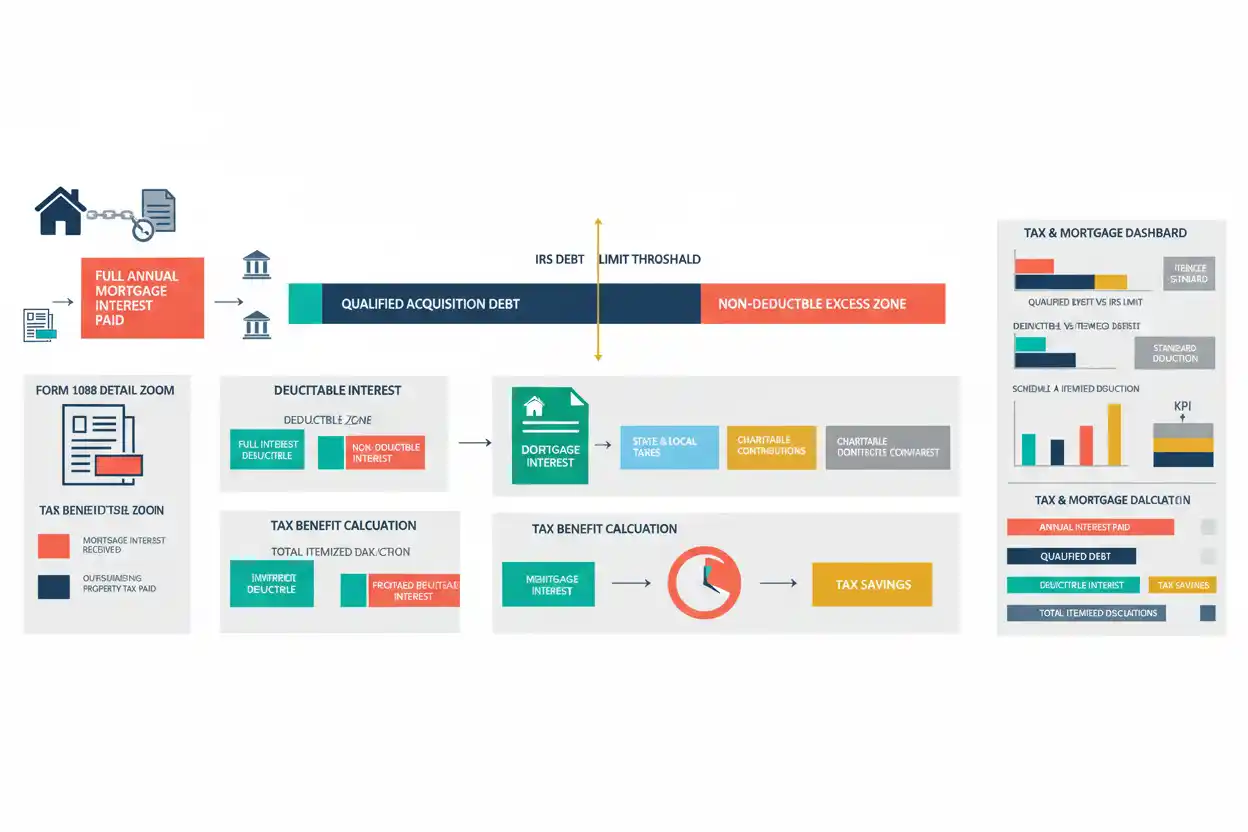
The mortgage interest deduction can allow eligible U.S. taxpayers who itemize deductions to deduct qualifying home mortgage interest from taxable income.
It does not mean every dollar of mortgage interest is deductible, and it does not provide a dollar-for-dollar tax credit.
Current IRS guidance requires, among other conditions, that the taxpayer itemize deductions on Schedule A and that the mortgage be secured by a qualified home. The amount deductible can also depend on when the mortgage was incurred, the amount of qualifying debt, and how the borrowed funds were used.
For many mortgages secured after December 15, 2017, current IRS guidance uses a home-acquisition-debt limit of:
$750,000
or:
$375,000 if Married Filing Separately
Older qualifying acquisition debt can be subject to the prior $1 million/$500,000 limits, and grandfathered debt has separate treatment.
Mortgage Interest Deduction Formula
When mortgage debt exceeds the applicable qualified loan limit, IRS Publication 936 provides a worksheet-based calculation.
A simplified representation for an otherwise straightforward limited-debt example is:
Deductible Interest Ratio = Qualified Loan Limit ÷ Average Qualifying Mortgage Balance
Then:
Deductible Mortgage Interest = Interest Paid × Deductible Interest Ratio
This is only a simplified expression of the Publication 936 worksheet. Mixed-use mortgages, multiple homes, grandfathered debt, refinances, and other circumstances can require the full IRS calculation.
Mortgage Interest Deduction Example
Suppose:
Average qualifying post-2017 acquisition mortgage balance = $900,000
Applicable qualified loan limit = $750,000
Mortgage interest paid = $54,000
Ratio:
Deductible Ratio = $750,000 ÷ $900,000
Deductible Ratio ≈ 83.33%
Estimated deductible interest under the simplified example:
Deductible Interest ≈ $54,000 × 83.33%
Deductible Interest ≈ $45,000
Approximately $9,000 of the interest would fall outside the simplified deductible portion.
IRS Publication 936’s limitation worksheet similarly uses the qualified loan limit relative to average mortgage balances to calculate limited deductible interest.
What Is Home Acquisition Debt?
Current IRS guidance defines home acquisition debt generally as qualifying mortgage debt used to:
buy, build, or substantially improve
a qualified main or second home, with the debt secured by that home.
This definition matters because merely borrowing against a house does not automatically make the resulting interest deductible as home mortgage interest.
Itemizing Is Required
The mortgage interest deduction is an itemized deduction.
IRS Publication 936 states that taxpayers claiming the deduction generally must itemize on Schedule A.
Therefore:
Mortgage Interest Paid ≠ Automatic Tax Deduction
If a taxpayer uses the standard deduction rather than itemizing, qualifying mortgage interest does not create a separate additional Schedule A deduction on top of the standard deduction.
Mortgage Interest vs Tax Credit
Suppose a taxpayer has:
$20,000 of Deductible Mortgage Interest
That does not mean federal tax is reduced by:
$20,000
A deduction reduces income subject to tax under the applicable rules.
A credit generally reduces tax liability directly.
The actual tax benefit depends on the taxpayer’s complete return.
Rough Tax-Benefit Illustration
For education only, suppose:
Deductible mortgage interest = $20,000
The deduction creates an additional $10,000 of itemized deductions above what would otherwise have been claimed
Marginal tax rate on that portion = 24%
A rough incremental benefit could be illustrated as:
Approximate Tax Effect = Incremental Deduction × Marginal Rate
≈ $10,000 × 24%
≈ $2,400
This is not a tax-return calculation. Brackets, deductions, credits, filing status, alternative rules, and other items can change the actual result.
Current Debt Limits
Current IRS guidance says qualifying home mortgage interest can generally be deducted on the first $750,000 of qualifying indebtedness for relevant post-December 15, 2017 acquisition debt, or $375,000 for married filing separately. Higher $1 million/$500,000 limits can apply to qualifying debt incurred before December 16, 2017.
These limits apply across the taxpayer’s qualifying main and second homes under the rules described by Publication 936, rather than providing a fresh $750,000 limit for each home.
Mortgage Interest and Form 1098
Qualified mortgage interest and points are generally reported by the mortgage holder on Form 1098, Mortgage Interest Statement, when applicable.
However, the amount shown on Form 1098 is not necessarily identical to the final deductible amount.
The taxpayer can still be subject to:
debt limits, use-of-proceeds rules, multiple-mortgage calculations, or other restrictions.
Mortgage Interest Deduction and Mortgage Interest
The mapped mortgage interest page calculates how much contractual mortgage interest is generated.
This page asks a different question:
How Much of That Interest Qualifies for a Federal Tax Deduction?
Suppose:
Mortgage interest paid = $30,000
Deductible amount = $24,000
The borrower still paid $30,000.
The tax rules merely determine how much can be claimed as qualifying mortgage interest on the federal return.
Home Equity Loans and HELOC Interest
Current IRS Publication 936 states that interest on home equity loans and lines of credit is deductible as home mortgage interest only when the borrowed funds are used to buy, build, or substantially improve the taxpayer’s home securing the debt and the other requirements are met.
For example:
HELOC proceeds used for a qualifying major addition to the home securing the HELOC can potentially create home acquisition debt.
HELOC proceeds used to buy a personal vehicle generally do not become qualifying home acquisition debt merely because the HELOC is secured by a house.
Cash-Out Refinance and the Deduction
A cash-out refinance can create mixed tax treatment.
IRS guidance says refinance debt can retain home-acquisition-debt treatment up to the old qualifying mortgage principal, while additional debt must satisfy the qualifying use rules to count as home acquisition debt.
Suppose:
Old qualifying mortgage principal = $300,000
New refinance = $400,000
Additional cash = $100,000
The original $300,000 does not automatically lose acquisition-debt treatment merely because it was refinanced.
However, treatment of the extra $100,000 depends on how the proceeds are used and the other tax requirements.
Mortgage Origination Fee and Tax Deduction
A mortgage origination fee should not automatically be treated as deductible mortgage interest.
Tax rules for points and other mortgage charges depend on the nature of the charge and applicable IRS requirements.
Publication 936 contains separate rules for points and other mortgage-related amounts.
A fee labeled “origination fee” by a lender is therefore not automatically transformed into deductible interest simply because it is calculated as a percentage of principal.
Mortgage Points
The mortgage points tax treatment can differ from ordinary interest.
IRS Publication 936 contains detailed rules determining when qualifying points can be deducted in the year paid and when they must be deducted over the mortgage term.
The lending calculation and tax calculation should therefore remain separate.
Mortgage Insurance Is Different
Mortgage insurance is not the same thing as mortgage interest.
Even when both appear in the same monthly mortgage payment:
Interest ≠ Mortgage Insurance Premium
Tax treatment can also differ, so do not include insurance automatically when calculating the mortgage interest deduction.
Mortgage Escrow Is Not Mortgage Interest
Mortgage escrow can collect property taxes and homeowners insurance.
Those amounts do not become mortgage interest merely because the mortgage servicer collects them.
Your annual mortgage statement should therefore be separated into:
interest, principal, escrow, and other charges.
How Mortgage Payments Affect the Deduction
The how mortgage payments work page explains why interest is highest in the early years of an amortizing loan.
Because deductible mortgage interest is based on qualifying interest actually paid under applicable tax rules, the potential deduction can decline as mortgage interest declines over time.
That means a borrower should not assume the first-year deduction will continue unchanged for 30 years.
Paying Extra Principal
Suppose an extra principal payment reduces the mortgage balance.
Future mortgage interest falls.
That can reduce future deductible interest.
This does not mean extra principal payments are financially harmful.
Paying one dollar of unnecessary interest merely to obtain a fraction of a dollar in tax benefit generally does not create an economic gain.
Tax effects should be included in the analysis, not allowed to reverse the basic cost of borrowing.
Main Home and Second Home
Publication 936’s qualified-home rules can apply to a taxpayer’s main home and a second home when the applicable requirements are met. The mortgage debt limits are coordinated across qualifying homes rather than simply multiplied by the number of properties.
Special second-home-use rules can also apply.
For unusual circumstances, the IRS publication or a qualified tax professional should be consulted.
Mortgage Interest Credit
A mortgage interest deduction is also different from the federal mortgage interest credit available to certain taxpayers with a qualifying Mortgage Credit Certificate.
IRS Topic 505 notes that eligible taxpayers can potentially claim that credit using Form 8396, and any credit claimed can affect the mortgage interest deduction.
Do not use the terms interchangeably.
Common Mortgage Interest Deduction Mistakes
One mistake is assuming all mortgage interest is deductible.
Another is forgetting that itemizing is generally required.
Taxpayers also apply the $750,000 limit separately to multiple homes instead of following the combined rules.
A fourth mistake is treating home-equity borrowing used for personal spending as acquisition debt.
Another is assuming the amount on Form 1098 is automatically the final Schedule A deduction.
Finally, mortgage-interest deduction rules can change, so tax-year-specific IRS guidance should be used.
Frequently Asked Questions
What is the mortgage interest deduction?
It is an itemized federal income-tax deduction for qualifying home mortgage interest when the applicable requirements are satisfied.
Do I have to itemize?
Generally yes. Publication 936 requires itemizing on Schedule A for the home mortgage interest deduction.
What is the current post-2017 debt limit?
Current IRS guidance uses:
$750,000
or:
$375,000 for Married Filing Separately
for relevant acquisition debt incurred after December 15, 2017.
What about older acquisition mortgages?
Qualifying debt incurred before December 16, 2017 can be subject to the older $1 million/$500,000 limits.
Is HELOC interest deductible?
It can qualify when the proceeds are used to buy, build, or substantially improve the qualified home securing the debt and the other requirements are met.
Is mortgage insurance the same as deductible mortgage interest?
No.
Is Form 1098 the same as my final deduction?
Not necessarily. Limits and other rules can change the deductible amount.
Can refinance interest remain deductible?
Qualifying refinance debt can retain acquisition-debt treatment up to relevant limits, while additional debt is subject to use-of-proceeds rules.
Is the deduction a tax credit?
No. A deduction reduces taxable income; a credit reduces tax under separate rules.
Can I deduct interest on a second home?
Potentially, if the qualified-home and other applicable rules are satisfied.
Does paying extra principal reduce future deductions?
It can because it reduces future mortgage interest.
Should I keep a mortgage only for the deduction?
A tax deduction normally recovers only part of an otherwise deductible expense. The complete borrowing cost should be evaluated rather than spending interest solely to obtain a deduction.
Final Takeaway
The mortgage interest deduction is not simply:
Mortgage Interest Paid = Mortgage Interest Deducted
Current IRS rules require the mortgage to satisfy qualifying conditions, generally require itemizing, and impose debt limitations.
In the simplified example:
Average qualifying mortgage balance = $900,000
Qualified loan limit = $750,000
Interest paid = $54,000
Deductible ratio:
$750,000 ÷ $900,000 ≈ 83.33%
Estimated deductible interest:
≈ $45,000
Use the applicable tax year’s IRS rules, especially when the mortgage involves pre-2017 debt, refinancing, HELOCs, mixed-use proceeds, multiple homes, points, or balances above the qualified loan limit.