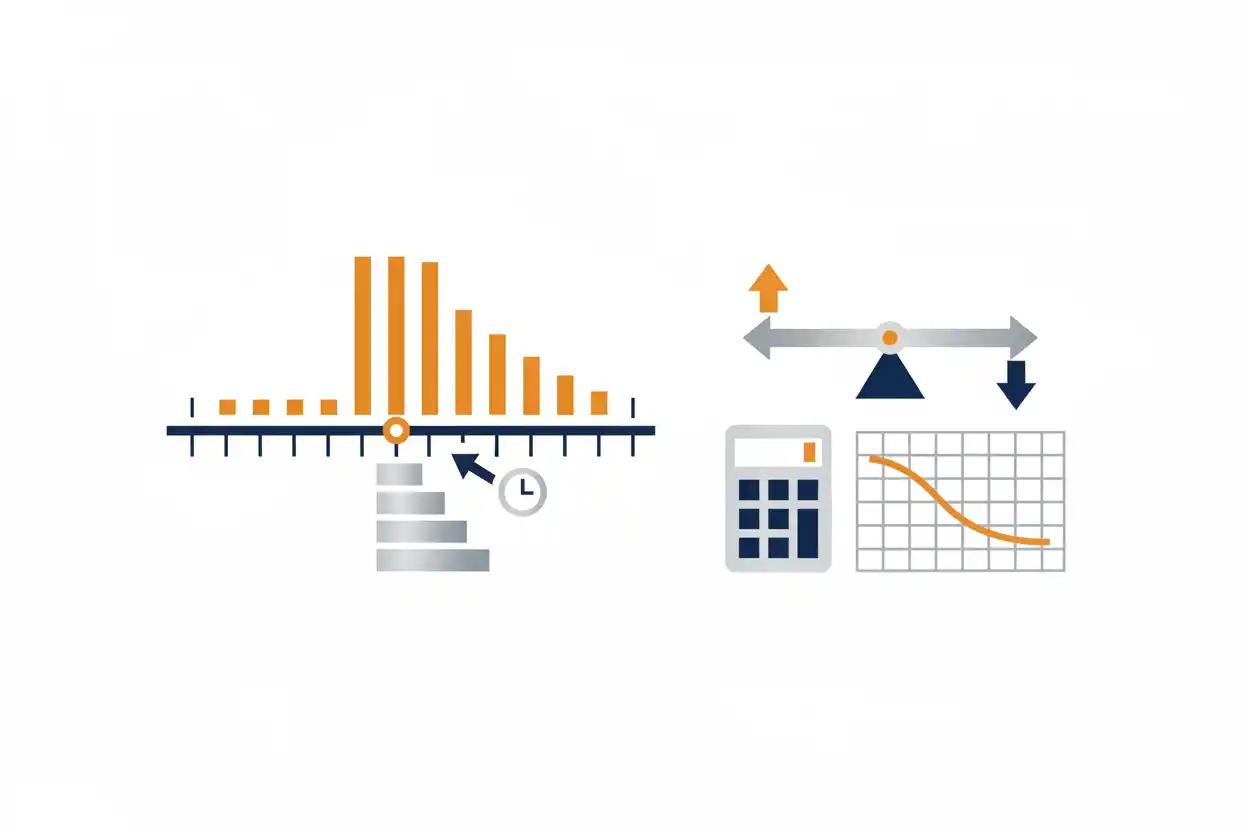
Duration is a fixed-income measure that summarizes the timing of a bond’s cash flows and, in modified form, helps estimate how sensitive the bond’s price is to changes in yield.
Two common versions are Macaulay duration and modified duration.
Macaulay duration is a present-value-weighted average time until the bond’s cash flows are received. Modified duration converts that measure into an approximate percentage price sensitivity to changes in yield.
A bond with modified duration of 5 would be expected, as a first-order approximation, to fall about 5% if its yield increased by one percentage point.
That approximation becomes less precise as the yield change grows because the true bond price-yield relationship is curved.
What Is Duration?
Duration brings the timing and present value of a bond’s future cash flows into one measure.
A bond may make:
- periodic coupon payments;
- a principal repayment at maturity.
Cash flows arriving earlier receive different weights from cash flows arriving later because their present values and timing differ.
Macaulay duration calculates the weighted average timing of those cash flows.
Macaulay Duration Formula
For annual cash flows:
Macaulay Duration = Σ[t × PV(CFₜ)] ÷ Bond Price
Where:
- t = time until each cash flow;
- PV(CFₜ) = present value of the cash flow at time t;
- Bond Price = sum of the present values of all cash flows.
Equivalently:
Macaulay Duration = Σ[t × CFₜ ÷ (1 + y)^t] ÷ P
Where:
- CFₜ = cash flow in period t;
- y = yield per period;
- P = bond price.
Duration Example
Consider a three-year bond with:
- Face value = $1,000
- Annual coupon rate = 5%
- Annual coupon = $50
- Yield to maturity = 6%
- Annual coupon payments
The cash flows are:
- Year 1: $50
- Year 2: $50
- Year 3: $1,050
First calculate the bond price.
Price = $50 ÷ 1.06 + $50 ÷ 1.06² + $1,050 ÷ 1.06³
Present value of year-one cash flow:
$50 ÷ 1.06 ≈ $47.17
Year two:
$50 ÷ 1.06² ≈ $44.50
Year three:
$1,050 ÷ 1.06³ ≈ $881.60
Total:
Bond Price ≈ $973.27
Calculate the Time-Weighted Present Values
Now multiply each present value by its time.
Year 1:
1 × $47.17 = $47.17
Year 2:
2 × $44.50 = $89.00
Year 3:
3 × $881.60 = $2,644.80
Add them:
Weighted PV Total ≈ $2,780.97
Now divide by the bond price:
Macaulay Duration ≈ $2,780.97 ÷ $973.27
Macaulay Duration ≈ 2.857 years
The bond’s Macaulay duration is approximately 2.86 years.
Although maturity is three years, duration is slightly shorter because some value is received through earlier coupon payments.
Modified Duration Formula
Modified duration adjusts Macaulay duration for the bond’s yield.
For annual compounding:
Modified Duration = Macaulay Duration ÷ (1 + Yield)
Using the example:
Modified Duration = 2.857 ÷ 1.06
Modified Duration ≈ 2.696
The bond’s modified duration is approximately 2.70.
Using Modified Duration to Estimate a Price Change
The approximation is:
Percentage Price Change ≈ −Modified Duration × Change in Yield
Suppose yield rises from 6% to 6.5%.
The yield change is:
6.5% − 6% = 0.5%
As a decimal:
Δy = 0.005
Then:
Estimated Price Change ≈ −2.6956 × 0.005
Estimated Price Change ≈ −0.013478
Convert to a percentage:
Estimated Price Change ≈ −1.35%
Modified duration therefore estimates a price decline of approximately 1.35%.
Convert the Percentage Estimate to Dollars
Starting bond price:
$973.27
Estimated decline:
$973.27 × 1.3478% ≈ $13.12
Estimated new price:
$973.27 − $13.12 ≈ $960.15
Exact repricing of the same cash flows at a 6.5% yield gives approximately $960.27.
The duration estimate is close because the yield change is relatively small.
Why Duration Has a Negative Sign
Bond price and required yield generally move in opposite directions.
Therefore:
Yield ↑ → Bond Price ↓
and:
Yield ↓ → Bond Price ↑
Modified duration is normally reported as a positive number, while the price-change approximation includes a negative sign to reflect this inverse relationship.
Duration vs Maturity
Maturity tells you when the bond’s final contractual payment is scheduled.
Duration incorporates the timing of all cash flows.
Consider two 10-year bonds:
- Bond A pays no coupons until maturity.
- Bond B pays substantial coupons every year.
Both mature in 10 years, but Bond B returns more value earlier.
Its Macaulay duration would generally be shorter than that of the otherwise comparable zero-coupon bond.
Duration of a Zero-Coupon Bond
A zero-coupon bond has only one contractual cash flow: its maturity payment.
For a zero-coupon bond:
Macaulay Duration = Time to Maturity
If a zero-coupon bond matures in five years:
Macaulay Duration = 5 years
There are no earlier coupon payments to pull the weighted-average timing forward.
What Makes Duration Longer?
All else equal, duration tends to be greater when:
- maturity is longer;
- coupon is lower;
- yield is lower.
Longer maturity places more value farther into the future.
Lower coupons also shift a larger proportion of total value toward the final maturity payment.
What Makes Duration Shorter?
All else equal, duration tends to decline when:
- maturity is shorter;
- coupon is higher;
- yield is higher.
Higher coupons return more cash earlier, which pulls the present-value-weighted average timing toward the present.
Duration vs Current Yield
Current yield measures annual coupon income relative to the current bond price.
Duration measures something different.
A bond can have:
- current yield of 6%;
- modified duration of 4.5.
The 6% figure concerns income relative to price.
The 4.5 figure concerns price sensitivity and cash-flow timing.
They should not be compared as competing return measures.
Duration vs Convexity
Convexity refines duration analysis.
Duration uses a straight-line approximation to the bond price-yield relationship.
The actual relationship is curved.
The combined approximation is:
ΔP ÷ P ≈ −Modified Duration × Δy + ½ × Convexity × (Δy)²
For small yield changes, duration often explains most of the estimated movement.
For larger yield changes, convexity becomes increasingly important.
Duration and Dividend Yield
Dividend yield applies to stock income.
Duration primarily concerns fixed-income cash flows.
A stock does not normally have a contractual maturity date and predetermined principal repayment like a conventional bond.
Consequently, standard bond duration should not be used as a substitute for equity dividend analysis.
Duration and Earnings Yield
Earnings yield is also an equity valuation ratio.
It compares earnings per share with share price.
Duration instead measures bond cash-flow timing and interest-rate sensitivity.
The two percentages or numerical values can coexist in a portfolio analysis but answer different questions.
Duration and Dollar-Cost Averaging
An investor can use dollar-cost averaging to purchase bond funds or other investments periodically.
DCA governs the timing of contributions.
Duration describes interest-rate sensitivity of the fixed-income exposure purchased.
Repeated investing does not remove duration risk.
Duration and Emergency Funds
An emergency fund is generally intended to be accessible when an unexpected expense occurs.
A long-duration bond position can experience meaningful market-price changes if yields move.
That does not automatically make bonds inappropriate for every liquidity objective, but it illustrates why time horizon and price sensitivity matter when selecting assets for money that may be needed soon.
Duration and Discounts
A falling bond price might look like an ordinary discount from face value, but fixed-income pricing requires more analysis.
A bond priced at $900 instead of $1,000 may reflect changes in market yields, credit quality, maturity, or other factors.
Duration helps estimate one component of that price sensitivity.
A percentage-off calculation does not.
Portfolio Duration
A simplified portfolio duration can be calculated as the market-value-weighted duration of its components.
Portfolio Duration = Σ(Portfolio Weight × Security Duration)
Suppose:
- 60% is invested in bonds with duration 3;
- 40% is invested in bonds with duration 7.
Then:
Portfolio Duration = (0.60 × 3) + (0.40 × 7)
Portfolio Duration = 1.8 + 2.8
Portfolio Duration = 4.6
The portfolio’s approximate duration is 4.6, assuming the individual duration measures are calculated consistently.
Limitations of Duration
Duration is an approximation.
Its limitations include:
- changing cash flows;
- embedded options;
- credit-spread movements;
- nonparallel yield-curve changes;
- large yield changes;
- changing market liquidity.
Modified duration works best as a local estimate around the current yield.
It should not be treated as an exact prediction of every bond-price movement.
Common Duration Mistakes
One mistake is confusing duration with maturity.
Another is using percentage points directly rather than converting them into decimal yield changes.
For example:
0.50 percentage points = 0.005
not 0.50.
Investors can also overlook convexity when modeling larger yield movements.
Finally, duration is not a complete measure of bond risk because credit and liquidity risks can also matter.
Frequently Asked Questions
What is duration in bonds?
Duration summarizes the timing of bond cash flows and, in modified form, helps estimate sensitivity to yield changes.
What is Macaulay duration?
Macaulay duration is the present-value-weighted average time until a bond’s cash flows are received.
What is modified duration?
Modified duration converts Macaulay duration into an approximate percentage price sensitivity to changes in yield.
What is the modified duration formula?
For annual compounding:
Modified Duration = Macaulay Duration ÷ (1 + Yield)
How do you estimate a bond price change using duration?
% Price Change ≈ −Modified Duration × Change in Yield
What does duration of 5 mean?
A modified duration of 5 implies that a one-percentage-point yield increase corresponds to an approximate 5% price decline, before convexity and other effects.
Is duration the same as maturity?
No. Maturity considers the final payment date; duration incorporates the timing and present value of all cash flows.
Why is duration shorter for higher-coupon bonds?
Higher coupons return more value earlier, reducing the weighted-average timing of cash flows.
Does duration measure credit risk?
No. It mainly addresses cash-flow timing and interest-rate sensitivity.
Why does convexity matter?
It corrects part of the error created by approximating a curved price-yield relationship with a straight line.
Can a bond fund have duration?
Yes. A portfolio of bonds can have a weighted duration that summarizes its approximate interest-rate sensitivity.
Where does duration fit in investing?
Duration is an important fixed-income risk measure within a diversified Savings & Investing framework.