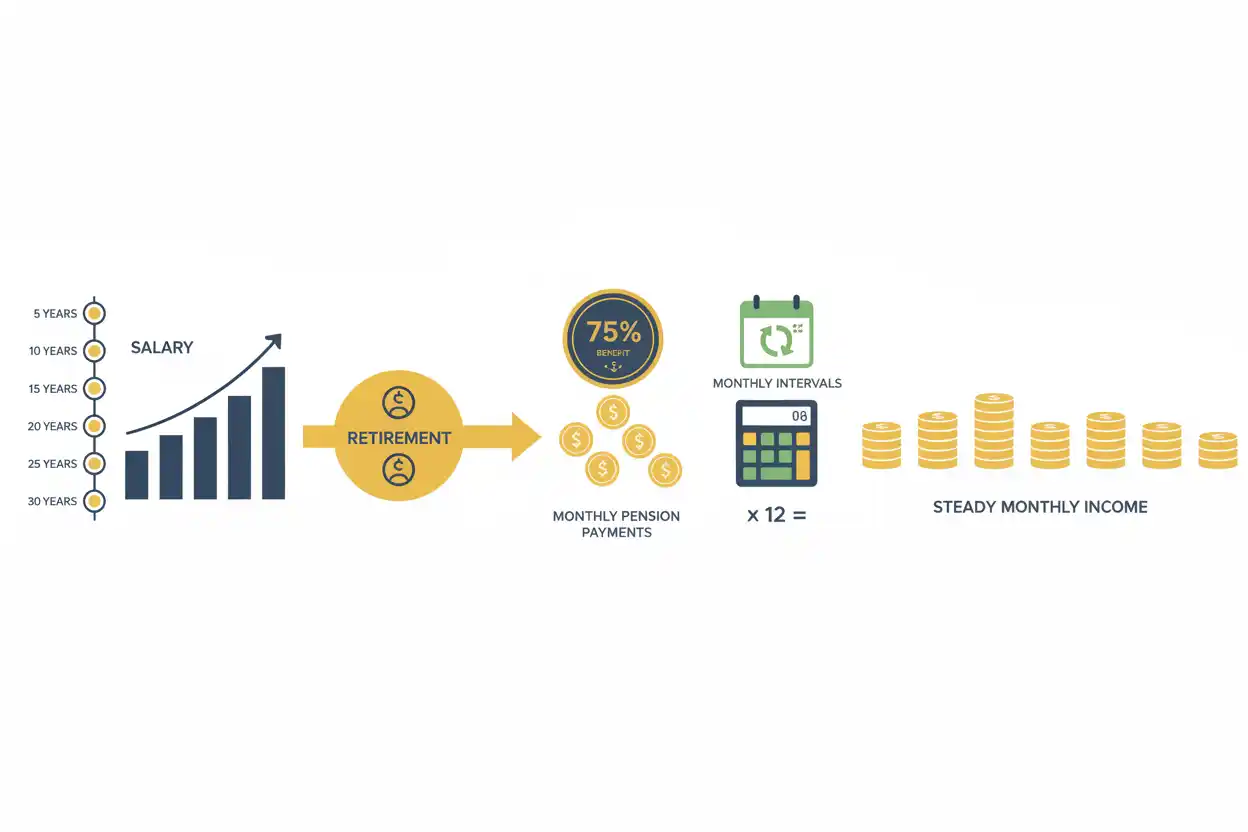

Pension payouts are recurring retirement payments provided under the rules of a pension plan.
For a traditional defined-benefit pension, the monthly amount may be determined by a formula using factors such as years of credited service, compensation history, a benefit multiplier, retirement age, and the payout option selected.
For example, a hypothetical formula using a 1.5% multiplier, $80,000 of final-average compensation, and 30 years of service produces an estimated annual benefit of $36,000, or $3,000 per month before any plan-specific reductions or adjustments.
Actual pension formulas vary significantly, so the plan document controls the benefit—not a universal pension formula.
What Is a Pension Payout?
A pension payout is retirement income paid according to a pension plan’s benefit provisions.
Depending on the plan, payments may be:
- monthly;
- another periodic schedule;
- lifetime income;
- joint-and-survivor income;
- a lump-sum option where offered;
- another plan-specific structure.
A pension should therefore be evaluated according to its exact benefit formula and distribution rules.
Basic Defined-Benefit Pension Formula
A common conceptual structure is:
Annual Pension = Benefit Multiplier × Credited Service × Pensionable Compensation
The actual terms can use different definitions.
For example:
- “compensation” might mean final salary;
- it might mean an average over selected years;
- only certain earnings might qualify;
- service credits can follow plan-specific rules.
The formula below is therefore illustrative rather than universal.
Pension Payout Example
Suppose a hypothetical pension plan uses:
- benefit multiplier = 1.5%;
- final-average compensation = $80,000;
- credited service = 30 years.
Convert the multiplier:
1.5% = 0.015
Calculate:
Annual Pension = 0.015 × 30 × $80,000
First:
0.015 × 30 = 0.45
Then:
0.45 × $80,000 = $36,000
Estimated annual pension:
$36,000
Monthly amount:
$36,000 ÷ 12 = $3,000
The hypothetical pension payout is $3,000 per month before considering payout-option adjustments or other plan provisions.
Understanding the Benefit Multiplier
A multiplier converts service into a percentage of pensionable compensation.
In the example:
1.5% × 30 Years = 45%
The plan therefore replaces 45% of the $80,000 pensionable-compensation measure.
$80,000 × 45% = $36,000
This percentage relationship makes the pension formula easier to interpret.
The underlying percentages must be converted correctly when performing the calculation.
How Service Years Affect Pension Payouts
Holding compensation and multiplier constant, additional credited service increases the benefit.
Using:
- multiplier = 1.5%;
- pensionable compensation = $80,000.
20 Years
0.015 × 20 × $80,000 = $24,000 per year
Monthly:
$2,000
25 Years
0.015 × 25 × $80,000 = $30,000 per year
Monthly:
$2,500
30 Years
0.015 × 30 × $80,000 = $36,000 per year
Monthly:
$3,000
The service component changes the payout directly under this simplified formula.
How Compensation Affects the Estimate
Now hold:
- multiplier = 1.5%;
- service = 30 years.
At $60,000 pensionable compensation:
0.015 × 30 × $60,000 = $27,000
At $80,000:
= $36,000
At $100,000:
= $45,000
The exact compensation definition is therefore one of the most important plan provisions to understand.
Final Salary vs Final-Average Salary
Some pension formulas may use an average of compensation across selected service years rather than the final year’s salary alone.
Suppose compensation for the relevant three-year period is:
- $76,000;
- $80,000;
- $84,000.
Average:
($76,000 + $80,000 + $84,000) ÷ 3
$240,000 ÷ 3
$80,000
A formula based on this average would use $80,000 rather than simply using the final $84,000 salary.
Actual averaging periods and compensation definitions vary by plan.
Pension Timeline
A pension timeline can contain several important dates:
Vesting date: when the participant obtains a nonforfeitable right to the benefit under plan rules.
Employment or service end date: when credited service may stop accumulating.
Benefit commencement date: when pension payments begin.
Normal retirement date: a plan-defined reference date.
Early or delayed commencement date: where plan rules permit payments before or after the normal timing.
The date employment ends and the date payments begin are not necessarily identical.
Early Retirement Reductions
Some plans permit pension payments to begin before a plan’s normal retirement date but apply a reduction.
Suppose the unreduced monthly benefit is:
$3,000
and an illustrative early-commencement adjustment reduces it by 15%.
Reduction:
$3,000 × 15% = $450
Adjusted payout:
$3,000 − $450 = $2,550
The actual reduction schedule must come from the plan.
Delayed Commencement
A plan may also provide a different benefit when payment begins later.
Possible reasons include:
- additional credited service;
- higher compensation;
- actuarial adjustment;
- plan-specific delayed-retirement rules.
The effect should not be estimated by simply applying an arbitrary growth rate unless the plan explicitly uses such a formula.
Single-Life Pension Option
A single-life pension generally provides payments for the participant’s lifetime.
Under a simplified example:
Single-Life Pension = $3,000 per month
Payments continue according to the plan’s life-contingent terms.
Once the participant dies, the treatment of future payments depends on the selected option and plan rules.
Joint-and-Survivor Pension
A joint-and-survivor option generally provides continued benefits to another person after the participant’s death.
Because this protection can extend the expected payment period, the participant’s initial monthly amount may be lower than the single-life amount.
Suppose:
Single-Life Benefit = $3,000 per month
and a hypothetical joint-and-survivor option reduces the initial benefit to 90%:
Adjusted Benefit = $3,000 × 90%
Adjusted Benefit = $2,700 per month
The 90% figure is only an illustration.
Actual actuarial adjustments depend on the plan.
Survivor Percentage
A pension can also specify how much of the participant’s adjusted payment continues to a survivor.
Suppose the participant receives:
$2,700 per month
and the survivor continuation is hypothetically 50%.
Then:
Survivor Payment = $2,700 × 50%
Survivor Payment = $1,350 per month
Again, actual percentages and formulas are plan-specific.
Pension Payouts vs Ordinary Annuity
Recurring pension payments can resemble an ordinary annuity, but the two concepts should not automatically be treated as identical.
A fixed ordinary annuity might specify:
$3,000 monthly for exactly 240 months
A lifetime pension may instead continue until death, making the total number of payments uncertain.
Present-value analysis of lifetime benefits therefore requires actuarial assumptions beyond a fixed-period annuity formula.
Pension Payouts vs Perpetuity
A perpetuity is a cash-flow stream that theoretically continues indefinitely.
A lifetime pension is not a perpetuity.
Even if payments continue throughout someone’s life, they eventually stop or change according to plan provisions.
The mathematical distinction matters because perpetuity formulas assume no finite ending date.
Pension Payment Calculations
The broader article on how payment amounts are calculated explains principal-rate-term amortization.
Pension formulas use different inputs.
A pension payment is not generally calculated as though the retiree were repaying a loan.
Instead, the plan may use compensation, service, multipliers, actuarial factors, or account conversion rules.
Always identify the type of payment before selecting a formula.
Pension Payout and Replacement Ratio
A useful planning measure compares pension income with pre-retirement compensation.
Pension Replacement Ratio = Annual Pension ÷ Pre-Retirement Income × 100
Suppose:
- pension = $36,000;
- pre-retirement income = $80,000.
Then:
Replacement Ratio = $36,000 ÷ $80,000 × 100
Replacement Ratio = 45%
The pension replaces 45% of the assumed compensation measure.
This does not mean total retirement income replaces only 45%; other income sources may also exist.
Cost-of-Living Adjustments
Some pension arrangements may provide periodic benefit adjustments.
Suppose a $36,000 annual benefit receives a hypothetical 2% increase.
New Benefit = $36,000 × 1.02
New Benefit = $36,720
Monthly:
$36,720 ÷ 12 = $3,060
Whether adjustments exist, how they are calculated, and whether they are guaranteed depends on the plan.
Fixed Pension and Inflation
If a pension remains fixed while prices rise, its purchasing power declines.
Suppose:
Annual Pension = $36,000
and inflation averages an assumed 3% annually.
The purchasing-power equivalent after 20 years is:
Real Value = $36,000 ÷ 1.03²⁰
≈ $19,932
A fixed $36,000 future income would buy substantially less under that inflation assumption.
This is why nominal payment amounts should not be evaluated without considering purchasing power.
Pension Payout and Nominal Return
If a pension plan offers a lump-sum alternative, comparing that lump sum with future monthly payments may involve an assumed nominal return or discount rate.
That assumption can materially change the comparison.
For example, a higher assumed investment return can make a lump sum appear capable of supporting larger future withdrawals.
But future investment returns are uncertain, while pension payments depend on plan promises and terms.
The comparison therefore involves both mathematics and risk.
Total Nominal Pension Payments
For a fixed-period illustration only, total nominal payments are:
Total Payments = Monthly Benefit × Number of Months
Suppose:
- monthly benefit = $3,000;
- period = 20 years.
Number of months:
20 × 12 = 240
Total:
$3,000 × 240 = $720,000
This $720,000 is a nominal total.
It is not the present value of the payments because it ignores timing.
Why Total Payments Can Be Misleading
Suppose one option pays $720,000 spread across 20 years.
Comparing that nominal total directly with a lump sum today ignores the time value of money.
A dollar received 20 years from now is not economically equivalent to a dollar available today when discount rates are positive.
Present-value analysis is required for a true same-date comparison.
Pension Payout Start Date
If retirement occurs on June 30, that does not automatically mean the first pension payment arrives July 1.
Administrative processing, plan payment cycles, commencement elections, and plan rules can affect the actual timeline.
Participants should distinguish:
- retirement date;
- benefit commencement date;
- first payment date.
These may be separate dates.
Retroactive or Catch-Up Payments
If administrative processing delays the first payment after the official commencement date, a plan may have procedures for amounts attributable to the delayed periods.
The treatment is plan-specific.
Do not assume a payment delay changes the underlying benefit amount without checking the plan’s rules.
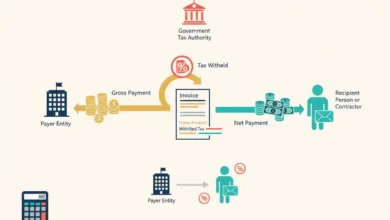
Taxes and Pension Payouts
The after-tax amount available for spending can differ from the gross pension benefit.
Tax treatment depends on jurisdiction, contribution history, plan structure, and individual circumstances.
For planning, distinguish:
Gross Pension Income
from:
Net Spendable Pension Income
A $3,000 gross monthly pension does not necessarily create $3,000 of spendable cash.
Pension Income and Other Retirement Assets
Pension payouts can reduce the amount that must be withdrawn from other assets.
Suppose retirement spending is:
$60,000 per year
and pension income is:
$36,000 per year
Remaining spending to be funded elsewhere:
$60,000 − $36,000
$24,000 per year
This interaction can materially affect a broader retirement portfolio.
Pension Payouts Are Not Investment Returns
Receiving $36,000 annually from a pension does not mean the retiree has a 36% return on some implied $100,000 investment.
Pension payments can reflect:
- employer funding;
- employee contributions;
- plan formula;
- longevity pooling;
- actuarial assumptions.
Payment amount and investment return are different concepts.
Common Pension Payout Mistakes
One mistake is assuming every pension uses the same salary × service formula.
Another is ignoring reductions associated with an early commencement or survivor option.
People can also compare a lump sum with the nominal total of future payments without discounting.
A further mistake is assuming a fixed pension automatically preserves purchasing power.
Frequently Asked Questions
What determines pension payouts?
Depending on the plan, factors can include credited service, compensation, benefit multipliers, retirement timing, survivor elections, and other plan provisions.
What is a common pension estimate formula?
A simplified defined-benefit example is:
Annual Pension = Benefit Multiplier × Service Years × Pensionable Compensation
Actual formulas vary by plan.
How do I convert an annual pension to monthly income?
Monthly Pension = Annual Pension ÷ 12
Does retiring earlier reduce a pension?
Some plans apply early-commencement reductions, but the exact treatment depends on the plan.
Does working longer increase a pension?
It can if additional service, compensation, or delayed-retirement provisions increase the benefit under the plan formula.
What is a single-life pension?
It generally provides income for the participant’s lifetime without the same survivor continuation provided by certain joint options.
What is a joint-and-survivor pension?
It generally provides some continued payment to a survivor after the participant’s death, usually under plan-specific terms.
Is a pension the same as an ordinary annuity?
Not necessarily. Lifetime pension payments have uncertain duration, while a standard ordinary annuity can use a fixed number of periods.
Is a lifetime pension a perpetuity?
No. A perpetuity theoretically continues indefinitely; a life-contingent pension does not.
Do pension payouts always rise with inflation?
No. Cost-of-living adjustments depend on the specific pension plan.
Is the total of future pension payments the same as their value today?
No. Present-value calculations account for the timing of future payments.
Why estimate pension payouts?
They help determine how much retirement spending may already be covered and how much additional saving or investment income may be required within a broader Savings & Investing plan.