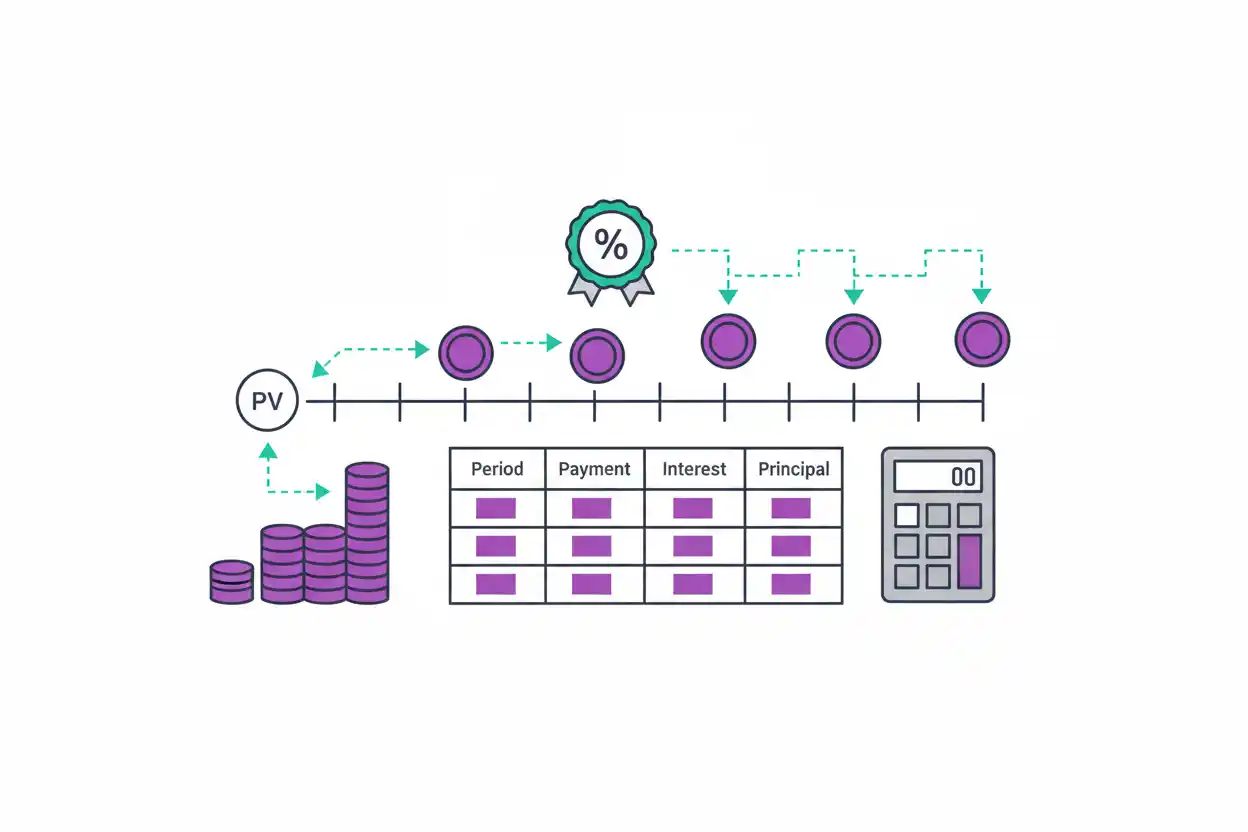

An ordinary annuity is a series of equal payments made at the end of each period.
Monthly loan payments, certain retirement distributions, and other recurring cash-flow arrangements can be modeled as ordinary annuities when the amount is level and the timing follows an end-of-period schedule.
The timing distinction matters because a payment received at the end of a month is worth slightly less today than an otherwise identical payment received at the beginning of that month.
Ordinary annuity formulas use present-value or future-value mathematics to account for every payment’s timing.
What Is an Ordinary Annuity?
An ordinary annuity has three defining characteristics:
- equal recurring payments;
- regular time intervals;
- payments at the end of each period.
For example:
$1,000 at the end of every month for 60 months
is an ordinary annuity if the cash flows are otherwise level.
The word annuity in financial mathematics describes a cash-flow pattern. It does not necessarily mean a particular commercial annuity insurance product.
Ordinary Annuity Timeline
For monthly payments:
Today → Month 1 Payment → Month 2 Payment → Month 3 Payment → …
The first payment occurs one full period from today.
That is what distinguishes an ordinary annuity from a beginning-of-period payment structure.
Present Value of Ordinary Annuity Formula
The present value formula is:
PV = PMT × [1 − (1 + r)^−n] ÷ r
Where:
- PV = present value of the payment stream;
- PMT = equal payment each period;
- r = rate per payment period;
- n = total number of payments.
Ordinary Annuity Example
Suppose an ordinary annuity pays:
- $1,000 per month;
- for 5 years;
- using a 5% nominal annual discount rate;
- monthly periods.
First convert the annual rate:
Monthly Rate = 5% ÷ 12
Monthly Rate ≈ 0.416667%
In decimal form:
r = 0.05 ÷ 12
r ≈ 0.00416667
Number of payments:
n = 5 × 12
n = 60
Step 1: Insert the Values
PV = $1,000 × [1 − (1.00416667)^−60] ÷ 0.00416667
Calculate the discount term:
(1.00416667)^−60 ≈ 0.779205
Then:
1 − 0.779205 ≈ 0.220795
Divide by the monthly rate:
0.220795 ÷ 0.00416667 ≈ 52.9907
Multiply by $1,000:
PV ≈ $52,990.71
The present value of the 60 monthly $1,000 end-of-month payments is approximately $52,990.71 at the assumed rate.
Why Present Value Is Less Than Total Payments
Total nominal payments are:
$1,000 × 60 = $60,000
But present value is only:
≈ $52,990.71
Why?
Because future payments are discounted.
A dollar received years from now is assigned a smaller present value than a dollar received today when the discount rate is positive.
Present Value at a Zero Rate
If the discount rate were exactly zero, the standard formula would require division by zero.
The economic result is simple:
PV at 0% = Payment × Number of Payments
For the example:
PV = $1,000 × 60
PV = $60,000
With no discounting, every future dollar is valued at its nominal amount.
How a Higher Rate Changes Present Value
Holding payment and number of periods constant:
Higher Discount Rate → Lower Present Value
Suppose the same $1,000 monthly payments are discounted at a higher rate.
Future cash flows become less valuable today because they are discounted more heavily.
This rate sensitivity is central to annuity valuation.
How More Payments Change Present Value
Holding the rate and payment amount constant:
More Payments → Higher Present Value
A 10-year payment stream generally has a higher present value than an otherwise identical five-year payment stream because it includes more payments.
However, later payments contribute progressively less present value because they are discounted for more periods.
Payment Formula From Present Value
The present-value formula can be rearranged to solve for the periodic payment:
PMT = PV × r ÷ [1 − (1 + r)^−n]
Suppose:
- PV = $50,000;
- nominal annual rate = 6%;
- monthly rate = 0.005;
- n = 60.
Then:
PMT = $50,000 × 0.005 ÷ [1 − (1.005)^−60]
PMT ≈ $966.64
A $50,000 present value corresponds to approximately $966.64 per month for 60 months under those assumptions.
This payment relationship is part of the broader mechanics of how payment amounts are calculated.
Future Value of an Ordinary Annuity
When the question concerns accumulation rather than present value, the ordinary annuity future-value formula is:
FV = PMT × [(1 + r)^n − 1] ÷ r
Using $1,000 monthly for 60 months at the same monthly rate:
FV = $1,000 × [(1.00416667)^60 − 1] ÷ 0.00416667
FV ≈ $68,006.08
Total contributions are $60,000.
Growth contributes approximately:
$68,006.08 − $60,000
$8,006.08
The future-value formula answers a different question from present value, but both use the same ordinary end-of-period timing.
Ordinary Annuity vs Beginning-of-Period Payments
If payments occur at the beginning of each period, every payment is shifted one period earlier.
At a positive rate, beginning-of-period cash flows have a greater present and future value than otherwise identical end-of-period payments.
The adjustment is:
Beginning-of-Period Value = Ordinary Annuity Value × (1 + r)
Timing matters even when every payment amount is identical.
Ordinary Annuity and Monthly Interest
An ordinary annuity calculation must use a periodic rate matching the payment frequency.
If payments are monthly and the applicable nominal annual rate is 6%:
Monthly Rate = 6% ÷ 12 = 0.5%
The mechanics of this conversion are covered more directly under monthly interest.
Using 6% as though it were the monthly rate would produce a severely incorrect result.
Ordinary Annuity and Nominal Return
A nominal return or nominal interest rate must be interpreted correctly before it is inserted into an annuity formula.
For example, a 6% nominal annual rate with monthly compounding and a 6% effective annual rate do not imply exactly the same monthly periodic rate.
Rate conventions should therefore be identified before calculating PV or PMT.
Ordinary Annuity and Pension Payouts
Some pension payouts can resemble annuity cash flows because they involve recurring payments.
However, a lifetime pension is not automatically a fixed 20-year ordinary annuity.
Lifetime payments depend on plan terms and an uncertain lifespan.
An ordinary annuity formula with a fixed n is appropriate only when the number of periods is actually specified or deliberately assumed for modeling.
Ordinary Annuity and Net Worth
A future payment stream may have economic value, but net worth is a point-in-time balance-sheet measure.
Simply adding all nominal future payments to current assets would ignore time value.
Present-value mathematics can be more relevant when a future stream needs to be valued today.
The appropriate treatment depends on the purpose of the financial statement or analysis.
Loan Payments as Ordinary Annuities
Many fixed-payment loans can be modeled using ordinary-annuity mathematics when payments are made at the end of each payment period.
The present value is the amount financed.
The recurring cash flow is the payment.
The periodic interest rate and number of payments determine how large the payment must be.
This is why annuity formulas appear frequently in loan calculations.
Why the First Payment Matters
Suppose two contracts each make 60 monthly payments of $1,000.
Contract A pays first in one month.
Contract B pays first today.
The nominal totals are both:
$60,000
But their values are not identical at a positive rate because every Contract B payment arrives one month earlier.
Cash-flow timing affects value independently of total nominal dollars.
Annuity Factor
The term:
[1 − (1 + r)^−n] ÷ r
is often called the present-value annuity factor.
In the $1,000 monthly example:
Annuity Factor ≈ 52.9907
Therefore:
PV = $1,000 × 52.9907
PV ≈ $52,990.71
Separating the annuity factor can make comparisons easier.
Solving for Number of Payments
If PV, payment, and rate are known, the number of payments can be solved using logarithms.
Starting from:
PV = PMT × [1 − (1 + r)^−n] ÷ r
the equation can be rearranged.
In practice, financial calculators and spreadsheets are often used because the logarithmic expression is less intuitive than solving for PV or PMT.
Solving for Rate
Finding the unknown rate from PV, PMT, and n generally requires numerical methods because the rate appears in several places in the equation.
This is similar to internal-rate-of-return problems.
A calculator or spreadsheet can search for the rate that makes the present value of payments equal the specified PV.
Ordinary Annuity With Irregular Payments
If payments differ from period to period, the standard ordinary annuity formula no longer applies directly.
Instead, discount each cash flow separately:
PV = CF₁ ÷ (1 + r) + CF₂ ÷ (1 + r)² + … + CFₙ ÷ (1 + r)ⁿ
The equal-payment annuity formula is simply a shortcut for a regular series.
Ordinary Annuity With Missed Payments
Likewise, a skipped payment breaks the equal-cash-flow assumption.
If a 60-payment schedule contains only 59 actual payments, the actual value differs from the standard 60-payment annuity calculation.
Use the cash flows that actually occur.
Common Ordinary Annuity Mistakes
One mistake is using an annual rate with monthly payments without converting the rate.
Another is confusing beginning-of-period with end-of-period payments.
People can also calculate total nominal payments and call that present value.
A further mistake is using the equal-payment annuity formula when cash flows are irregular.
Frequently Asked Questions
What is an ordinary annuity?
An ordinary annuity is a series of equal payments made at the end of each regular period.
What is the present value formula?
PV = PMT × [1 − (1 + r)^−n] ÷ r
What does PMT mean?
PMT is the equal recurring payment made each period.
What does r mean?
r is the interest or discount rate per payment period.
What does n mean?
n is the total number of payments.
Why is ordinary annuity present value less than total payments?
At a positive discount rate, future payments are worth less today than their nominal future amounts.
How do I calculate the payment from present value?
PMT = PV × r ÷ [1 − (1 + r)^−n]
Can monthly payments use an annual rate directly?
Not usually. The rate must first be converted to a periodic rate consistent with the payment schedule.
Is a pension an ordinary annuity?
A fixed-period pension stream can sometimes be modeled this way, but lifetime pensions involve additional assumptions and plan terms.
What happens if payments are made at the beginning of each period?
Each cash flow occurs one period earlier, increasing value at a positive rate relative to an otherwise identical ordinary annuity.
Does an ordinary annuity require equal payments?
Yes. If cash flows vary, value them separately or use an appropriate irregular cash-flow method.
Why is ordinary annuity math useful?
It provides a consistent framework for valuing recurring end-of-period payments within broader Savings & Investing calculations.