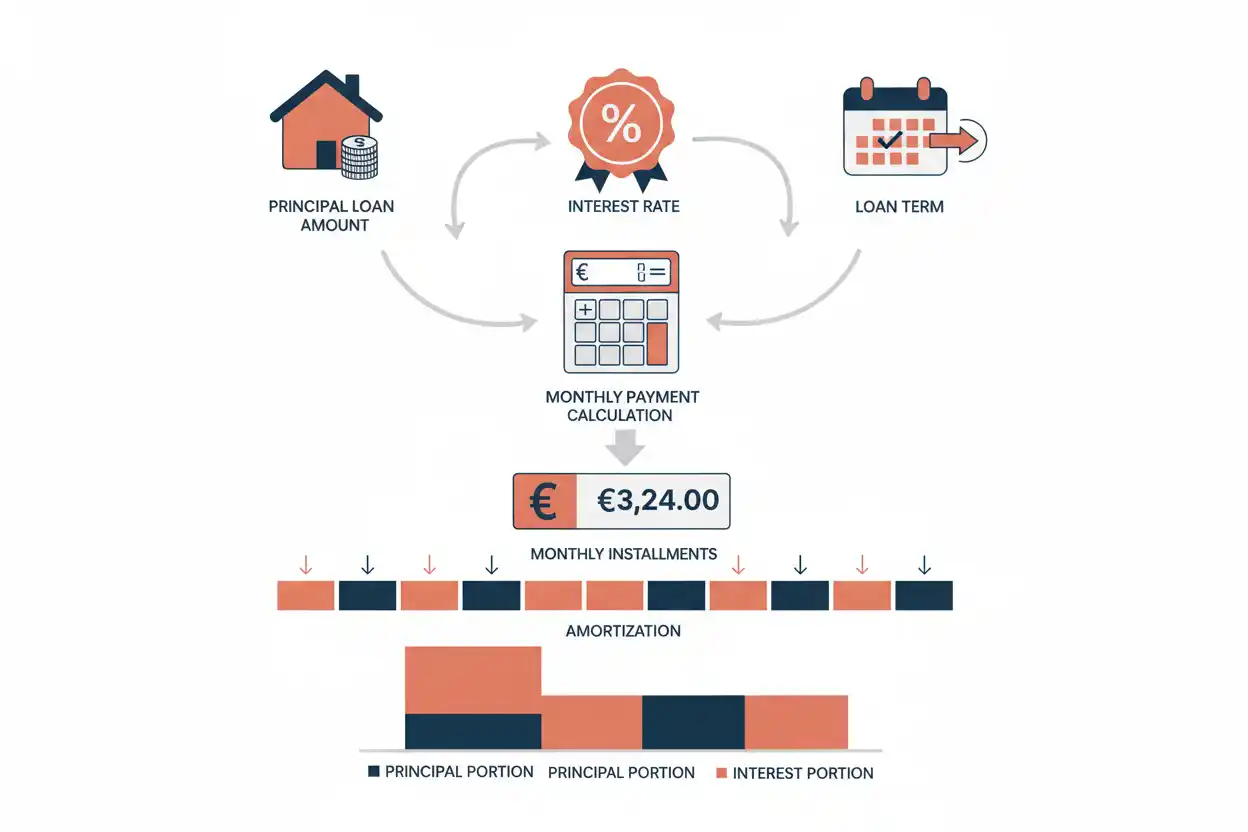

Payment amounts are calculated by combining the amount financed, the periodic interest rate, the number of payments, and the timing of those payments.
For a standard fixed-payment amortizing balance, increasing the principal or interest rate generally increases the required payment. Extending the term generally reduces the periodic payment but can increase total interest paid.
For example, financing $25,000 for five years at a 7% nominal annual rate with monthly payments produces a payment of approximately $495.03 per month under the standard amortization formula.
The Three Main Payment Variables
For a fixed-rate installment calculation, the three central inputs are:
Principal: the amount financed today.
Rate: the interest charged per payment period.
Term: the number of payment periods.
These inputs determine the recurring payment required to reduce the balance to zero by the end of the schedule, assuming payments occur as modeled and no additional fees or charges are included.
Fixed Payment Formula
For payments at the end of each period:
Payment = Principal × r ÷ [1 − (1 + r)^−n]
Where:
- Principal = amount financed;
- r = interest rate per payment period;
- n = total number of payments.
The formula is mathematically the same present-value relationship used for an ordinary annuity.
Payment Calculation Example
Suppose:
- principal = $25,000;
- nominal annual interest rate = 7%;
- term = 5 years;
- payments = monthly.
First convert the annual rate to a monthly rate.
Monthly Rate = 7% ÷ 12
Monthly Rate ≈ 0.583333%
In decimal form:
r = 0.07 ÷ 12
r ≈ 0.00583333
Calculate the Number of Payments
Five years of monthly payments gives:
n = 5 × 12
n = 60 payments
Now insert the values:
Payment = $25,000 × 0.00583333 ÷ [1 − (1.00583333)^−60]
The calculated payment is approximately:
Payment ≈ $495.03 per month
Verify the Total of Payments
Over 60 months:
Total Payments = $495.03 × 60
Total Payments ≈ $29,701.80
Subtract principal:
Approximate Total Interest = $29,701.80 − $25,000
Approximate Total Interest = $4,701.80
This simplified calculation assumes the rounded payment does not create a small final-payment adjustment.
How Principal Changes the Payment
Holding rate and term constant, payment is proportional to principal.
If the $25,000 example requires about $495.03 monthly, financing twice as much:
Principal = $50,000
under identical rate and term assumptions produces approximately:
Payment ≈ $990.06
because the entire formula scales with principal.
Principal Comparison
At 7% for 60 months:
| Principal | Approx. Monthly Payment |
|---|---|
| $10,000 | $198.01 |
| $25,000 | $495.03 |
| $50,000 | $990.06 |
A larger principal requires a larger payment when all other variables stay unchanged.
How Interest Rate Changes the Payment
Now keep:
- principal = $25,000;
- term = 60 months.
Compare rates.
5% Annual Rate
Payment ≈ $471.78
7% Annual Rate
Payment ≈ $495.03
9% Annual Rate
Payment ≈ $518.96
A higher rate raises the payment because more of each payment must cover interest while still retiring the same principal within the same term.
Total Interest at Different Rates
Using the same $25,000 principal and 60-month term:
At 5%:
Total Interest ≈ $3,306.85
At 7%:
Total Interest ≈ $4,701.80
At 9%:
Total Interest ≈ $6,137.53
The rate affects both the periodic payment and the total interest cost.
How Term Changes the Payment
Now hold:
- principal = $25,000;
- annual rate = 7%.
Compare repayment terms.
36 Months
Payment ≈ $771.93
60 Months
Payment ≈ $495.03
84 Months
Payment ≈ $377.32
A longer term reduces the required monthly payment.
However, the borrower makes more payments.
Total Interest at Different Terms
At 7%:
36 Months
Total Interest ≈ $2,789.39
60 Months
Total Interest ≈ $4,701.80
84 Months
Total Interest ≈ $6,694.63
The 84-month term produces the lowest monthly payment but the highest total interest in this example.
This is a core payment tradeoff:
Longer Term → Lower Periodic Payment, Generally More Total Interest
Why Rate and Payment Frequency Must Match
If payments occur monthly, the formula requires a monthly periodic rate.
For a nominal 7% annual rate:
Monthly Rate = 0.07 ÷ 12
Using 7% directly as though it were a monthly rate would dramatically overstate the payment.
This is why understanding nominal return and nominal-rate conventions is important in payment calculations.
What If the Rate Is an Effective Annual Rate?
If 7% represents an effective annual rate rather than a nominal annual rate, the equivalent monthly rate is:
Monthly Rate = (1.07)^(1/12) − 1
This is approximately:
0.5654% per month
That is slightly different from:
7% ÷ 12 ≈ 0.5833%
Always identify how the annual rate is defined before converting it.
Payment at Zero Interest
If the interest rate is zero, the standard formula encounters division by zero.
The payment is simply:
Payment = Principal ÷ Number of Payments
For $25,000 over 60 months:
Payment = $25,000 ÷ 60
Payment ≈ $416.67
Every dollar of payment reduces principal because no interest is charged.
First Payment Breakdown
Using the $25,000, 7%, 60-month example:
Monthly rate:
0.00583333
First month’s interest:
Interest = $25,000 × 0.00583333
Interest ≈ $145.83
Payment:
$495.03
Principal reduction:
$495.03 − $145.83
≈ $349.20
New approximate principal:
$25,000 − $349.20
≈ $24,650.80
The next month’s interest is calculated from the lower balance.
Why Interest Declines During Amortization
As principal falls:
Period Interest = Remaining Principal × Periodic Rate
the interest component generally becomes smaller.
More of the same fixed payment can therefore go toward principal as the schedule progresses.
This creates the familiar amortization pattern:
- early payments: relatively more interest;
- later payments: relatively more principal.
Payment Formula vs Simple Division
A common mistake is:
$25,000 ÷ 60 = $416.67
and treating that as the monthly payment even when interest applies.
That calculation covers principal only.
The actual 7% payment is approximately:
$495.03
The difference funds interest over the repayment period.
Fees Can Change the Effective Cost
The standard payment formula models principal and interest.
Real financing can also include:
- origination fees;
- insurance;
- service charges;
- taxes;
- other costs.
Some charges may be financed into principal, while others are paid separately.
Therefore, the contractual payment and total borrowing cost can differ from a principal-and-interest example.
Balloon Payments
Not every financing arrangement fully amortizes to zero.
A balloon loan may use smaller regular payments and leave a large final amount due.
For example:
Regular Payments + Final Balloon = Complete Repayment
The standard fully amortizing formula should not be used without adjustment when a nonzero balance is intentionally left at maturity.
Interest-Only Payments
An interest-only structure may calculate:
Interest-Only Payment = Principal × Periodic Rate
For $25,000 at 7% nominal annual interest:
Monthly Interest = $25,000 × 0.07 ÷ 12
≈ $145.83
That is much lower than the $495.03 amortizing payment because principal is not being fully repaid through the regular interest-only amount.
Payment Amounts and Percentages
Many errors occur because percentages are entered incorrectly.
For example:
7% = 0.07
not:
7
The monthly nominal rate is:
0.07 ÷ 12
not:
7 ÷ 12
Percentage-to-decimal conversion is basic but essential.
Payment Amounts and Net Worth
A financing payment affects cash flow, while net worth compares assets with liabilities.
A $495 monthly payment does not automatically reduce net worth by $495.
Part of the payment reduces the loan liability, while another part represents interest expense.
The principal component improves the balance-sheet position by reducing debt.
Pension Payments Use Different Inputs
Pension payouts may also be described as periodic payments, but their amount is often determined by a plan-specific benefit formula rather than by a borrower repaying principal.
The word “payment” therefore does not imply one universal formula.
Always identify the underlying cash-flow structure first.
Changing Rates
If the interest rate changes over time, one fixed payment formula may no longer describe the entire schedule.
An adjustable-rate structure can recalculate the payment when the rate resets.
The new payment can be based on:
- remaining principal;
- new periodic rate;
- remaining term.
This can cause payment amounts to rise or fall during the life of the financing.
Extra Principal Payments
An additional principal payment reduces the outstanding balance faster.
Depending on the contract, this can:
- shorten the payoff period;
- reduce future interest;
- or trigger a formal payment recalculation.
It does not automatically mean the required scheduled payment falls immediately.
The contractual terms determine what changes.
Common Payment Calculation Mistakes
One mistake is dividing principal by months and ignoring interest.
Another is mixing annual rates with monthly periods.
People also assume longer terms always save money because the monthly payment is lower.
A further mistake is forgetting balloon amounts, fees, or changing rates that fall outside a simple fixed-payment model.
Frequently Asked Questions
How are payment amounts calculated?
For a standard fixed-rate amortizing balance:
Payment = Principal × r ÷ [1 − (1 + r)^−n]
What does principal mean?
Principal is the amount financed or the remaining amount on which the payment calculation is based.
What does r mean?
r is the interest rate per payment period.
What does n mean?
n is the total number of scheduled payments.
Does a higher rate increase the payment?
All else equal, yes.
Does a longer term reduce the monthly payment?
Generally yes, but it can increase total interest because payments continue for more periods.
Does a larger principal increase the payment?
Yes, when rate and term are unchanged.
How do I convert a nominal annual rate to a monthly rate?
Monthly Rate = Nominal Annual Rate ÷ 12
Is dividing principal by the number of payments enough?
Only when interest is zero. With interest, the amortization formula is required.
What is an interest-only payment?
It generally covers periodic interest without fully amortizing principal.
Why does the interest part of a fixed payment decline?
Because interest is calculated from the declining principal balance in a standard amortizing schedule.
Why understand payment mechanics?
It helps compare financing structures and their impact within a broader Savings & Investing plan.