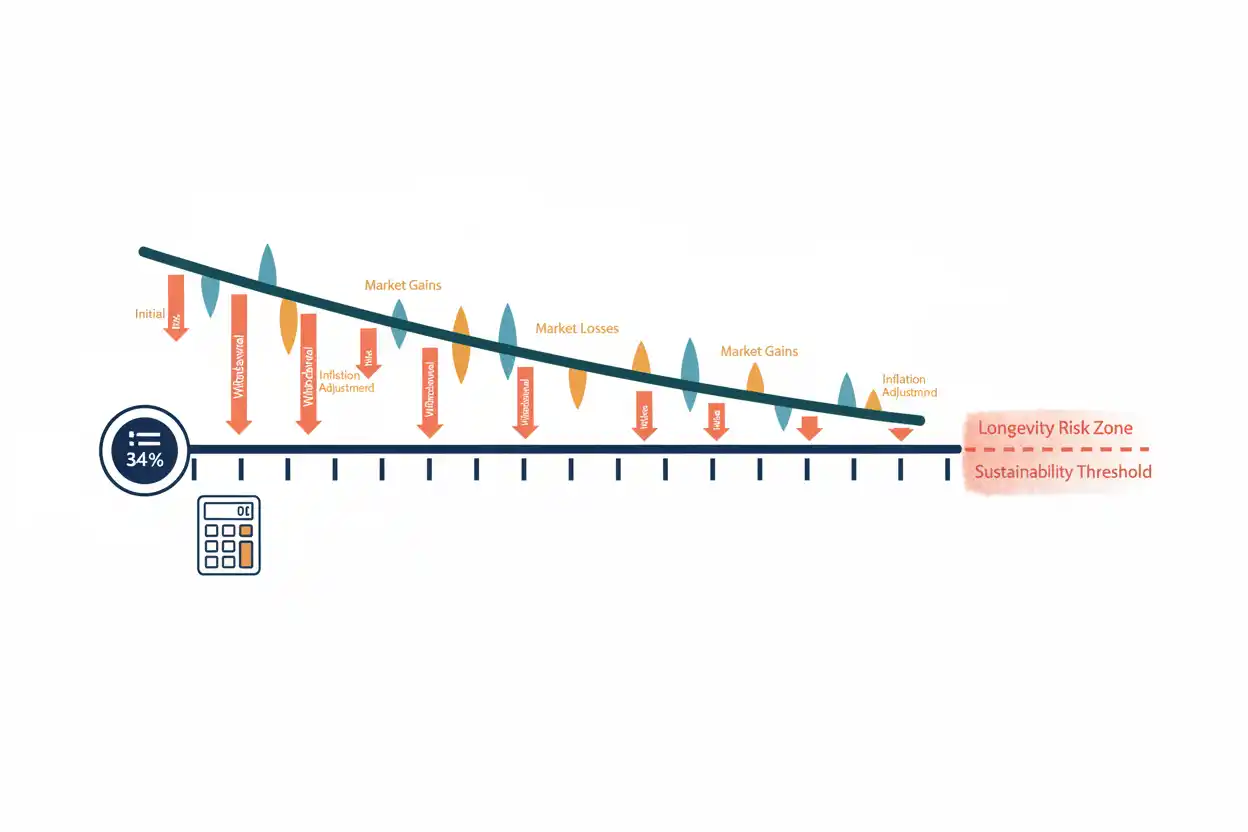

A safe withdrawal rate is a retirement-planning percentage intended to estimate how much of an investment portfolio can be withdrawn while limiting the risk of exhausting the portfolio over a specified retirement period.
The word safe does not mean guaranteed.
A withdrawal rate that succeeds under one combination of market returns, inflation, retirement length, fees, taxes, and asset allocation can fail under another.
For example, an illustrative 4% initial withdrawal from a $1 million portfolio is $40,000 in the first year. Whether that withdrawal path remains sustainable depends on what happens afterward.
What Is a Safe Withdrawal Rate?
A safe withdrawal rate, or SWR, is generally expressed as a percentage of a retirement portfolio.
A basic first-year calculation is:
Initial Withdrawal = Starting Portfolio × Initial Withdrawal Rate
Suppose:
- retirement portfolio = $1,000,000;
- initial withdrawal rate = 4%.
Then:
Initial Withdrawal = $1,000,000 × 0.04
Initial Withdrawal = $40,000
The initial annual withdrawal is $40,000.
Why the Rate Is Only a Starting Point
A retirement withdrawal plan lasts many years.
The first-year percentage does not determine future outcomes by itself.
Portfolio sustainability can be affected by:
- investment returns;
- order of returns;
- inflation;
- fees;
- taxes;
- asset allocation;
- retirement duration;
- spending changes.
A 4% withdrawal rate is therefore better treated as an analytical scenario than as a universal guarantee.
Different Initial Withdrawal Rates
For a $1 million portfolio:
At 3%:
$1,000,000 × 3% = $30,000
At 3.5%:
= $35,000
At 4%:
= $40,000
At 5%:
= $50,000
Higher initial withdrawals provide more spending immediately but put greater demands on the portfolio.
Withdrawal Rate Formula
If annual spending need and portfolio value are known:
Withdrawal Rate = Annual Portfolio Withdrawal ÷ Starting Portfolio × 100
Suppose:
- portfolio = $800,000;
- required first-year withdrawal = $36,000.
Then:
Withdrawal Rate = $36,000 ÷ $800,000 × 100
Withdrawal Rate = 4.5%
The plan requires an initial portfolio withdrawal rate of 4.5%.
Portfolio Required for a Target Withdrawal
The formula can be rearranged:
Required Portfolio = Annual Withdrawal ÷ Withdrawal Rate
Suppose the portfolio needs to provide $30,000 annually.
At 4%:
$30,000 ÷ 0.04 = $750,000
At 3.5%:
$30,000 ÷ 0.035 ≈ $857,143
At 3%:
$30,000 ÷ 0.03 = $1,000,000
A lower assumed initial withdrawal rate requires more starting capital.
Inflation-Adjusted Withdrawal Example
Many retirement scenarios begin with a first-year dollar withdrawal and then increase that amount to preserve purchasing power.
Suppose:
- first-year withdrawal = $40,000;
- inflation assumption = 3%.
Year 2:
$40,000 × 1.03 = $41,200
Year 3:
$41,200 × 1.03 = $42,436
Year 4:
$42,436 × 1.03 = $43,709.08
The withdrawal percentage relative to the portfolio is no longer fixed at exactly 4%.
The dollar withdrawal path changes while portfolio value also changes.
Fixed Percentage vs Inflation-Adjusted Dollar Withdrawal
These are different strategies.
Fixed Percentage
Suppose the retiree withdraws 4% of the current balance every year.
If the portfolio falls:
$1,000,000 → $800,000
next withdrawal becomes:
$800,000 × 4% = $32,000
Income falls with the portfolio.
Inflation-Adjusted Dollar Amount
The retiree might instead continue a planned dollar amount such as:
$40,000 → $41,200 → $42,436
regardless of short-term portfolio declines.
That provides more spending stability but can increase depletion risk after poor returns.
Why Sequence of Returns Matters
Two retirees can earn the same average return and still experience different outcomes.
If large losses occur early while withdrawals are being made, capital can fall sharply.
Later gains then apply to a smaller asset base.
This interaction is called sequence of returns risk, and it is one of the central limitations of treating a withdrawal rate as guaranteed.
Simple Sequence Example
Suppose a $1 million portfolio experiences a 20% decline before a $40,000 withdrawal.
After loss:
$1,000,000 × 0.80 = $800,000
After withdrawal:
$800,000 − $40,000 = $760,000
The original $40,000 withdrawal now equals:
$40,000 ÷ $760,000 ≈ 5.26%
of the remaining balance.
A poor early return can therefore raise the effective burden of future spending.
Safe Withdrawal Rate and Savings Growth
Before retirement, savings growth determines how much capital may be available.
Suppose projected retirement savings are only $500,000 while the desired first-year portfolio income is $40,000.
Required initial withdrawal rate:
$40,000 ÷ $500,000 = 8%
That is a very different retirement problem from withdrawing $40,000 from $1 million.
Increasing retirement savings can reduce the percentage of the portfolio that needs to be withdrawn.
Safe Withdrawal Rate and Savings Rate
A higher savings rate during working years can help increase retirement capital.
Suppose a household needs a $1 million portfolio but is projected to accumulate only $750,000.
Possible responses include:
- saving more;
- working longer;
- reducing retirement spending;
- combining several changes.
Simply choosing a higher withdrawal percentage does not eliminate the underlying funding gap.
Safe Withdrawal Rate and Roth IRA
A Roth IRA can be one component of the retirement portfolio.
Its tax treatment may affect how much of a gross withdrawal is available for spending.
However, account type does not make an otherwise aggressive withdrawal rate mathematically sustainable.
Portfolio longevity still depends on the assets, returns, spending, and time horizon.
Safe Withdrawal Rate and Rule of 72
The Rule of 72 estimates how quickly untouched capital can double at a constant rate.
A retirement portfolio under active withdrawals behaves differently.
Suppose a portfolio is modeled at 8% growth.
Rule of 72 suggests:
72 ÷ 8 = 9 years
for doubling without cash flows.
If the retiree withdraws money every year, the portfolio may grow much more slowly, remain flat, or decline.
Safe Withdrawal Rate and Rule of 69
The Rule of 69 is another doubling shortcut associated with continuous compounding.
Like Rule of 72, it assumes a growth process without retirement withdrawals.
Neither doubling rule should be used as a substitute for modeling retirement cash flows.
Retirement Length Matters
A withdrawal rate designed for:
20 years
does not automatically have the same depletion risk over:
40 years
The longer the retirement horizon, the more years the portfolio must withstand:
- withdrawals;
- inflation;
- market declines;
- unexpected expenses.
Longevity therefore affects what level of initial spending is prudent.
Asset Allocation Matters
A portfolio invested entirely in cash may have low short-term volatility but insufficient long-term growth.
A portfolio invested entirely in volatile growth assets can face severe drawdowns.
A retirement allocation needs to balance:
- growth potential;
- volatility;
- income;
- liquidity;
- spending horizon.
No withdrawal percentage can compensate for an unsuitable investment structure.
Inflation Matters
Suppose a retiree starts with $40,000 annual spending.
At 3% inflation, after 20 years:
Future Withdrawal = $40,000 × 1.03²⁰
≈ $72,244.45
A plan that assumes the retiree will always spend exactly $40,000 nominally may significantly understate future income needs.
Fees Matter
Suppose:
- gross portfolio return = 6%;
- investment expenses = 1%;
- simplified net return = 5%.
A retirement model using 6% while the investor effectively retains only 5% will overstate expected portfolio growth.
Recurring costs can therefore reduce the withdrawal rate a portfolio can support under otherwise identical assumptions.
Taxes Matter
Suppose a retiree needs:
$40,000 of spendable income
but withdrawals from the selected account create tax obligations.
The gross withdrawal may need to exceed $40,000.
If $45,000 must be distributed to provide $40,000 after taxes, then the portfolio burden is based on the larger gross amount.
Account tax treatment should therefore be included in a detailed withdrawal plan.
Spending Flexibility Can Help
A rigid withdrawal path assumes the retiree spends the planned amount regardless of market conditions.
A flexible strategy might reduce discretionary spending after weak market years.
For example:
Planned Withdrawal = $50,000
After a severe decline:
Temporary Withdrawal = $44,000
The $6,000 reduction leaves more capital available for potential recovery.
Flexibility cannot eliminate portfolio risk, but it can reduce pressure during unfavorable periods.
Income Floors Can Change the Analysis
Suppose essential retirement expenses are $45,000.
Reliable pension and other income cover:
$35,000
Portfolio must cover only:
$10,000 of essential spending
Additional withdrawals may be discretionary.
A household with a strong income floor can often tolerate more variation in discretionary portfolio withdrawals than one depending entirely on investments for basic needs.
Initial Rate vs Current Withdrawal Rate
Suppose:
- starting portfolio = $1 million;
- first withdrawal = $40,000.
Initial rate:
4%
Years later, portfolio value is $700,000 and withdrawal is $50,000.
Current withdrawal percentage:
$50,000 ÷ $700,000
≈ 7.14%
The initial rate remains 4%, but the current burden has risen substantially.
Both values can be useful.
A “Safe” Rate Is Scenario-Dependent
The same initial rate can produce different outcomes under different assumptions.
For example:
Scenario A
- strong early returns;
- moderate inflation;
- low fees.
Scenario B
- severe early losses;
- high inflation;
- larger expenses.
The same 4% initial withdrawal can behave very differently.
That is why retirement planning should use ranges and stress tests instead of one percentage alone.
Common Safe Withdrawal Rate Mistakes
One mistake is interpreting the word “safe” as guaranteed.
Another is assuming average return alone determines sustainability.
People can also ignore inflation, taxes, investment costs, or retirement duration.
A further mistake is raising the withdrawal rate merely because current savings are below the desired retirement target.
Frequently Asked Questions
What is a safe withdrawal rate?
It is a planning percentage used to estimate how much can initially be withdrawn from a retirement portfolio while attempting to limit depletion risk over a specified period.
Is a safe withdrawal rate guaranteed?
No.
How do I calculate the first-year withdrawal?
Initial Withdrawal = Starting Portfolio × Initial Withdrawal Rate
What is 4% of a $1 million portfolio?
$1,000,000 × 0.04 = $40,000
How much portfolio is needed for $30,000 at 4%?
$30,000 ÷ 0.04 = $750,000
Does the withdrawal stay at 4% every year?
Not necessarily. Some strategies adjust the dollar amount for inflation, while others use a percentage of current portfolio value.
Why does sequence of returns matter?
Large early losses combined with withdrawals can leave less capital available for later recovery.
Does a Roth IRA change the safe withdrawal rate?
Tax treatment can affect spendable income, but Roth status does not eliminate portfolio longevity risk.
Does higher investment return guarantee a higher safe withdrawal rate?
No. Volatility, timing of returns, inflation, and retirement duration also matter.
Should withdrawals increase with inflation?
That depends on the retirement strategy and spending objective.
Can flexible spending improve portfolio resilience?
Potentially. Reducing discretionary withdrawals after poor market periods can leave more capital invested.
Why calculate several withdrawal scenarios?
Because retirement outcomes are uncertain, and scenario analysis provides a more realistic view within the broader Savings & Investing plan.