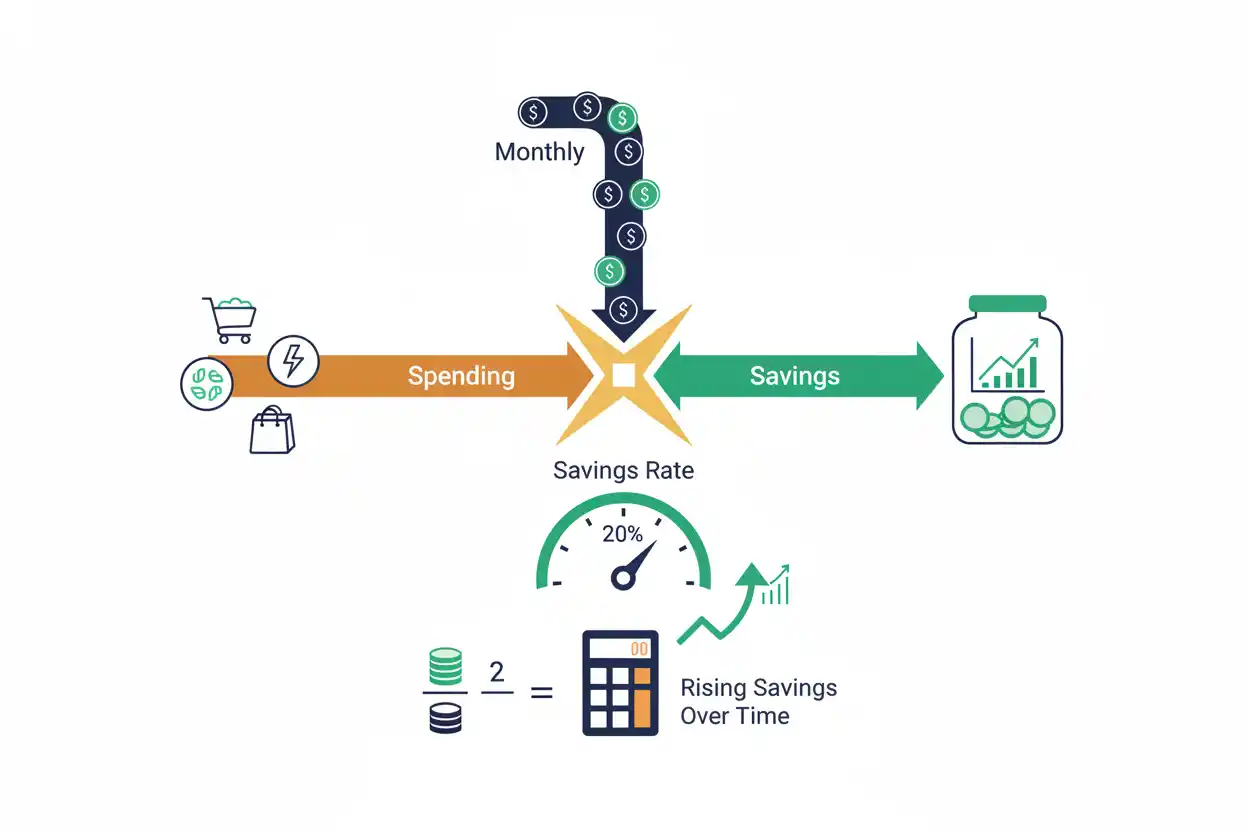
Savings rate measures the percentage of income that is saved rather than spent.
If a household takes home $6,200 per month and saves $1,500, its take-home-income savings rate is approximately 24.19%.
If the same household earns $8,000 before taxes and other payroll deductions, the savings rate relative to gross income is 18.75%.
Both calculations can be mathematically correct. The important point is to define the numerator and denominator consistently.
What Is a Savings Rate?
A savings rate compares money saved during a period with an income measure from the same period.
The basic formula is:
Savings Rate = Amount Saved ÷ Income × 100
The period can be:
- monthly;
- quarterly;
- annually.
The income definition can be:
- gross income;
- after-tax income;
- take-home pay.
Because different definitions produce different percentages, always state which one is being used.
Savings Rate Example
Suppose:
- monthly take-home income = $6,200;
- monthly savings = $1,500.
Then:
Savings Rate = $1,500 ÷ $6,200 × 100
Savings Rate ≈ 24.19%
The household saves approximately 24.19% of take-home income.
Gross-Income Savings Rate
Suppose gross monthly income is:
$8,000
Savings remain:
$1,500
Then:
Gross-Income Savings Rate = $1,500 ÷ $8,000 × 100
= 18.75%
The same household therefore has:
- 24.19% take-home savings rate;
- 18.75% gross-income savings rate.
Neither percentage should be compared with another household’s rate unless the definitions match.
Annual Savings Rate
Suppose:
- annual after-tax income = $75,000;
- annual savings = $18,000.
Then:
Savings Rate = $18,000 ÷ $75,000
= 24%
A monthly calculation should produce a similar result when income and saving are consistent through the year.
Solve for Amount Saved
If income and target savings rate are known:
Amount Saved = Income × Savings Rate
Suppose:
- take-home income = $5,000 monthly;
- target savings rate = 20%.
Then:
Savings = $5,000 × 0.20
Savings = $1,000 per month
Annual savings:
$1,000 × 12 = $12,000
Solve for Income Needed
The formula can also be rearranged:
Income = Savings Amount ÷ Savings Rate
Suppose someone wants to save $1,500 per month at a 25% savings rate.
Income = $1,500 ÷ 0.25
Income = $6,000
A $6,000 income base supports $1,500 of savings at a 25% rate.
What Counts as Savings?
The answer depends on the measurement convention.
Potential savings can include:
- cash added to savings accounts;
- retirement-plan contributions;
- IRA contributions;
- taxable investment contributions;
- other increases in financial assets funded from current income.
Debt principal repayment is sometimes treated separately and sometimes included in broader wealth-building calculations.
Whatever definition is chosen should remain consistent.
What Should Not Be Counted Twice?
Suppose $1,000 is transferred from checking to savings.
That is savings if the checking balance represented current income not previously counted as saved.
But moving the same $1,000 later from savings into an investment account is not another $1,000 of new savings.
It is a transfer between assets.
Double counting makes the savings rate appear artificially high.
Investment Gains Are Not New Savings
Suppose:
- $1,000 is contributed;
- investment rises by $100.
New contribution:
$1,000
Investment gain:
$100
The amount saved from income is still $1,000.
The $100 represents investment performance, not an additional savings contribution.
This distinction matters when connecting savings rate with savings growth.
Employer Contributions
If an employer contributes to a retirement plan, there are two reasonable approaches:
- exclude employer contributions from both savings and income;
- include the contribution in savings and include corresponding compensation in the income denominator.
What should be avoided is adding employer contributions to the numerator while using an income denominator that excludes them and then comparing that rate directly with someone using a different convention.
Savings Rate and Savings Growth
A higher savings rate generally increases the recurring deposits available for savings growth.
Suppose take-home income is $6,000 monthly.
At 10%:
Savings = $600
At 20%:
Savings = $1,200
At 30%:
Savings = $1,800
Increasing the savings rate from 10% to 30% triples the monthly contribution.
Ten-Year Contribution Difference
Suppose two households each earn $6,000 take-home monthly.
Household A saves 10%:
$600 per month
Household B saves 25%:
$1,500 per month
Difference:
$900 per month
Over 10 years before investment growth:
$900 × 120 = $108,000
Compounding can increase the eventual gap further.
Savings Rate and Safe Withdrawal Rate
The safe withdrawal rate applies after a retirement portfolio has been accumulated.
Savings rate affects how quickly that portfolio is built.
The relationship is intuitive:
Higher Savings Rate → More Contributions → Potentially Larger Future Portfolio → Lower Withdrawal Burden for the Same Spending Goal
Increasing the savings rate is often more controllable than trying to increase future market returns.
Savings Rate and Sequence of Returns Risk
Sequence of returns risk becomes especially important when money is being withdrawn.
During accumulation, a strong savings rate can partly offset market declines because fresh contributions continue entering the portfolio.
For example, a 20% market decline can reduce current assets while new savings buy assets at lower prices.
Once withdrawals begin, cash flows reverse direction and poor early returns can be more damaging.
Savings Rate and Sharpe Ratio
The Sharpe ratio measures excess investment return relative to volatility.
Savings rate measures personal cash-flow behavior.
A household can have:
- high savings rate;
- low-risk portfolio;
or:
- low savings rate;
- high-risk portfolio.
The two metrics answer completely different questions.
Increasing portfolio risk does not substitute for saving more.
Savings Rate and Rule of 72
The Rule of 72 estimates how long an existing amount takes to double.
Savings rate changes the amount of new money entering the account.
Suppose an account doubles partly because the owner contributes heavily.
That cannot be attributed to compound return alone.
A full savings projection should separate contributions from investment growth.
Gross vs Net Savings Rate
Suppose:
- gross income = $100,000;
- taxes and deductions = $25,000;
- take-home income = $75,000;
- savings = $15,000.
Gross savings rate:
$15,000 ÷ $100,000 = 15%
Take-home savings rate:
$15,000 ÷ $75,000 = 20%
The label should specify which definition is used.
Savings Rate and Spending Rate
If savings and spending are defined from the same after-tax income base and every dollar is assigned to one or the other:
Savings Rate + Spending Rate = 100%
For example:
Savings Rate = 25%
Spending Rate = 75%
Real household budgets can be more complicated when taxes, employer benefits, transfers, or irregular income are treated separately.
How Spending Cuts Affect Savings Rate
Suppose take-home income is $5,000.
Current savings:
$500
Savings rate:
10%
If spending falls by $500 and the entire difference is saved:
New Savings = $1,000
New savings rate:
$1,000 ÷ $5,000 = 20%
A $500 spending reduction doubled the savings rate.
How an Income Increase Affects Savings Rate
Suppose take-home income rises:
$5,000 → $5,500
while spending remains $4,500.
Old savings:
$500
Old rate:
10%
New savings:
$1,000
New rate:
$1,000 ÷ $5,500
≈ 18.18%
Keeping spending stable while income rises can increase the savings rate substantially.
Lifestyle Inflation
If income rises but spending rises equally, the savings rate may not improve.
Suppose:
- income rises by $500;
- spending rises by $500.
Savings remain unchanged.
This is often described as lifestyle inflation.
A savings-rate target can help direct at least part of income growth toward future goals.
Variable Income
People with irregular income can calculate savings rate over a longer period.
For example:
Annual Savings Rate = Total Annual Savings ÷ Total Annual Income
This can be more meaningful than a single month when commissions, bonuses, or freelance income vary substantially.
Negative Savings Rate
A savings rate can be negative.
Suppose:
- take-home income = $4,000;
- spending = $4,500.
Net saving:
$4,000 − $4,500 = −$500
Savings rate:
−$500 ÷ $4,000
= −12.5%
The household is spending $500 more than current take-home income and may be using debt or existing savings to cover the difference.
Savings Rate Above 100%
A calculated savings rate above 100% can occur under unusual definitions or when assets are transferred into savings from sources not included in the income denominator.
Before interpreting such a result, check whether the numerator and denominator refer to the same economic period and source of funds.
Savings Rate Is Not Net Worth Growth
A household might save $20,000 while net worth increases $80,000 because investments and property values rose.
Another household could save $20,000 while net worth falls because assets declined sharply.
Savings rate measures current-income allocation, not the total change in wealth.
There Is No Universal Perfect Savings Rate
A suitable rate depends on:
- income;
- age;
- existing assets;
- debt;
- retirement goals;
- housing costs;
- dependents;
- time horizon.
A person who already has substantial assets may need a different rate from someone starting with no savings.
The useful goal is a rate consistent with the financial plan, not a percentage chosen solely because it is popular.
Common Savings Rate Mistakes
One mistake is comparing a gross-income savings rate with someone else’s take-home-income rate.
Another is counting investment gains as new savings.
People can also double count money when it moves between accounts.
A further mistake is increasing investment risk to compensate for an inadequate savings rate without first examining controllable cash flows.
Frequently Asked Questions
What is savings rate?
Savings rate is the percentage of income saved during a specified period.
What is the formula?
Savings Rate = Amount Saved ÷ Income × 100
What is a 20% savings rate on $5,000 monthly income?
$5,000 × 20% = $1,000 per month
Should I use gross income or take-home income?
Either can be used, but the definition should be stated and used consistently.
Do investment gains count as savings?
No. They are investment returns rather than new amounts saved from current income.
Do retirement contributions count as savings?
They commonly can, depending on the definition used.
Should employer retirement contributions be included?
They can be, but the income denominator should be adjusted consistently if the goal is a comparable comprehensive savings rate.
Can savings rate be negative?
Yes, when spending exceeds the income measure used.
Does a higher savings rate guarantee financial independence?
No, but it increases the amount of capital available for future growth, all else equal.
Is savings rate the same as savings growth?
No. Savings rate measures current contributions relative to income; savings growth measures how the balance accumulates over time.
Is there one ideal savings rate?
No. The appropriate rate depends on goals, time horizon, current wealth, and expenses.
Why track savings rate?
It measures one of the most controllable drivers of long-term wealth within the broader Savings & Investing plan.