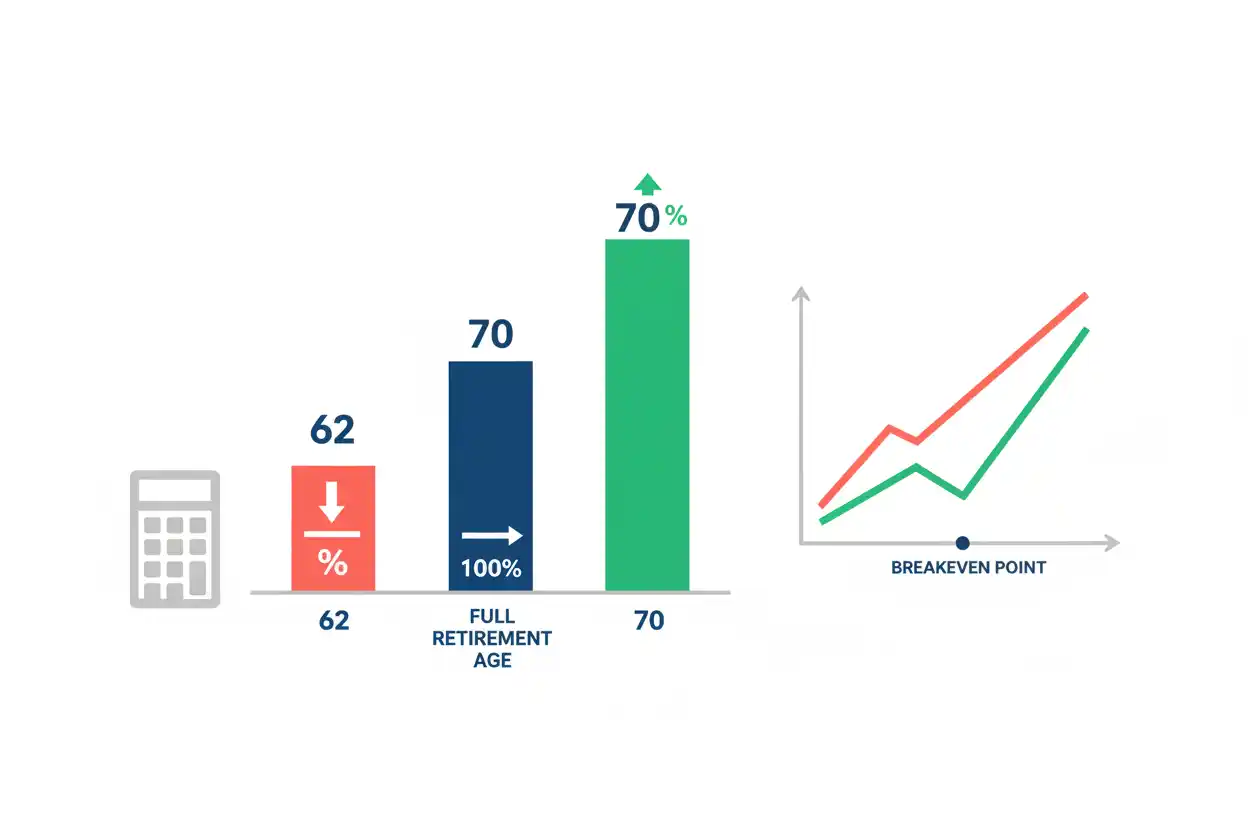
Social Security benefits can change substantially depending on the age at which retirement benefits begin.
Under current rules, retirement benefits can generally begin as early as age 62. Claiming before full retirement age reduces the monthly benefit, while delaying beyond full retirement age can increase it until age 70.
For someone born in 1960 or later, full retirement age is 67. In that case, starting at age 62 produces 70% of the worker’s full retirement benefit, while delaying until age 70 produces approximately 124%.
The claiming decision therefore involves a tradeoff:
Claim earlier: receive more monthly checks over your lifetime if you live long enough to collect them, but each monthly payment is smaller.
Claim later: give up earlier payments in exchange for a larger monthly benefit.
What Are Social Security Retirement Benefits?
Social Security retirement benefits are monthly payments available to eligible workers based on federal Social Security rules.
The amount ultimately received depends on several factors, including:
- earnings history;
- benefit eligibility;
- claiming age;
- continued work where relevant;
- applicable family or survivor provisions.
This page focuses narrowly on the claiming-age impact rather than attempting to reproduce the complete Social Security benefit formula.
Earliest Retirement Claiming Age
Retirement benefits can generally begin at age 62. Starting before full retirement age causes a permanent reduction to the worker’s monthly retirement benefit relative to the full-retirement-age amount.
Age 62 is therefore not the same as full retirement age.
It is the earliest ordinary retirement-benefit claiming age.
Full Retirement Age
Full retirement age depends on year of birth.
For workers born in 1960 or later:
Full Retirement Age = 67
At full retirement age, the worker receives 100% of the calculated full retirement benefit before considering other adjustments.
People born before 1960 can have an earlier full retirement age, so a claiming comparison should use the age applicable to the individual’s birth year rather than assuming age 67 universally.
Early Claiming Reduction Formula
When retirement benefits begin before full retirement age, the reduction is calculated monthly.
For the first 36 months before full retirement age:
Monthly Reduction = 5/9 of 1%
For months beyond the first 36:
Additional Monthly Reduction = 5/12 of 1%
For someone whose full retirement age is 67 and who claims at 62, there are 60 reduction months, producing a total reduction of 30%.
Age 62 Example for Someone Born in 1960 or Later
Suppose the worker’s full-retirement-age benefit is:
$2,000 per month
At age 62, the applicable percentage for someone born in 1960 or later is 70%.
Therefore:
Age-62 Benefit = $2,000 × 70%
Age-62 Benefit = $1,400 per month
Reduction:
$2,000 − $1,400 = $600 per month
The worker receives benefits five years earlier but at a monthly amount $600 lower in this simplified example.
Claiming at Age 63
For someone born in 1960 or later, SSA’s schedule shows a worker claiming at exactly age 63 receives 75% of the full retirement benefit.
Using a $2,000 full benefit:
$2,000 × 75%
= $1,500 per month
Waiting from 62 to 63 increases the monthly amount in this example from $1,400 to $1,500.
Claiming at Age 64
For the same birth-year group, claiming at age 64 corresponds to 80% of the full benefit.
$2,000 × 80% = $1,600 per month
Claiming at Age 65
SSA’s age table shows approximately 86.7% of the full worker benefit at exactly age 65 for someone born in 1960 or later.
With a $2,000 full benefit:
$2,000 × 86.7%
≈ $1,734 per month
Claiming at Age 66
At exactly age 66, the same birth-year group receives approximately 93.3% of the full benefit.
$2,000 × 93.3%
≈ $1,866 per month
Claiming at Full Retirement Age
At age 67 in this example:
Benefit Percentage = 100%
Monthly Benefit = $2,000
There is no early-claiming reduction.
Delayed Retirement Credits
After full retirement age, delaying retirement benefits can increase the monthly amount through delayed retirement credits.
For people born in 1943 or later, the delayed retirement credit is generally 8% per year, and benefit increases stop at age 70.
For someone born in 1960 or later whose full retirement age is 67, delaying to 70 produces approximately:
124% of Full Retirement Benefit
Age 70 Example
Full-retirement-age benefit:
$2,000
Age-70 percentage:
124%
Then:
Age-70 Benefit = $2,000 × 1.24
Age-70 Benefit = $2,480 per month
Compared with claiming at age 67:
$2,480 − $2,000 = $480 more per month
Compared with claiming at 62:
$2,480 − $1,400 = $1,080 more per month
These comparisons isolate the claiming-age adjustment for the simplified $2,000 example.
Waiting Beyond Age 70
Under current rules, delayed retirement credits stop increasing retirement benefits at age 70. Waiting beyond 70 does not generate additional delayed retirement credits.
Therefore, someone delaying solely to earn additional delayed retirement credits does not receive further claiming-age increases after 70.
Simple Break-Even: Age 62 vs 67
Suppose:
- age-62 benefit = $1,400;
- age-67 benefit = $2,000.
By waiting from 62 to 67, the person gives up 60 months of $1,400 payments:
Foregone Benefits = $1,400 × 60
= $84,000
The higher age-67 benefit adds:
$2,000 − $1,400 = $600 per month
Simple break-even after age 67:
$84,000 ÷ $600
= 140 months
≈ 11.67 years
Approximate break-even age:
67 + 11.67 ≈ 78.67
This is only a simplified cash-flow comparison. It ignores cost-of-living adjustments, taxes, investment opportunity cost, survivor considerations, work, and other individual circumstances.
Simple Break-Even: Age 67 vs 70
Suppose:
- benefit at 67 = $2,000;
- benefit at 70 = $2,480.
Waiting three years means giving up:
$2,000 × 36
= $72,000
Additional monthly benefit after 70:
$2,480 − $2,000
= $480
Simple break-even:
$72,000 ÷ $480
= 150 months
= 12.5 years
Approximate age:
70 + 12.5 = 82.5
Again, this is a simplified arithmetic comparison rather than a personalized claiming recommendation.
Why Break-Even Age Is Not the Whole Decision
A claiming decision can also depend on:
- life expectancy;
- health;
- employment;
- spouse or survivor considerations;
- other retirement assets;
- taxes;
- desire for guaranteed monthly income;
- liquidity needs.
A person who lives well beyond the simple break-even age can receive substantially more cumulative benefits from the larger delayed monthly payment.
A person who dies earlier can have a different cumulative result.
Working Before Full Retirement Age
Receiving retirement benefits while continuing to work can trigger the retirement earnings test before full retirement age.
For 2026, someone under full retirement age for the entire year can have $1 of benefits withheld for every $2 of earnings above $24,480. In the year full retirement age is reached, SSA uses a higher $65,160 limit for earnings before the month full retirement age is reached and generally withholds $1 for every $3 above that limit.
Beginning with the month full retirement age is reached, the earnings limit no longer reduces retirement benefits.
Benefits Withheld Under the Earnings Test Are Not Simply Lost Forever
When full retirement age is reached, SSA recalculates the retirement benefit to give credit for months in which benefits were reduced or withheld because of excess earnings.
That makes the retirement earnings test different from a simple tax on working.
The timing of payments can change even though later recalculation can increase the ongoing benefit.
What Counts as Earnings for the Test?
SSA states that wages from employment and net profit from self-employment generally count toward the retirement earnings test, while pensions, annuities, investment income, interest, veterans benefits, and other government or military retirement benefits are not counted as earnings for that test.
This distinction matters for retirees who have both earned income and investment income.
Social Security Benefits and Sinking Funds
A sinking fund prepares for a known future expense.
Social Security benefits instead provide recurring retirement income under federal benefit rules.
A retiree might use a sinking fund for:
- vehicle replacement;
- home repairs;
- travel;
rather than increasing reliance on monthly Social Security income for irregular large expenses.
Social Security Benefits and Simple Interest
Simple interest should not be used to estimate Social Security retirement benefits.
Benefits are not calculated as accumulated payroll taxes plus an interest rate.
Claiming-age percentages are applied to the worker’s benefit under Social Security’s statutory retirement-benefit rules.
Social Security Benefits and Sharpe Ratio
The Sharpe ratio evaluates investment return relative to market volatility.
Social Security retirement income is not a market investment portfolio and should not be assigned a Sharpe ratio in the same way.
However, predictable retirement income can reduce the amount of spending that must be funded from volatile investments.
Social Security and Sortino Ratio
Similarly, the Sortino ratio measures investment performance relative to downside deviation.
It does not calculate the attractiveness of claiming Social Security at 62, 67, or 70.
Claiming age is a retirement-income decision, while Sortino is a portfolio-performance metric.
Social Security and Standard Deviation of Returns
The standard deviation of returns measures investment variability.
Monthly Social Security retirement benefits can change under statutory mechanisms such as cost-of-living adjustments, but they are not market-valued assets fluctuating daily like stocks.
This makes their role in retirement planning fundamentally different from portfolio returns.
Monthly Income Comparison
Using the $2,000 full-retirement-age example:
| Claiming Age | Illustrative Benefit Percentage | Monthly Amount |
|---|---|---|
| 62 | 70% | $1,400 |
| 63 | 75% | $1,500 |
| 64 | 80% | $1,600 |
| 65 | 86.7% | $1,734 |
| 66 | 93.3% | $1,866 |
| 67 | 100% | $2,000 |
| 70 | 124% | $2,480 |
The percentages shown here correspond to the SSA schedules for workers born in 1960 or later.
Claiming Earlier Can Reduce Portfolio Withdrawals Earlier
Suppose a retiree needs:
$60,000 per year
Starting Social Security at 62 might provide:
$1,400 × 12 = $16,800
from the simplified example.
Remaining amount:
$60,000 − $16,800 = $43,200
If the person delays to 67, the portfolio or other income sources must fund the missing Social Security payments during the five-year delay.
The tradeoff is a larger benefit later.
Claiming Later Can Increase the Income Floor
At age 70 in the example:
$2,480 × 12 = $29,760 annually
Compared with age 62:
$16,800 annually
Difference:
$12,960 per year
A larger lifelong monthly benefit can reduce the amount that must later be withdrawn from investments, although the delayed claimant had to fund expenses during the waiting years.
Claiming Decision Is Individual
There is no universally optimal claiming age.
Waiting longer increases the monthly benefit under current rules up to age 70, but the financial value of waiting depends on how long benefits are ultimately received and what the claimant gives up during the delay.
A complete decision can also involve spouse and survivor rules that go beyond the scope of this claiming-age overview.
Common Social Security Claiming Mistakes
One mistake is treating age 62 as full retirement age.
Another is assuming the benefit continues increasing after age 70.
People can also ignore the retirement earnings test when claiming before full retirement age while working.
A further mistake is using a simple break-even age as the only decision factor without considering longevity, household benefits, taxes, and other retirement resources.
Frequently Asked Questions
What is the earliest age to claim Social Security retirement benefits?
Under current rules, retirement benefits can generally begin at age 62.
What is full retirement age for someone born in 1960 or later?
Age 67
How much of the full benefit does a worker born in 1960 or later receive at age 62?
Approximately 70% of the full retirement benefit.
How much at age 70?
Approximately 124% for someone born in 1960 or later.
Do benefits keep increasing if I wait beyond age 70?
No additional delayed retirement credits accrue after age 70 under current rules.
How are early retirement reductions calculated?
Generally, the first 36 early months reduce benefits by 5/9 of 1% per month, with additional early months reduced by 5/12 of 1% per month.
Can I work while receiving Social Security retirement benefits?
Yes, but benefits can be withheld under the retirement earnings test before full retirement age when earnings exceed applicable limits.
What is the 2026 earnings limit if I am under full retirement age all year?
$24,480
What happens after I reach full retirement age?
Beginning with the month full retirement age is reached, earnings no longer reduce retirement benefits under the earnings test.
Are benefits withheld under the earnings test permanently lost?
SSA recalculates benefits at full retirement age to credit months when benefits were reduced or withheld because of excess earnings.
Is claiming later always better?
No. Waiting produces a larger monthly benefit up to age 70, but the best economic outcome depends on longevity and individual circumstances.
Why does claiming age matter?
It can materially change the amount of recurring income available to support retirement expenses within a broader Savings & Investing plan.