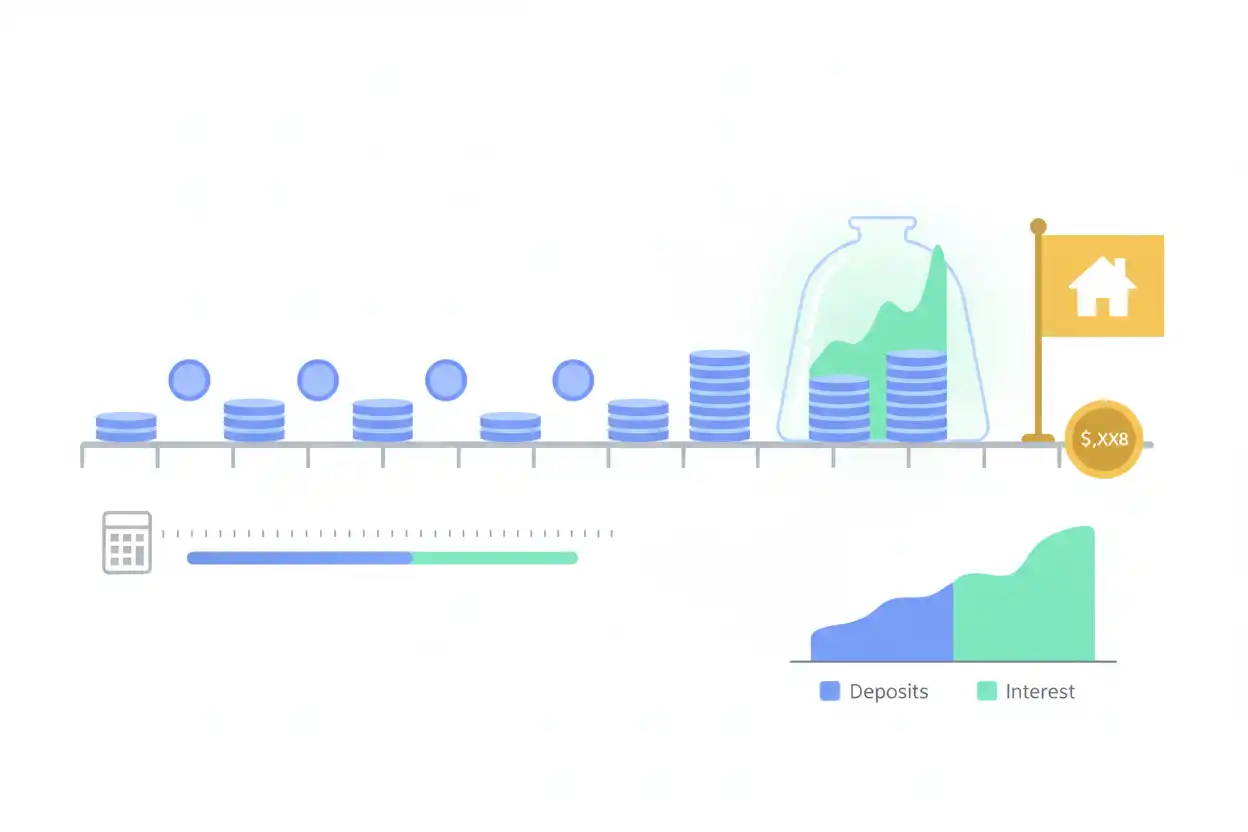

A sinking fund is money deliberately set aside over time for a known future expense.
Instead of waiting until a $30,000 expense arrives and then borrowing or draining other savings, a sinking fund breaks that amount into planned deposits made before the deadline.
If the goal is $30,000 in three years and the money earns a hypothetical 4% nominal annual rate compounded monthly, approximately $785.72 per month deposited at each month-end would reach the target under the constant-rate assumptions.
Without interest, the required deposit would be $833.33 per month.
What Is a Sinking Fund?
A sinking fund has:
- a defined goal;
- a target date;
- recurring contributions.
Examples can include saving for:
- vehicle replacement;
- home repairs;
- annual insurance;
- property taxes;
- travel;
- equipment;
- large business expenses;
- other predictable costs.
The concept separates a known future expense from an emergency.
An emergency fund addresses unexpected financial shocks.
A sinking fund prepares for an expected cost.
Sinking Fund Formula
When equal deposits are made at the end of each period and earn a constant rate:
Deposit = Future Target × r ÷ [(1 + r)^n − 1]
Where:
- Deposit = recurring contribution;
- Future Target = desired ending amount;
- r = interest rate per contribution period;
- n = number of contributions.
This is the future-value-of-annuity formula rearranged to solve for payment.
Sinking Fund Example
Suppose:
- target = $30,000;
- time = 3 years;
- nominal annual return = 4%;
- contributions = monthly;
- deposits occur at month-end.
Monthly rate:
r = 0.04 ÷ 12
r ≈ 0.00333333
Number of deposits:
n = 3 × 12
n = 36
Now:
Deposit = $30,000 × 0.00333333 ÷ [(1.00333333)^36 − 1]
Deposit ≈ $785.72 per month
Total Contributions
Over 36 months:
Total Contributions = $785.72 × 36
≈ $28,285.92
Target:
$30,000
Approximate growth earned:
$30,000 − $28,285.92
≈ $1,714.08
Investment or interest growth reduces the amount that must be contributed directly.
Sinking Fund With No Interest
At a zero rate:
Deposit = Target ÷ Number of Deposits
For $30,000 over 36 months:
$30,000 ÷ 36
= $833.33 per month
Compared with the 4% example:
$833.33 − $785.72
≈ $47.61 less per month
under the assumed interest rate.
Annual Sinking Fund Example
Suppose:
- target = $20,000;
- five annual deposits;
- 5% annual return;
- deposits made at year-end.
Use:
Deposit = $20,000 × 0.05 ÷ [(1.05)^5 − 1]
Deposit ≈ $3,619.50 per year
Total contributions:
$3,619.50 × 5
≈ $18,097.50
Approximate growth:
$20,000 − $18,097.50
≈ $1,902.50
Beginning-of-Period Deposits
If deposits are made at the beginning of each period, they receive one additional period of growth.
For the $30,000 monthly target:
End-of-month required deposit:
≈ $785.72
Beginning-of-month deposit:
$785.72 ÷ 1.00333333
≈ $783.11
Earlier deposits slightly reduce the recurring amount required.
Sinking Fund With Existing Savings
Suppose the $30,000 goal already has:
$5,000 saved
and three years remain at the same hypothetical 4% nominal annual rate compounded monthly.
First calculate what the existing $5,000 could become:
FV = $5,000 × (1 + 0.04 ÷ 12)^36
FV ≈ $5,636.36
Remaining future amount to be funded:
$30,000 − $5,636.36
= $24,363.64
Recurring monthly contribution:
≈ $638.10
The existing balance reduces the monthly contribution required.
Why You Should Grow the Existing Balance First
A common mistake is:
$30,000 Target − $5,000 Current Savings = $25,000
and then treating $25,000 as the amount recurring deposits must produce.
If the existing $5,000 also earns interest, it contributes more than $5,000 to the final goal.
Both current savings and future deposits should be modeled.
Sinking Fund and Simple Interest
If the sinking fund earns simple interest rather than compound interest, the ordinary annuity formula above may not match the actual account mechanics.
The interest-crediting method should be identified before choosing the formula.
For most recurring deposit models with compound growth, future-value mathematics is the more appropriate framework.
Sinking Fund and Social Security Benefits
A Social Security benefits claiming decision can affect retirement cash flow, but it is not a sinking fund.
A sinking fund builds a finite amount for a known future expense.
Social Security retirement benefits are recurring payments determined under federal benefit rules.
The planning tools solve different problems.
Sinking Fund and Sharpe Ratio
The Sharpe ratio compares excess investment return with volatility.
A sinking fund has a specific spending deadline.
That can make certainty, liquidity, and preservation more important than maximizing historical risk-adjusted return.
Money required in six months usually has a different investment objective from money intended for retirement in 30 years.
Sinking Fund and Sortino Ratio
Similarly, the Sortino ratio focuses on downside-risk-adjusted performance.
It can help compare investments, but it does not tell you whether a risky investment is suitable for a near-term sinking-fund goal.
Goal horizon should determine how much investment uncertainty can reasonably be accepted.
Sinking Fund and Sequence Risk
Sequence of returns risk can affect a sinking fund when the money is invested in assets with variable returns.
Suppose a large market decline occurs immediately before the target expense is due.
There may not be enough time for recovery.
As the spending date approaches, protecting the required amount can become more important than maximizing growth.
How Target Date Changes Contributions
Suppose a $24,000 expense must be funded.
With no interest:
12 Months
$24,000 ÷ 12 = $2,000 per month
24 Months
$24,000 ÷ 24 = $1,000 per month
48 Months
$24,000 ÷ 48 = $500 per month
Starting earlier can dramatically reduce the monthly contribution requirement.
How Target Amount Changes Contributions
If time and interest rate remain unchanged, a larger target requires a proportionally larger deposit.
Suppose the required monthly contribution for $30,000 is $785.72.
For $15,000 under identical assumptions:
≈ $392.86
For $60,000:
≈ $1,571.44
The relationship is linear with respect to the target value.
Adjusting for Inflation
Suppose an expense costs $20,000 today but will occur five years from now.
If its cost is assumed to rise 3% annually:
Future Cost = $20,000 × 1.03⁵
Future Cost ≈ $23,185.48
The sinking-fund target should be based on the estimated future cost:
$23,185.48
rather than the current $20,000 amount.
Irregular Contributions
If contributions vary each month, the equal-payment sinking-fund formula no longer exactly applies.
Instead, calculate the future value of each contribution according to how long it will remain invested.
A spreadsheet can model:
- different contribution dates;
- changing contribution amounts;
- changing rates.
Missed Contribution Example
Suppose the plan requires:
$785.72 per month
but one contribution is skipped.
The funding shortfall is not merely $785.72 at the target date because that skipped deposit also loses its potential investment growth.
The earlier the missed payment, the larger the opportunity cost can be.
Recalculate Periodically
If:
- the rate changes;
- the target cost changes;
- a contribution is missed;
- money is withdrawn;
the required future contribution should be recalculated.
A sinking fund is most useful when it is actively tied to the remaining target rather than treated as a fixed contribution regardless of changing circumstances.
Separate Sinking Funds
Some households use separate funds for different goals.
For example:
- vehicle;
- home maintenance;
- travel;
- annual insurance.
This can make it easier to determine whether each future expense is adequately funded rather than combining every goal into one savings balance with no clear allocation.
Sinking Fund vs Emergency Fund
A planned roof replacement in three years can be a sinking-fund expense.
Unexpected storm damage next week may be an emergency.
The distinction is:
Expected Expense → Sinking Fund
Unexpected Expense → Emergency Reserve
Some events contain both predictable and unpredictable elements, so financial planning may use both.
Sinking Fund vs Debt
Without a sinking fund, a known future expense may eventually require borrowing.
Suppose a $12,000 expense is funded with debt rather than advance savings.
The borrower can then face:
- interest cost;
- required payments;
- reduced future cash flow.
A sinking fund reverses the direction: money is accumulated before the purchase rather than repaid afterward.
Common Sinking Fund Mistakes
One mistake is dividing the target by months while ignoring growth when the account earns interest.
Another is assuming an aggressive market return for a near-term goal.
People may also forget to inflate the future expense.
A further mistake is failing to recalculate after missed deposits or changes in the target.
Frequently Asked Questions
What is a sinking fund?
It is money accumulated over time for a known future expense.
What is the sinking fund formula?
Deposit = Future Target × r ÷ [(1 + r)^n − 1]
for equal end-of-period deposits.
How much must I save monthly for $30,000 in three years at 4% nominal interest?
Approximately $785.72 per month under monthly compounding.
How much without interest?
$30,000 ÷ 36 = $833.33 per month
What if I already have money saved?
Project the current balance to the target date, subtract that future value from the target, then calculate deposits for the remainder.
Do beginning-of-month deposits help?
Yes. Each deposit receives one additional growth period.
Is a sinking fund an emergency fund?
No. Sinking funds typically prepare for known expenses; emergency funds address unexpected needs.
Should a sinking fund be invested aggressively?
That depends on time horizon and risk tolerance. Near-term required money generally has less capacity to recover from losses.
Should inflation be included?
Yes when the expected future cost is likely to rise.
What if the account’s rate changes?
Recalculate the required deposit using the updated assumptions.
Can I have multiple sinking funds?
Yes. Separate funds can help track multiple planned expenses.
Why use a sinking fund?
It turns a large future cost into manageable recurring contributions within a broader Savings & Investing plan.