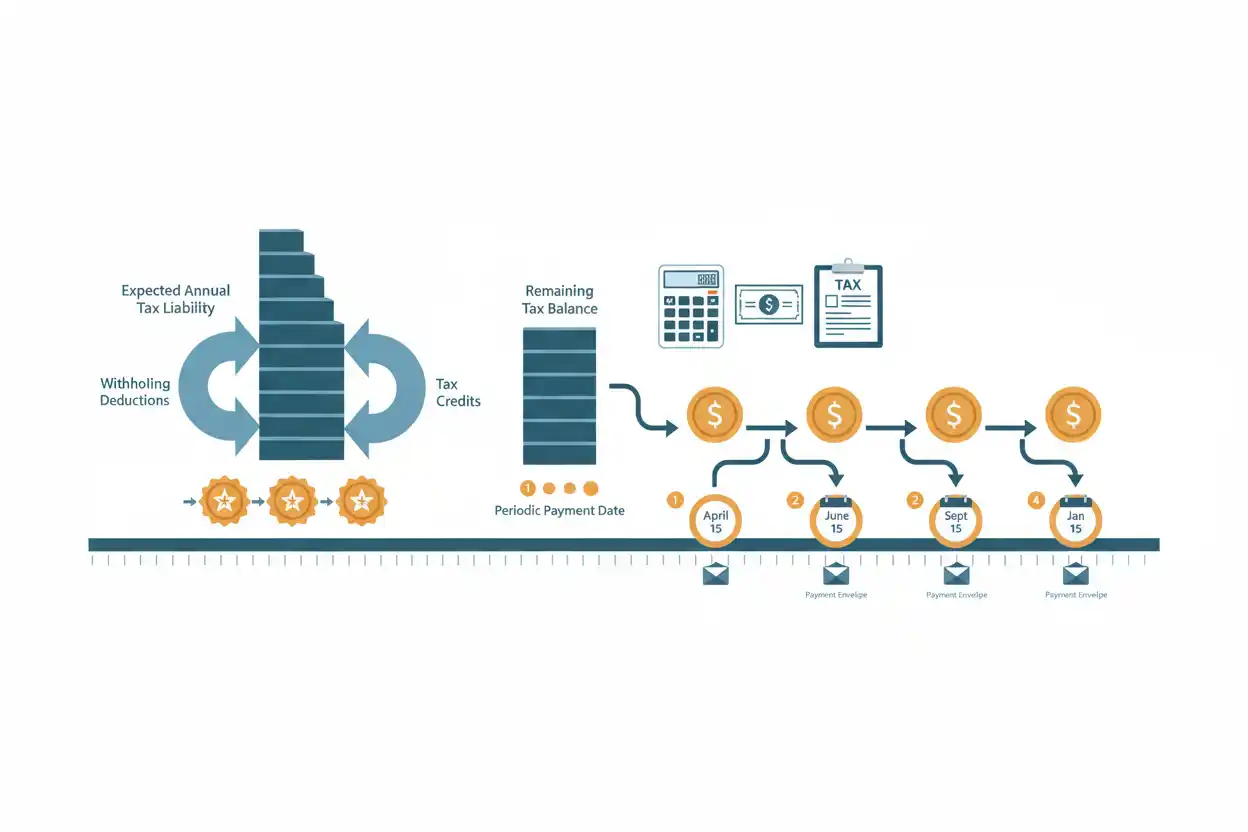
Estimated taxes are periodic tax payments made during the year when ordinary withholding or other prepayments are not expected to cover the required annual tax obligation.
Suppose someone expects $24,000 of annual tax and expects $10,000 to be paid through withholding. Ignoring other credits and prepayments, the remaining projected amount is $14,000.
If that amount is divided into four equal planning payments:
$14,000 ÷ 4 = $3,500
The simplified quarterly estimate is $3,500 per payment.
Real estimated-tax requirements can depend on current-year income, prior-year tax, withholding, safe-harbor rules, payment timing, and the specific tax jurisdiction. The formula below provides the planning framework rather than replacing current filing instructions.
What Are Estimated Taxes?
Estimated taxes are advance payments toward an expected tax liability.
They become especially relevant when income is not fully covered by employer withholding. Common examples can involve self-employment, investment income, business income, rental income, or other sources without sufficient withholding.
The core planning question is:
How much tax do I expect to owe that will not already be paid through withholding or other credits?
Basic Estimated Taxes Formula
A useful simplified calculation is:
Remaining Estimated Tax = Expected Annual Tax − Expected Withholding − Applicable Credits or Other Prepayments
If the result is positive, it represents the remaining amount that needs to be addressed.
For equal periodic planning payments:
Payment per Period = Remaining Estimated Tax ÷ Number of Payments
The legal amount required at each deadline can differ when income or payments are uneven.
Estimated Taxes Example
Suppose:
Expected Annual Tax = $24,000
Expected withholding:
$10,000
Assume no other credits or payments for this example.
Then:
Remaining Estimated Tax = $24,000 − $10,000
= $14,000
For four equal payments:
$14,000 ÷ 4 = $3,500
The simplified estimated payment is $3,500 each.
Why Withholding Must Be Included
Suppose someone expects annual tax of $20,000 but already expects $17,000 to be withheld.
The remaining amount is:
$20,000 − $17,000 = $3,000
Calculating estimated payments from the full $20,000 would ignore $17,000 that is already expected to be paid.
Estimated-tax planning should therefore focus on the uncovered liability, not simply total projected tax.
Estimated Taxes With Credits
Suppose:
Expected Tax = $18,000
Withholding = $8,000
Applicable Credits = $2,000
Remaining amount:
$18,000 − $8,000 − $2,000
= $8,000
If paid through four equal installments:
$8,000 ÷ 4 = $2,000
Credits reduce the remaining tax estimate dollar for dollar in this simplified framework when they are properly applicable to the liability.
Estimated Tax vs Effective Tax Rate
An effective tax rate can help estimate tax as a percentage of an income base, but it should not automatically be treated as the correct estimated-tax percentage for next year.
Suppose a person’s prior effective rate was:
15%
and expected taxable income changes substantially.
Simply multiplying new income by 15% may produce a poor estimate because tax brackets, deductions, credits, income composition, and tax law can all change.
Effective rate is descriptive; estimated taxes are forward-looking.
Estimated Taxes and Estate Tax
Estate tax uses an estate-transfer tax base rather than recurring employment or business income.
An executor dealing with estate-related tax obligations should not assume that the individual’s ordinary quarterly estimated-tax formula automatically determines estate tax.
Both topics involve tax planning, but the taxable events are different.
Estimated Taxes and FICA
Fica tax concerns Social Security and Medicare payroll taxes in the U.S. system.
Estimated income-tax payments are a separate calculation.
Someone with self-employment or other nonwage income can have multiple tax components to consider, so “estimated tax” should not be interpreted as one universal percentage applied to gross receipts.
Estimated Taxes and Double-Time Pay
An employee receiving double-time pay can have higher wage income than originally expected.
Suppose annual taxable compensation rises by several thousand dollars because of premium hours.
That can change projected annual tax and therefore alter the amount still needed through withholding or estimated payments.
The pay premium itself does not dictate the estimated-tax rate.
Estimated Taxes and Export Duty
Export duty is generally associated with customs or trade rules on exported goods.
It is not an ordinary quarterly income-tax prepayment.
A business can face both income-tax obligations and transaction-based trade duties, but they should be modeled separately.
Equal Payments Work Best With Stable Income
Suppose expected uncovered annual tax is:
$12,000
and income arrives evenly throughout the year.
An equal-payment model gives:
$12,000 ÷ 4 = $3,000
per installment.
This is easy to budget.
However, someone whose income is heavily concentrated in one part of the year may need a more precise timing method.
Variable Income Example
Suppose a consultant’s projected annual uncovered tax is still $14,000, but the income pattern is highly seasonal.
A simple planning schedule might be:
First period:
$2,500
Second:
$3,500
Third:
$4,500
Fourth:
$3,500
Total:
$2,500 + $3,500 + $4,500 + $3,500
= $14,000
The total matches the annual estimate even though the payments are unequal.
Whether this schedule satisfies actual required-payment rules depends on the applicable tax rules and income timing.
Recalculate When Income Changes
Suppose a self-employed person originally expects:
Annual Tax = $20,000
with:
$8,000 Withholding
Remaining estimate:
$12,000
Halfway through the year, income rises and expected annual tax becomes:
$26,000
The new remaining amount before considering payments already made is:
$26,000 − $8,000 = $18,000
If $6,000 has already been paid through estimated installments:
Remaining Unpaid Estimate = $18,000 − $6,000
= $12,000
The plan should be updated rather than continuing with an obsolete estimate.
Overpayment Example
Suppose estimated payments and withholding total:
$25,000
while final tax is:
$22,000
Difference:
$25,000 − $22,000
= $3,000
Subject to the final tax-return calculation and other balances, that represents $3,000 more paid than the modeled liability.
Overpaying can reduce cash available during the year even if it ultimately creates a refund or credit.
Underpayment Example
Suppose final tax is:
$30,000
while withholding and estimated payments total:
$25,000
Remaining balance:
$30,000 − $25,000
= $5,000
The taxpayer still needs to address the $5,000 shortfall, and applicable underpayment rules can create additional consequences.
Estimated Tax Percentage of Income
Suppose a freelancer expects:
Net Tax-Relevant Income Base = $80,000
and estimates uncovered tax of:
$16,000
The planning ratio is:
$16,000 ÷ $80,000
= 20%
The freelancer might reserve approximately 20 cents from each dollar of that modeled income.
This is a budgeting ratio, not proof that the taxpayer’s statutory tax rate is 20%.
Monthly Reserve for Quarterly Payments
Suppose expected quarterly payment is:
$3,600
Instead of finding $3,600 at once, the taxpayer can reserve:
$3,600 ÷ 3
= $1,200 per month
The reserve does not change the tax owed. It simply smooths the cash-flow burden.
Business Revenue Is Not Automatically Taxable Income
Suppose a business collects:
$100,000 Revenue
and has:
$40,000 of deductible business expenses
The relevant income-tax calculation may begin from a net amount rather than simply applying a tax percentage to all $100,000 of receipts.
This distinction is similar to why gross income and taxable income should not be treated as interchangeable.
Withholding Can Sometimes Reduce the Need for Separate Payments
If employment withholding rises during the year, the remaining amount that must be addressed through separate estimated payments can fall.
For example:
Expected Tax = $24,000
Original withholding estimate:
$10,000
Original uncovered amount:
$14,000
If withholding is increased to:
$16,000
New uncovered amount:
$24,000 − $16,000
= $8,000
The tax liability did not necessarily change; the payment method changed.
Estimated Taxes Are Not an Extra Tax
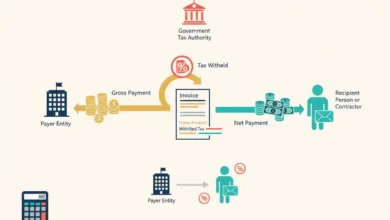
Estimated payments are generally prepayments toward an expected tax liability.
Suppose final tax is $20,000 and the taxpayer already paid $15,000 in estimated taxes.
The simplified remaining balance is:
$20,000 − $15,000 = $5,000
The original $15,000 was not an additional tax on top of the $20,000.
Common Estimated Tax Mistakes
One mistake is calculating quarterly payments from gross income instead of expected tax liability.
Another is ignoring withholding already being paid.
People can also continue using an outdated estimate after income changes substantially or assume four equal payments are appropriate in every uneven-income situation.
Frequently Asked Questions
What are estimated taxes?
They are periodic prepayments toward expected tax liability when withholding or other prepayments may be insufficient.
What is the basic formula?
Remaining Estimated Tax = Expected Annual Tax − Withholding − Applicable Credits and Other Prepayments
How do I estimate equal quarterly payments?
Quarterly Estimate = Remaining Estimated Tax ÷ 4
as a basic planning calculation.
Are estimated taxes an extra tax?
No. They are generally payments toward the underlying tax liability.
Should gross revenue be multiplied directly by a tax rate?
Not necessarily.
What if my income changes during the year?
Recalculate expected annual tax and subtract withholding plus payments already made.
Does withholding reduce estimated payments?
Yes, when withholding counts toward the relevant liability.
Can estimated payments be unequal?
They can be, particularly when income is uneven, though actual required-payment rules should be checked.
Is effective tax rate the same as an estimated-tax rate?
No.
Can an employee need estimated payments?
Potentially, especially when withholding does not cover tax generated by other income.
What happens if I pay too much?
The final return calculation can show an overpayment.
Why should current rules be checked?
Payment thresholds, safe-harbor rules, deadlines, and other requirements can change even though the underlying planning math remains part of the broader Taxes & Pay framework.