Income tax calculations become much easier to understand when they are separated into two questions: how much income is taxable, and what rates apply to different portions of that taxable income?
In a progressive tax system, moving into a higher bracket does not normally mean every dollar of income is suddenly taxed at the new highest rate.
Suppose a purely hypothetical system taxes the first $15,000 at 10%, the next $35,000 at 20%, and additional taxable income at 30%. Someone with $70,000 of taxable income would owe $14,500 under those simplified brackets, not $21,000.
The highest marginal rate is 30%, while the effective rate on the $70,000 taxable-income base is approximately 20.71%.
Actual tax brackets, deductions, credits, filing statuses, and thresholds change over time and by jurisdiction, so the figures in this article are illustrative rather than current tax tables.
The Basic Income Tax Structure
A simplified income-tax calculation can be viewed as:
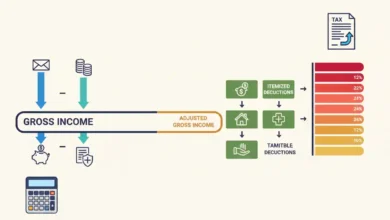
Gross Income → Adjusted Income → Deductions → Taxable Income → Apply Tax Brackets → Tax Before Credits → Apply Credits and Payments
Each stage answers a different question.
Confusing them can cause major calculation errors.
Gross Income Comes First
Gross income combines the income sources included under the applicable rules.
Suppose:
Salary = $70,000
Bonus = $5,000
Other Included Income = $5,000
Simplified gross income:
$80,000
Gross income is not automatically the amount on which the final tax rates are applied.
From Gross Income to Taxable Income
Suppose the simplified example continues with:
Gross Income = $80,000
Qualifying adjustments:
$4,000
Then:
Adjusted Income = $80,000 − $4,000
= $76,000
Suppose an applicable deduction is:
$15,000
Taxable income becomes:
$76,000 − $15,000
= $61,000
The tax brackets would be applied to the $61,000 taxable income, not automatically to the full $80,000 gross income.
Income Tax Brackets
A progressive tax bracket applies different rates to different slices of taxable income.
Consider this purely hypothetical structure:
| Taxable Income Slice | Illustrative Rate |
|---|---|
| First $15,000 | 10% |
| Next $35,000 | 20% |
| Amount above $50,000 | 30% |
For $70,000 of taxable income, all three rates apply—but each rate applies only to its own portion.
Step-by-Step Tax Example
First $15,000:
$15,000 × 10% = $1,500
Next $35,000:
$35,000 × 20% = $7,000
Remaining income:
$70,000 − $50,000
= $20,000
Tax on that portion:
$20,000 × 30% = $6,000
Total:
$1,500 + $7,000 + $6,000
= $14,500
The simplified income tax is $14,500.
Why 30% of Everything Is Wrong
A common mistake is:
$70,000 × 30% = $21,000
That assumes every dollar is taxed at the highest bracket.
Correct hypothetical tax:
$14,500
Overstatement:
$21,000 − $14,500
= $6,500
Progressive brackets are marginal, not all-or-nothing rates.
Marginal Tax Rate
The marginal tax rate is the rate applying to the next taxable dollar.
With $70,000 of taxable income in the hypothetical structure:
Marginal Rate = 30%
This tells you that the next taxable dollar remains in the 30% bracket until the next threshold is reached.
It does not mean the average tax burden is 30%.
Effective Tax Rate
Effective rate is:
Effective Tax Rate = Total Tax ÷ Income Base × 100
Using taxable income:
$14,500 ÷ $70,000 × 100
≈ 20.71%
The effective tax rate is substantially below the 30% marginal rate because earlier income slices were taxed at lower rates.
Deduction Example
Suppose taxable income before a deduction would otherwise be:
$70,000
A $10,000 deduction reduces it to:
$60,000
Using the illustrative brackets, tax at $70,000 is:
$14,500
At $60,000:
First $15,000:
$1,500
Next $35,000:
$7,000
Remaining $10,000:
$10,000 × 30% = $3,000
Total:
$11,500
Tax reduction:
$14,500 − $11,500
= $3,000
The $10,000 deduction did not create $10,000 of tax savings. In this simplified example it reduced tax by $3,000.
Itemized Deductions
Itemized deductions concern qualifying deductible expenses that can be claimed under the applicable tax rules instead of another deduction method where allowed.
The important mathematical distinction is:
Deduction Reduces Income Subject to Tax
rather than:
Deduction Directly Reduces Tax Dollar for Dollar
That latter effect is more characteristic of a tax credit.
Deduction vs Credit
Suppose taxable income is reduced by a $1,000 deduction while the taxpayer is in a hypothetical 20% marginal bracket.
Approximate tax reduction:
$1,000 × 20% = $200
A $1,000 tax credit, when fully usable, can instead reduce tax by:
$1,000
The nominal dollar amounts match, but their tax effects can differ dramatically.
Income Replacement and Tax
An income replacement ratio might show that replacement income equals 70% of previous gross wages.
Take-home income may not decline by exactly 30%, because the tax burden can also change when income falls.
This is why net replacement ratios can differ from gross ratios.
Income Tax and Hourly Wage
An hourly wage establishes the rate at which employment income is earned.
Suppose:
Hourly Wage = $25
Annual Paid Hours = 2,000
Gross wages:
$50,000
The tax calculation starts from the resulting income figures and applicable tax rules—not by applying a bracket directly to the $25 hourly rate.
Income Tax and Import Duty
Import duty uses a customs-related tax base.
Income tax uses income.
A 10% tariff and a 10% income-tax bracket therefore have completely different denominators.
Financial percentages are meaningful only when the base is identified.
Long-Term Capital Gains
Income from selling investments can receive tax treatment different from ordinary wage income.
The long-term capital gains calculation therefore deserves separate treatment rather than assuming every dollar of investment gain enters the same ordinary-income bracket structure.
Income type matters in addition to income amount.
Standard vs Itemized Deduction Concept
Where a tax system provides a standard deduction and an itemized alternative, taxpayers generally compare which permitted method produces the relevant tax result under the applicable rules.
Suppose, hypothetically:
Standard Deduction = $15,000
and qualifying itemized deductions total:
$19,000
The numerical difference is:
$4,000
Whether itemizing is preferable requires considering the actual tax rules and the taxpayer’s entire return.
Taxable Income Cannot Be Found From Take-Home Pay
Suppose an employee takes home:
$4,000 per Month
That does not tell you taxable income.
The paycheck may already reflect:
- income-tax withholding;
- payroll taxes;
- insurance;
- retirement contributions;
- other deductions.
Taxable income should be calculated from the underlying tax information rather than reverse-engineered from one net paycheck.
Tax Withholding Is a Prepayment
Suppose total tax for the year is ultimately:
$14,500
while employer withholding totals:
$16,000
Difference:
$16,000 − $14,500
= $1,500
In the simplified example, $1,500 was paid beyond the final modeled liability.
The withholding itself was not the tax calculation.
Underwithholding Example
Suppose final modeled tax is:
$14,500
while withholding totals:
$12,000
Remaining amount:
$14,500 − $12,000
= $2,500
Other payments or credits could change the eventual balance.
Why a Raise Does Not Make Earlier Income Worth Less
Suppose taxable income rises from $49,000 to $51,000 under the hypothetical brackets.
The first $50,000 continues to be taxed under the lower bracket portions.
Only:
$1,000
lies in the 30% tier.
Moving into the next bracket does not retroactively apply 30% to all $51,000.
Tax Rate on an Additional Dollar
This is the practical meaning of marginal rate.
If the taxpayer is in a hypothetical 30% bracket and earns another $100 of taxable ordinary income:
Additional Tax ≈ $100 × 30%
= $30
before considering interactions with credits, deductions, phaseouts, payroll taxes, or other rules.
The taxpayer still retains approximately $70 from that additional $100 under this isolated income-tax assumption.
Multiple Taxes
Income tax is not necessarily the only deduction from compensation.
A paycheck can also include payroll taxes and, depending on location, state or local taxes.
Therefore:
Income-Tax Rate ≠ Total Payroll Deduction Percentage
Combining every paycheck deduction and calling it an income-tax rate produces a misleading number.
Tax Brackets Change
Current bracket thresholds and deduction amounts can change from year to year.
A tax example should therefore specify its tax year when using real thresholds.
For timeless educational calculations, hypothetical bracket structures are useful because they teach the mechanics without becoming obsolete when statutory amounts change.
Common Income Tax Mistakes
One of the most common errors is applying the highest marginal rate to all taxable income.
Another is confusing gross income with taxable income.
People also treat deductions like tax credits, use withholding as though it were final liability, or mix investment tax rules with ordinary income-tax brackets.
Frequently Asked Questions
What is income tax?
Income tax is a tax calculated from income under the rules applicable to the taxpayer and jurisdiction.
What is taxable income?
It is the amount to which applicable income-tax rates are ultimately applied after relevant adjustments and deductions.
What is a tax bracket?
It is a range of taxable income subject to a specified marginal rate.
Does entering a higher bracket tax all my income at that rate?
Not in a progressive bracket system.
What is marginal tax rate?
It is the rate applying to the next taxable dollar within the bracket structure.
What is effective tax rate?
Effective Tax Rate = Total Tax ÷ Defined Income Base × 100
Is gross income the same as taxable income?
No.
Does a $1,000 deduction save $1,000 of tax?
Usually not. A deduction generally reduces taxable income rather than tax dollar for dollar.
How is a credit different?
A usable tax credit generally reduces tax itself.
Is withholding the same as final tax liability?
No.
Are investment gains always taxed like salary?
No. Their treatment can depend on the type of gain and applicable tax rules.
Why avoid memorizing one set of tax brackets?
Thresholds, deductions, and tax rules can change, while the underlying bracket mechanics remain the same.