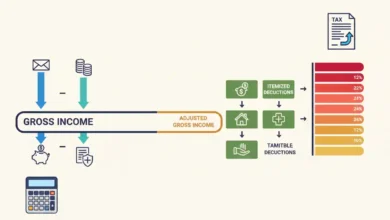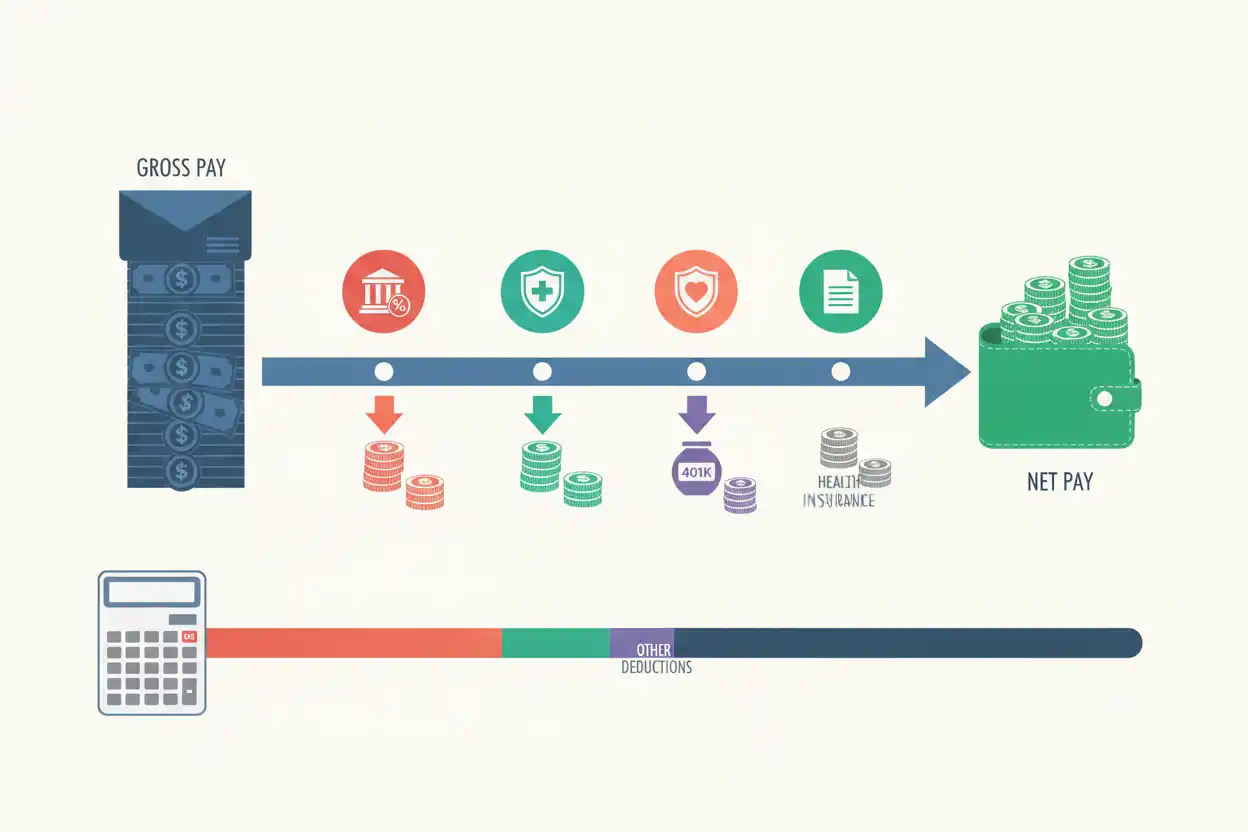

Net pay is the amount of a paycheck remaining after applicable taxes, withholding, employee benefit deductions, and other payroll deductions have been subtracted from gross pay.
If gross pay is $5,000 and combined deductions total $1,250:
Net Pay = $5,000 − $1,250
= $3,750
The employee takes home $3,750.
Gross compensation and net pay should not be confused. A salary offer describes earnings before many deductions, while net pay determines how much paycheck cash is actually available for spending and saving.
Net Pay Formula
The general formula is:
Net Pay = Gross Pay − Total Payroll Deductions
A more detailed version is:
Net Pay = Gross Pay − Taxes Withheld − Employee Benefit Deductions − Other Applicable Deductions
The calculation should use deductions from the same pay period as the gross amount.
Net Pay Example
Suppose:
Gross Pay = $5,000
Federal, state, payroll, or other modeled taxes total:
$900
Employee benefits and other deductions total:
$350
Total deductions:
$900 + $350 = $1,250
Then:
Net Pay = $5,000 − $1,250
= $3,750
Net pay is $3,750.
Take-Home Pay Percentage
The percentage of gross pay retained can be calculated as:
Take-Home Percentage = Net Pay ÷ Gross Pay × 100
Using the example:
$3,750 ÷ $5,000 × 100
= 75%
The employee retains 75% of gross pay as take-home cash.
The remaining 25% is the combined deduction percentage in this simplified paycheck.
Deduction Percentage
The same relationship can be expressed from the other side:
Deduction Percentage = Total Deductions ÷ Gross Pay × 100
$1,250 ÷ $5,000 × 100
= 25%
This does not mean the employee’s income-tax rate is 25%.
The $1,250 can contain several different deductions.
Solve for Gross Pay From Net Pay
If net pay and the take-home percentage are known:
Gross Pay = Net Pay ÷ Take-Home Percentage
Suppose:
Net Pay = $3,750
Take-Home Percentage = 75%
Then:
Gross Pay = $3,750 ÷ 0.75
= $5,000
Net Pay From Annual Salary
Suppose annual gross salary is:
$78,000
and annual net pay after all modeled payroll deductions is:
$58,500
Average monthly net pay:
$58,500 ÷ 12
= $4,875
Average gross monthly salary:
$78,000 ÷ 12
= $6,500
Difference:
$1,625 per Month
That difference represents the average effect of all modeled deductions.
Net Pay From Biweekly Pay
Suppose net biweekly pay is:
$2,000
Annual net income under 26 pay periods:
$2,000 × 26
= $52,000
Average monthly income on a net basis is:
$52,000 ÷ 12
≈ $4,333.33
Simply multiplying $2,000 by two gives only $4,000 and ignores the two additional biweekly checks across the year.
Why Net Pay Can Change When Gross Pay Does Not
Suppose gross biweekly pay remains:
$3,000
One pay period has deductions of:
$700
Net pay:
$2,300
A later paycheck has deductions of:
$850
Net pay:
$2,150
Gross pay remained unchanged.
The difference comes from the deductions.
Net Pay and Overtime
Overtime pay increases gross compensation for qualifying hours.
Suppose ordinary gross pay is:
$1,000
and overtime adds:
$300
New gross pay:
$1,300
If deductions on the larger paycheck total $280:
Net Pay = $1,300 − $280
= $1,020
The employee does not necessarily take home the full $300 overtime increase because additional gross pay can also increase deductions and withholding.
Net Pay and Medicare Tax
Medicare tax can be one component deducted from U.S. employee wages.
If Medicare wages are:
$4,000
regular employee Medicare tax at 1.45% is:
$58
That $58 contributes to the difference between gross and net pay but is only one payroll deduction.
Net Pay and Marriage Tax
Marriage can change the household’s tax situation, which can make marriage tax considerations relevant when withholding is adjusted.
If withholding changes after marriage while gross salary remains constant, paycheck net pay can rise or fall.
A withholding change itself does not prove the household’s final annual tax liability changed by exactly the same amount.
Net Pay and Pay Frequency
Pay frequency changes how annual compensation is divided across paychecks.
Suppose annual net compensation after modeled deductions is:
$52,000
Weekly equivalent:
$52,000 ÷ 52 = $1,000
Biweekly equivalent:
$52,000 ÷ 26 = $2,000
Semimonthly equivalent:
$52,000 ÷ 24 ≈ $2,166.67
Monthly equivalent:
$52,000 ÷ 12 ≈ $4,333.33
The annual net amount is unchanged.
Gross Pay Raise vs Net Pay Raise
Suppose annual gross compensation increases by:
$6,000
That does not guarantee net annual pay also rises by $6,000.
If the additional gross pay causes $1,800 of additional taxes and payroll deductions in a simplified example:
Net Increase = $6,000 − $1,800
= $4,200
Monthly net increase:
$4,200 ÷ 12
= $350
The gross raise and take-home raise are different measures.
Pretax Deductions
Some payroll deductions can reduce certain taxable wage bases before particular taxes are calculated.
Suppose gross pay is:
$5,000
and an eligible pretax deduction is:
$500
A relevant taxable wage base might become:
$4,500
for a particular tax calculation.
However, different payroll taxes can treat deductions differently, so the same taxable base should not be assumed for every tax.
After-Tax Deductions
Other deductions can occur after relevant taxes have already been calculated.
Suppose payroll tax calculations are complete and an after-tax deduction of $100 is then applied.
That $100 still reduces net pay:
Net Pay After Deduction = Previous Net Pay − $100
but it did not necessarily reduce the earlier taxable wage base.
Retirement Contributions and Net Pay
An employee contribution to a retirement account can reduce take-home cash while also changing certain tax calculations depending on the account type.
Suppose an employee increases a payroll contribution by:
$200 per Paycheck
Net pay might fall by less than exactly $200 if the contribution also reduces applicable income-tax withholding.
The actual result depends on the plan and tax treatment.
Insurance Premiums
Employee-paid insurance premiums can also reduce net pay.
Suppose:
Gross Pay = $4,000
Taxes and withholding:
$750
Insurance deduction:
$200
Other deductions:
$150
Net pay:
$4,000 − $750 − $200 − $150
= $2,900
A paycheck should be reconciled by component rather than treating the entire $1,100 difference as “tax.”
Net Pay for Hourly Workers
Suppose an hourly worker earns:
$25 per Hour
and works:
40 Hours
Gross pay:
$1,000
If payroll deductions equal:
$210
Net pay:
$790
If hours fall to 32 and the deduction structure changes proportionally or otherwise:
Gross Pay = $800
Net pay must be recalculated rather than assuming the prior $790 amount.
Net Pay for Variable-Income Workers
Commission and overtime can make net pay fluctuate substantially.
Suppose three net checks are:
$1,800, $2,600, $2,100
Average net pay:
($1,800 + $2,600 + $2,100) ÷ 3
≈ $2,166.67
For household planning, a multi-period average can be more useful than the largest paycheck.
Refunds Do Not Retroactively Change Paychecks
Suppose excessive withholding contributes to a later tax refund.
The paycheck received months earlier still had the same historical net pay.
A tax refund changes later cash flow, not the net-pay amount originally deposited for that pay period.
Employer Costs Are Not Employee Deductions
An employer can pay payroll taxes or benefits beyond the employee’s gross wages.
Those costs do not reduce employee net pay unless the employee is separately charged for them.
Employer cost and paycheck deduction are different concepts.
Net Pay and Budgeting
Recurring expenses should generally be compared with recurring net cash rather than gross salary.
If gross monthly pay is $6,500 but average net pay is $4,875, a budget committing $5,500 to monthly spending is already:
$5,500 − $4,875 = $625
above available paycheck cash before other income sources are considered.
Common Net Pay Mistakes
One mistake is subtracting only income-tax withholding while ignoring payroll taxes and other deductions.
Another is assuming gross salary divided by 12 equals spendable monthly income.
People also interpret the total deduction percentage as one tax rate or assume every gross pay raise appears dollar for dollar in net pay.
Frequently Asked Questions
What is net pay?
Net pay is the amount of employee compensation remaining after applicable payroll taxes, withholding, and deductions.
What is the net pay formula?
Net Pay = Gross Pay − Total Payroll Deductions
Is net pay the same as take-home pay?
The terms are commonly used to describe the same paycheck concept.
How do I calculate take-home percentage?
Net Pay ÷ Gross Pay × 100
Why is net pay lower than gross pay?
Taxes and other employee deductions are subtracted from gross compensation.
Is the difference between gross and net pay all tax?
No.
Can two employees with the same salary have different net pay?
Yes.
Does overtime increase net pay?
Usually, but the net increase can be smaller than the gross overtime amount.
Does pay frequency change annual net income?
Not by itself; it changes how the annual amount is distributed across checks.
Can pretax deductions change net pay by less than their face amount?
Potentially, because they can also affect some tax calculations.
Should I budget from gross or net pay?
Net pay is generally more useful for recurring cash-flow planning.
Why reconcile every deduction?
It explains exactly how gross compensation became the final paycheck amount.