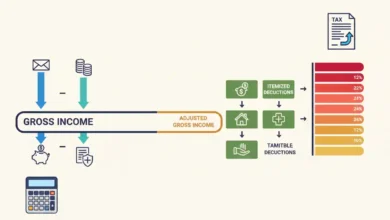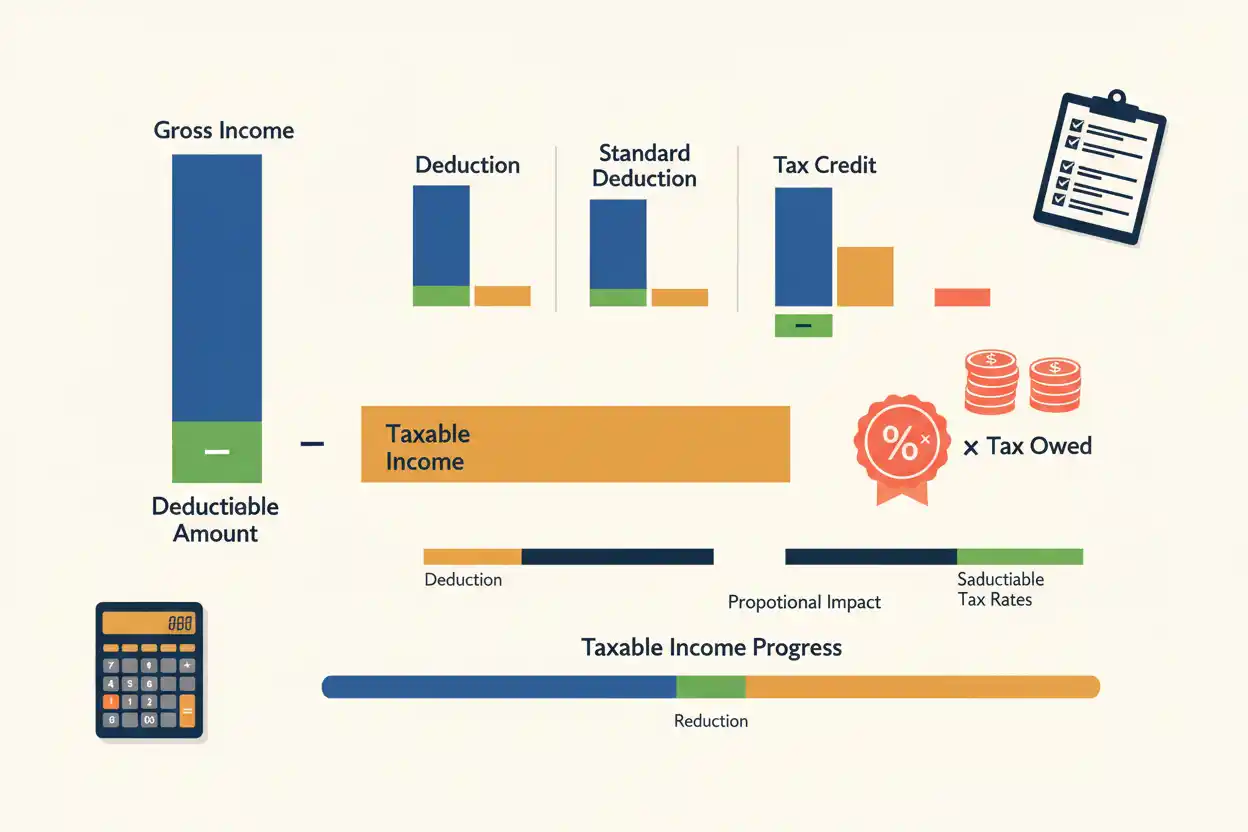

A tax deduction reduces an income amount used to calculate tax rather than generally reducing the final tax bill dollar for dollar.
The IRS describes deductions as amounts that reduce taxable income, while tax credits reduce the amount of tax due.
Suppose income subject to a particular deduction is $80,000 and an allowable $10,000 deduction applies.
Income After Deduction = $80,000 − $10,000
= $70,000
The taxpayer has a $10,000 deduction, but the tax savings depend on the rates that would otherwise have applied to those $10,000 of income.
Tax Deduction Formula
A simplified formula is:
Income After Deduction = Income Before Deduction − Allowable Deduction
For example:
Income Before Deduction = $95,000
Deduction = $7,500
Then:
$95,000 − $7,500
= $87,500
The deduction reduces the modeled tax base by $7,500.
Estimating Tax Savings From a Deduction
When the entire deduction removes income from one marginal tax bracket:
Estimated Tax Savings ≈ Deduction × Marginal Tax Rate
Suppose:
Deduction = $5,000
and the relevant illustrative marginal rate is:
22%
Then:
Estimated Tax Savings ≈ $5,000 × 22%
= $1,100
The deduction is $5,000.
The estimated tax reduction is $1,100.
Why a $5,000 Deduction Does Not Usually Save $5,000
A deduction reduces income.
If the removed income would have been taxed at 22%, each deductible dollar saves approximately:
$1 × 22% = $0.22
Therefore:
$5,000 × $0.22 = $1,100
A deduction would need a 100% applicable tax rate to create tax savings equal to the full deduction amount under this simplified framework.
Tax Deduction vs Tax Credit
A tax credit operates later in the calculation.
Suppose a taxpayer can compare an illustrative $4,000 deduction with a fully usable $4,000 credit.
If the deduction removes income from a 25% bracket:
Tax Effect of Deduction ≈ $4,000 × 25%
= $1,000
Credit:
Tax Reduction = $4,000
The IRS specifically distinguishes these mechanisms: deductions reduce taxable income, while credits reduce tax due.
Tax Deduction vs Standard Deduction
The standard deduction is a specific deduction method available to eligible federal taxpayers.
For 2026, the IRS lists basic standard deduction amounts of $16,100 for single and married-filing-separately taxpayers, $32,200 for married filing jointly and qualifying surviving spouses, and $24,150 for heads of household.
Other deductions can operate elsewhere in the tax calculation.
Therefore, “tax deduction” is the broad concept, while “standard deduction” names a particular deduction.
Deduction Crossing Tax Brackets
Suppose a taxpayer receives a $10,000 deduction.
Without the deduction, $4,000 would fall in a hypothetical 24% bracket and $6,000 would fall in a 22% bracket.
Estimated savings:
$4,000 × 24% + $6,000 × 22%
= $960 + $1,320
= $2,280
Simply multiplying the full $10,000 by 24% would overstate the modeled savings.
Deduction Percentage of Income
Suppose:
Income Before Deduction = $100,000
Deduction = $15,000
Deduction as a percentage of income:
$15,000 ÷ $100,000 × 100
= 15%
Income remaining:
$85,000
This 15% is the reduction in the modeled income base, not the taxpayer’s tax rate.
Solve for Original Income
Suppose:
Income After Deduction = $80,000
and:
Deduction = $10,000
Then:
Income Before Deduction = $80,000 + $10,000
= $90,000
Solve for Deduction
Suppose:
Income Before Deduction = $90,000
Income After Deduction = $82,000
Then:
Deduction = $90,000 − $82,000
= $8,000
Whether the entire $8,000 is legally allowable must be established separately from the arithmetic.
Deduction Eligibility Comes Before the Formula
An expense does not become deductible merely because paying it reduced cash.
Federal tax deductions are governed by specific rules, limitations, and eligibility requirements. The IRS provides separate guidance for individual and business deductions because the treatment varies by deduction.
Therefore:
Cash Expense ≠ Automatically Tax Deduction
The financial event should first be classified correctly.
Tax Deduction and Tax-Exclusive Price
A tax-exclusive price is a price before transaction tax is added.
Suppose:
Tax-Exclusive Price = $100
Transaction Tax = $8
Customer Pays = $108
The $8 transaction tax should not automatically be labeled a personal income-tax deduction.
Transaction pricing and income-tax deductions answer different questions.
Tax Deduction and Tax-Inclusive Price
A tax-inclusive price already contains the transaction tax.
For example:
Tax-Inclusive Price = $108
at an 8% tax rate corresponds to:
Pre-Tax Price = $108 ÷ 1.08
= $100
Again, extracting a tax component from a purchase does not by itself establish that the amount is deductible on an income-tax return.
Tax Deduction and Social Security Tax
An income-tax deduction does not automatically reduce wages subject to Social Security tax.
Suppose an employee receives $70,000 of covered Social Security wages and later claims an allowable income-tax deduction.
The federal taxable-income calculation can fall while the historical Social Security wage base remains $70,000.
Payroll and income-tax rules use different definitions.
Above-the-Line and Other Deduction Concepts
Federal deductions do not all enter the return at the same stage.
Some adjustments can be available regardless of whether the taxpayer takes the standard deduction or itemizes, while other deductions depend on a particular method or qualification. Current IRS Publication 17 notes that some deductions can be claimed by eligible taxpayers whether they use the standard deduction or itemize.
This is why the generic formula should not be interpreted as meaning every deduction is simply added into one single deduction bucket.
Business Deduction Example
Suppose a business has:
Revenue = $120,000
and:
Allowable Business Expenses = $40,000
A simplified business-income calculation might produce:
$120,000 − $40,000 = $80,000
The $40,000 affects the business income calculation.
It should not automatically be added again as a personal itemized deduction, which could double count the same economic expense.
Deduction and Refund Example
Suppose an additional deduction lowers final calculated tax from:
$8,000 to $7,000
and withholding is:
$7,500
Without the deduction:
Balance Due = $500
With the deduction:
Refund = $500
The deduction changed tax by $1,000, which changed the filing result by $1,000.
The refund is determined only after payments and withholding are compared with final tax.
Deduction and Marginal Tax Planning
Suppose a taxpayer is deciding whether an eligible $3,000 deductible expenditure creates enough tax savings to justify the cash outlay.
At an illustrative 25% tax effect:
Tax Savings ≈ $750
Net economic cost after simplified tax savings:
$3,000 − $750
= $2,250
Spending $3,000 solely to obtain a $750 tax reduction still leaves the taxpayer $2,250 worse off in cash.
A deduction does not make an expense free.
Deduction Phaseout Example
Suppose a hypothetical $10,000 deduction is reduced by 20% because of an applicable limitation.
Allowed deduction:
$10,000 × 80%
= $8,000
If the taxpayer incorrectly claims the full $10,000, the modeled income base is understated by:
$2,000
Always apply eligibility limits before calculating the tax effect.
Deduction vs Exclusion
A deduction generally subtracts an amount during the tax calculation.
An exclusion can instead prevent qualifying income from entering a particular income measure in the first place.
Although both can reduce taxable income, they are not necessarily the same legal mechanism.
The underlying tax rule determines the correct classification.
Common Tax Deduction Mistakes
A common mistake is subtracting a deduction directly from tax due.
Another is assuming every personal expense is deductible or counting the same expense in multiple parts of the return.
Taxpayers also confuse deductions with credits, use the wrong standard deduction amount, or estimate savings using the highest tax bracket even when the deduction spans several brackets.
Frequently Asked Questions
What is a tax deduction?
A tax deduction generally reduces an income amount used in calculating tax.
What is the basic formula?
Income After Deduction = Income Before Deduction − Allowable Deduction
Does a $1,000 deduction reduce tax by $1,000?
Usually not.
How can I estimate the tax savings?
For a deduction entirely within one marginal bracket:
Tax Savings ≈ Deduction × Marginal Rate
Is a tax deduction the same as a tax credit?
No.
Is the standard deduction a tax deduction?
Yes. It is a specific deduction method available under federal income-tax rules.
Are all expenses deductible?
No.
Can deductions operate at different stages of a return?
Yes.
Does an income-tax deduction automatically reduce Social Security wages?
No.
Does paying transaction tax automatically create a deduction?
No.
Can a deduction create a larger refund?
It can contribute to one by reducing tax, but the refund also depends on payments, withholding, and credits.
Why should eligibility be checked before calculating savings?
Because only the allowable deduction amount belongs in the tax calculation.