
Value-based pricing sets a price primarily according to the economic or perceived value a product creates for the customer rather than simply adding a markup to cost.
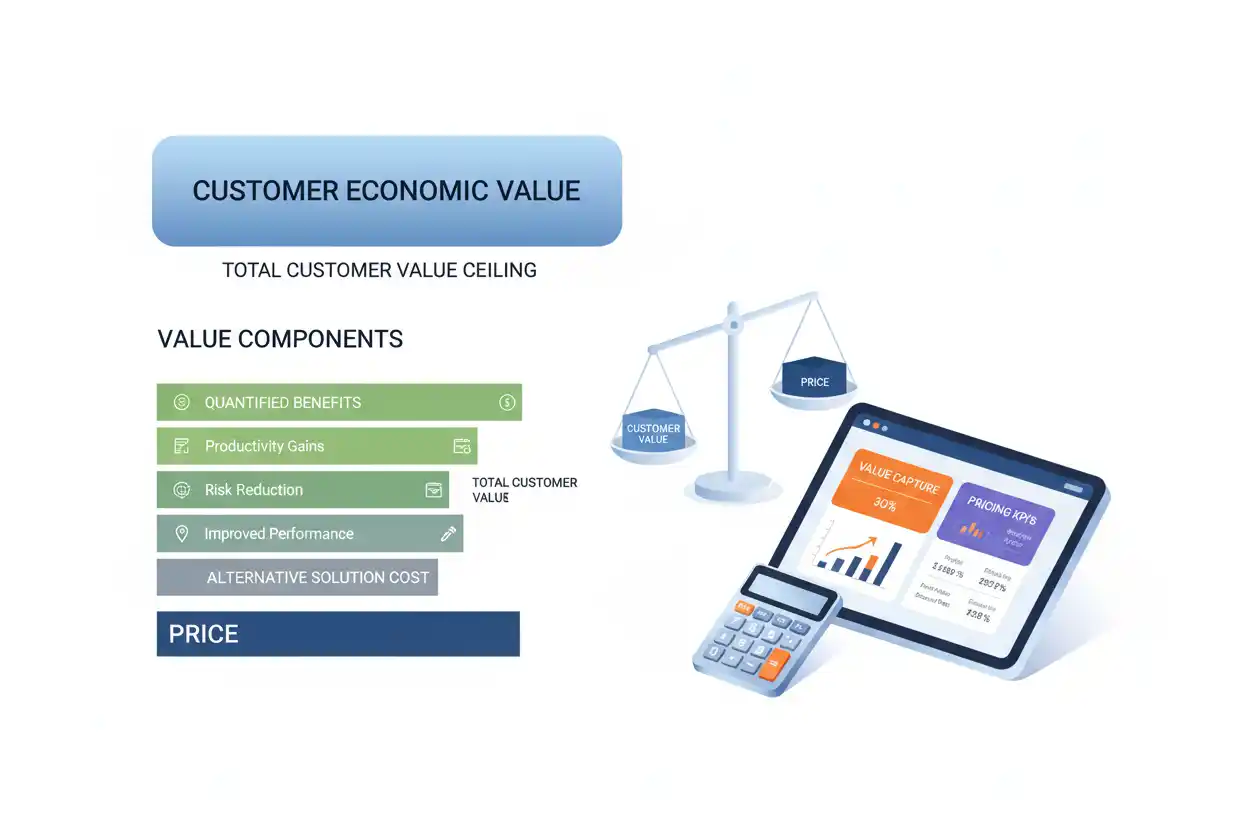
There is no single universal value-based pricing formula because customer value can come from different sources. A useful quantitative framework is:
Customer Economic Value = Value of Best Alternative + Incremental Value Created by Your Solution
The company then chooses how much of that total value to capture:
Value-Based Price = Reference Alternative Price + Portion of Incremental Value Captured
Suppose a customer could use an alternative solution costing $50,000 per year.
Your product creates another $100,000 of measurable annual economic benefit compared with that alternative.
Total economic value relative to doing without the benefits is:
$50,000 + $100,000 = $150,000
If the company chooses to capture 30% of the incremental $100,000 value:
Value-Based Price = $50,000 + ($100,000 × 30%)
= $80,000
The customer pays $80,000 while retaining $70,000 of economic value relative to the estimated $150,000 total.
Value-based pricing is therefore not simply “charge as much as possible.” The goal is to understand customer value and divide it in a way that produces attractive economics for both buyer and seller.
What Is Value-Based Pricing?
Value-based pricing starts with the customer’s perspective.
Instead of asking:
What did the product cost us to make?
the business asks:
What financial or practical value does this product create for this customer?
Suppose software costs only $5,000 annually to serve but saves a customer:
$200,000 per Year
A purely cost-plus model might produce:
$5,000 Cost + 50% Markup = $7,500 Price
But a $7,500 price captures very little of the value created.
A value-based approach might justify a materially higher price while still leaving the customer with a strong return.
A Practical Value-Based Pricing Formula
One useful framework is:
Economic Value to Customer = Reference Value + Differentiation Value
Where:
Reference value is the value or price of the customer’s next-best alternative.
Differentiation value is the additional economic benefit or cost created by choosing your solution rather than that alternative.
Then:
Value-Based Price = Reference Price + Share of Positive Differentiation Value Captured
The capture percentage is a strategic choice rather than a universal constant.
Value-Based Pricing Example
Suppose a manufacturer is considering software that reduces production waste.
Current alternative costs:
$40,000 per Year
The new software also saves:
$120,000 per Year in Waste
and:
$20,000 per Year in Labor
Incremental economic value:
$120,000 + $20,000 = $140,000
If the competing alternative costs $40,000:
Total Economic Value = $40,000 + $140,000 = $180,000
Suppose the vendor wants the customer to retain 70% of the incremental value while capturing 30%.
Captured incremental value:
$140,000 × 30% = $42,000
Value-based price:
$40,000 + $42,000 = $82,000
Customer economic benefit remaining relative to the calculated $180,000 value:
$180,000 − $82,000 = $98,000
The vendor charges more than the alternative while the customer still retains substantial economic benefit.
Value-Based Pricing Is Not Cost-Plus Pricing
Cost-plus pricing starts with cost:
Price = Cost + Markup
Suppose:
Unit Cost = $60
and:
Markup = 50%
Price:
$60 + $30 = $90
The customer’s value is not part of the formula.
Value-based pricing starts from customer benefit instead.
If that $60 product creates $500 of measurable customer value, a $90 price may substantially undercapture value.
If customers value the product at only $70, the same $90 price may be unsustainable even though the cost-plus calculation appears reasonable.
Value-Based Pricing vs. Break-Even Price
The break-even price asks:
What price is required to cover the relevant cost structure at a specified volume?
Value-based pricing asks:
What price is justified by the value delivered to the customer?
Suppose:
Break-Even Price = $40
but customers receive:
$200 of Economic Value
A value-based price might be:
$120
The $40 break-even level establishes an internal economic floor under the assumptions.
Customer value determines how much room exists above that floor.
Value-Based Pricing and Margin
A value-based price can improve margin when customers are willing to pay more because the product creates demonstrable value.
Suppose:
Cost = $50
Cost-plus price:
$75
Margin:
($75 − $50) ÷ $75 = 33.33%
Value-based research supports:
$125 Price
Margin:
($125 − $50) ÷ $125 = 60%
The price more than doubles the dollar margin:
$25 → $75
But a higher margin is only sustainable if customers genuinely perceive and realize the stated value.
Quantifying Revenue Value
Suppose a product helps a customer generate:
1,000 Additional Sales
Each sale contributes:
$50 of Gross Profit
Economic benefit:
1,000 × $50 = $50,000
If the product also costs the customer $10,000 less in administrative work:
Total Quantified Benefit = $60,000
This quantified value can inform willingness-to-pay analysis.
Using additional revenue rather than additional profit would overstate value if the customer incurs substantial costs to generate those sales.
Quantifying Cost Savings
Suppose automation reduces required labor by:
2,000 Hours per Year
Fully loaded labor cost:
$40 per Hour
Annual value:
2,000 × $40 = $80,000
If the solution costs:
$25,000 Annually
customer net benefit:
$80,000 − $25,000 = $55,000
The customer retains more than twice the subscription price in measured annual benefit.
Quantifying Time Savings
Time savings only have economic value when the saved time creates useful capacity, reduces costs, avoids hiring, or supports additional valuable work.
Suppose software saves:
500 Employee Hours
If economically relevant labor value is:
$60 per Hour
estimated value:
$30,000
But if those hours cannot be redeployed productively, the actual economic value can be lower.
Value-based pricing requires realistic benefit assumptions rather than multiplying every saved minute by a theoretical wage rate.
Quantifying Risk Reduction
Some products create value by reducing expected losses.
Suppose a control reduces the probability of a $1 million operational loss:
From 10% to 4%
Original expected loss:
$1M × 10% = $100,000
New expected loss:
$1M × 4% = $40,000
Expected annual risk reduction:
$60,000
That amount can contribute to quantified customer value.
Risk estimates should be evidence-based because small changes in assumed probability can materially alter the calculation.
Combining Several Value Drivers
Suppose a product provides:
Labor Savings = $50,000
Additional Gross Profit = $80,000
Expected Risk Reduction = $20,000
Total quantified annual benefit:
$150,000
If the current alternative costs:
$30,000
and the new solution replaces it, the pricing analysis should carefully distinguish gross benefits, avoided costs, replacement costs, and incremental benefits to avoid double counting.
Accurate value modeling matters more than creating the largest possible value estimate.
Customer Value vs. Seller Cost
A product can have:
Low Seller Cost
and:
High Customer Value
Software is a common example.
The marginal cost of providing another account may be relatively low while the application saves the customer hundreds of thousands of dollars.
Value-based pricing allows the seller to capture some of that value.
Cost information still matters because pricing below sustainable economics can destroy profitability regardless of customer value.
Value-Based Pricing and Reference Alternatives
Customers rarely evaluate a product in isolation.
Their alternative could be:
- a competitor;
- internal staff;
- spreadsheets;
- outsourcing;
- manual processes;
- another technology;
- delaying the decision; or
- doing nothing.
The value-based price must be considered relative to the next-best alternative.
Suppose your product creates $100,000 of benefits but a competitor creates $90,000 for much less money.
Your differentiation value may be only the incremental $10,000 rather than the full $100,000.
Example: Competing Alternative
Alternative product:
Price = $40,000
Customer benefit:
$120,000
Your product creates:
$170,000 of Benefit
Incremental value over alternative:
$170,000 − $120,000 = $50,000
If your company captures 40% of the additional value:
Premium = $50,000 × 40% = $20,000
Potential price:
$40,000 + $20,000 = $60,000
Customer pays $20,000 more but receives $50,000 more benefit.
Net incremental benefit retained by the customer:
$30,000
Different Customers Can Have Different Value
The same product can create very different economic value for different customers.
Suppose software saves:
1% of Transaction Costs
Customer A processes:
$1M
Potential value:
$10,000
Customer B processes:
$100M
Potential value:
$1M
A uniform price may undercharge Customer B or overcharge Customer A.
This is one reason value-based pricing often works with customer segmentation, tiers, usage pricing, or enterprise negotiation.
Value-Based Pricing and Customer Segmentation
Suppose three segments receive different annual values:
| Segment | Estimated Customer Value | Possible Price |
|---|---|---|
| Small Business | $10,000 | $2,000 |
| Mid-Market | $100,000 | $20,000 |
| Enterprise | $1,000,000 | $150,000 |
The pricing structure reflects different customer economics rather than treating every account identically.
The specific prices still need market validation.
Estimated value does not automatically equal willingness to pay.
Economic Value vs. Perceived Value
A product can create measurable economic value that customers do not fully perceive.
Suppose analytics software saves:
$100,000 annually
but customers believe the benefit is only:
$30,000
A $50,000 price may appear unattractive even though the true economic case is strong.
Sales messaging, proof, case studies, implementation confidence, and product usability can therefore affect how much value the business can actually capture.
Pricing cannot be separated completely from communication.
Perceived Value Without Easily Measurable Savings
Not all value is purely financial.
Products can create:
- convenience;
- prestige;
- simplicity;
- confidence;
- design quality;
- reduced frustration;
- speed;
- access;
- brand identity; or
- user experience.
Consumer value-based pricing often relies more heavily on research into willingness to pay, customer preferences, and alternatives than on a spreadsheet of direct cost savings.
The underlying principle remains the same: price is anchored to customer value rather than production cost alone.
Value-Based Pricing and Willingness to Pay
Customer willingness to pay is an important constraint.
Suppose estimated economic value is:
$100,000
but buyers consistently refuse prices above:
$25,000
Theoretical value does not make $80,000 commercially realistic.
The business should investigate whether:
- benefits are overstated;
- value is poorly communicated;
- the customer bears implementation risk;
- competing alternatives are cheaper;
- budgets are constrained; or
- only a small portion of the value is considered attributable to the product.
Value Capture Percentage
A useful analytical measure is:
Value Capture % = Price ÷ Quantified Customer Value × 100
Suppose:
Customer Value = $100,000
Price = $25,000
Value capture:
25%
The customer retains:
$75,000
of the quantified benefit before considering implementation costs or other factors.
There is no universal ideal value-capture percentage.
Customer ROI Under Value-Based Pricing
A customer may evaluate:
Customer ROI = (Customer Benefit − Price) ÷ Price × 100
Suppose:
Quantified Benefit = $100,000
Price = $25,000
Net benefit:
$75,000
Customer ROI:
$75,000 ÷ $25,000 × 100 = 300%
A high customer ROI can leave room for a higher price while still providing attractive customer economics.
The appropriate ROI threshold depends on risk, implementation effort, capital constraints, and alternatives.
Value-Based Pricing and Sales Efficiency
Sales efficiency can improve when the sales organization captures more justified value from each customer.
Suppose commercial spending stays:
$1M
Incremental revenue under old pricing:
$1.5M
Sales efficiency:
1.5
Value-based packaging increases incremental revenue to:
$2M
New efficiency:
2.0
The sales organization generates more revenue from the same commercial investment.
This benefit disappears if the higher price dramatically reduces conversion or lengthens sales cycles.
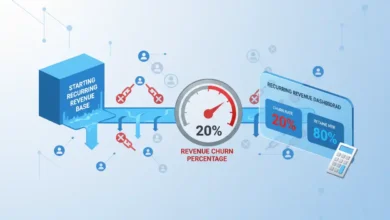
Value-Based Pricing and Revenue Churn
Revenue churn provides an important test of whether the price remains aligned with customer value.
If a price increase produces substantial recurring revenue churn, customers may no longer perceive adequate value at the new price.
However, some churn after repricing can be economically rational if the customers leaving were structurally unprofitable or poorly matched.
Pricing success should be judged by total customer economics rather than retention percentage alone.
Value-Based Pricing and Net Revenue Retention
Value-based packaging can support net revenue retention when customers pay more as they receive more value.
Examples include pricing linked to:
- seats;
- transaction volume;
- locations;
- data processed;
- users;
- revenue managed; or
- functionality adopted.
As customer usage and value grow, recurring revenue can expand naturally.
The pricing metric should still align with customer value closely enough that growth does not feel punitive.
Value-Based Pricing and the Rule of 40
The rule of 40 combines growth and profitability.
Effective value-based pricing can potentially strengthen both components.
Higher realized prices can increase revenue growth.
Improved unit economics can increase profitability.
If higher pricing causes substantial churn, growth can weaken enough to offset the margin improvement.
The total effect matters.
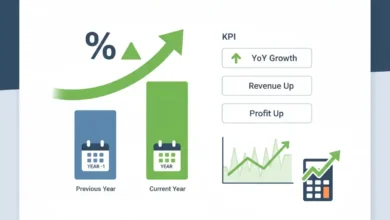
Value-Based Pricing and Year-Over-Year Growth
Year-over-year growth can reveal whether a pricing change is supporting durable revenue expansion.
Suppose average price increases 12%.
Year-over-year revenue grows:
18%
Volume, customer mix, and expansion explain the additional growth beyond the price change.
If YoY revenue grows only 3%, the higher price may be offset by customer losses or lower volume.
Revenue growth should be decomposed into price and quantity effects.
Value-Based Pricing and Quarter-Over-Quarter Growth
Quarter-over-quarter growth can detect near-term effects after a pricing change.
Suppose quarterly revenue rises:
15%
immediately following a repricing.
Management should determine how much came from:
- higher realized prices;
- customer volume;
- account expansion;
- new acquisition; and
- seasonality.
A single QoQ increase is not sufficient evidence that the pricing model is optimal.
Value-Based Pricing vs. Competitive Pricing
Competitive pricing starts heavily from competitor prices.
Value-based pricing starts from customer value.
Competitor information still matters because alternatives influence willingness to pay.
Suppose competitors charge:
$50,000
Your product creates substantially more economic benefit.
Automatically matching $50,000 may underprice the differentiated value.
Conversely, charging $150,000 solely because internal value modeling supports it may fail if buyers view alternatives as close substitutes.
Value and competitive context should be combined intelligently.
Value-Based Pricing vs. Cost-Plus Pricing
Cost-plus:
Price = Cost + Markup
Value-based:
Price Is Anchored to Customer Value
Suppose:
Cost = $10
Customer Value = $200
A 50% markup gives:
$15
That price captures little of the customer value.
Now suppose:
Cost = $100
Customer Value = $110
A 50% markup gives:
$150
The customer may refuse because the price exceeds the perceived value.
Cost-plus pricing can therefore underprice high-value products and overprice low-value ones.
Value-Based Pricing vs. Penetration Pricing
Penetration pricing deliberately starts low to accelerate adoption or market entry.
Value-based pricing attempts to capture a justified portion of customer value.
A business can still use a lower introductory price within a broader value-based strategy, but the purpose is different.
Penetration pricing sacrifices near-term value capture to gain customers, usage, distribution, or network effects.
Value-Based Pricing and Discounts
Discounting should have a clear value rationale.
Suppose list price is:
$100,000
and quantified customer value is:
$300,000
A 20% discount creates:
$80,000 Price
The customer retains:
$220,000 of Gross Quantified Value
The discount may be unnecessary if customers already perceive the economics as compelling.
Frequent discounts can train buyers to treat the published price as artificial.
Value-Based Pricing and Price Increases
A price increase percentage can be easier to defend when additional customer value has clearly increased.
Suppose a product previously creates:
$100,000 Annual Value
at:
$20,000 Price
After major product improvements, measurable value rises to:
$160,000
A price increase to:
$28,000
is:
40%
Even after the increase, value capture is:
$28,000 ÷ $160,000 = 17.5%
compared with:
20%
previously.
The nominal price increased substantially while the share of value captured actually decreased.
Value-Based Pricing and Price Decreases
A lower price can be appropriate if competitive alternatives improve or customer value falls.
Suppose your solution previously saves customers:
$100,000
but new automation elsewhere reduces the incremental value to:
$60,000
Maintaining the old price can produce poorer customer economics.
A price decrease percentage may be justified when the value proposition genuinely weakens.
Value-based pricing is not inherently a strategy for raising prices.
Pricing by Outcomes
Some businesses tie price directly to outcomes.
Examples include:
- percentage of savings generated;
- percentage of revenue created;
- payment per successful transaction;
- performance fee;
- fee per qualified outcome.
Suppose a service generates:
$500,000 of Verified Savings
and pricing is:
10% of Savings
Fee:
$50,000
Outcome-based pricing closely connects price with realized value, though measurement, attribution, risk, and verification become important.
Shared-Savings Example
Suppose consulting work identifies:
$1 Million Annual Cost Savings
Agreement:
Vendor Receives 15%
Fee:
$150,000
Customer retains:
$850,000
The pricing structure aligns vendor compensation with measurable financial value.
The contract should define how savings are calculated to prevent disputes over attribution.
Usage-Based Value Pricing
Suppose customers receive roughly $2 of economic value for every transaction processed through a platform.
The vendor charges:
$0.30 per Transaction
Customer retains:
$1.70 of Estimated Value per Transaction
At one million transactions:
Vendor revenue:
$300,000
Estimated customer value:
$2M
As customer usage grows, both customer value and vendor revenue increase.
This creates a natural expansion mechanism when the value metric is well chosen.
Seat-Based Pricing and Customer Value
Seat pricing works well when value scales approximately with the number of users.
Suppose each employee using a tool saves:
$100 per Month
Vendor charges:
$20 per User per Month
For 500 users:
Customer value:
$50,000 per Month
Price:
$10,000 per Month
The customer retains substantial benefit while vendor revenue grows with adoption.
If value does not actually scale with seats, another pricing metric can produce better alignment.
Value-Based Packaging
Pricing is not only about the numeric price.
Packaging determines what customers receive at different levels.
Suppose:
Basic:
Core Workflow
Professional:
Automation + Analytics
Enterprise:
Advanced Security + Integrations + Support
Customers with greater needs and greater economic value can select higher packages.
This can create natural expansion without forcing every customer into one price.
Testing Value-Based Prices
Value estimates should be tested with real customers.
Useful evidence can come from:
- win/loss analysis;
- customer interviews;
- willingness-to-pay research;
- price experiments;
- proposal acceptance;
- sales-cycle changes;
- retention;
- expansion;
- discount frequency; and
- customer ROI.
A spreadsheet model of economic value is a starting hypothesis, not proof that buyers will pay the modeled amount.
Value-Based Pricing and Customer Trust
Value claims should be credible.
If a seller claims:
“$1 Million of Value”
based on unrealistic assumptions, sophisticated customers will challenge the model.
A more conservative and transparent value case can support stronger pricing because buyers trust the analysis.
Value-based pricing works best when both sides can understand where the estimated value comes from.
Different Value for Different Use Cases
The same customer can receive different value from the same product depending on use case.
For one department, software might save:
$20,000 annually
For another:
$500,000
Pricing purely by company size can miss this variation.
Use-case segmentation can sometimes provide a better connection between price and realized value.
Value-Based Pricing and Customer Lifetime Value
A stronger price can increase customer lifetime value when retention remains healthy.
Suppose a customer stays three years.
Original annual contribution:
$20,000
Simplified lifetime contribution:
$60,000
After better value-based pricing:
$30,000 Annual Contribution
Same three-year lifetime:
$90,000
Lifetime value increases 50%.
If the higher price cuts customer lifetime in half, the result may be worse.
Price and retention should be modeled together.
Pricing and Customer Acquisition Economics
A stronger value proposition can improve both price and conversion.
Suppose customer acquisition cost remains:
$10,000
Lifetime value increases:
From $30,000 to $50,000
The customer economics become significantly stronger.
But higher pricing that lengthens sales cycles or reduces close rates can increase acquisition cost.
Value capture should therefore be optimized across the entire commercial process.
Value-Based Pricing and Customer Concentration
Enterprise value-based pricing can produce very large contracts.
Suppose one customer receives:
$10M of Annual Economic Value
and agrees to pay:
$1M
The economics can look extremely attractive.
But if only a few customers generate most revenue, customer concentration risk rises.
Pricing success should not obscure portfolio risk.
Value-Based Pricing Example: SaaS Automation
Suppose software automates a process currently requiring:
10 Employees
Fully loaded employee cost:
$70,000 Each
Total annual labor:
$700,000
The software reduces the requirement by the equivalent of four employees:
4 × $70,000 = $280,000
It also reduces errors worth:
$40,000
Total estimated annual benefit:
$320,000
Suppose the next-best alternative costs:
$60,000
Your solution provides:
$100,000 More Benefit
than that alternative.
If the company captures 40% of the incremental value:
Premium = $40,000
Potential price:
$60,000 + $40,000 = $100,000
The customer still receives substantial net economic benefit.
Value-Based Pricing Example: Professional Service
Suppose a consulting engagement is expected to increase annual gross profit by:
$500,000
A conventional time-based fee might be:
1,000 Hours × $200 = $200,000
A value-based fee could instead be negotiated relative to the expected business impact.
If agreed pricing is:
$150,000
Customer net estimated benefit:
$350,000
The price is not determined simply by hours worked.
The consulting firm’s expertise and the client’s expected outcome drive the economics.
Value-Based Pricing Example: Cost Reduction
Suppose a logistics platform reduces annual transportation cost:
From $5M to $4.5M
Annual savings:
$500,000
Current competing solution costs:
$100,000
If the platform charges:
$175,000
the customer pays $75,000 more than the alternative but receives $500,000 of annual savings under the model.
Net incremental economic benefit relative to the competing price requires careful treatment of what savings the alternative would also produce, but the example illustrates the central principle: price is justified by customer economics, not vendor cost alone.
When Value-Based Pricing Works Best
Value-based pricing is particularly useful when:
- customer outcomes can be measured;
- product differentiation is meaningful;
- customers vary substantially in value received;
- the seller has credible evidence of ROI;
- the product materially affects revenue or costs; and
- alternatives are well understood.
It can be harder when products are highly commoditized and buyers can compare nearly identical substitutes immediately.
When Value Is Difficult to Quantify
Some products create meaningful value that cannot be reduced to one financial number.
Brand, design, convenience, prestige, trust, entertainment, and emotional benefits can still support value-based pricing.
In those situations, customer research becomes more important than a strict economic-value formula.
The principle is still customer-centered:
Price according to what customers value and are willing to pay, not simply according to production cost.
What Is a Good Value-Based Price?
There is no universal percentage of customer value that a company should capture.
The appropriate price depends on:
- customer alternatives;
- competitive intensity;
- confidence in the value estimate;
- implementation risk;
- switching costs;
- differentiation;
- customer bargaining power;
- product maturity;
- sales strategy; and
- the value the seller wants the customer to retain.
A price that captures 50% of value may work in one market and be unrealistic in another.
Common Value-Based Pricing Mistakes
A common mistake is treating theoretical customer value as guaranteed willingness to pay.
Another is double-counting benefits.
Businesses can also ignore the next-best alternative and price against total value rather than incremental differentiated value.
Another error is assuming every customer receives the same benefit.
Companies sometimes choose a price based on value while ignoring their own cost floor and margin requirements.
Inflated ROI claims can reduce customer trust.
Finally, value-based pricing should not become a justification for raising prices without evidence that customer value supports the increase.
Frequently Asked Questions
What is value-based pricing in simple terms?
Value-based pricing sets prices primarily according to the value a customer receives rather than simply adding a markup to the seller’s cost.
What is the value-based pricing formula?
There is no single universal formula. A useful framework is:
Economic Value = Reference Alternative Value + Incremental Differentiation Value
Then:
Value-Based Price = Reference Price + Portion of Incremental Value Captured
What is an example of value-based pricing?
If an alternative costs $50,000 and your solution creates $100,000 of additional value, capturing 30% of that incremental value gives:
$50,000 + ($100,000 × 30%) = $80,000
Is value-based pricing the same as cost-plus pricing?
No.
Cost-plus pricing starts with seller cost.
Value-based pricing starts with customer value.
Does value-based pricing ignore costs?
No.
Customer value helps determine the pricing opportunity, but the seller still needs sustainable unit economics and an acceptable margin.
What is reference value?
Reference value is the value or price of the customer’s next-best alternative.
What is differentiation value?
Differentiation value is the additional positive or negative economic value created by choosing one solution over the next-best alternative.
How do you calculate value capture percentage?
Value Capture % = Price ÷ Quantified Customer Value × 100
Can customer value be higher than the price?
Yes. In a sustainable value exchange, customers usually need to retain enough benefit to make the purchase economically attractive.
Can different customers pay different value-based prices?
Potentially, because different customer segments can receive different amounts of value. Pricing structures must still comply with applicable contractual, legal, and market requirements.
How does value-based pricing affect margin?
When customers support higher prices because they receive substantial value, value-based pricing can improve margin relative to purely cost-based pricing.
How can value-based pricing improve sales efficiency?
Higher justified deal values or stronger customer ROI can generate more revenue from the same commercial resources, although conversion and sales-cycle effects must also be considered.
How does value-based pricing affect revenue churn?
Pricing that remains clearly below perceived customer value can support retention. Pricing beyond perceived value can increase churn.
Can value-based pricing improve NRR?
Yes.
Pricing tied to growing customer usage or value can create natural expansion revenue and support stronger NRR.
Is value-based pricing always more expensive?
No.
If customer value falls or alternatives become stronger, a value-based approach can support a lower price.
Is value-based pricing suitable for SaaS?
Yes, particularly when software creates measurable savings, revenue gains, risk reduction, productivity improvement, or expanding value as customer usage grows.
Is value-based pricing suitable for services?
Yes.
Consulting and professional services can sometimes be priced relative to the value of the outcome rather than hours worked.
Why is value-based pricing important?
It connects price with customer economics rather than seller cost alone. When value is measured credibly, it can improve pricing power, margins, sales efficiency, customer ROI, and expansion while preserving a mutually beneficial economic relationship.