Price Decrease Percentage: Formula, Meaning & Example

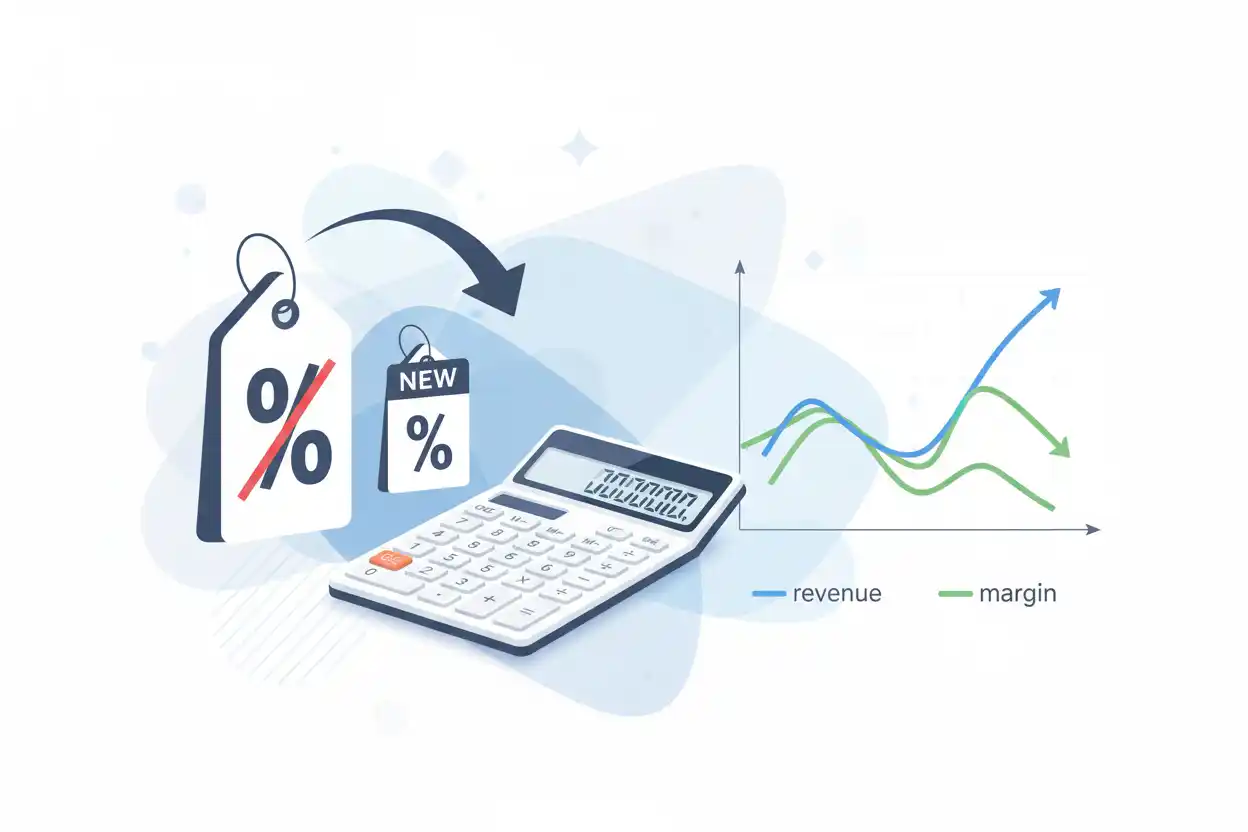
Price decrease percentage measures how much a price has fallen relative to its original value.
If a product’s price falls from $100 to $80:
Price Decrease Percentage = (Old Price − New Price) ÷ Old Price × 100
Price Decrease Percentage = ($100 − $80) ÷ $100 × 100 = 20%
The price decreased 20%.
The denominator is the old price, because the calculation measures the reduction relative to the starting value.
This is important because percentage decreases and later percentage increases are not symmetrical. A 20% decrease from $100 produces $80, but returning from $80 to $100 requires a 25% increase.
What Is Price Decrease Percentage?
Price decrease percentage expresses the reduction between an old price and a lower new price as a percentage of the original amount.
Suppose:
Old Price = $250
New Price = $200
Absolute decrease:
$250 − $200 = $50
Percentage decrease:
$50 ÷ $250 × 100 = 20%
The product became $50 cheaper, representing a 20% decrease relative to its former price.
This metric is useful for analyzing changes in product prices, subscription rates, service fees, negotiated contract values, commodities, procurement costs, and other price-based measures.
Price Decrease Percentage Formula
The formula is:
Price Decrease % = (Old Price − New Price) ÷ Old Price × 100
Where:
Old price is the original or previous price.
New price is the lower current price.
The absolute decrease is:
Price Decrease Amount = Old Price − New Price
Suppose:
Old Price = $600
New Price = $510
Decrease:
$90
Percentage:
$90 ÷ $600 × 100 = 15%
The price decreased 15%.
Price Decrease Percentage Example
Suppose a subscription price changes:
From $80 per Month
to:
$68 per Month
Absolute decrease:
$80 − $68 = $12
Percentage decrease:
$12 ÷ $80 × 100
= 15%
The monthly price is 15% lower.
If 1,000 customers continue paying the new price:
Original monthly recurring revenue:
1,000 × $80 = $80,000
New recurring revenue:
1,000 × $68 = $68,000
The recurring revenue base also declines 15% if nothing else changes.
How to Calculate a Price Decrease Step by Step
Suppose a price falls from $150 to $120.
First calculate the absolute difference:
$150 − $120 = $30
Then divide by the old price:
$30 ÷ $150 = 0.20
Convert to percentage:
0.20 × 100 = 20%
The price decreased by 20%.
5% Price Decrease Example
Old price:
$200
Decrease:
5%
New price:
$200 × (1 − 0.05)
= $190
Absolute reduction:
$10
10% Price Decrease Example
Old price:
$500
New price after a 10% decrease:
$500 × 0.90
= $450
The price falls by:
$50
20% Price Decrease Example
Old price:
$120
New price:
$96
Decrease:
$24
Percentage:
$24 ÷ $120 × 100 = 20%
25% Price Decrease Example
Old price:
$80
A 25% decrease means the new price is 75% of the old amount:
$80 × 0.75 = $60
Price reduction:
$20
50% Price Decrease Example
A price that falls from $1,000 to $500 has declined:
($1,000 − $500) ÷ $1,000 × 100 = 50%
The new price is exactly half of the original price.
Find the New Price From a Percentage Decrease
If the old price and decrease percentage are known:
New Price = Old Price × (1 − Price Decrease %)
Suppose:
Old Price = $400
Decrease = 15%
Then:
New Price = $400 × 0.85
= $340
The price falls by:
$60
Find the Old Price From a New Price
If the new price and percentage decrease are known:
Old Price = New Price ÷ (1 − Decrease Rate)
Suppose a product now costs:
$72
after a 20% decrease.
The new price represents 80% of the old price:
Old Price = $72 ÷ 0.80
= $90
Check:
$90 − $72 = $18
$18 ÷ $90 = 20%
Find the Percentage From the Dollar Reduction
Suppose the price falls by:
$45
from an original:
$300
Price decrease percentage:
$45 ÷ $300 × 100
= 15%
The new price is:
$255
Price Decrease vs. Price Increase Percentage
Price increase percentage measures an upward price movement relative to the old price.
Suppose a price decreases from:
$100 to $80
Decrease:
20%
To return from $80 to $100:
Increase = ($100 − $80) ÷ $80 × 100
= 25%
A 20% decrease requires a 25% increase to reverse because the increase is calculated from the lower $80 base.
Why Percentage Decreases Are Not Symmetrical
Suppose a price falls:
50%
from:
$100 to $50
Returning from $50 to $100 requires:
($100 − $50) ÷ $50 × 100
= 100%
A 50% decrease requires a 100% increase to recover.
The arithmetic is not symmetrical because each percentage is calculated from a different starting denominator.
Decrease Required to Reverse a Price Increase
Suppose a price rises 25%:
$100 → $125
To return to $100:
Decrease = ($125 − $100) ÷ $125 × 100
= 20%
A 25% increase is reversed by a 20% decrease.
This is the mirror image of the earlier example.
Price Decrease vs. Discount Percentage
Discount percentage uses very similar arithmetic but usually has a different commercial meaning.
Suppose:
Original Price = $100
Sale Price = $80
Discount percentage:
20%
If a company’s standard list price permanently changes from $100 to $80:
Price Decrease Percentage = 20%
The arithmetic is identical.
The difference is intent.
A discount is usually a promotional or negotiated reduction from a reference price.
A price decrease describes the movement of the price itself from an old level to a new lower level.
Price Decrease vs. Discounted Price
Discounted price is the actual price after applying a discount.
Suppose:
Original Price = $200
Price Reduction = 15%
New or discounted price:
$200 × 85% = $170
The 15% describes the relative reduction.
The $170 is the final price.
Keeping the percentage and final dollar amount distinct is important when comparing offers or modeling revenue.
Price Decrease and Revenue
Revenue depends on both price and quantity:
Revenue = Price × Quantity
Suppose a company sells:
10,000 Units at $100
Revenue:
$1,000,000
Price falls 10%:
New Price = $90
If sales volume remains unchanged:
Revenue = 10,000 × $90 = $900,000
Revenue falls 10%.
But if lower pricing increases volume, the final revenue result can differ.
Required Volume Growth After a Price Decrease
Suppose price falls:
From $100 to $80
Original volume:
1,000 Units
Original revenue:
$100,000
Required units at $80 to preserve the same revenue:
$100,000 ÷ $80 = 1,250 Units
Required volume growth:
(1,250 − 1,000) ÷ 1,000 × 100
= 25%
A 20% price decrease requires 25% more units to preserve revenue.
The required volume increase is larger than the percentage price decrease.
10% Price Decrease and Required Volume
Suppose original price is $100.
New price after a 10% decrease:
$90
To preserve the same revenue:
Required Volume Factor = $100 ÷ $90 ≈ 1.1111
Required increase:
≈ 11.11%
A 10% price reduction requires approximately 11.11% more sales volume to maintain revenue.
25% Price Decrease and Required Volume
Original price:
$100
New price:
$75
Required volume factor:
$100 ÷ $75 = 1.3333
Required volume growth:
33.33%
A 25% price decrease therefore requires approximately one-third more volume to preserve revenue.
50% Price Decrease and Required Volume
If price falls 50%:
$100 → $50
Volume must double to preserve revenue:
$100 ÷ $50 = 2
Required volume growth:
100%
This is another example of the asymmetric relationship between percentage reductions and the growth required to offset them.
Price Decrease and Margin
A lower price can compress margin rapidly when costs remain unchanged.
Suppose:
Original Price = $100
Unit Cost = $60
Original margin amount:
$40
Margin percentage:
40%
Price falls 20%:
New Price = $80
New margin amount:
$20
New margin percentage:
$20 ÷ $80 = 25%
The price decreases 20%.
Margin dollars decline 50%.
Margin percentage falls from 40% to 25%.
Price Decrease and Break-Even Price
A price reduction should be compared with the applicable break-even price.
Suppose:
Current Price = $100
Break-Even Price = $70
A 20% decrease produces:
$80
The price remains above the current break-even level.
A 35% decrease produces:
$65
The price falls below the original $70 break-even threshold.
If lower pricing changes expected volume materially, the break-even price should also be recalculated because fixed costs may be spread across a different number of units.
Price Decrease and Monthly Recurring Revenue
For subscription businesses, a lower recurring price can reduce monthly recurring revenue if customer count and usage do not increase.
Suppose:
2,000 Customers × $50 = $100,000 MRR
Price falls 10%:
New Price = $45
With the same customers:
New MRR = $90,000
MRR declines:
10%
The company needs additional customers or expansion to compensate.
Price Decrease and Monthly Recurring Revenue Growth
A price reduction can affect monthly recurring revenue growth even when acquisition remains healthy.
Suppose:
Starting MRR = $100,000
A broad price decrease causes:
−$10,000
in recurring revenue.
New acquisition adds:
+$15,000
Ending MRR:
$105,000
MRR growth:
5%
The company still grows, but new acquisition must first replace the $10,000 pricing-related reduction.
Price Decrease and Net Revenue Retention
A recurring price decrease applied to existing customers can reduce net revenue retention.
Suppose:
Starting Customer Cohort MRR = $500,000
A 10% broad price reduction lowers recurring revenue to:
$450,000
if usage, account count, and expansion remain unchanged.
NRR:
90%
Every customer can remain active while NRR falls because the recurring value of those relationships has decreased.
Price Decrease Can Improve NRR Indirectly
A lower price can sometimes reduce customer churn enough to improve long-term revenue retention.
Suppose customers currently generate:
$100,000 MRR
Management expects $30,000 of recurring revenue to churn at the current price.
Projected retained MRR:
$70,000
Instead, a 10% price reduction lowers the theoretical full-customer amount to:
$90,000
but almost eliminates churn.
If actual retained recurring revenue becomes:
$88,000
the lower price produces a stronger retention outcome than remaining at $100,000 list value but losing $30,000 through churn.
The economic result depends on customer behavior, not the price percentage alone.
Price Decrease and Customer Churn
Lower pricing can improve customer churn when customers are highly price-sensitive.
But price is only one reason customers leave.
A customer dissatisfied with product quality, reliability, or service may still churn at a lower price.
A price reduction that sacrifices revenue without fixing the actual retention problem can weaken economics without producing durable customer benefits.
Price Decrease and ARPA
Suppose 1,000 customer accounts produce:
$500,000 Monthly Revenue
Average revenue per account is:
$500
A 10% broad price decrease with no customer-count change reduces average realized account revenue to approximately:
$450
The business needs higher account volume, expansion, usage, or another monetization source to offset the decline.
Price Decrease and ARR
A recurring price reduction can also affect annual recurring revenue.
Suppose:
ARR = $12M
and a broad price decrease reduces the recurring base 5%, with no other movements.
New ARR:
$12M × 95%
= $11.4M
Decrease:
$600,000
Even a small price percentage can have a large absolute effect when applied across a large recurring revenue base.
Price Decrease and Month-Over-Month Growth
Suppose monthly revenue changes:
From $1M to $950K
because the company deliberately lowers prices.
($950K − $1M) ÷ $1M × 100
= −5%
That does not necessarily mean unit demand weakened.
If units sold increased significantly, the lower revenue could primarily reflect pricing.
Revenue growth should therefore be decomposed into price and volume effects.
Price Decrease and Quarter-Over-Quarter Growth
Quarter-over-quarter growth can similarly be affected by pricing changes.
Suppose quarterly units sold increase 15%, but average realized price decreases 10%.
Total quarterly revenue may grow much more slowly than volume.
A QoQ revenue comparison alone cannot determine whether underlying demand strengthened or pricing weakened.
Price and volume should be separated when the distinction affects the decision.
Price Decrease and Price Variance
A price variance compares an actual unit price with a standard or expected unit price under its specific variance framework.
Price decrease percentage instead compares an old price with a new lower price.
Suppose:
Old Price = $100
New Price = $90
Price decrease:
10%
If the standard price in a separate budgeting system was $95, the related price variance would use that $95 benchmark rather than the historical $100 price.
The two calculations therefore answer different questions.
Cost Decrease vs. Selling Price Decrease
The same percentage formula can mathematically measure a lower purchase cost, but the business interpretation differs.
Suppose supplier cost falls:
From $50 to $45
Percentage decrease:
10%
If selling price remains $100:
Original margin:
50%
New margin:
55%
A cost decrease can improve margin.
A selling-price decrease with unchanged costs usually compresses it.
Always identify which price is changing.
Sequential Price Decreases
Suppose a product falls 20% and then another 10%.
Original price:
$100
After first decrease:
$80
After second:
$80 × 90% = $72
Total decrease from the original:
$100 − $72 = $28
Overall price decrease percentage:
28%
The two decreases do not simply add to 30%.
Each percentage is applied to a different base.
Combined Price Decrease Formula
For sequential decreases:
Final Price = Original Price × (1 − d1) × (1 − d2)
For 20% and 10%:
$100 × 0.80 × 0.90 = $72
Combined percentage decrease:
1 − (0.80 × 0.90)
= 28%
The same logic extends to more than two sequential price changes.
Price Decrease Followed by an Increase
Suppose:
Price Falls 20%
from $100 to:
$80
Then rises 10%:
$80 × 1.10 = $88
The final price is still:
12% below the original $100
because:
($100 − $88) ÷ $100 = 12%
A later increase does not cancel an earlier decrease unless the percentage is calculated to restore the original amount.
Comparing Two Price Decreases
Product A:
$100 → $80
Decrease:
20%
Product B:
$1,000 → $850
Decrease:
15%
Product A has the larger percentage decrease.
Product B has the larger dollar decrease:
$150 vs. $20
Percentage and absolute price movement answer different questions.
Price Decrease Percentage and Elasticity
A price decrease is often designed to increase demand.
Suppose price falls 10% and quantity demanded rises 25%.
Revenue before:
1,000 Units × $100 = $100,000
Revenue after:
1,250 Units × $90 = $112,500
Revenue increases 12.5%.
If quantity rises only 5%:
1,050 × $90 = $94,500
Revenue declines 5.5%.
The success of a lower price depends on how strongly customer demand responds.
Price Decrease and Market Share
A business might intentionally reduce price to attract more customers, enter a new market, respond to competitors, or encourage adoption.
The lower price can increase:
- unit sales;
- customer acquisition;
- market penetration;
- usage;
- conversion; or
- retention.
But it can also reduce:
- margin;
- ARPA;
- ARPU;
- ARR;
- perceived premium positioning; or
- future pricing flexibility.
The correct decision depends on the complete economics.
Price Decrease and CAC Payback
Lower pricing can extend CAC payback period when acquisition cost stays unchanged.
Suppose:
CAC = $1,200
Monthly Price = $200
Gross Margin = 75%
Monthly gross contribution:
$150
Payback:
8 Months
Price falls 20% to:
$160
If the simplified 75% margin rate still applies:
Monthly Gross Contribution = $120
Payback:
$1,200 ÷ $120 = 10 Months
Lower monetization adds two months to the modeled payback period.
A Price Decrease Can Still Improve Acquisition Economics
Suppose the lower price dramatically improves conversion and reduces CAC.
Original:
CAC = $1,200
Monthly Gross Contribution = $150
Payback:
8 Months
After price reduction:
CAC = $700
Monthly Gross Contribution = $120
Payback:
$700 ÷ $120 ≈ 5.83 Months
Despite lower customer contribution, acquisition economics improve because acquisition cost falls more sharply.
The numerator and denominator both matter.
Price Decrease Trend Example
Suppose a subscription’s standard price changes:
| Year | Price | Change |
|---|---|---|
| Year 1 | $100 | — |
| Year 2 | $95 | -5.0% |
| Year 3 | $90 | -5.26% |
| Year 4 | $81 | -10.0% |
The dollar reductions are:
$5, $5, and $9
But percentage changes differ because each decrease is measured relative to the immediately preceding price.
From Year 1 to Year 4, the total decline is:
($100 − $81) ÷ $100 = 19%
It would be incorrect to simply add the annual percentages.
What Is a Good Price Decrease Percentage?
There is no universal ideal decrease.
An appropriate reduction depends on:
- customer demand;
- margin;
- unit cost;
- break-even price;
- competitive conditions;
- customer acquisition;
- retention;
- inventory;
- contract structure;
- market positioning; and
- expected volume response.
A 30% decrease can be rational for obsolete inventory.
A 5% decrease can be damaging for a business operating on a 4% margin.
The economic context matters more than the percentage alone.
Common Price Decrease Percentage Mistakes
A common mistake is dividing the reduction by the new price instead of the old price.
Another is assuming the same percentage increase will reverse a percentage decrease.
Sequential decreases are often added rather than compounded.
Businesses may focus on higher unit volume without calculating the additional volume required to preserve revenue or margin.
Another mistake is treating a promotional discount and a permanent price decrease as economically identical without considering duration.
Companies can also ignore recurring-revenue effects on MRR, NRR, and ARR.
Finally, a price decrease should be evaluated alongside costs and customer behavior rather than judged from the percentage alone.
Frequently Asked Questions
What is price decrease percentage in simple terms?
Price decrease percentage measures how much a price fell relative to its original or previous value.
What is the price decrease percentage formula?
Price Decrease % = (Old Price − New Price) ÷ Old Price × 100
How do you calculate a price decrease from $100 to $80?
($100 − $80) ÷ $100 × 100 = 20%
The price decreased 20%.
How do you find the new price after a percentage decrease?
New Price = Old Price × (1 − Decrease Rate)
For a 15% decrease from $200:
$200 × 0.85 = $170
How do you find the original price?
Old Price = New Price ÷ (1 − Decrease Rate)
If $80 is the new price after a 20% decrease:
$80 ÷ 0.80 = $100
Is a 20% price decrease reversed by a 20% increase?
No.
A 20% decrease from $100 produces $80.
Returning to $100 requires a 25% increase.
Why are price decreases and increases not symmetrical?
Because the percentage is calculated from a different starting base after the price changes.
Is price decrease percentage the same as discount percentage?
The arithmetic can be identical, but the commercial intent differs. A discount generally describes a promotional or negotiated reduction, while a price decrease measures the movement from an old price to a new lower price.
What volume increase offsets a 20% price decrease?
To preserve the same revenue when price falls from $100 to $80, volume must increase from 1,000 to 1,250 units—an increase of 25%.
How does a price decrease affect margin?
If costs remain unchanged, lower pricing generally reduces both margin dollars and margin percentage.
How does a price decrease affect MRR?
A lower recurring price reduces MRR unless additional customers, usage, or expansion compensate for the lower price.
How does a price decrease affect NRR?
A reduction applied to existing customers can create recurring-revenue contraction and reduce NRR unless expansion or improved retention compensates.
Can lower prices reduce customer churn?
Yes, when customers are price-sensitive. But lower pricing may not solve churn caused by product quality, service, or poor customer fit.
Can a price decrease improve revenue?
Yes, if the resulting increase in sales volume is large enough to offset the lower price.
Can a price decrease shorten CAC payback?
Potentially. Although lower customer contribution tends to lengthen payback, a lower price can improve conversion enough to reduce acquisition cost and produce a shorter overall payback.
How do sequential price decreases work?
They compound rather than simply add. A 20% decrease followed by 10% produces an overall 28% decrease:
1 − (0.80 × 0.90) = 28%
Why is price decrease percentage important?
It provides a standardized way to quantify a downward price movement. Combined with revenue, margin, MRR growth, NRR, customer behavior, and break-even analysis, it helps determine whether lower pricing strengthens demand or weakens the underlying economics.