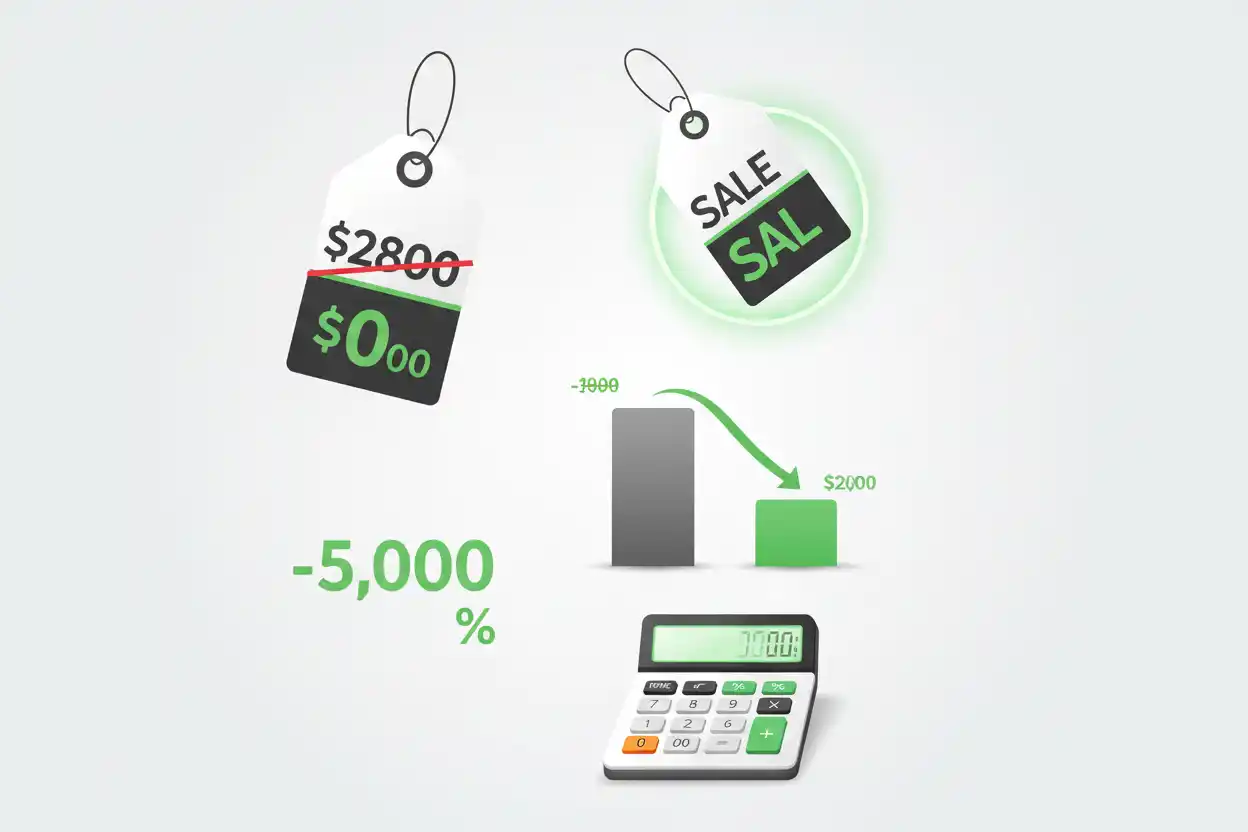

Discount percentage measures the reduction from an original price as a percentage of that original price.
If an item originally costs $200 and is sold for $150, the discount amount is $50.
Discount Percentage = Discount Amount ÷ Original Price × 100
Discount Percentage = $50 ÷ $200 × 100 = 25%
The item has a 25% discount.
You can calculate the same result directly from the original and sale prices:
Discount Percentage = (Original Price − Discounted Price) ÷ Original Price × 100
Discount Percentage = ($200 − $150) ÷ $200 × 100 = 25%
Discount percentage answers how large the reduction is relative to the original price. The discounted price answers what the customer actually pays after applying that reduction.
What Is Discount Percentage?
Discount percentage expresses savings relative to the starting price.
Suppose a product normally costs $80 and receives a $12 discount.
Discount Percentage = $12 ÷ $80 × 100
Discount Percentage = 15%
The new price is:
$80 − $12 = $68
The customer saves 15% of the original price and pays 85% of it.
This relationship is useful in retail pricing, promotions, subscriptions, sales negotiations, procurement, markdowns, and other commercial transactions.
Discount Percentage Formula
When the discount amount is known:
Discount Percentage = Discount Amount ÷ Original Price × 100
When the original and discounted prices are known:
Discount Percentage = (Original Price − Discounted Price) ÷ Original Price × 100
Where:
Original price is the pre-discount price.
Discounted price is the final price after the reduction.
Discount amount is:
Original Price − Discounted Price
Suppose original price is $500 and sale price is $425.
Discount amount:
$500 − $425 = $75
Discount percentage:
$75 ÷ $500 × 100 = 15%
Discount Percentage Example
Suppose a business lists a product at $120 and sells it for $90.
Discount amount:
$120 − $90 = $30
Discount percentage:
$30 ÷ $120 × 100
Discount Percentage = 25%
The customer pays:
100% − 25% = 75%
of the original price.
Check:
$120 × 75% = $90
The result reconciles.
How to Calculate the Discount Amount
If the discount percentage and original price are known:
Discount Amount = Original Price × Discount Percentage
Suppose:
Original Price = $250
Discount = 20%
Then:
Discount Amount = $250 × 20%
Discount Amount = $50
The customer saves $50.
How to Calculate the Discounted Price
After calculating the discount amount:
Discounted Price = Original Price − Discount Amount
Using the previous example:
$250 − $50 = $200
A direct formula is:
Discounted Price = Original Price × (1 − Discount Percentage)
Using decimal form:
$250 × (1 − 0.20) = $250 × 0.80 = $200
The sale price is $200.
Find the Original Price From a Discounted Price
Sometimes the discounted price and discount percentage are known, but the original price is not.
Use:
Original Price = Discounted Price ÷ (1 − Discount Percentage)
Suppose an item costs $72 after a 20% discount.
The customer pays 80% of the original price:
Original Price = $72 ÷ 0.80
Original Price = $90
Check:
20% of $90 = $18
$90 − $18 = $72
Find the Original Price From the Discount Amount
If a $30 discount represents 15% of the original price:
Original Price = Discount Amount ÷ Discount Percentage
Original Price = $30 ÷ 0.15
Original Price = $200
The final price is:
$200 − $30 = $170
10% Discount Example
Original price:
$80
Discount:
10%
Discount amount:
$80 × 0.10 = $8
Discounted price:
$80 − $8 = $72
The customer saves $8.
20% Discount Example
Original price:
$150
Discount:
20%
Discount amount:
$150 × 0.20 = $30
Discounted price:
$120
The customer pays 80% of the original price.
25% Discount Example
Original price:
$400
Discount:
25%
Discount amount:
$400 × 0.25 = $100
Discounted price:
$400 − $100 = $300
A 25% discount is equivalent to paying 75% of the original price.
30% Discount Example
Original price:
$70
Discount:
30%
Savings:
$70 × 0.30 = $21
Discounted price:
$70 − $21 = $49
50% Discount Example
A 50% discount cuts the original price in half.
Suppose original price is $600:
Discount Amount = $600 × 50% = $300
Discounted Price = $300
A 50% reduction means the customer pays the remaining 50%.
Discount Percentage vs. Discounted Price
Discount percentage tells you the relative reduction.
Discounted price tells you the final amount paid.
Suppose:
Original Price = $1,000
Discount = 15%
The 15% is the discount percentage.
Discount amount:
$150
Final price:
$850
The percentage and final price should not be confused.
Two products can receive the same percentage discount but produce very different dollar savings.
Same Discount Percentage, Different Savings
Product A:
Original Price = $100
20% Discount = $20 Savings
Product B:
Original Price = $1,000
20% Discount = $200 Savings
Both discounts are 20%.
The dollar saving on Product B is ten times greater because the starting price is ten times larger.
Percentage measures relative change; dollars measure absolute change.
Same Dollar Discount, Different Percentages
Suppose two products each receive a $20 reduction.
Product A:
Original Price = $100
Discount Percentage = $20 ÷ $100 = 20%
Product B:
Original Price = $400
Discount Percentage = $20 ÷ $400 = 5%
The same $20 saving represents a very different discount depending on the original price.
Discount Percentage vs. Price Decrease Percentage
Price decrease percentage uses closely related arithmetic but typically describes a change from an old price to a new lower price rather than a promotional discount.
Suppose a product’s regular price permanently changes from $100 to $85.
Price decrease:
($100 − $85) ÷ $100 × 100 = 15%
If a store temporarily marks a $100 item down to $85, the discount percentage is also 15%.
The arithmetic can be identical.
The search intent differs:
Discount percentage focuses on promotional or transactional savings from an original price.
Price decrease percentage focuses on measuring how much a price itself declined between two levels.
Discount Percentage vs. Price Increase Percentage
A discount percentage does not reverse symmetrically with a subsequent price increase percentage.
Suppose a $100 item receives a 20% discount:
New Price = $80
To return from $80 to $100:
Required Increase = ($100 − $80) ÷ $80 × 100
= 25%
A 20% decrease requires a 25% increase to return to the original price.
This occurs because the percentage base changes.
Why Percentage Decreases and Increases Are Asymmetric
Suppose a product falls 50% from $100:
New Price = $50
To return to $100:
Increase = $50
Relative to the new $50 base:
$50 ÷ $50 × 100 = 100%
A 50% discount therefore requires a 100% increase from the discounted price to restore the original amount.
This is a common source of pricing errors.
Multiple Discounts Are Not Added
Suppose a product receives two successive 20% discounts.
It is incorrect to assume the combined discount is automatically 40%.
Original price:
$100
First 20% discount:
$100 × 0.80 = $80
Second 20% discount:
$80 × 0.80 = $64
Total reduction:
$100 − $64 = $36
Combined discount:
$36 ÷ $100 × 100 = 36%
Two successive 20% discounts equal a 36% total discount, not 40%.
Combined Discount Formula
For two sequential discounts:
Final Price = Original Price × (1 − Discount 1) × (1 − Discount 2)
The combined discount percentage is:
Combined Discount = 1 − [(1 − d1)(1 − d2)]
For 20% and 20%:
1 − (0.80 × 0.80)
1 − 0.64 = 0.36
Combined Discount = 36%
20% Then 10% Discount Example
Original price:
$200
First discount:
20%
Price after first discount:
$200 × 0.80 = $160
Second discount:
10%
Final price:
$160 × 0.90 = $144
Total savings:
$200 − $144 = $56
Combined discount:
$56 ÷ $200 × 100 = 28%
A 20% discount followed by 10% produces a 28% total reduction, not 30%.
Discount Percentage and Margin
A discount can reduce margin much faster than it reduces price.
Suppose:
Original Selling Price = $100
Unit Cost = $60
Original margin amount:
$100 − $60 = $40
Now apply a 20% discount:
Discounted Price = $80
New margin amount:
$80 − $60 = $20
Price fell 20%.
Margin dollars fell:
($40 − $20) ÷ $40 × 100 = 50%
A 20% price discount cut the margin amount in half.
This is why promotional decisions should be evaluated using unit economics rather than the discount percentage alone.
Volume Required to Offset a Discount
Using the same example:
Original contribution per sale:
$40
Discounted contribution:
$20
Suppose the company originally sells 1,000 units.
Original contribution:
1,000 × $40 = $40,000
To generate the same $40,000 after discounting:
Required Units = $40,000 ÷ $20
= 2,000 Units
Unit sales need to double.
The 20% discount therefore requires a 100% volume increase to preserve the same contribution under these cost assumptions.
Discount Percentage and Break-Even Price
Before discounting, compare the resulting sale price with the break-even price.
Suppose:
Original Price = $100
Break-Even Price = $70
A 20% discount produces:
$80
The discounted price remains $10 above break-even.
A 35% discount produces:
$65
The price falls $5 below the existing break-even threshold.
If the discount significantly changes sales volume, break-even price should be recalculated using the new expected volume rather than assuming the old threshold remains unchanged.
Maximum Discount Before a Given Price Floor
Suppose original price is $200 and management does not want to sell below $150.
Maximum discount amount:
$200 − $150 = $50
Maximum discount percentage:
$50 ÷ $200 × 100 = 25%
A discount greater than 25% would push price below $150.
This can be useful when a business establishes a minimum acceptable selling price.
Discount Percentage and Customer Churn
Discounts are sometimes used to reduce customer churn.
Suppose a subscription customer pays $100 monthly and is offered a 20% retention discount.
New price:
$100 × 80% = $80
The company preserves the customer relationship but gives up:
$20 per Month
If the customer remains another 12 months:
Revenue at normal price would have been:
$1,200
Discounted revenue:
$960
Revenue concession:
$240
The retention decision should compare the value of preserving the customer with the economics of the $240 annual discount.
Discount Percentage and CAC Payback Period
A discount can extend CAC payback period when acquisition cost remains unchanged.
Suppose:
CAC = $1,200
Monthly Price = $200
Gross Margin = 75%
Monthly gross profit:
$150
Payback:
$1,200 ÷ $150 = 8 Months
A 20% discount reduces price to:
$160
At the same 75% margin assumption:
Monthly Gross Profit = $120
New payback:
$1,200 ÷ $120 = 10 Months
The discount extends payback by two months.
If the promotion substantially reduces CAC or improves retention, the full effect may differ.
Discount Percentage and Expansion Revenue
Discounting can also affect expansion revenue.
Suppose an existing customer normally would pay $50 per additional seat.
A 20% expansion discount reduces the price to:
$40 per Seat
If the customer adds 100 seats:
Expansion Revenue = 100 × $40 = $4,000
At full price:
100 × $50 = $5,000
The discount sacrifices $1,000 of potential revenue.
If the customer would have purchased only 50 seats without the discount:
Full-price expansion would have been:
50 × $50 = $2,500
In that scenario, the discounted offer produces more total expansion revenue despite lower revenue per seat.
The actual customer response determines the result.
Discount Percentage and Annual Contract Value
Suppose an annual contract normally costs $120,000.
A 15% discount produces:
Discount Amount = $120,000 × 15% = $18,000
Discounted annual value:
$102,000
If this represents the recurring contract value, the customer’s annual contract value decreases by $18,000.
Discounting enterprise contracts can therefore materially affect ACV even when the customer count does not change.
Discount Percentage and Annual Recurring Revenue
A broad recurring price discount can reduce annual recurring revenue unless it creates enough incremental customer or expansion volume to compensate.
Suppose:
1,000 Customers × $100 Monthly = $100,000 MRR
ARR:
$1.2 Million
A 10% discount applied to all customers reduces price to $90.
If customer count remains 1,000:
MRR = $90,000
ARR = $1,080,000
ARR falls by:
$120,000
The company needs additional recurring customers or expansion to recover that reduction.
Required Customer Growth After a Discount
Using the same example, the original monthly revenue is $100,000.
After discounting price to $90, required customer count to preserve revenue is:
Required Customers = $100,000 ÷ $90
≈ 1,111.11
Since fractional customers are not possible, at least 1,112 customers are required to exceed the old revenue level in this simplified example.
Required customer increase:
Approximately 112 Customers
or roughly:
11.2%
A 10% price discount therefore requires more than 10% customer growth to preserve revenue because the new percentage is measured from a lower price.
Why a 50% Discount Requires 100% More Volume
Suppose:
Original Price = $100
Original Volume = 1,000
Original revenue:
$100,000
A 50% discount creates:
New Price = $50
Required units to preserve $100,000 revenue:
$100,000 ÷ $50 = 2,000
Volume must increase from 1,000 to 2,000:
100% Increase
A discount percentage and the required volume increase are not symmetric.
Discount Percentage in B2B Negotiations
Suppose list price for an enterprise contract is $500,000.
The customer negotiates a final price of $425,000.
Discount amount:
$500,000 − $425,000 = $75,000
Discount percentage:
$75,000 ÷ $500,000 × 100 = 15%
This gives management a consistent way to compare pricing concessions across contracts of different sizes.
A $50,000 discount might be enormous on a $100,000 contract but minor on a multi-million-dollar agreement.
Comparing Two Discounts
Offer A:
$120 reduced to $90
Discount:
$30 ÷ $120 = 25%
Offer B:
$200 reduced to $160
Discount:
$40 ÷ $200 = 20%
Offer A has the larger percentage discount.
Offer B provides the larger dollar saving.
The “better” deal therefore depends on whether the comparison concerns percentage reduction, absolute savings, or the product’s actual value.
Markup and Discount Are Not Opposites
Suppose a product costs $100 and is marked up 50%:
Selling Price = $150
A 50% discount on $150 gives:
$75
The product does not return to its original $100 cost.
Likewise, a 50% discount requires a 100% increase to return to the pre-discount price.
Percentage changes always depend on the base to which the percentage is applied.
Discount Percentage With Tax
Whether tax is calculated before or after a discount depends on the applicable tax rules and transaction structure.
For pure discount arithmetic, calculate the discounted selling price first when that is the relevant commercial price:
Original price:
$100
20% discount:
$80
If a separate 10% tax is then applied to the discounted amount in a simplified example:
Tax = $80 × 10% = $8
Final amount:
$88
The tax itself is not part of the discount percentage.
Actual tax treatment depends on the applicable jurisdiction and rules.
Discount Percentage With Coupons
Suppose a product costs $200.
A 20% promotion reduces it to:
$160
A further $20 fixed-value coupon reduces it to:
$140
Total saving:
$200 − $140 = $60
Equivalent total discount percentage:
$60 ÷ $200 × 100 = 30%
The fixed coupon should not simply be called another 20% discount unless $20 actually represents 20% of the relevant price base.
Discount Percentage Trend Example
Suppose average promotional discount changes as follows:
| Quarter | Average Discount |
|---|---|
| Q1 | 10% |
| Q2 | 12% |
| Q3 | 15% |
| Q4 | 20% |
The company is becoming increasingly dependent on price reductions.
That can support higher sales volume, but management should investigate whether gross margins, customer acquisition, retention, and normal-price conversion are deteriorating.
Rising discount percentage can be a deliberate strategy or a sign of weakening pricing power.
What Is a Good Discount Percentage?
There is no universal good discount percentage.
A sustainable discount depends on:
- unit cost;
- break-even price;
- gross margin;
- customer acquisition economics;
- demand response;
- inventory objectives;
- contract length;
- customer value; and
- competitive conditions.
A 50% discount can be economically reasonable for obsolete seasonal inventory.
A 5% discount can be excessive for a low-margin product.
The percentage needs commercial context.
When a Larger Discount Can Make Sense
A deeper discount can be rational when it helps:
- clear obsolete or seasonal inventory;
- acquire customers at acceptable lifetime economics;
- increase economically profitable volume;
- secure a strategically valuable long-term contract;
- encourage annual prepayment;
- move customers into a broader product relationship; or
- reduce costs associated with unsold inventory.
The relevant question is not whether the discount looks large.
It is whether the transaction creates better economics than the available alternatives.
Common Discount Percentage Mistakes
A common mistake is dividing the discount by the final price instead of the original price.
Another is adding sequential discounts together rather than compounding them.
Businesses can also assume a 20% price reduction requires only 20% more volume to restore revenue.
Another error is confusing discount percentage with margin percentage.
A promotional price can also fall below break-even even when the percentage looks modest.
Companies may focus on increased conversion while ignoring longer CAC payback or lower recurring revenue.
Finally, a percentage discount should always identify the original price against which it was calculated.
Frequently Asked Questions
What is discount percentage in simple terms?
Discount percentage is the amount a price is reduced expressed as a percentage of the original price.
What is the discount percentage formula?
Discount Percentage = (Original Price − Discounted Price) ÷ Original Price × 100
You can also use:
Discount Percentage = Discount Amount ÷ Original Price × 100
How do you calculate a discount amount?
Discount Amount = Original Price × Discount Percentage
If a $200 item receives a 15% discount:
Discount Amount = $30
How do you calculate the discounted price?
Discounted Price = Original Price × (1 − Discount Percentage)
For a $200 item discounted 15%:
Discounted Price = $170
What percentage discount is $100 reduced to $80?
Discount amount:
$20
Discount percentage:
$20 ÷ $100 × 100 = 20%
What is 25% off $80?
Discount:
$80 × 25% = $20
Sale price:
$60
How do you find the original price after a discount?
Original Price = Discounted Price ÷ (1 − Discount Percentage)
If the sale price is $80 after a 20% discount:
Original Price = $80 ÷ 0.80 = $100
Are two 20% discounts the same as a 40% discount?
No.
$100 × 0.80 × 0.80 = $64
The combined reduction is 36%.
Is discount percentage the same as price decrease percentage?
The arithmetic can be similar, but the intent differs. Discount percentage usually describes a promotional or negotiated reduction from an original price, while price decrease percentage measures a price moving from one level to another.
Is a 20% discount reversed by a 20% increase?
No.
A 20% decrease from $100 produces $80.
Returning from $80 to $100 requires a 25% increase.
Does a larger discount always create more revenue?
No.
Revenue depends on both price and sales volume. The additional volume produced by the discount must be large enough to compensate for the lower price.
How can discounts affect customer churn?
A retention discount can persuade some customers to stay, but it also reduces revenue per retained customer and may not address the underlying reason for cancellation.
How can discounts affect CAC payback?
Lower customer contribution can lengthen CAC payback unless the discount sufficiently reduces acquisition cost, increases retention, or produces greater profitable volume.
Should a discount be checked against break-even price?
Yes.
A discount that pushes the sale price below the relevant break-even level can create losses unless higher volume or other economic changes alter the break-even calculation.
Why is discount percentage important?
Discount percentage provides a consistent way to measure price reductions across products and contracts of different sizes. Combined with discounted price, margins, break-even economics, customer behavior, and acquisition metrics, it helps determine whether a promotion creates economic value rather than merely increasing apparent savings.