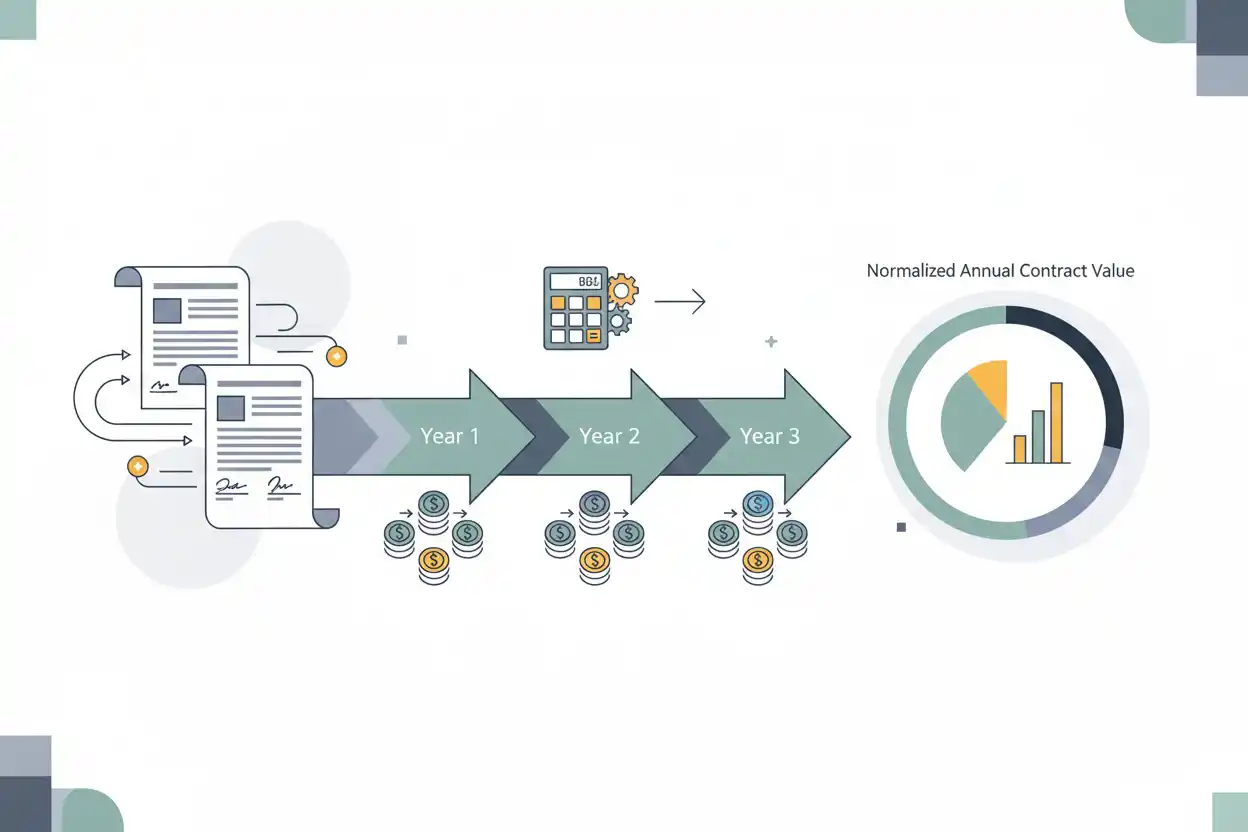

Annual contract value (ACV) measures the average annual value of a customer contract after its applicable contract value is normalized across the contract term.
If a three-year customer contract has $360,000 of value included in the ACV calculation, its annual contract value is $120,000.
Annual Contract Value = Contract Value ÷ Contract Term in Years
ACV = $360,000 ÷ 3 = $120,000 per Year
Annual contract value is especially useful for subscription, SaaS, enterprise-service, and other contract-based businesses because contracts can have different durations.
Normalizing them to an annual basis makes commercial comparisons easier.
ACV should not automatically be treated as annual recurring revenue, recognized accounting revenue, cash collected, or total contract value. Those measures answer different questions.
What Is Annual Contract Value?
Annual contract value expresses a contract’s applicable economic value on a one-year basis.
Suppose a business signs two customers:
Customer A: $120,000 contract lasting one year.
Customer B: $360,000 contract lasting three years.
The total contract values are very different:
Customer A = $120,000
Customer B = $360,000
But their annual contract values are:
Customer A ACV = $120,000 ÷ 1 = $120,000
Customer B ACV = $360,000 ÷ 3 = $120,000
Both contracts represent approximately $120,000 per contracted year under the simplified calculation.
That makes ACV useful for comparing contracts of different durations without allowing a longer agreement to appear larger simply because more years are included.
Annual Contract Value Formula
A basic formula is:
ACV = Applicable Contract Value ÷ Contract Duration in Years
For a contract stated in months:
ACV = Applicable Contract Value ÷ Contract Duration in Months × 12
Suppose a 24-month contract is worth $180,000.
ACV = $180,000 ÷ 24 × 12
ACV = $90,000
The result is the same as:
$180,000 ÷ 2 Years = $90,000 per Year
The numerator must be defined consistently.
Some companies calculate ACV using recurring contract value and exclude one-time implementation, setup, hardware, or professional-service fees. Others use a broader internal definition.
The important requirement is to document which amounts are included before comparing ACV across customers or periods.
Annual Contract Value Example
Suppose a software company signs a customer to a four-year contract with $600,000 of recurring contract value.
Contract Term = 4 Years
Applicable Contract Value = $600,000
Calculate:
ACV = $600,000 ÷ 4
ACV = $150,000
The customer’s annual contract value is $150,000.
This does not necessarily mean the company recognizes exactly $150,000 of accounting revenue in each calendar year.
Contract start dates, performance obligations, usage charges, amendments, discounts, and accounting recognition can produce a different revenue pattern.
ACV is primarily a commercial normalization measure.
ACV for a One-Year Contract
A one-year contract requires no multi-year normalization.
Suppose:
Contract Value = $96,000
Contract Term = 1 Year
Then:
ACV = $96,000 ÷ 1 = $96,000
The annual contract value equals the applicable contract value because the entire contract term is already one year.
ACV for a Three-Year Contract
Suppose a three-year agreement has $450,000 of recurring contractual value.
ACV = $450,000 ÷ 3
ACV = $150,000
The total contract value is $450,000.
The annual contract value is $150,000.
These two figures should not be used interchangeably.
The total amount describes the value across the entire contract duration; ACV normalizes it to an annual period.
ACV for an 18-Month Contract
Suppose a contract lasts 18 months and includes $180,000 of value applicable to the ACV calculation.
Using the monthly formula:
ACV = $180,000 ÷ 18 × 12
ACV = $120,000
Alternatively, 18 months equals 1.5 years:
$180,000 ÷ 1.5 = $120,000
The annualized contract value is $120,000.
ACV With Monthly Pricing
A customer may be contracted at a fixed monthly amount.
Suppose:
Contracted Monthly Value = $8,000
If the amount applies consistently:
ACV = $8,000 × 12
ACV = $96,000
This calculation is straightforward when the contractual monthly amount is stable.
Usage-based pricing, ramp schedules, seasonal charges, and contract amendments can make the annual normalization more complex.
ACV With a Ramp Contract
Some contracts increase in value over time.
Suppose a three-year contract is structured as:
| Contract Year | Contract Value |
|---|---|
| Year 1 | $100,000 |
| Year 2 | $140,000 |
| Year 3 | $180,000 |
| Total | $420,000 |
Average ACV across the full term is:
$420,000 ÷ 3 = $140,000
But the actual annual contractual amounts differ.
Year 1 is $100,000.
Year 3 is $180,000.
An average ACV of $140,000 is useful for contract normalization, but it hides the ramp.
Management should preserve the underlying contract schedule when timing matters.
ACV With One-Time Fees
Suppose a two-year subscription contract contains:
Recurring Subscription Value = $200,000
One-Time Implementation Fee = $30,000
If the company’s ACV definition excludes nonrecurring implementation fees:
ACV = $200,000 ÷ 2 = $100,000
If someone instead divides the full $230,000 by two:
$230,000 ÷ 2 = $115,000
The result becomes $115,000.
Neither arithmetic calculation is difficult. The problem is definition consistency.
If one sales team includes setup fees and another excludes them, their ACV figures are not comparable.
For recurring-business analysis, separating recurring and nonrecurring elements is usually important.
Annual Contract Value vs. Annual Recurring Revenue
ACV and ARR are closely related but distinct.
ACV generally measures the normalized annual value of an individual contract or group of contracts.
ARR measures the annualized recurring revenue base across qualifying recurring customers or subscriptions.
Suppose a business has 100 customers, each with an average ACV of $20,000.
A simplified recurring base might be approximately:
100 × $20,000 = $2,000,000
But the company’s reported ARR may differ because contracts start at different times, expansion or contraction occurs, customers churn, and not every contractual component necessarily qualifies as recurring revenue.
ACV is primarily contract-centric.
ARR is revenue-base-centric.
ACV vs. Monthly Recurring Revenue
Monthly recurring revenue normalizes recurring revenue to a monthly basis.
If a stable recurring contract has ACV of $120,000:
Monthly Equivalent = $120,000 ÷ 12 = $10,000
Conversely:
$10,000 Monthly Recurring Amount × 12 = $120,000
The numbers can be mathematically connected when the contract is evenly recurring.
Their use differs.
MRR is particularly useful for monthly operating trends.
ACV emphasizes the annualized value of a customer contract.
ACV vs. Average Revenue Per Account
Average revenue per account measures revenue relative to the average or active account base under the selected period definition.
ACV measures contract value.
Suppose a customer signs a three-year $300,000 agreement:
ACV = $100,000
But because the contract begins halfway through the accounting year, recognized revenue from that customer during the first calendar year might be considerably less than $100,000.
The customer can therefore have:
ACV = $100,000
while contributing a different amount to the company’s period-based average revenue per account.
ACV reflects contracted annual economics rather than necessarily recognized period revenue.
ACV vs. Average Revenue Per User
Average revenue per user becomes especially different when one contract covers many individual users.
Suppose an enterprise contract has:
ACV = $120,000
and includes:
2,000 Users
Contract value per user on a simple annual basis is:
$120,000 ÷ 2,000 = $60 per User per Year
The account’s ACV remains $120,000.
The user-level amount is only $60.
A business selling enterprise agreements should therefore avoid mixing account-level contract metrics with user-level monetization metrics.
ACV vs. Total Contract Value
Suppose a five-year contract is worth $1 million.
Total contract value:
$1,000,000
Annual contract value:
$1,000,000 ÷ 5 = $200,000
The difference matters when comparing a five-year contract with a one-year agreement.
A one-year $300,000 contract is smaller in total nominal value than the $1 million five-year contract, but its annual value is larger:
One-Year Contract ACV = $300,000
Five-Year Contract ACV = $200,000
ACV removes contract-duration distortion from the comparison.
ACV Is Not Recognized Revenue
Suppose a customer signs a $240,000 two-year contract on October 1.
Simplified ACV:
$240,000 ÷ 2 = $120,000
That does not mean the business automatically records $120,000 as revenue during the calendar year in which the contract was signed.
Accounting revenue recognition depends on when the company satisfies the applicable obligations and on the relevant accounting framework.
The contract’s signing date, service period, billing schedule, and revenue-recognition pattern all matter.
ACV is therefore not a substitute for accounting revenue.
ACV Is Not Cash Collected
A contract can have $120,000 ACV but very different payment terms.
Customer A pays the full annual amount upfront.
Customer B pays $10,000 monthly.
Customer C pays quarterly.
All three can have the same $120,000 ACV while producing different cash-flow timing.
This distinction matters when assessing liquidity and CAC payback period.
Commercial contract value and cash collection timing should be modeled separately.
ACV and Billing Frequency
Suppose two customers each have:
ACV = $120,000
Customer A pays:
$120,000 Annually Upfront
Customer B pays:
$10,000 per Month
The annual economics are similar under the simple contract-value definition.
But Customer A provides cash sooner.
That can improve working capital and reduce the financing required to support customer acquisition.
Billing frequency therefore can matter economically even when ACV is unchanged.
ACV and Contract Length
Longer contracts can provide greater commercial visibility, but they should not automatically be interpreted as higher annual customer value.
Consider:
Contract A:
$100,000 for 1 Year
Contract B:
$240,000 for 3 Years
ACV A:
$100,000
ACV B:
$240,000 ÷ 3 = $80,000
Contract B has higher total value but lower annual contract value.
This distinction is one of the main reasons ACV exists.
Average ACV Across Customers
A company can calculate average ACV:
Average ACV = Sum of Customer ACVs ÷ Number of Contracts
Suppose four contracts have ACVs of:
- $50,000
- $80,000
- $120,000
- $150,000
Total:
$400,000
Average:
$400,000 ÷ 4 = $100,000
Average ACV is $100,000.
The figure can change significantly when the company wins or loses unusually large enterprise customers.
Median ACV can sometimes provide additional context when contract values are highly skewed.
ACV Growth
Suppose average ACV rises from $80,000 to $100,000.
Increase:
$100,000 − $80,000 = $20,000
Growth:
$20,000 ÷ $80,000 × 100 = 25%
Average ACV increased by 25%.
Possible causes include:
- higher prices;
- larger customer accounts;
- more seats;
- additional products;
- changes in customer mix; or
- longer commercial commitments structured with greater annual value.
The increase should be investigated rather than automatically attributed to better pricing.
ACV Can Rise Because Customer Mix Changes
Suppose a business has many small contracts and begins targeting enterprise customers.
Average ACV may rise sharply even if no individual customer’s price changes.
For example:
Original:
100 Customers × $10,000 Average ACV
Later:
50 Customers × $25,000 Average ACV
Average ACV increases 150%, yet the company has half as many customers.
The business may be intentionally moving upmarket.
Average ACV therefore reflects both pricing and customer composition.
ACV and Break-Even Price
A high contract value is not automatically economically attractive if the price does not cover the relevant costs.
Break-even price helps evaluate the pricing threshold required to cover the applicable cost structure.
Suppose a customer’s ACV is $50,000.
If supporting the account requires $55,000 of relevant annual cost, the contract destroys value under that simplified cost comparison.
A lower-volume $75,000 ACV contract with $30,000 of relevant annual cost could be much more attractive.
ACV measures contract size, not profitability.
ACV and Gross Margin
Suppose two contracts each have $100,000 ACV.
Contract A has 80% gross margin.
Approximate annual gross profit:
$100,000 × 80% = $80,000
Contract B has 30% gross margin:
$100,000 × 30% = $30,000
Their ACVs are identical, but Contract A produces much more gross profit under these assumptions.
This is why sales teams should not evaluate contract quality using ACV alone.
ACV and CAC Payback Period
Customer acquisition economics depend on how much contribution the contract produces—not just its headline annual value.
Suppose:
CAC = $20,000
Customer A:
ACV = $100,000
Gross Margin = 80%
Simplified annual gross contribution:
$80,000
Customer B:
ACV = $100,000
Gross Margin = 30%
Simplified annual gross contribution:
$30,000
The contracts have equal ACV but materially different potential CAC payback period economics.
High ACV can improve payback only when the associated margin, collection timing, and retention are favorable.
ACV and Customer Churn
A high-ACV customer can create substantial exposure when lost.
Suppose a company has 20 customers, each with $100,000 ACV.
Simplified annual contracted base:
20 × $100,000 = $2,000,000
If one customer leaves:
Lost Annual Contract Value = $100,000
That single account represents:
$100,000 ÷ $2,000,000 × 100 = 5%
of the simplified base.
Large ACV can make customer concentration and customer churn particularly important.
New ACV vs. Expansion ACV
Contract value can grow in two fundamentally different ways.
New ACV comes from newly acquired customers.
Expansion ACV comes from existing customers increasing their contractual value.
Suppose a customer initially has:
ACV = $50,000
and later adds products worth another:
$20,000 per Year
New contract value:
$70,000 ACV
Expansion:
$20,000
Separating new and expansion activity helps management understand whether growth is being driven by acquisition or existing customer relationships.
ACV and Pricing Strategy
Within a broader pricing & growth framework, ACV helps show the commercial effect of pricing architecture.
A business can increase ACV through:
- price increases;
- additional seats;
- higher-value packages;
- usage commitments;
- cross-selling;
- minimum commitments; or
- enterprise tiers.
However, raising ACV at the expense of conversion, retention, or customer value can weaken the business.
The objective is not merely a larger contract number. It is stronger long-term customer economics.
High ACV Does Not Guarantee High ARR Growth
Suppose a company wins one $1 million ACV customer but loses ten customers worth $120,000 each annually.
New contract:
+$1,000,000
Lost contracts:
10 × $120,000 = −$1,200,000
Net change:
−$200,000
Winning a very large contract does not guarantee that the recurring revenue base grows.
ACV should therefore be analyzed alongside retention and ARR.
ACV and Discounts
Suppose a three-year contract has an undiscounted annual price of $100,000.
Without discount:
Contract Value = $300,000
ACV = $100,000
A 20% discount reduces annualized contract value to:
$100,000 × 80% = $80,000
Three-year contract value becomes:
$240,000
The lower ACV may increase conversion or support a longer commitment, but management should understand the revenue and margin sacrificed.
ACV and Multi-Year Discounts
Suppose a customer can buy:
One-year contract: $120,000
Three-year contract: $300,000 total
Three-year ACV:
$300,000 ÷ 3 = $100,000
The customer receives a lower annual price in exchange for a longer commitment.
Compared with the one-year contract:
Annual Reduction = $120,000 − $100,000 = $20,000
Percentage reduction:
$20,000 ÷ $120,000 × 100 ≈ 16.67%
The business gains contractual duration while accepting a lower annual value.
Whether that is attractive depends on retention risk, cash collection, margin, and strategic value.
ACV Trend Example
Suppose average ACV evolves as follows:
| Year | Average ACV |
|---|---|
| Year 1 | $40,000 |
| Year 2 | $48,000 |
| Year 3 | $60,000 |
Year 1 to Year 2 growth:
($48,000 − $40,000) ÷ $40,000 × 100 = 20%
Year 2 to Year 3 growth:
($60,000 − $48,000) ÷ $48,000 × 100 = 25%
The company is steadily increasing annualized contract value.
Management should determine whether this comes from better monetization, expansion, customer mix, or changes in contract construction.
When ACV Is Most Useful
ACV is particularly useful when:
contracts have different durations;
sales teams manage negotiated customer agreements;
enterprise customers represent different annual values;
management wants to compare contracts on a normalized annual basis; or
customer acquisition economics vary with contract size.
It is less useful for businesses built almost entirely around small one-time retail transactions with no meaningful contract duration.
Common Annual Contract Value Mistakes
A common mistake is treating total contract value as ACV.
Another is including one-time fees in some contracts but excluding them from others.
Businesses can also treat ACV as recognized annual revenue even when contract timing differs.
Another mistake is assuming a larger ACV automatically means a more profitable customer.
Companies may compare ACV with user-level metrics even though one enterprise contract contains many users.
Using contract signature value without normalizing contract duration is another common error.
Finally, average ACV can be distorted by a few unusually large customers, so the underlying distribution deserves attention.
Frequently Asked Questions
What is annual contract value in simple terms?
Annual contract value is the applicable value of a customer contract normalized to one year.
What is the annual contract value formula?
A basic formula is:
ACV = Applicable Contract Value ÷ Contract Term in Years
How do you calculate ACV for a three-year contract?
If a three-year contract is worth $300,000:
ACV = $300,000 ÷ 3 = $100,000
How do you calculate ACV for an 18-month contract?
Convert the term to years or use months:
ACV = Contract Value ÷ 18 × 12
If contract value is $150,000:
ACV = $100,000
Is ACV the same as total contract value?
No.
Total contract value covers the full agreement.
ACV normalizes applicable value to an annual amount.
Is ACV the same as ARR?
No.
ACV generally focuses on annualized value at the contract level.
ARR measures the annualized recurring revenue base across qualifying subscriptions or contracts.
Is ACV the same as revenue?
No.
ACV is a commercial contract metric. Accounting revenue depends on the applicable revenue-recognition rules and timing.
Does ACV include one-time setup fees?
That depends on the company’s defined methodology.
For recurring-business analysis, companies often separate one-time amounts from recurring contract value. Whatever method is chosen should be applied consistently.
Can ACV be higher than annual recognized revenue from a new customer?
Yes.
A contract signed partway through a reporting year can have full annual contract value even though only a portion is recognized as revenue during that calendar year.
Can two contracts have the same ACV but different cash flow?
Yes.
One customer might pay annually upfront while another pays monthly. ACV can be identical while cash-collection timing differs.
Does higher ACV mean higher profitability?
Not necessarily.
Gross margin, implementation cost, support requirements, acquisition expense, discounts, and retention can make two equal-ACV contracts economically very different.
Why is ACV useful for CAC payback analysis?
Larger contract economics can generate more contribution toward recovering customer acquisition cost, although margin and cash timing must also be considered.
Can average ACV rise without a price increase?
Yes.
The customer mix can shift toward larger accounts, or existing customers can buy more products, seats, or usage commitments.
Why should ACV and ARR be tracked together?
ACV helps explain contract size, while ARR shows the scale of the recurring revenue base. Together they provide a clearer picture of contract economics and recurring growth.