De Moivre’s theorem provides a powerful way to calculate integer powers of complex numbers written in trigonometric or polar form.
The core formula is:
[r(cos θ + i sin θ)]ⁿ = rⁿ[cos(nθ) + i sin(nθ)]
where:
r = modulus of the complex number
θ = argument or angle
n = integer power
i² = -1
For a complex number on the unit circle, where r = 1, the formula simplifies to:
(cos θ + i sin θ)ⁿ = cos(nθ) + i sin(nθ)
The theorem replaces repeated complex multiplication with two simpler operations:
Raise the modulus to the nth power
and:
Multiply the angle by n
It is also fundamental to finding complex roots.
What Is De Moivre’s Theorem?
De Moivre’s theorem connects complex-number powers with trigonometric angles.
Suppose:
z = r(cos θ + i sin θ)
Then:
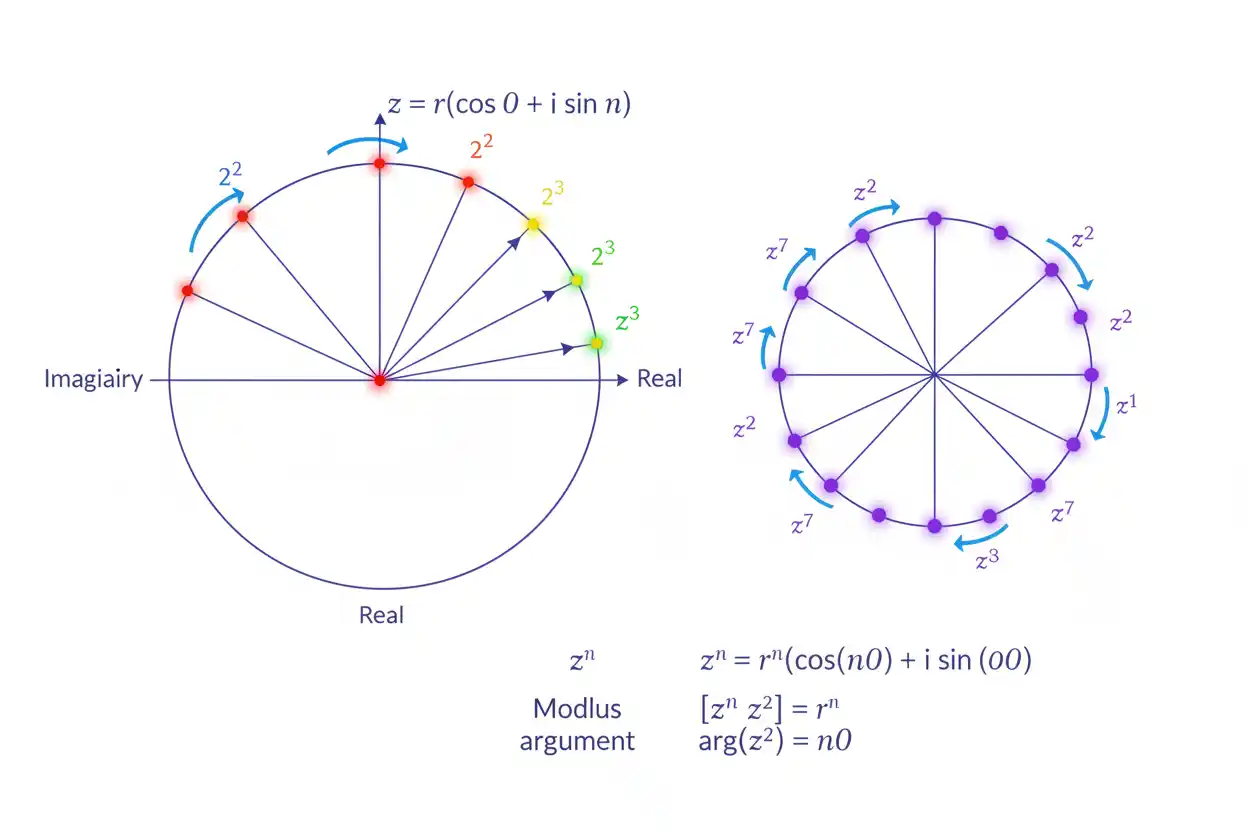
zⁿ = rⁿ[cos(nθ) + i sin(nθ)]
Instead of expanding:
z × z × z × …
n times, the theorem transforms the problem into:
r → rⁿ
and:
θ → nθ
This makes large powers dramatically easier to calculate.
The theorem is one of the central bridges between complex numbers, trigonometry, and algebra.
De Moivre’s Theorem Formula
The formula is:
[r(cos θ + i sin θ)]ⁿ = rⁿ[cos(nθ) + i sin(nθ)]
For a unit complex number:
[cos θ + i sin θ]ⁿ = cos(nθ) + i sin(nθ)
This standard form assumes:
n is an integer
The theorem is particularly straightforward for positive integer powers.
Negative integer powers can also be handled for nonzero complex numbers.
What Is Polar Form?
A complex number:
z = a + bi
can also be written as:
z = r(cos θ + i sin θ)
where:
r = √(a² + b²)
and θ is the angle measured from the positive real axis.
The first form:
a + bi
is called rectangular form.
The second:
r(cos θ + i sin θ)
is trigonometric or polar form.
De Moivre’s theorem works naturally with the polar representation.
Finding the Modulus
For:
z = a + bi
the modulus is:
r = |z| = √(a² + b²)
Suppose:
z = 3 + 4i
Then:
r = √(3² + 4²)
r = √25
r = 5
The complex number lies five units from the origin.
Finding the Argument
For:
z = a + bi
an angle can be found from:
tan θ = b/a
with the correct quadrant taken into account.
For:
z = 1 + i
the point is:
(1, 1)
so:
θ = 45°
or:
θ = π/4
The modulus is:
√2
Therefore:
1 + i = √2[cos(π/4) + i sin(π/4)]
Basic De Moivre’s Theorem Example
Find:
[cos 30° + i sin 30°]³
Apply De Moivre’s theorem:
= cos(3 × 30°) + i sin(3 × 30°)
= cos 90° + i sin 90°
Since:
cos 90° = 0
and:
sin 90° = 1
the result is:
i
Repeated multiplication is unnecessary.
Example With a Modulus
Find:
[2(cos 30° + i sin 30°)]³
Apply the theorem:
= 2³[cos 90° + i sin 90°]
= 8(0 + i)
Therefore:
8i
Both the modulus and angle change:
2 → 8
30° → 90°
Converting 1 + i Before Applying the Theorem
Suppose we want:
(1 + i)⁴
First convert:
1 + i
to polar form.
Modulus:
r = √2
Angle:
θ = 45°
Therefore:
1 + i = √2(cos 45° + i sin 45°)
Now apply power 4:
(1 + i)⁴ = (√2)⁴[cos 180° + i sin 180°]
Since:
(√2)⁴ = 4
and:
cos 180° = -1
sin 180° = 0
we get:
(1 + i)⁴ = -4
Checking With Ordinary Algebra
Using the binomial theorem:
(1 + i)² = 1 + 2i + i²
Since:
i² = -1
then:
(1 + i)² = 2i
Square again:
(2i)² = 4i²
= -4
The answer matches De Moivre’s theorem.
For large powers, however, the polar method is usually much shorter.
Large-Power Example
Find:
[cos 20° + i sin 20°]⁹
Using De Moivre:
= cos(180°) + i sin(180°)
Therefore:
= -1
Without the theorem, multiplying nine complex factors would be unnecessarily cumbersome.
Another Large-Power Example
Find:
[3(cos 15° + i sin 15°)]⁸
Modulus:
3⁸ = 6,561
Angle:
8 × 15° = 120°
Therefore:
= 6,561[cos 120° + i sin 120°]
Using:
cos 120° = -1/2
sin 120° = √3/2
we obtain:
= -6,561/2 + (6,561√3/2)i
That is the rectangular result.
Why De Moivre’s Theorem Works
Consider two unit complex numbers:
cos α + i sin α
and:
cos β + i sin β
Multiply them:
(cos α + i sin α)(cos β + i sin β)
Expand:
cos α cos β – sin α sin β + i(sin α cos β + cos α sin β)
Using angle-addition identities:
cos(α + β) = cos α cos β – sin α sin β
and:
sin(α + β) = sin α cos β + cos α sin β
the product becomes:
cos(α + β) + i sin(α + β)
Therefore multiplying complex numbers in trigonometric form adds their angles.
Repeated multiplication naturally produces:
nθ
which gives De Moivre’s theorem.
Complex Multiplication in Polar Form
More generally:
z₁ = r₁(cos θ₁ + i sin θ₁)
and:
z₂ = r₂(cos θ₂ + i sin θ₂)
Then:
z₁z₂ = r₁r₂[cos(θ₁ + θ₂) + i sin(θ₁ + θ₂)]
So multiplication:
multiplies moduli
and:
adds arguments
De Moivre’s theorem is the repeated-power version of this rule.
De Moivre’s Theorem for Negative Integers
For a nonzero complex number and positive integer m:
z^(-m) = 1/zᵐ
If:
z = r(cos θ + i sin θ)
then:
z^(-m) = r^(-m)[cos(-mθ) + i sin(-mθ)]
Using:
cos(-x) = cos x
and:
sin(-x) = -sin x
the result can be simplified as needed.
The nonzero requirement matters because zero has no multiplicative reciprocal.
Example With a Negative Power
Let:
z = cos 30° + i sin 30°
Find:
z⁻²
Apply the theorem:
z⁻² = cos(-60°) + i sin(-60°)
Therefore:
z⁻² = 1/2 – (√3/2)i
Because the modulus is 1, there is no additional radial factor.
De Moivre’s Theorem and Complex Roots
The theorem is especially important for reversing powers.
Suppose:
wⁿ = z
and:
z = r(cos θ + i sin θ)
Then the n distinct roots are:
wₖ = r^(1/n)[cos((θ + 2πk)/n) + i sin((θ + 2πk)/n)]
where:
k = 0, 1, 2, …, n – 1
This formula is one of the most useful consequences of De Moivre’s theorem.
Why 2πk Is Added
Angles differing by a full rotation represent the same complex number.
Therefore:
θ
θ + 2π
θ + 4π
and so on all describe the same direction before root extraction.
When dividing these possible angles by n, they generate different roots.
That is why:
θ + 2πk
appears in the nth-root formula.
Square Roots Using De Moivre’s Theorem
Find the square roots of:
z = 4
Write:
4 = 4(cos 0 + i sin 0)
The square-root modulus is:
√4 = 2
Angles:
(0 + 2πk)/2
for:
k = 0, 1
For k = 0:
Angle = 0
Root:
2
For k = 1:
Angle = π
Root:
-2
Therefore the square roots are:
2 and -2
Square Roots of -4
Write:
-4 = 4(cos π + i sin π)
Square-root modulus:
2
For k = 0:
Angle = π/2
so:
w₀ = 2i
For k = 1:
Angle = 3π/2
so:
w₁ = -2i
Therefore:
√ roots of -4: 2i and -2i
Cube Roots of 8
Solve:
z³ = 8
Write:
8 = 8(cos 0 + i sin 0)
Cube-root modulus:
∛8 = 2
Root angles are:
(0 + 2πk)/3
for:
k = 0, 1, 2
This gives:
0°
120°
240°
Therefore the roots are:
2
-1 + i√3
-1 – i√3
All three are required.
Fourth Roots of 16
Solve:
z⁴ = 16
Write:
16 = 16(cos 0 + i sin 0)
Fourth-root modulus:
16^(1/4) = 2
Angles:
0°
90°
180°
270°
Therefore:
z = 2
z = 2i
z = -2
z = -2i
All four lie on the circle of radius 2.
Roots Are Equally Spaced
For nth roots, the angular difference between consecutive roots is:
2π/n radians
or:
360°/n
For cube roots:
360°/3 = 120°
For fourth roots:
360°/4 = 90°
For fifth roots:
360°/5 = 72°
This produces a regular polygon on the complex plane.
Roots of Unity
The solutions to:
zⁿ = 1
are called the nth roots of unity.
Because:
|1| = 1
every root also has modulus 1.
The formula is:
zₖ = cos(2πk/n) + i sin(2πk/n)
for:
k = 0, 1, …, n – 1
All roots lie on the unit circle.
Third Roots of Unity
Set:
n = 3
Angles:
0°
120°
240°
Roots:
1
-1/2 + (√3/2)i
-1/2 – (√3/2)i
These are also the complex roots of:
z³ – 1 = 0
Fourth Roots of Unity
For:
z⁴ = 1
angles are:
0°
90°
180°
270°
Roots:
1, i, -1, -i
They form a square centered at the origin.
Fifth Roots of Unity
For:
z⁵ = 1
the angular spacing is:
72°
The roots occur at:
0°
72°
144°
216°
288°
They form a regular pentagon on the unit circle.
De Moivre’s Theorem and Cubic Equations
The theorem provides a natural way to solve some cubic equations over the complex numbers.
For example:
z³ – 1 = 0
becomes:
z³ = 1
De Moivre’s root method immediately generates all three roots.
Ordinary real-number cube-root reasoning would find only:
z = 1
and miss the two nonreal roots.
De Moivre’s Theorem and Complex Conjugates
Suppose one unit-circle root has angle:
θ
Its complex conjugate has angle:
-θ
or equivalently:
360° – θ
For example:
cos 120° + i sin 120°
and:
cos 240° + i sin 240°
are conjugates.
This symmetry explains why real-coefficient polynomials often produce root pairs reflected across the real axis.
De Moivre’s Theorem and Composite Functions
The theorem can be interpreted through a composite function.
Suppose:
g(θ) = cos θ + i sin θ
and:
f(z) = zⁿ
Then:
f(g(θ)) = [cos θ + i sin θ]ⁿ
De Moivre simplifies the composite output to:
cos(nθ) + i sin(nθ)
Function composition describes the nesting; De Moivre provides the complex-number identity.
De Moivre’s Theorem and the Binomial Theorem
The binomial theorem provides another way to expand:
(cos θ + i sin θ)ⁿ
For small n, the binomial expansion can be manageable.
For large n, De Moivre is usually far shorter.
For example:
(cos θ + i sin θ)¹⁰
would require 11 binomial terms before simplification.
De Moivre gives immediately:
cos(10θ) + i sin(10θ)
Deriving Trigonometric Identities
Because the binomial theorem and De Moivre’s theorem describe the same expression, they can be compared to derive multiple-angle identities.
For example:
(cos θ + i sin θ)²
By De Moivre:
cos 2θ + i sin 2θ
By direct expansion:
cos²θ + 2i sin θ cos θ + i²sin²θ
Since:
i² = -1
we get:
cos²θ – sin²θ + 2i sin θ cos θ
Match real and imaginary parts:
cos 2θ = cos²θ – sin²θ
and:
sin 2θ = 2 sin θ cos θ
This provides an elegant algebraic derivation of double-angle formulas.
Deriving Triple-Angle Formulas
Use:
(cos θ + i sin θ)³
De Moivre gives:
cos 3θ + i sin 3θ
Expand the cube:
cos³θ + 3i cos²θ sin θ – 3 cos θ sin²θ – i sin³θ
Match real parts:
cos 3θ = cos³θ – 3cos θ sin²θ
Using:
sin²θ = 1 – cos²θ
this can be rewritten:
cos 3θ = 4cos³θ – 3cos θ
Match imaginary parts:
sin 3θ = 3cos²θ sin θ – sin³θ
which can be rewritten:
sin 3θ = 3sin θ – 4sin³θ
Geometric Meaning of Raising a Complex Number to a Power
Suppose:
z = r(cos θ + i sin θ)
Then:
zⁿ = rⁿ(cos nθ + i sin nθ)
Geometrically, this does two things.
The distance from the origin changes:
r → rⁿ
The angle rotates:
θ → nθ
For example, squaring a complex number doubles its argument.
Cubing triples the argument.
This provides an intuitive geometric meaning for complex exponentiation.
Example: Squaring as Angle Doubling
Suppose:
z = 2(cos 40° + i sin 40°)
Then:
z² = 4(cos 80° + i sin 80°)
The distance from the origin changes from:
2 to 4
and the angle changes from:
40° to 80°
Example: Cubing as Angle Tripling
Suppose:
z = 3(cos 50° + i sin 50°)
Then:
z³ = 27(cos 150° + i sin 150°)
The modulus becomes:
27
and the angle becomes:
150°
The geometric transformation is immediate from the theorem.
Angles Beyond 360 Degrees
An angle such as:
450°
represents the same direction as:
90°
because:
450° – 360° = 90°
When De Moivre produces a large angle, it can be reduced modulo:
360°
or:
2π radians
For example:
cos 450° + i sin 450° = i
Example With a Very Large Power
Suppose:
z = cos 15° + i sin 15°
Find:
z²⁴
Apply:
z²⁴ = cos(360°) + i sin(360°)
Therefore:
z²⁴ = 1
No repeated multiplication is required.
Powers of i Through De Moivre
The number:
i
can be written:
i = cos 90° + i sin 90°
Therefore:
iⁿ = cos(90°n) + i sin(90°n)
This reproduces the familiar cycle:
i¹ = i
i² = -1
i³ = -i
i⁴ = 1
and then repeats.
De Moivre’s theorem gives a geometric reason for the four-step cycle.
De Moivre and Difference of Squares
The difference of squares can appear when complex conjugates generated through polar methods are multiplied.
For:
(a + bi)(a – bi)
we get:
a² – (bi)²
Since:
i² = -1
the result is:
a² + b²
This gives the squared modulus.
Although De Moivre’s theorem and the difference-of-squares identity solve different problems, both become useful when moving between rectangular and polar representations.
De Moivre and Direct Variation
Direct variation has the basic form:
y = kx
De Moivre’s theorem is not a direct-variation rule.
For powers:
r → rⁿ
and:
θ → nθ
the angle does scale linearly with n, but the modulus scales through exponentiation.
This distinction helps prevent unrelated algebraic structures from being treated as interchangeable merely because they involve multiplication.
Degrees vs. Radians
De Moivre’s theorem works with either degrees or radians as long as the angle calculations are consistent.
For example:
60° = π/3 radians
Therefore:
3 × 60° = 180°
is equivalent to:
3 × π/3 = π
When working with root formulas, radians often make expressions involving:
2πk
more compact.
Principal Argument vs. All Possible Arguments
A complex number has infinitely many equivalent arguments:
θ
θ + 2π
θ + 4π
and:
θ + 2πk
for integer k.
For ordinary power calculations, one representation is sufficient because multiplying equivalent angles produces equivalent final directions.
For roots, however, the different angle representations are essential because dividing them by n generates distinct roots.
Power vs. Root Direction
For powers:
Angle → nθ
For nth roots:
Angle → (θ + 2πk)/n
These operations are opposites in an important sense.
Powers multiply angles.
Roots divide possible angles.
This is why De Moivre’s theorem handles both problems naturally.
Checking a Root
Suppose a cube root candidate is:
z = 2(cos 120° + i sin 120°)
To check whether:
z³ = 8
apply De Moivre:
z³ = 2³[cos 360° + i sin 360°]
= 8(1 + 0i)
= 8
The candidate is valid.
Verification with the theorem is often much easier than multiplying the complex number three times in rectangular form.
Root Formula
The complete nth-root formula is:
wₖ = r^(1/n) × [cos((θ + 2πk)/n) + i sin((θ + 2πk)/n)]
with:
k = 0, 1, 2, …, n – 1
This version uses plain characters and standard Unicode symbols, so it does not require a LaTeX or MathJax plugin.
Power Formula
The power formula can be viewd directly as:
zⁿ = rⁿ × [cos(nθ) + i sin(nθ)]
when:
z = r × [cos θ + i sin θ]
For editors that handle superscript Unicode poorly, the equivalent plain-text version is:
z^n = r^n × [cos(nθ) + i sin(nθ)]
Both communicate the same formula.
Common De Moivre’s Theorem Mistakes
A common mistake is raising the angle to a power instead of multiplying it by the exponent.
Incorrect:
cos(θⁿ)
Correct:
cos(nθ)
Another error is forgetting to raise the modulus:
r → rⁿ
When finding roots, students often calculate only the principal root and forget the remaining n - 1 roots.
Another common mistake is omitting:
2πk
from the root formula.
Quadrant errors can occur when converting rectangular complex numbers to polar form.
Degrees and radians should not be mixed inside the same calculation.
Finally, the theorem should not be applied directly to a + bi until the complex number has been expressed in an appropriate polar or trigonometric form.
Frequently Asked Questions
What is De Moivre’s theorem?
De Moivre’s theorem relates powers of complex numbers in polar form to powers of their modulus and multiples of their angle.
What is De Moivre’s theorem formula?
[r(cos θ + i sin θ)]ⁿ = rⁿ[cos(nθ) + i sin(nθ)]
What is the unit-circle version?
When:
r = 1
the formula becomes:
(cos θ + i sin θ)ⁿ = cos(nθ) + i sin(nθ)
What happens to the modulus?
For the nth power:
r → rⁿ
What happens to the angle?
θ → nθ
Why is De Moivre’s theorem useful?
It converts repeated complex multiplication into simple power and angle calculations.
Can De Moivre’s theorem find complex roots?
Yes. It leads directly to the nth-root formula.
What is the nth-root formula?
wₖ = r^(1/n)[cos((θ + 2πk)/n) + i sin((θ + 2πk)/n)]
for:
k = 0, 1, …, n – 1
How many nth roots does a nonzero complex number have?
Exactly:
n distinct roots
Why do we add 2πk?
Equivalent representations of the original angle generate different roots after division by n.
How far apart are the roots?
2π/n radians
or:
360°/n
What are roots of unity?
They are solutions of:
zⁿ = 1
What are the cube roots of unity?
1
-1/2 + (√3/2)i
-1/2 – (√3/2)i
What are the fourth roots of unity?
1, i, -1, -i
Can De Moivre’s theorem be used with negative powers?
Yes, for nonzero complex numbers and integer exponents.
Does De Moivre’s theorem work in degrees?
Yes. Degrees or radians can be used as long as the angle units remain consistent.
How is De Moivre’s theorem related to the binomial theorem?
Both can expand powers such as:
(cos θ + i sin θ)ⁿ
Comparing the two forms can derive multiple-angle trigonometric identities.
How is De Moivre’s theorem related to complex roots?
The theorem explains how raising a complex number multiplies its angle. Reversing that process produces all nth roots by dividing the possible angles.
How is De Moivre’s theorem related to cubic equations?
Equations such as:
z³ = 1
can be solved by applying the complex-root formula derived from De Moivre’s theorem, producing all three roots rather than only the obvious real cube root.
Why is De Moivre’s theorem important?
It turns complex powers and roots into predictable operations on magnitude and angle. This makes it fundamental for complex-number algebra, roots of unity, polynomial solutions, trigonometric identities, rotations, and many higher-level mathematical applications.