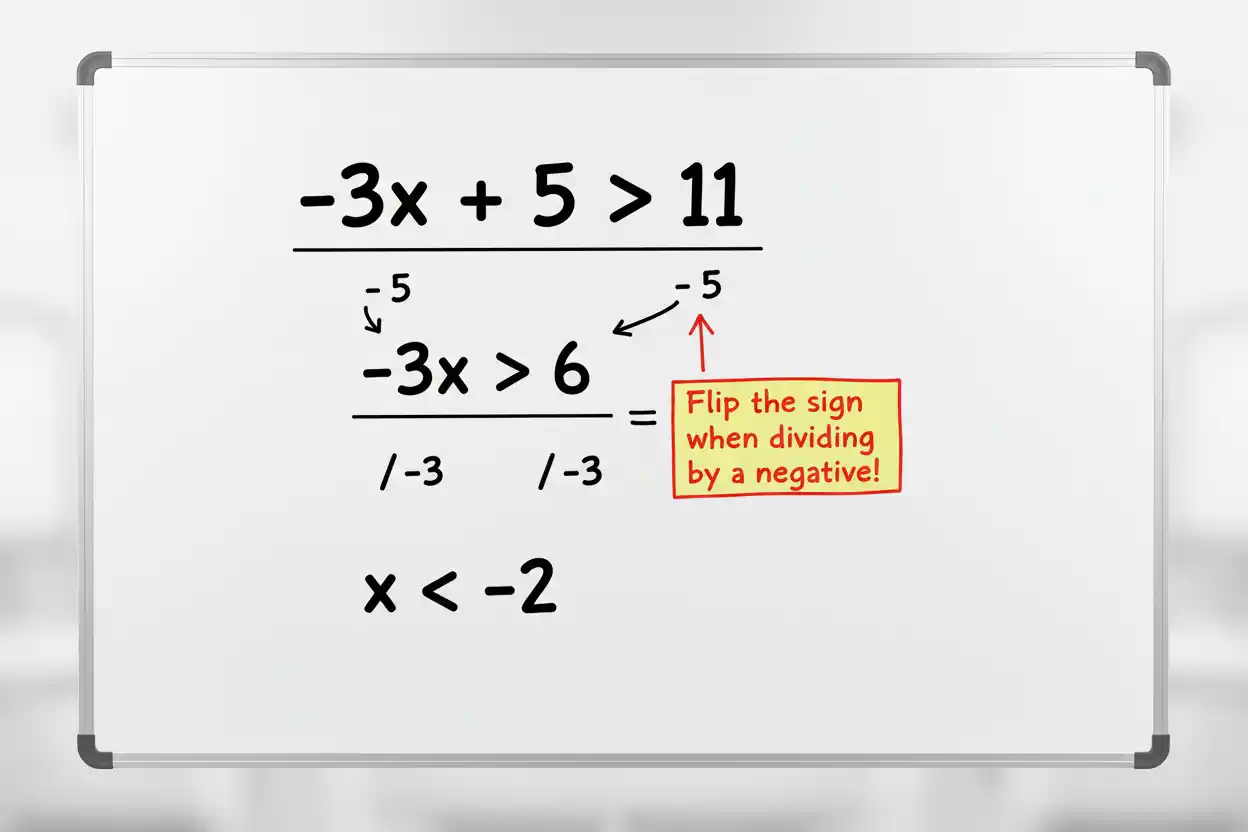
An inequality compares two expressions and shows that one is greater than, less than, greater than or equal to, or less than or equal to the other.
For example:
2x + 3 > 11
is an inequality.
Solving it means finding every value of x that makes the statement true:
2x > 8
x > 4
Unlike an equation, which often has one or several exact solutions, an inequality commonly has an entire range of solutions.
The central rule is simple: you may perform the same valid operation on both sides of an inequality, but multiplying or dividing both sides by a negative number reverses the inequality sign.
For example:
-2x > 8
becomes:
x < -4
That reversal rule is one of the most important distinctions between solving an inequality and solving an ordinary equation.
What Is an Inequality?
An inequality is a mathematical comparison between two quantities.
The four primary symbols are:
| Symbol | Meaning | Example |
|---|---|---|
| > | Greater than | x > 5 |
| < | Less than | x < 5 |
| ≥ | Greater than or equal to | x ≥ 5 |
| ≤ | Less than or equal to | x ≤ 5 |
A fifth symbol:
≠
means “not equal to.”
For example:
x ≠ 5
states that x may take any value except 5.
In algebra, inequalities are manipulated using many of the same balancing principles as equations, with special attention to operations that change order.
Inequality Rules
Suppose:
a < b
Several fundamental rules follow.
Addition Rule
Adding the same number c to both sides preserves the inequality:
a + c < b + c
For example, if:
3 < 8
then adding 4 gives:
7 < 12
The statement remains true.
Subtraction Rule
Subtracting the same quantity from both sides also preserves the inequality:
a – c < b – c
For example:
10 > 6
Subtract 2:
8 > 4
Multiplication by a Positive Number
If c > 0, multiplying both sides by c keeps the same inequality direction:
ac < bc
For example:
2 < 5
Multiply by 3:
6 < 15
Division by a Positive Number
Dividing both sides by the same positive quantity preserves the sign:
a / c < b / c
provided c > 0.
Multiplication by a Negative Number
Multiplying both sides by a negative number reverses the inequality:
If a < b, then -a > -b
For example:
2 < 5
Multiply by -1:
-2 > -5
The direction must reverse because -2 is greater than -5.
Division by a Negative Number
The sign also reverses when both sides are divided by a negative quantity.
For example:
-4x ≥ 20
Divide by -4:
x ≤ -5
The ≥ symbol becomes ≤.
Why Does the Inequality Sign Reverse?
Consider the true statement:
3 < 7
Multiply both sides by -1:
-3
and:
-7
On the number line, -3 lies to the right of -7, so:
-3 > -7
Multiplication by a negative number reflects values across zero. That reflection reverses their order.
The same principle applies to division by a negative number.
How to Solve a Linear Inequality
A linear inequality can usually be solved by isolating the variable.
Suppose:
3x + 5 > 17
Subtract 5:
3x > 12
Divide by 3:
x > 4
The solution includes every real number greater than 4.
A solution such as x > 4 can also be represented on a number line or in interval notation. The detailed conversion conventions are covered in inequalities.
Example 1: Addition and Subtraction
Solve:
x – 7 ≤ 12
Add 7 to both sides:
x ≤ 19
Therefore every value of x less than or equal to 19 satisfies the inequality.
Check x = 19:
19 – 7 ≤ 12
12 ≤ 12
True.
Check x = 20:
20 – 7 ≤ 12
13 ≤ 12
False.
The boundary is therefore correct.
Example 2: Positive Multiplication or Division
Solve:
5x > 35
Divide both sides by positive 5:
x > 7
Because the divisor is positive, the inequality direction does not change.
Example 3: Negative Coefficient
Solve:
-3x < 18
Divide both sides by -3.
Because -3 is negative, reverse the inequality:
x > -6
Check with x = 0:
-3(0) < 18
0 < 18
True.
Check with x = -10:
-3(-10) < 18
30 < 18
False.
So x > -6 is correct.
Example 4: Variables on Both Sides
Solve:
5x – 4 ≥ 2x + 11
Subtract 2x from both sides:
3x – 4 ≥ 11
Add 4:
3x ≥ 15
Divide by 3:
x ≥ 5
Check the boundary value x = 5:
Left side:
5(5) – 4 = 21
Right side:
2(5) + 11 = 21
Therefore:
21 ≥ 21
which is true.
Example 5: Negative Variable on Both Sides
Solve:
2 – 4x > 14
Subtract 2:
-4x > 12
Divide by -4 and reverse the sign:
x < -3
The sign reversal is essential. Writing x > -3 would produce the wrong solution set.
Inequalities With Fractions
Fractions can often be removed by multiplying both sides by a common positive denominator.
Suppose:
x / 4 + 2 ≤ 7
Subtract 2:
x / 4 ≤ 5
Multiply by positive 4:
x ≤ 20
Because 4 is positive, the inequality direction remains unchanged.
If you multiply or divide by a quantity whose sign is unknown, however, additional care is required because the direction depends on whether that quantity is positive or negative.
Inequalities With Parentheses
Solve:
3(x – 2) < 15
Distribute:
3x – 6 < 15
Add 6:
3x < 21
Divide by 3:
x < 7
You could also divide both sides by positive 3 before expanding:
x – 2 < 5
x < 7
Both approaches are valid.
Inequality With a Negative Factor
Solve:
-2(x + 3) ≥ 10
Divide by -2 and reverse the sign:
x + 3 ≤ -5
Subtract 3:
x ≤ -8
Alternatively, expand first:
-2x – 6 ≥ 10
-2x ≥ 16
x ≤ -8
Both methods give the same result.
Inequalities That Are Always True
Some inequalities lose the variable during simplification.
Consider:
3x + 5 < 3x + 9
Subtract 3x from both sides:
5 < 9
This statement is always true.
Therefore every real number satisfies the original inequality.
Inequalities With No Solution
Consider:
4x + 10 > 4x + 15
Subtract 4x:
10 > 15
This statement is false for every value of x.
Therefore the inequality has no solution.
Recognizing these cases prevents unnecessary attempts to continue solving after the variable disappears.
Compound Inequalities
A compound inequality combines two conditions.
For example:
3 < x ≤ 10
means x must satisfy both:
x > 3
and:
x ≤ 10
A compound inequality can often be manipulated as a three-part expression.
Suppose:
2 ≤ 3x – 1 < 14
Add 1 to all three parts:
3 ≤ 3x < 15
Divide every part by positive 3:
1 ≤ x < 5
When a negative quantity is used to multiply or divide all parts, both inequality symbols must reverse.
The resulting solution set can be converted into brackets and parentheses using the interval-notation rules on the inequalities page.
Inequalities With Function Notation
An inequality may be imposed on a function’s output.
For example:
f(x) ≥ 0
means find the inputs for which f produces a nonnegative result.
If:
f(x) = 2x – 8
then:
2x – 8 ≥ 0
Add 8:
2x ≥ 8
Divide by 2:
x ≥ 4
Understanding function notation makes it clear that the inequality is constraining the function’s output rather than changing what f(x) means.
Polynomial Inequalities
An inequality can involve powers of x.
For example:
x² – 5x + 6 > 0
Such problems often require identifying important boundary values first and then determining the sign of the expression on the intervals between them.
This differs from simply setting the polynomial equal to zero. The zeros provide boundaries, while the inequality determines which ranges satisfy the required positive or negative condition.
Because polynomial inequalities can contain multiple solution intervals, the final answer is often represented using interval notation rather than one isolated value.
Inequality Conditions in a Geometric Series
Inequalities are also used to express conditions on mathematical formulas.
For an infinite geometric series to converge, its common ratio must satisfy:
|r| < 1
Equivalently:
-1 < r < 1
The inequality does not calculate the sum by itself; it states which values of r make the infinite-sum formula applicable.
Inequalities in Inverse Variation
An inverse variation relationship typically has the form:
y = k / x
with:
x ≠ 0
If additional requirements are placed on x or y—for example, x > 0 in a physical application—inequalities state the permitted range of the variables.
This illustrates an important role of inequalities: they frequently describe valid inputs and constraints rather than merely appearing as isolated algebra exercises.
Inequalities and Inverse Functions
Inequalities can also restrict the domain of a function before an inverse is considered.
For example, a function may be restricted to:
x ≥ 0
so that each allowed output corresponds to one allowed input.
Such domain restrictions can be important when defining an inverse function. The inequality specifies which portion of the original domain is permitted; it does not itself perform the inversion.
Strict vs Non-Strict Inequalities
A strict inequality uses:
<
or:
>
The boundary value is excluded.
Examples:
x < 4
x > -2
A non-strict inequality uses:
≤
or:
≥
The boundary value is included.
Examples:
x ≤ 4
x ≥ -2
This distinction matters when checking a boundary value or representing a solution graphically.
How to Check an Inequality Solution
After solving an inequality, choose a value from the proposed solution set and substitute it into the original statement.
Suppose the result is:
x > 3
from:
2x – 1 > 5
Choose x = 4:
2(4) – 1 > 5
7 > 5
True.
Now test a value outside the proposed solution, such as x = 2:
2(2) – 1 > 5
3 > 5
False.
This confirms that the solution direction is sensible.
Testing the boundary value is also helpful. With x = 3:
2(3) – 1 > 5
5 > 5
False.
That confirms the boundary should not be included.
Common Inequality Mistakes
Forgetting to Reverse the Sign
This is the most common error.
For:
-5x ≤ 20
dividing by -5 gives:
x ≥ -4
not:
x ≤ -4
Reversing the Sign After Addition or Subtraction
Adding or subtracting the same number from both sides does not reverse the inequality.
For:
x – 3 < 8
add 3:
x < 11
The sign stays unchanged.
Reversing the Sign After Multiplying by a Positive Number
A sign reversal occurs only when multiplying or dividing by a negative quantity.
For:
x / 3 > 4
multiply by positive 3:
x > 12
Treating an Inequality Like an Equation
An equation may produce a boundary value, while an inequality usually asks which side of that boundary satisfies the condition.
For example:
x > 4
contains infinitely many solutions, not just x = 4.
Ignoring Equality in ≥ or ≤
If the symbol contains an equality bar, the boundary value itself is allowed.
For:
x ≥ 6
x = 6 is a valid solution.
Dividing by an Expression Without Knowing Its Sign
Suppose an inequality contains multiplication by a variable expression. Dividing by that expression without knowing whether it is positive or negative may invalidate the solution because the required inequality direction is unknown.
Sign conditions must be handled before such a division is justified.
Worked Example
Solve:
7 – 3x ≤ 22
Subtract 7:
-3x ≤ 15
Divide by -3.
Because the divisor is negative, reverse ≤ to ≥:
x ≥ -5
Check the boundary:
7 – 3(-5) ≤ 22
7 + 15 ≤ 22
22 ≤ 22
True.
Check a value larger than -5, such as x = 0:
7 – 3(0) ≤ 22
7 ≤ 22
True.
Check a value below -5, such as x = -6:
7 – 3(-6) ≤ 22
25 ≤ 22
False.
Therefore:
x ≥ -5
is correct.
Frequently Asked Questions
What is an inequality?
An inequality compares two expressions using symbols such as <, >, ≤, or ≥. Its solution is the set of values that makes the comparison true.
What are the four main inequality symbols?
The four primary symbols are:
<, >, ≤, ≥
They mean less than, greater than, less than or equal to, and greater than or equal to.
What is the most important inequality rule?
When you multiply or divide both sides of an inequality by a negative number, reverse the inequality sign.
For example:
-2x > 6
becomes:
x < -3
Do you reverse an inequality when adding a negative number?
No. Addition and subtraction do not require a sign reversal. Only multiplication or division by a negative quantity reverses the inequality direction.
Do you reverse an inequality when dividing by a positive number?
No. Dividing by a positive number preserves the inequality direction.
How is an inequality different from an equation?
An equation states that two expressions are equal and often identifies specific values. An inequality compares their order and commonly produces a range of valid values.
Can an inequality have no solution?
Yes. If simplification produces a false statement such as:
8 > 12
then no value satisfies the original inequality.
Can every real number satisfy an inequality?
Yes. If simplification produces an always-true statement such as:
4 < 9
then every real number satisfies the original inequality.
How do you check an inequality answer?
Substitute a value from the proposed solution set into the original inequality. It should make the statement true. Testing the boundary and a value outside the solution can provide an additional check.
What happens when an inequality contains variables on both sides?
Move variable terms to one side and constants to the other using equivalent operations. Then isolate the variable as usual, reversing the inequality only if multiplication or division by a negative number occurs.
How do you write an inequality solution as an interval?
Interval notation uses parentheses for excluded endpoints and brackets for included finite endpoints. For example:
x ≥ 2
becomes:
[2, ∞)
The broader conventions for single, compound, and disconnected solution sets are covered under inequalities and interval notation.