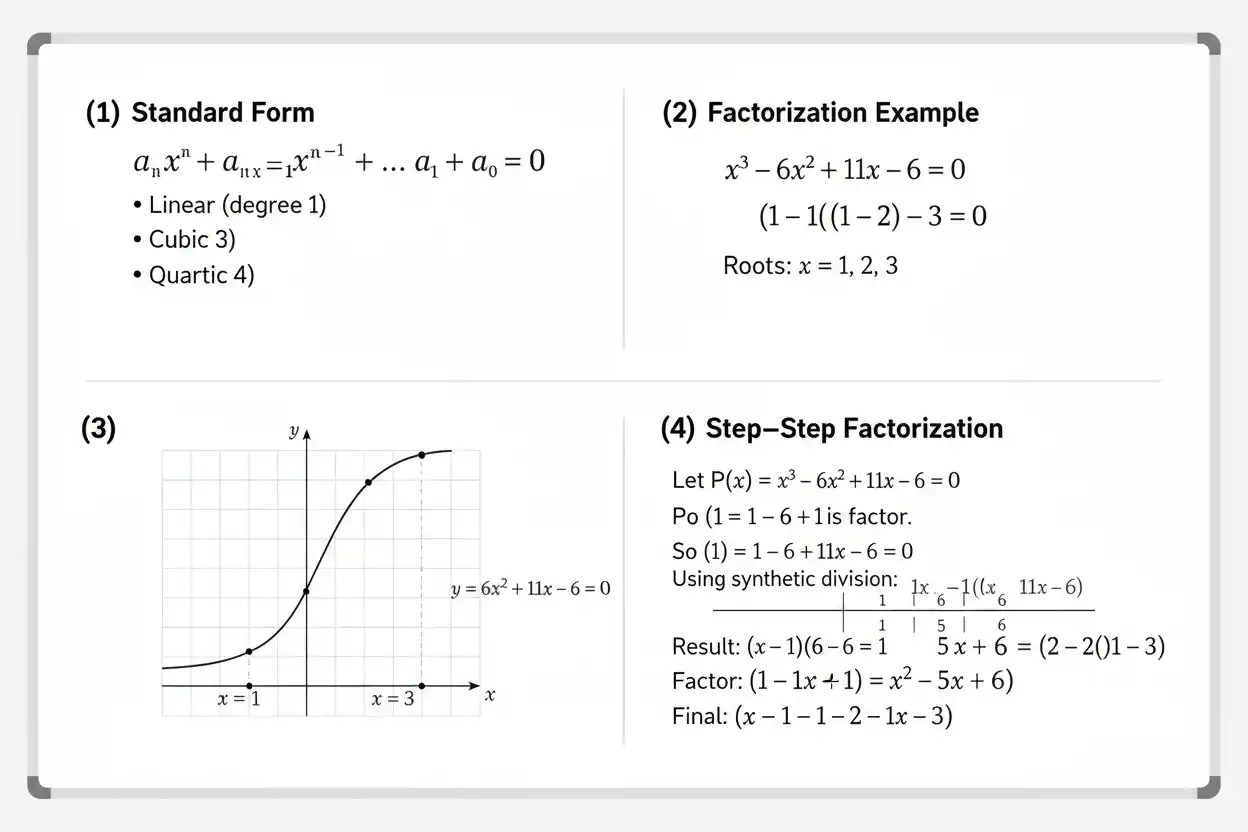

A polynomial equation is an equation formed by setting a polynomial expression equal to another expression, usually zero. In standard form:
aₙx^n + aₙ₋₁x^(n-1) + … + a₂x² + a₁x + a₀ = 0
where the exponents are nonnegative integers and the leading coefficient satisfies:
aₙ ≠ 0
For example:
x³ – 6x² + 11x – 6 = 0
is a polynomial equation of degree 3.
It factors as:
(x – 1)(x – 2)(x – 3) = 0
so its solutions are:
x = 1, 2, 3
The appropriate solving method depends on the polynomial’s degree and structure. Some equations factor immediately, some reduce to a quadratic equation, and higher-degree equations may require division, substitution, or numerical methods.
What Is a Polynomial Equation?
A polynomial equation contains a polynomial in one or more variables and an equality sign.
In one variable, a polynomial has the general form:
P(x) = aₙx^n + aₙ₋₁x^(n-1) + … + a₁x + a₀
A polynomial equation is commonly written:
P(x) = 0
Examples include:
3x – 12 = 0
x² – 7x + 10 = 0
2x³ + x² – 8x + 4 = 0
x⁴ – 5x² + 4 = 0
These are all polynomial equations because their variable exponents are whole numbers greater than or equal to zero.
Expressions such as:
1/x + 2 = 0
√x – 4 = 0
2^x = 8
are not polynomial equations in x.
Polynomial Equation Formula
The general polynomial equation of degree n is:
aₙx^n + aₙ₋₁x^(n-1) + … + a₂x² + a₁x + a₀ = 0
The coefficients:
aₙ, aₙ₋₁, …, a₁, a₀
are constants.
The highest exponent with a nonzero coefficient determines the degree.
For:
4x⁵ – 3x³ + 8x – 2 = 0
the degree is:
5
even though the x⁴ and x² terms are missing.
Degree of a Polynomial Equation
The degree helps determine the equation type.
| Degree | Common Name | Example |
|---|---|---|
| 1 | Linear | 2x + 3 = 0 |
| 2 | Quadratic | x² – 5x + 6 = 0 |
| 3 | Cubic | x³ – 4x = 0 |
| 4 | Quartic | x⁴ – 5x² + 4 = 0 |
| 5 | Quintic | x⁵ – x + 1 = 0 |
A degree-1 equation can be solved using standard linear algebra.
Degree 2 has specialized factoring and formula methods.
Cubic and higher-degree polynomial equations may sometimes factor cleanly, but there is no expectation that every higher-degree polynomial will have an elementary factorization.
What Is a Root of a Polynomial Equation?
A root, zero, or solution is a value of x that makes the polynomial equal zero.
Suppose:
P(x) = x² – 5x + 6
Check x = 2:
P(2) = 2² – 5(2) + 6
P(2) = 4 – 10 + 6
P(2) = 0
Therefore:
x = 2
is a root.
Likewise:
P(3) = 9 – 15 + 6 = 0
so x = 3 is another root.
The polynomial factors as:
x² – 5x + 6 = (x – 2)(x – 3)
How to Solve a Polynomial Equation
The first step is usually to write the equation in standard form:
P(x) = 0
Then inspect its structure.
If there is a common factor, factor it out first. If the polynomial factors completely, apply the zero-product property. If the remaining factor is quadratic, use suitable quadratic methods. For certain higher-degree equations, substitution can reduce the degree. Polynomial division can also help when a known factor or root is available.
The correct method depends on the equation rather than on one universal solving formula.
Zero-Product Property
A fundamental rule for factored polynomial equations is:
If AB = 0, then A = 0 or B = 0
For example:
(x – 4)(x + 7) = 0
Set each factor equal to zero:
x – 4 = 0
or:
x + 7 = 0
Therefore:
x = 4
or:
x = -7
This is why converting a polynomial equation into factored form is so useful.
Example 1: Solve by Factoring
Solve:
x² – 7x + 12 = 0
Find two numbers whose product is 12 and whose sum is -7:
-3 and -4
Factor:
(x – 3)(x – 4) = 0
Apply the zero-product property:
x – 3 = 0
or:
x – 4 = 0
Therefore:
x = 3, 4
For equations specifically centered on second-degree factorization, the methods in factoring quadratics provide the more focused treatment.
Example 2: Factor Out a Common Factor
Solve:
x³ – 4x² = 0
Factor out x²:
x²(x – 4) = 0
Set each factor equal to zero:
x² = 0
or:
x – 4 = 0
Therefore:
x = 0
or:
x = 4
The root x = 0 occurs twice algebraically because the factor x² has multiplicity 2.
Repeated Roots
A polynomial root may occur more than once.
For example:
(x – 3)²(x + 1) = 0
has roots:
x = 3
and:
x = -1
But x = 3 has multiplicity 2 because its factor appears twice.
The degree of the polynomial is:
2 + 1 = 3
When roots are counted according to multiplicity, this cubic has three roots represented by:
3, 3, -1
Example 3: Solve a Cubic Polynomial Equation
Solve:
x³ – 6x² + 11x – 6 = 0
The polynomial factors as:
(x – 1)(x – 2)(x – 3) = 0
Apply the zero-product property:
x – 1 = 0
x – 2 = 0
x – 3 = 0
Therefore:
x = 1, 2, 3
Check one root, x = 2:
2³ – 6(2²) + 11(2) – 6
= 8 – 24 + 22 – 6
= 0
Polynomial Division and Known Factors
Suppose a polynomial P(x) contains a known factor:
x – r
Dividing P(x) by x – r can reduce the degree and expose the remaining factors.
For example:
x³ – 6x² + 11x – 6
is divisible by:
x – 1
because x = 1 is a root.
Using polynomial long division gives:
x³ – 6x² + 11x – 6 = (x – 1)(x² – 5x + 6)
The quadratic quotient then factors:
x² – 5x + 6 = (x – 2)(x – 3)
so all three roots become visible.
Example 4: Polynomial Equation With a Substitution
Solve:
x⁴ – 5x² + 4 = 0
The equation contains x⁴ and x² but no odd powers.
Let:
u = x²
Then:
x⁴ = u²
The equation becomes:
u² – 5u + 4 = 0
Factor:
(u – 1)(u – 4) = 0
Therefore:
u = 1
or:
u = 4
Replace u with x²:
x² = 1
or:
x² = 4
Therefore:
x = ±1, ±2
The original fourth-degree equation has four real roots.
Polynomial Equations That Reduce to Quadratics
A higher-degree equation does not always require a completely new method.
For example:
x⁶ – 10x³ + 9 = 0
Let:
u = x³
Then:
u² – 10u + 9 = 0
Factor:
(u – 1)(u – 9) = 0
So:
u = 1
or:
u = 9
Return to x:
x³ = 1
or:
x³ = 9
The substitution reduces the polynomial structure to an easier equation before the remaining roots are determined.
Quadratic Factors
If a polynomial equation contains a quadratic factor that does not factor conveniently, solve that factor using quadratic methods.
For example:
(x – 2)(x² + x – 1) = 0
One root is:
x = 2
The remaining roots come from:
x² + x – 1 = 0
This is a quadratic equation and should be solved using the appropriate second-degree method rather than treating the entire cubic as an unrelated problem.
Real and Complex Roots
Not every polynomial equation has only real roots.
For example:
x² + 4 = 0
gives:
x² = -4
There is no real number whose square equals -4.
In the complex number system:
x = ±2i
Polynomial equations can therefore have both real and non-real roots. The behavior and interpretation of non-real solutions are treated more directly under complex roots.
How Many Roots Can a Polynomial Have?
A nonzero polynomial of degree n cannot have more than n distinct roots.
For example, a degree-3 polynomial can have at most three distinct roots.
Over the complex numbers, the Fundamental Theorem of Algebra states that a degree-n polynomial has exactly n roots when multiplicities are counted.
A cubic might therefore have:
- three distinct roots;
- one repeated root and one other root; or
- one real root and two non-real complex roots.
The precise pattern depends on the polynomial.
Polynomial Graphs and Roots
For a polynomial function:
y = P(x)
a real root occurs where:
P(x) = 0
Graphically, these are x-values where the graph meets the x-axis.
If:
P(x) = (x – 2)(x + 1)
the real roots are:
x = 2
and:
x = -1
so the graph has x-intercepts at:
(2, 0)
and:
(-1, 0)
A repeated root may touch the x-axis without crossing it, depending on its multiplicity.
Root Multiplicity and Graph Behavior
Consider:
P(x) = (x – 2)²(x + 1)
At x = 2, the multiplicity is even.
The graph typically touches the x-axis there and turns back.
At x = -1, the multiplicity is odd.
The graph crosses the x-axis there.
For higher multiplicities, the graph may flatten near the root, but the even-versus-odd distinction remains important for whether the sign changes.
Polynomial Equation vs Polynomial Expression
A polynomial expression has no equality condition:
x³ – 4x + 1
A polynomial equation adds an equals sign:
x³ – 4x + 1 = 0
The expression can be evaluated, expanded, factored, or divided.
The equation asks which values make the equality true.
This distinction matters because algebraic manipulation does not become equation solving until a condition of equality is present.
Polynomial Equation vs Piecewise Function
A piecewise function assigns different formulas to different parts of a domain.
A polynomial equation instead asks for values satisfying a polynomial equality.
A branch of a piecewise function may itself contain a polynomial formula, and solving:
f(x) = 0
within that branch may lead to a polynomial equation. However, the branch conditions must still be respected.
Polynomial Equation vs Partial Fractions
Partial fractions decompose a rational expression into simpler rational terms.
For example:
P(x) / Q(x)
may be rewritten as a sum of simpler fractions.
That procedure is not itself a way of solving a polynomial equation. Polynomial factorization may be required to prepare the denominator, but partial fractions and polynomial root-finding have different goals.
Pascal Triangle and Polynomial Coefficients
Pascal triangle can generate coefficients for powers of a binomial.
For example, row 4 gives:
1, 4, 6, 4, 1
These coefficients appear in the expansion of a fourth power of a binomial.
Once such an expression is expanded and set equal to zero, it may become a polynomial equation. Pascal triangle supplies coefficients; it does not determine the equation’s roots by itself.
Standard Form Matters
Consider:
x³ + 2 = 5x – x²
Before solving, move every term to one side:
x³ + x² – 5x + 2 = 0
Now the polynomial’s degree, coefficients, and possible factorization are easier to inspect.
Writing:
P(x) = 0
also makes the connection between roots, factors, and x-intercepts explicit.
Checking Polynomial Equation Solutions
Substitute every proposed solution into the original equation.
Suppose:
x³ – 4x = 0
Factor:
x(x² – 4) = 0
x(x – 2)(x + 2) = 0
Candidate solutions are:
x = 0, 2, -2
Check x = -2:
(-2)³ – 4(-2)
= -8 + 8
= 0
The value is valid.
Checking is especially useful when earlier algebra involved squaring, substitutions, denominators, or other transformations that might introduce restrictions.
Common Polynomial Equation Mistakes
Not Setting the Equation Equal to Zero
Factoring is most useful with the zero-product property when the equation has the form:
P(x) = 0
Move all terms to one side first when necessary.
Treating the Degree as the Number of Terms
For:
x⁵ + 2x – 1
the degree is 5 even though there are only three written terms.
Forgetting the Zero-Product Property
From:
(x – 3)(x + 4) = 0
you must solve:
x – 3 = 0
or:
x + 4 = 0
You do not multiply the factors back together after successfully factoring.
Missing Repeated Roots
For:
(x – 2)³ = 0
the root is x = 2 with multiplicity 3.
Assuming Every Polynomial Factors Over the Integers
Some polynomial equations do not have convenient integer or rational factors.
Ignoring Complex Roots
A polynomial may have fewer visible real roots than its degree because some roots are complex.
Confusing Expansion Tools With Solving Methods
Pascal triangle can help expand a power, and polynomial division can reduce a polynomial, but neither automatically solves every polynomial equation.
Worked Polynomial Equation Example
Solve:
2x³ – 2x² – 8x + 8 = 0
Group terms:
(2x³ – 2x²) + (-8x + 8) = 0
Factor each group:
2x²(x – 1) – 8(x – 1) = 0
Factor out the common binomial:
(x – 1)(2x² – 8) = 0
Factor 2:
2(x – 1)(x² – 4) = 0
Use the difference of squares:
2(x – 1)(x – 2)(x + 2) = 0
Set each variable factor equal to zero:
x = 1
x = 2
x = -2
Check x = -2:
2(-2)³ – 2(-2)² – 8(-2) + 8
= -16 – 8 + 16 + 8
= 0
Therefore:
x = -2, 1, 2
Frequently Asked Questions
What is a polynomial equation?
A polynomial equation is an equation involving a polynomial expression, commonly written:
P(x) = 0
where the variable has only nonnegative integer exponents.
What is the general formula for a polynomial equation?
A degree-n polynomial equation can be written:
aₙx^n + aₙ₋₁x^(n-1) + … + a₁x + a₀ = 0
with aₙ ≠ 0.
How do you find the degree of a polynomial equation?
Find the highest exponent of the variable with a nonzero coefficient.
For:
3x⁴ – x + 7 = 0
the degree is 4.
What is a root of a polynomial?
A root is a value that makes the polynomial equal zero. If P(3) = 0, then x = 3 is a root of P(x) = 0.
How do you solve a factored polynomial equation?
Apply the zero-product property. If:
A(x)B(x) = 0
then solve:
A(x) = 0
or:
B(x) = 0
Can a polynomial equation have repeated roots?
Yes. In:
(x – 4)²(x + 1) = 0
x = 4 is a repeated root of multiplicity 2.
Can a polynomial equation have complex roots?
Yes. For example:
x² + 1 = 0
has the complex roots:
x = ±i
How many roots can a polynomial have?
A degree-n polynomial has at most n distinct roots. Over the complex numbers, it has exactly n roots when multiplicity is counted.
What is the difference between a polynomial and a polynomial equation?
A polynomial is an expression such as x² + 3x + 2. A polynomial equation contains an equality condition, such as x² + 3x + 2 = 0.
Why should a polynomial equation be written equal to zero?
Writing P(x) = 0 makes factoring and the zero-product property directly applicable and identifies solutions as zeros of the polynomial.
Can polynomial long division help solve a polynomial equation?
Yes. When a factor or root is known, division can reduce the polynomial to a lower degree, making the remaining equation easier to solve.