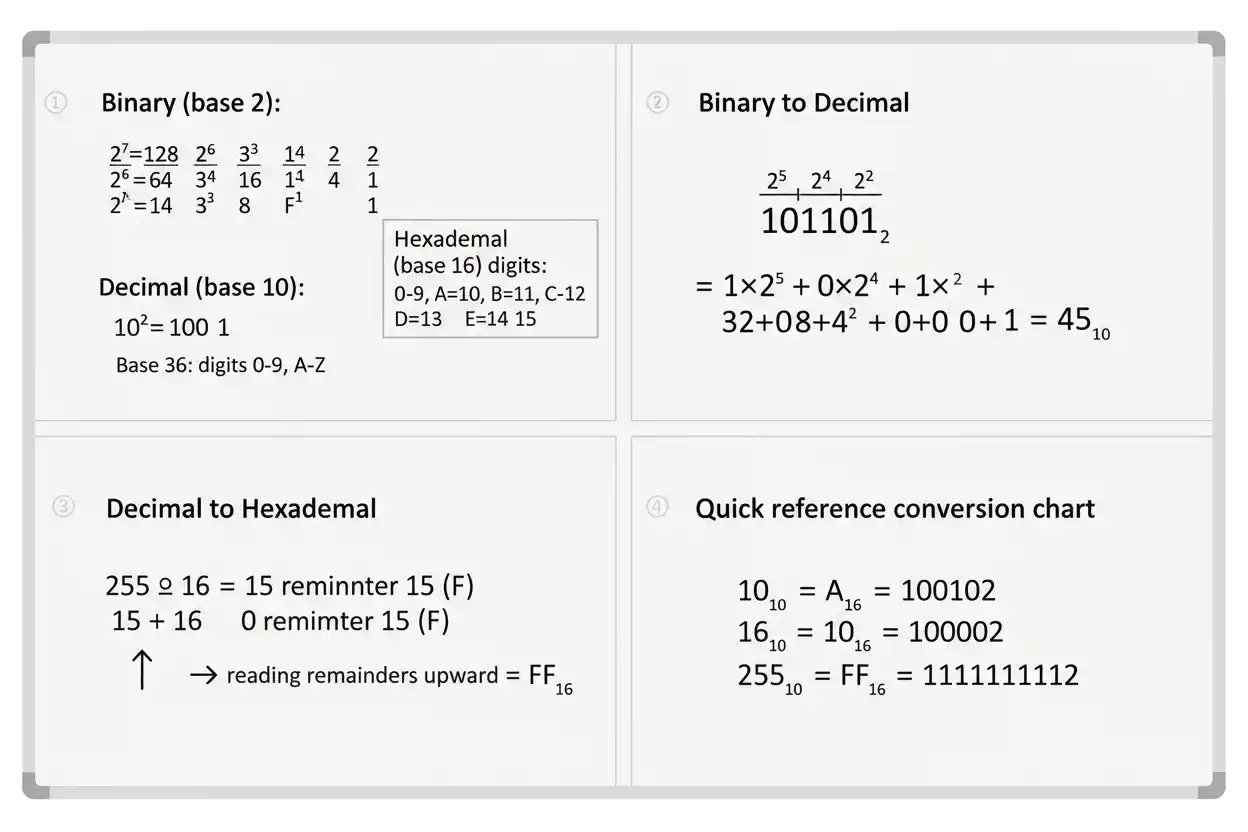
Base conversions change a number from one positional numeral system to another without changing its underlying numerical value.
For example:
101101₂ = 45₁₀
The digit string looks different because binary uses base 2 while decimal uses base 10, but both representations describe the same quantity.
For bases from 2 through 36, the standard digit symbols are:
0–9 for values 0–9
A–Z for values 10–35
So hexadecimal uses A through F, while base 36 can use every numeral 0–9 and letter A–Z.
The two fundamental conversion methods are:
Base b → decimal: multiply each digit by its place-value power of b and add
Decimal → base b: repeatedly divide by b and read the remainders in reverse order
These rules work for every integer base from 2 through 36.
What Is a Number Base?
A number base determines how many digit values are available before a new place is required.
Decimal is base 10 and uses:
0, 1, 2, 3, 4, 5, 6, 7, 8, 9
Binary is base 2 and uses only:
0, 1
Hexadecimal is base 16 and uses:
0–9 and A–F
Base 36 uses:
0–9 and A–Z
A valid digit in base b must have a value less than b.
Therefore:
2 is not a valid digit in base 2
and:
F is not a valid digit in base 15
because F represents 15, while base 15 allows digit values only from 0 through 14.
Positional Value in Any Base
In decimal, the number:
472₁₀
means:
4 × 10² + 7 × 10¹ + 2 × 10⁰
The same principle works in any base.
For example:
1011₂
means:
1 × 2³ + 0 × 2² + 1 × 2¹ + 1 × 2⁰
Calculate:
8 + 0 + 2 + 1 = 11
Therefore:
1011₂ = 11₁₀
Understanding positional value is the foundation of all base conversions.
General Base-to-Decimal Formula
Suppose a number in base b has digits:
dₙdₙ₋₁…d₂d₁d₀
Its decimal value is:
N = dₙb^n + dₙ₋₁b^(n-1) + … + d₂b² + d₁b + d₀
with each digit satisfying:
0 ≤ dᵢ < b
For example:
231₄
means:
2 × 4² + 3 × 4¹ + 1 × 4⁰
= 2 × 16 + 3 × 4 + 1
= 32 + 12 + 1
= 45
Therefore:
231₄ = 45₁₀
Converting Binary to Decimal
Consider:
110101₂
Write each place as a power of 2:
1 × 2⁵ + 1 × 2⁴ + 0 × 2³ + 1 × 2² + 0 × 2¹ + 1 × 2⁰
Calculate:
32 + 16 + 0 + 4 + 0 + 1
= 53
Therefore:
110101₂ = 53₁₀
The dedicated binary numbers guide focuses specifically on base-2 notation and arithmetic, while this page uses binary as one case of the broader base-conversion system.
Example: 101101₂ to Decimal
Convert:
101101₂
Expand:
1 × 2⁵ + 0 × 2⁴ + 1 × 2³ + 1 × 2² + 0 × 2¹ + 1 × 2⁰
= 32 + 0 + 8 + 4 + 0 + 1
= 45
So:
101101₂ = 45₁₀
Converting Base 8 to Decimal
Convert:
347₈
Expand:
3 × 8² + 4 × 8¹ + 7 × 8⁰
= 3 × 64 + 4 × 8 + 7
= 192 + 32 + 7
= 231
Therefore:
347₈ = 231₁₀
The digit 8 would not be valid inside an octal number because base 8 uses only digits 0 through 7.
Converting Hexadecimal to Decimal
Hexadecimal is base 16.
Its additional digit values are:
A = 10
B = 11
C = 12
D = 13
E = 14
F = 15
Convert:
2F₁₆
Expand:
2 × 16¹ + 15 × 16⁰
= 32 + 15
= 47
Therefore:
2F₁₆ = 47₁₀
Example: 3A7₁₆ to Decimal
Digit values are:
3 = 3
A = 10
7 = 7
Expand:
3 × 16² + 10 × 16 + 7
= 3 × 256 + 160 + 7
= 768 + 160 + 7
= 935
Therefore:
3A7₁₆ = 935₁₀
Digits for Bases Above 10
For bases up to 36, letters normally represent values greater than 9:
| Symbol | Value | Symbol | Value |
|---|---|---|---|
| A | 10 | N | 23 |
| B | 11 | O | 24 |
| C | 12 | P | 25 |
| D | 13 | Q | 26 |
| E | 14 | R | 27 |
| F | 15 | S | 28 |
| G | 16 | T | 29 |
| H | 17 | U | 30 |
| I | 18 | V | 31 |
| J | 19 | W | 32 |
| K | 20 | X | 33 |
| L | 21 | Y | 34 |
| M | 22 | Z | 35 |
Therefore:
Z₃₆ = 35₁₀
and:
10₃₆ = 36₁₀
The written number 10 always represents the base itself.
Base 36 Example
Convert:
1Z₃₆
Because:
Z = 35
expand:
1 × 36 + 35
= 71
Therefore:
1Z₃₆ = 71₁₀
Now consider:
ZZ₃₆
Its value is:
35 × 36 + 35
= 1260 + 35
= 1295
So:
ZZ₃₆ = 1295₁₀
Decimal to Another Base
To convert a positive decimal integer N to base b:
- Divide N by b.
- Record the remainder.
- Divide the quotient by b again.
- Continue until the quotient becomes zero.
- Read the remainders from bottom to top.
The remainders become the digits of the new representation.
This works because each division isolates one positional digit.
Decimal to Binary Example
Convert:
45₁₀
to binary.
Divide repeatedly by 2:
45 = 2 × 22 + 1
22 = 2 × 11 + 0
11 = 2 × 5 + 1
5 = 2 × 2 + 1
2 = 2 × 1 + 0
1 = 2 × 0 + 1
The remainders from last to first are:
1 0 1 1 0 1
Therefore:
45₁₀ = 101101₂
This matches the earlier binary-to-decimal example.
Decimal to Base 8 Example
Convert:
231₁₀
to base 8.
Divide:
231 = 8 × 28 + 7
28 = 8 × 3 + 4
3 = 8 × 0 + 3
Read the remainders upward:
3 4 7
Therefore:
231₁₀ = 347₈
Decimal to Hexadecimal Example
Convert:
255₁₀
to base 16.
Divide:
255 = 16 × 15 + 15
The remainder 15 is:
F
Now divide 15:
15 = 16 × 0 + 15
Again:
15 = F
Read upward:
FF
Therefore:
255₁₀ = FF₁₆
Larger Decimal-to-Hexadecimal Example
Convert:
12345₁₀
to hexadecimal.
Divide by 16:
12345 = 16 × 771 + 9
771 = 16 × 48 + 3
48 = 16 × 3 + 0
3 = 16 × 0 + 3
Read the remainders upward:
3 0 3 9
Therefore:
12345₁₀ = 3039₁₆
Check:
3 × 16³ + 0 × 16² + 3 × 16 + 9
= 3 × 4096 + 48 + 9
= 12288 + 57
= 12345
Decimal to Base 36 Example
Convert:
1000₁₀
to base 36.
Divide:
1000 = 36 × 27 + 28
Digit value 28 is:
S
Now:
27 = 36 × 0 + 27
Digit value 27 is:
R
Read upward:
RS
Therefore:
1000₁₀ = RS₃₆
Check:
R × 36 + S
= 27 × 36 + 28
= 972 + 28
= 1000
Converting Between Two Nondecimal Bases
A universal method for converting base a to base b is:
Base a → decimal → base b
For example, convert:
132₅
to base 7.
First convert to decimal:
1 × 5² + 3 × 5 + 2
= 25 + 15 + 2
= 42
Now convert 42 to base 7:
42 = 7 × 6 + 0
6 = 7 × 0 + 6
Read upward:
60₇
Therefore:
132₅ = 60₇
Using decimal as an intermediate base is straightforward and works for every base from 2 through 36.
Direct Binary-to-Hexadecimal Conversion
Binary and hexadecimal have a convenient relationship because:
16 = 2⁴
Every hexadecimal digit corresponds to exactly four binary digits.
For example, convert:
11101101₂
Group from the right in sets of four:
1110 1101
Convert each group:
1110₂ = 14 = E₁₆
1101₂ = 13 = D₁₆
Therefore:
11101101₂ = ED₁₆
No decimal intermediary is necessary.
Hexadecimal to Binary
Convert:
3A₁₆
Convert each hexadecimal digit to four binary digits:
3 = 0011₂
A = 1010₂
Combine:
00111010₂
Leading zeros can be omitted:
111010₂
Therefore:
3A₁₆ = 111010₂
Binary and Octal
Octal has base:
8 = 2³
so every octal digit corresponds to three binary digits.
For example:
725₈
becomes:
7 = 111₂
2 = 010₂
5 = 101₂
Therefore:
725₈ = 111010101₂
Conversely, binary can be grouped into sets of three from the right to convert directly to octal.
Why Grouping Works
Binary-to-hex grouping works because:
2⁴ = 16
Binary-to-octal grouping works because:
2³ = 8
More generally, direct grouping is convenient when one base is an integer power of another.
For unrelated bases such as base 5 and base 7, the decimal-intermediate method is usually simpler.
Converting Zero
Zero has the same numerical value in every base:
0₂ = 0₈ = 0₁₀ = 0₁₆ = 0₃₆
Repeated division needs a special practical case for zero because there is no positive quotient sequence to process.
The representation is simply:
0
Negative Numbers
Convert the magnitude and retain the negative sign.
For example:
-45₁₀
Since:
45₁₀ = 101101₂
we can write:
-45₁₀ = -101101₂
This mathematical signed representation should not be confused with computer-specific signed binary encodings such as two’s complement.
The conversion of the magnitude remains the same.
Fractions in Positional Bases
Positions to the right of the radix point use negative powers.
For decimal:
0.25₁₀ = 2 × 10^-1 + 5 × 10^-2
For binary:
0.101₂ = 1 × 2^-1 + 0 × 2^-2 + 1 × 2^-3
= 1/2 + 0 + 1/8
= 5/8
= 0.625₁₀
So:
0.101₂ = 0.625₁₀
Integer conversion is the simplest case, but positional notation extends naturally to fractional places.
Decimal Fraction to Another Base
For the fractional part, repeated multiplication replaces repeated division.
To convert 0.625₁₀ to binary:
Multiply by 2:
0.625 × 2 = 1.25
Record the integer digit:
1
Use the remaining fraction 0.25:
0.25 × 2 = 0.5
Record:
0
Then:
0.5 × 2 = 1.0
Record:
1
Therefore:
0.625₁₀ = 0.101₂
For fractions, digits are read in the order they are generated rather than reversed.
Some Fractions Do Not Terminate
A fraction that terminates in one base may repeat in another.
For example:
0.1₁₀
does not have a finite binary representation.
Its binary expansion repeats indefinitely.
This is one reason computer floating-point arithmetic can produce tiny representation differences for decimal values that appear simple to humans.
Base conversion therefore affects representation length even when the underlying number is unchanged.
Place Values Form a Geometric Pattern
In base b, successive place values are:
…, b³, b², b¹, b⁰, b^-1, b^-2, …
Each step changes by a factor of b.
This is different from an arithmetic sequence, whose consecutive terms differ by a constant amount.
For example, decimal place values:
1, 10, 100, 1000, …
do not have a constant difference. Their ratios are constant:
10
Recognizing this distinction helps explain why positional notation is multiplicative rather than additive in its place-value growth.
Base Conversion and Algebra
Variables can represent digits or unknown values in base-conversion problems.
Suppose:
2x₅ = 13₁₀
Interpreting the base-5 number gives:
2 × 5 + x = 13
Therefore:
10 + x = 13
x = 3
So:
23₅ = 13₁₀
The equation-solving step uses the same rules introduced in algebra basics.
The digit must also satisfy:
0 ≤ x < 5
which x = 3 does.
Base and Digit Length
Changing a number’s base changes the number of written digits.
For example:
255₁₀ = FF₁₆ = 11111111₂
The same value needs:
3 decimal digits
2 hexadecimal digits
8 binary digits
This happens because a larger base can encode more possibilities in each digit.
The relationship between magnitude and written digit count is developed specifically under big numbers.
Validating a Base Representation
Before converting, check every digit.
For example:
128₈
is invalid because octal permits only:
0 through 7
Similarly:
G₁₆
is invalid because hexadecimal stops at:
F = 15
But:
G₁₇
is valid because:
G = 16
and base 17 permits digit values 0 through 16.
Why Base 36 Stops at Z
Using numerals 0–9 and letters A–Z gives:
10 + 26 = 36
distinct digit symbols.
Therefore those symbols naturally support bases up to 36 with single-character digits.
A base greater than 36 would require an additional symbol convention or multi-character digit notation.
This article therefore keeps its scope to the workbook-assigned range of bases 2–36.
Common Base Conversion Mistakes
Reading Remainders in the Wrong Direction
For decimal-to-integer-base conversion, repeated-division remainders are read:
last remainder to first remainder
Using an Invalid Digit
A base-b digit must satisfy:
digit value < b
Treating Letters as Alphabet Positions
In standard base notation:
A = 10
not 1.
Therefore:
Z = 35
Forgetting Zero Placeholders
In:
10101₂
the zero digits represent place values that contribute zero. They cannot simply be ignored when assigning powers.
Using Decimal Place Values in Another Base
For:
123₅
the place values are:
5², 5¹, 5⁰
not 100, 10, and 1.
Confusing Representation With Value
10₂
does not equal decimal 10.
It equals:
2₁₀
because the digits are interpreted using powers of 2.
Reversing Fraction Digits
Repeated multiplication for fractional conversion records digits in the order generated. It does not use the reverse-remainder rule of integer conversion.
Worked Base Conversion Example
Convert:
2B7₁₆
to base 2.
Because hexadecimal and binary have a power relationship, convert each hex digit into four bits.
First:
2₁₆ = 0010₂
Next:
B₁₆ = 11₁₀ = 1011₂
Finally:
7₁₆ = 0111₂
Combine:
0010 1011 0111₂
Drop unnecessary leading zeros:
1010110111₂
Therefore:
2B7₁₆ = 1010110111₂
Check through decimal.
Hexadecimal:
2 × 16² + 11 × 16 + 7
= 512 + 176 + 7
= 695
Binary:
512 + 128 + 32 + 16 + 4 + 2 + 1
= 695
Both representations have the same value.
Frequently Asked Questions
What is a base conversion?
A base conversion rewrites a number in another numeral system while preserving its numerical value.
How do you convert any base to decimal?
Multiply each digit by the corresponding power of the original base and add the results:
N = Σ digit × base^position
How do you convert decimal to another integer base?
Repeatedly divide by the target base, record each remainder, and read the remainders in reverse order.
What digits are used for bases above 10?
The standard convention is:
A = 10, B = 11, …, Z = 35
What is 10₂ in decimal?
10₂ = 2₁₀
What is FF₁₆ in decimal?
FF₁₆ = 15 × 16 + 15 = 255₁₀
What is Z₃₆ in decimal?
Z₃₆ = 35₁₀
Why can binary convert directly to hexadecimal?
Because:
16 = 2⁴
so each hexadecimal digit corresponds exactly to four binary digits.
Can negative numbers be converted between bases?
Yes. Convert the magnitude and preserve the mathematical negative sign unless a specific computer encoding is required.
Can fractions be converted between bases?
Yes. Digits to the right of the radix point represent negative powers of the base. Decimal fractions can be converted using repeated multiplication.
Does changing the base change the actual number?
No. It changes only its representation.
Why does the same number have different digit lengths in different bases?
Each digit in a larger base can represent more possible values, so fewer digits may be needed to represent the same magnitude.