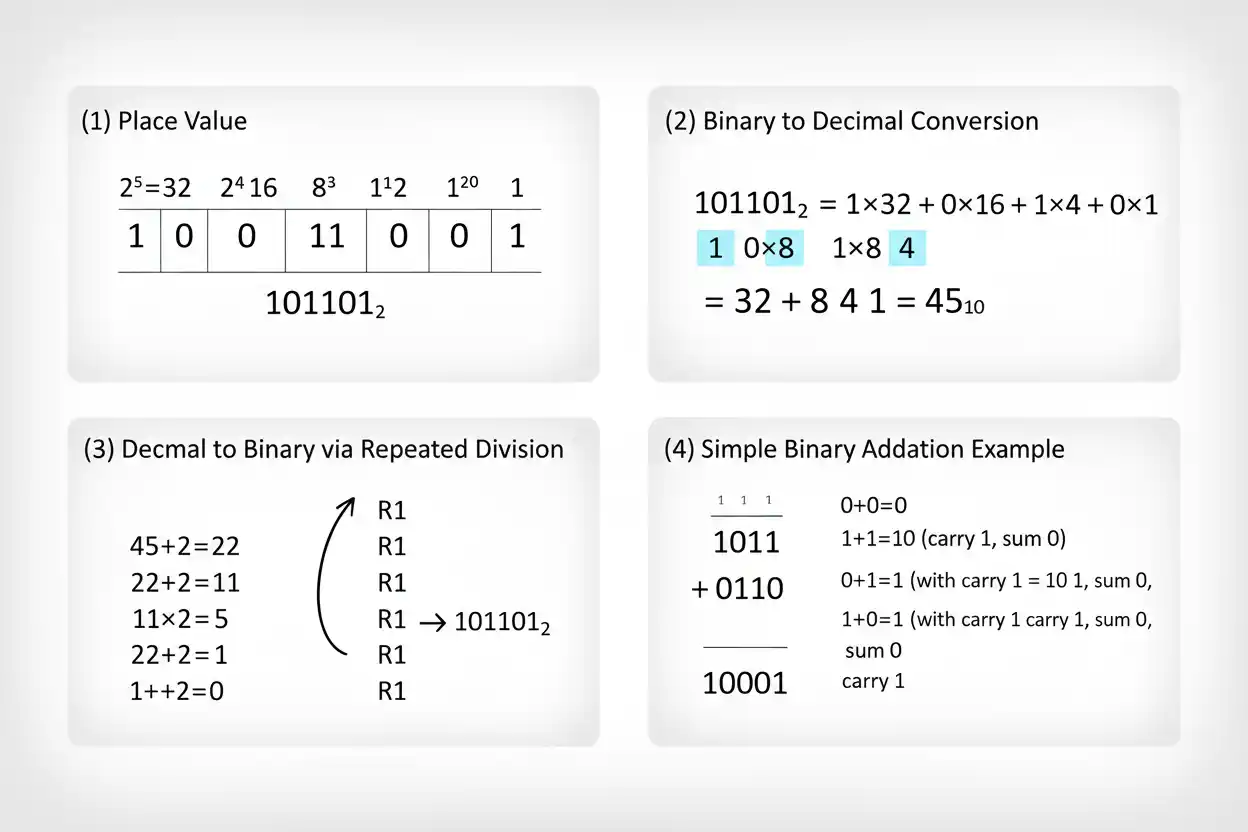

Binary numbers use a base-2 positional numeral system containing only two digits:
0 and 1
Each binary place represents a power of 2 rather than a power of 10.
For example:
1011₂
means:
1 × 2³ + 0 × 2² + 1 × 2¹ + 1 × 2⁰
= 8 + 0 + 2 + 1
= 11
Therefore:
1011₂ = 11₁₀
Binary numbers are mathematically ordinary positional numbers. Their importance in computing comes from the fact that two symbols can conveniently represent two physical or logical states.
What Are Binary Numbers?
A binary number is a number written in base 2.
Decimal uses ten possible digits:
0 through 9
Binary uses only:
0 and 1
The subscript 2 can be used to show explicitly that a number is binary:
10101₂
Without a base indicator, a string such as 10101 may be ambiguous because its value depends on the numeral system being used.
The broader principles for moving between base 2 and other positional systems are covered under base conversions.
Binary Place Values
Decimal place values are powers of 10:
…, 10³, 10², 10¹, 10⁰
Binary place values are powers of 2:
…, 2⁵, 2⁴, 2³, 2², 2¹, 2⁰
From right to left, common binary place values are:
| Power | Value |
|---|---|
| 2⁰ | 1 |
| 2¹ | 2 |
| 2² | 4 |
| 2³ | 8 |
| 2⁴ | 16 |
| 2⁵ | 32 |
| 2⁶ | 64 |
| 2⁷ | 128 |
| 2⁸ | 256 |
| 2⁹ | 512 |
| 2¹⁰ | 1024 |
A binary digit equal to 1 contributes its place value. A digit equal to 0 contributes nothing.
Example: Read 11001₂
Assign the powers of 2:
1 × 2⁴ + 1 × 2³ + 0 × 2² + 0 × 2¹ + 1 × 2⁰
Calculate:
16 + 8 + 0 + 0 + 1
= 25
Therefore:
11001₂ = 25₁₀
Binary-to-Decimal Formula
If a binary number contains digits:
bₙbₙ₋₁…b₂b₁b₀
where every bᵢ is either 0 or 1, its decimal value is:
N = bₙ2^n + bₙ₋₁2^(n-1) + … + b₂2² + b₁2 + b₀
For example:
101101₂
has:
1 × 2⁵ + 0 × 2⁴ + 1 × 2³ + 1 × 2² + 0 × 2¹ + 1 × 2⁰
= 32 + 8 + 4 + 1
= 45
So:
101101₂ = 45₁₀
Another Binary-to-Decimal Example
Convert:
111010₂
to decimal.
Expand:
1 × 2⁵ + 1 × 2⁴ + 1 × 2³ + 0 × 2² + 1 × 2¹ + 0 × 2⁰
= 32 + 16 + 8 + 0 + 2 + 0
= 58
Therefore:
111010₂ = 58₁₀
Decimal to Binary
To convert a positive decimal integer to binary, repeatedly divide by 2 and record the remainder.
Each remainder must be:
0 or 1
Continue until the quotient reaches zero.
Then read the remainders in reverse order.
Example: Convert 45 to Binary
Start with:
45 ÷ 2 = 22 remainder 1
Then:
22 ÷ 2 = 11 remainder 0
11 ÷ 2 = 5 remainder 1
5 ÷ 2 = 2 remainder 1
2 ÷ 2 = 1 remainder 0
1 ÷ 2 = 0 remainder 1
Read the remainders from bottom to top:
101101₂
Therefore:
45₁₀ = 101101₂
This is the reverse of the earlier conversion.
Decimal to Binary Using Powers of Two
Another method is to express the decimal number as a sum of powers of 2.
Convert:
53₁₀
The largest power of 2 not exceeding 53 is:
32 = 2⁵
Subtract:
53 – 32 = 21
The next usable power is:
16
so:
21 – 16 = 5
The next usable power is:
4
leaving:
1
Finally use:
1
Therefore:
53 = 32 + 16 + 4 + 1
The place values:
32, 16, 8, 4, 2, 1
produce digits:
1, 1, 0, 1, 0, 1
So:
53₁₀ = 110101₂
Zero in Binary
Zero is written:
0₂
Leading zeros do not change an ordinary number’s value:
00101₂ = 101₂
Both represent:
5₁₀
Leading zeros can still matter in fixed-width computer representations, but mathematically they do not change the number.
Counting in Binary
Binary counting follows the same positional principle as decimal counting.
The first few nonnegative integers are:
| Decimal | Binary |
|---|---|
| 0 | 0 |
| 1 | 1 |
| 2 | 10 |
| 3 | 11 |
| 4 | 100 |
| 5 | 101 |
| 6 | 110 |
| 7 | 111 |
| 8 | 1000 |
| 9 | 1001 |
| 10 | 1010 |
When a binary position would exceed 1, it carries into the next position.
That is analogous to decimal carrying after 9.
Why 10₂ Equals 2
The binary number:
10₂
contains:
1 × 2¹ + 0 × 2⁰
Therefore:
10₂ = 2₁₀
The written digits “10” do not always mean decimal ten. Their value depends on the base.
More generally:
10 in base b = b in decimal
Powers of Two
Powers of two appear constantly when working with binary numbers:
2⁰ = 1
2¹ = 2
2² = 4
2³ = 8
2⁴ = 16
2⁵ = 32
2⁶ = 64
2⁷ = 128
2⁸ = 256
2¹⁰ = 1024
Recognizing these values makes both binary-to-decimal and decimal-to-binary conversions faster.
What Is a Bit?
A bit is one binary digit.
It can hold one of two values:
0
or:
1
With one bit, there are:
2¹ = 2
possible patterns.
With two bits:
2² = 4
patterns:
00
01
10
11
With n bits:
Number of possible patterns = 2^n
This exponential growth explains why relatively few bits can encode many distinct combinations.
8-Bit Values
Eight bits provide:
2⁸ = 256
different bit patterns.
For an unsigned interpretation, the smallest value is:
00000000₂ = 0
and the largest is:
11111111₂
which equals:
128 + 64 + 32 + 16 + 8 + 4 + 2 + 1
= 255
Therefore the unsigned 8-bit range is:
0 through 255
The 256 patterns include zero, which is why the maximum value is 255 rather than 256.
n-Bit Unsigned Maximum
With n bits, the greatest unsigned value is:
2^n – 1
because a string of n ones represents:
2^(n-1) + 2^(n-2) + … + 2¹ + 2⁰
This geometric sum equals:
2^n – 1
For 16 bits:
Maximum = 2¹⁶ – 1
= 65,535
Binary Digit Length
For a positive integer N, the number of binary digits required is:
Binary digits = floor(log₂N) + 1
For example:
N = 100
Because:
2⁶ = 64
and:
2⁷ = 128
we have:
64 ≤ 100 < 128
so 100 requires:
7 binary digits
Indeed:
100₁₀ = 1100100₂
The broader relationship between magnitude, logarithms, and digit length is developed under big numbers.
Binary Addition
Binary addition follows ordinary place-value arithmetic with only two digits.
The basic rules are:
0 + 0 = 0
0 + 1 = 1
1 + 0 = 1
1 + 1 = 10₂
The last rule means write 0 in the current column and carry 1 to the next binary place.
Example: 101₂ + 11₂
Arrange the numbers:
101₂ + 011₂
From the right:
1 + 1 = 10₂
Write 0 and carry 1.
Next column:
0 + 1 + 1 carried = 10₂
Again write 0 and carry 1.
Final column:
1 + 0 + 1 carried = 10₂
The result is:
1000₂
Check in decimal:
101₂ = 5
11₂ = 3
and:
5 + 3 = 8
while:
1000₂ = 8
So the binary addition is correct.
Binary Subtraction
Basic binary subtraction includes:
0 – 0 = 0
1 – 0 = 1
1 – 1 = 0
When attempting:
0 – 1
a borrow is needed from the next binary place.
Borrowing one from the next place contributes:
10₂
which equals decimal 2.
Therefore:
10₂ – 1₂ = 1₂
Example: 1010₂ – 0011₂
Convert mentally first:
1010₂ = 10₁₀
0011₂ = 3₁₀
Therefore the answer should represent:
7₁₀
and:
7₁₀ = 111₂
So:
1010₂ – 0011₂ = 0111₂
or without the leading zero:
111₂
Binary Multiplication
Binary multiplication is simple because each digit is 0 or 1:
0 × 0 = 0
0 × 1 = 0
1 × 0 = 0
1 × 1 = 1
Long binary multiplication works like decimal long multiplication, except each partial product is either zero or a shifted copy of the other number.
Multiplication by 2 in Binary
Multiplying a nonnegative integer by 2 shifts its binary representation one place to the left and appends a zero.
For example:
1011₂ = 11₁₀
Multiply by 2:
10110₂
and:
10110₂ = 22₁₀
This works because shifting left multiplies every place value by 2.
Similarly, multiplying by:
2^k
corresponds to shifting left by k binary positions for ordinary nonnegative integer representations.
Division by 2
For even nonnegative binary integers, dividing by 2 shifts the representation one position to the right.
For example:
11000₂ = 24₁₀
Shift right:
1100₂ = 12₁₀
For odd numbers, integer division and a remainder must be considered.
The general quotient-and-remainder principles remain the same as ordinary division.
Even and Odd Binary Numbers
A binary integer’s final digit immediately reveals whether it is even or odd.
If the last bit is:
0
the number is even.
If the last bit is:
1
the number is odd.
Why?
Every binary place except:
2⁰ = 1
is divisible by 2.
Therefore only the final bit determines the remainder after division by 2.
For example:
11010₂
ends in 0, so it is even.
11011₂
ends in 1, so it is odd.
Binary Fractions
Binary positions to the right of the binary point use negative powers of 2:
2^-1 = 1/2
2^-2 = 1/4
2^-3 = 1/8
2^-4 = 1/16
For example:
0.101₂
means:
1 × 1/2 + 0 × 1/4 + 1 × 1/8
= 1/2 + 1/8
= 5/8
= 0.625₁₀
Therefore:
0.101₂ = 0.625₁₀
Mixed Binary Number
Convert:
101.11₂
The integer portion is:
1 × 2² + 0 × 2¹ + 1 × 2⁰
= 4 + 0 + 1
= 5
The fractional portion is:
1 × 2^-1 + 1 × 2^-2
= 1/2 + 1/4
= 0.75
Therefore:
101.11₂ = 5.75₁₀
Decimal Fractions May Repeat in Binary
A decimal fraction that terminates neatly in base 10 may not terminate in base 2.
For example, decimal:
0.1₁₀
has an infinite repeating binary expansion.
This happens because terminating representations depend on the prime factors of the numeral base.
Base 10 contains factors:
2 × 5
while base 2 contains only:
2
Fractions involving powers of 5 in their reduced denominator therefore may terminate in decimal but repeat in binary.
Binary to Octal
Because:
8 = 2³
binary digits can be grouped into sets of three to convert directly to octal.
Convert:
11010110₂
Group from the right:
011 010 110
Then:
011₂ = 3₈
010₂ = 2₈
110₂ = 6₈
Therefore:
11010110₂ = 326₈
Leading zeros added solely to complete a group do not change the value.
Binary to Hexadecimal
Because:
16 = 2⁴
group binary digits in sets of four.
Convert:
10111110₂
Group:
1011 1110
Then:
1011₂ = 11 = B₁₆
1110₂ = 14 = E₁₆
Therefore:
10111110₂ = BE₁₆
Direct grouping is much faster than converting through decimal when working between binary and hexadecimal.
Hexadecimal to Binary
Each hexadecimal digit corresponds to four bits.
For:
7D₁₆
convert:
7 = 0111₂
and:
D = 13 = 1101₂
Therefore:
7D₁₆ = 01111101₂
or without the unnecessary leading zero:
1111101₂
Binary Sequence vs Arithmetic Sequence
Binary counting produces:
0, 1, 10, 11, 100, 101, …
as written digit strings.
Their numerical values are:
0, 1, 2, 3, 4, 5, …
which increase by 1.
However, the visual binary strings themselves should not be analyzed as ordinary decimal terms.
An arithmetic sequence is defined by a constant numerical difference between represented values, not by how their digit strings look.
This distinction is especially important when numbers are written in different bases.
Binary Representation Does Not Change Magnitude
Consider:
11111111₂
and:
255₁₀
They are equal:
11111111₂ = 255₁₀
The binary representation uses eight digits while decimal uses three.
The different lengths do not imply different numerical magnitudes.
They reflect the amount of information each digit position can encode in its respective base.
Negative Binary Numbers
In pure mathematics, a negative binary integer can simply be written with a minus sign:
-101₂
which means:
-5₁₀
Computers often use structured signed encodings instead of storing an ordinary minus symbol. Two’s complement is one common example.
Those encoding conventions depend on a fixed bit width and should not be confused with the underlying base-2 positional value of an unsigned binary string.
Binary Numbers and Computing
Digital systems commonly model two distinguishable states as:
0
and:
1
Groups of bits can represent integers, text codes, colors, machine instructions, logical states, and many other types of data.
The mathematical foundation remains positional notation and powers of 2.
Understanding binary therefore does not require assuming that 0 and 1 have one universal physical meaning; their interpretation depends on the system using them.
Binary Numbers and Combinatorial Scale
Because n bits produce:
2^n
possible patterns, binary representations quickly lead to big numbers.
For example:
32 bits → 2³² = 4,294,967,296 patterns
while:
64 bits → 2⁶⁴ = 18,446,744,073,709,551,616 patterns
Doubling the number of bits does far more than merely double the number of possible patterns because the relationship is exponential.
Common Binary Number Mistakes
Using Digits Other Than 0 or 1
A binary number cannot contain:
2, 3, 4, …
The string:
1021₂
is invalid.
Reading Binary as Decimal
101₂
does not mean decimal 101.
It means:
1 × 4 + 0 × 2 + 1
= 5
Using Powers of 10
Binary place values are powers of 2, not 10.
Reading Repeated-Division Remainders Top to Bottom
When converting a positive decimal integer to binary, read the remainders in reverse order.
Forgetting Zero Positions
A zero bit contributes nothing, but its position remains important.
Thinking 8 Bits Can Represent Only 255 Patterns
Eight bits produce:
256 patterns
The unsigned numerical values run from 0 to 255.
Assuming Every Decimal Fraction Terminates in Binary
Many decimal fractions have repeating binary expansions.
Confusing Binary Representation With Signed Encoding
A bit string’s interpretation can depend on whether it is treated as unsigned, signed, fractional, or another data format.
Worked Binary Numbers Example
Convert:
173₁₀
to binary and verify the result.
Find powers of 2:
128 ≤ 173
Subtract:
173 – 128 = 45
Next use:
32
leaving:
45 – 32 = 13
The 16 place is not used.
Use:
8
leaving:
5
Use:
4
leaving:
1
The 2 place is not used.
Use:
1
Therefore the place values:
128, 64, 32, 16, 8, 4, 2, 1
receive bits:
1, 0, 1, 0, 1, 1, 0, 1
So:
173₁₀ = 10101101₂
Check:
1 × 128 + 0 × 64 + 1 × 32 + 0 × 16 + 1 × 8 + 1 × 4 + 0 × 2 + 1
= 128 + 32 + 8 + 4 + 1
= 173
The conversion is correct.
Frequently Asked Questions
What are binary numbers?
Binary numbers are numbers written in base 2 using only the digits 0 and 1.
What are binary place values?
From right to left, they are powers of 2:
1, 2, 4, 8, 16, 32, 64, …
What is 101₂ in decimal?
101₂ = 1 × 4 + 0 × 2 + 1 = 5₁₀
What is 10₂ in decimal?
10₂ = 2₁₀
How do you convert binary to decimal?
Multiply each bit by its corresponding power of 2 and add the results.
How do you convert decimal to binary?
Repeatedly divide the decimal integer by 2, record each remainder, and read the remainders from last to first.
What is a bit?
A bit is one binary digit that can contain either 0 or 1.
How many values can n bits represent?
There are:
2^n
possible bit patterns.
What is the largest unsigned value in n bits?
2^n – 1
How can you tell whether a binary number is even?
If its final bit is 0, it is even. If its final bit is 1, it is odd.
Can binary numbers contain fractions?
Yes. Positions to the right of the binary point represent negative powers of 2 such as 1/2, 1/4, and 1/8.
Why is binary important?
Binary provides a simple two-symbol positional system and maps naturally to systems that distinguish between two states, making it fundamental to digital computation.