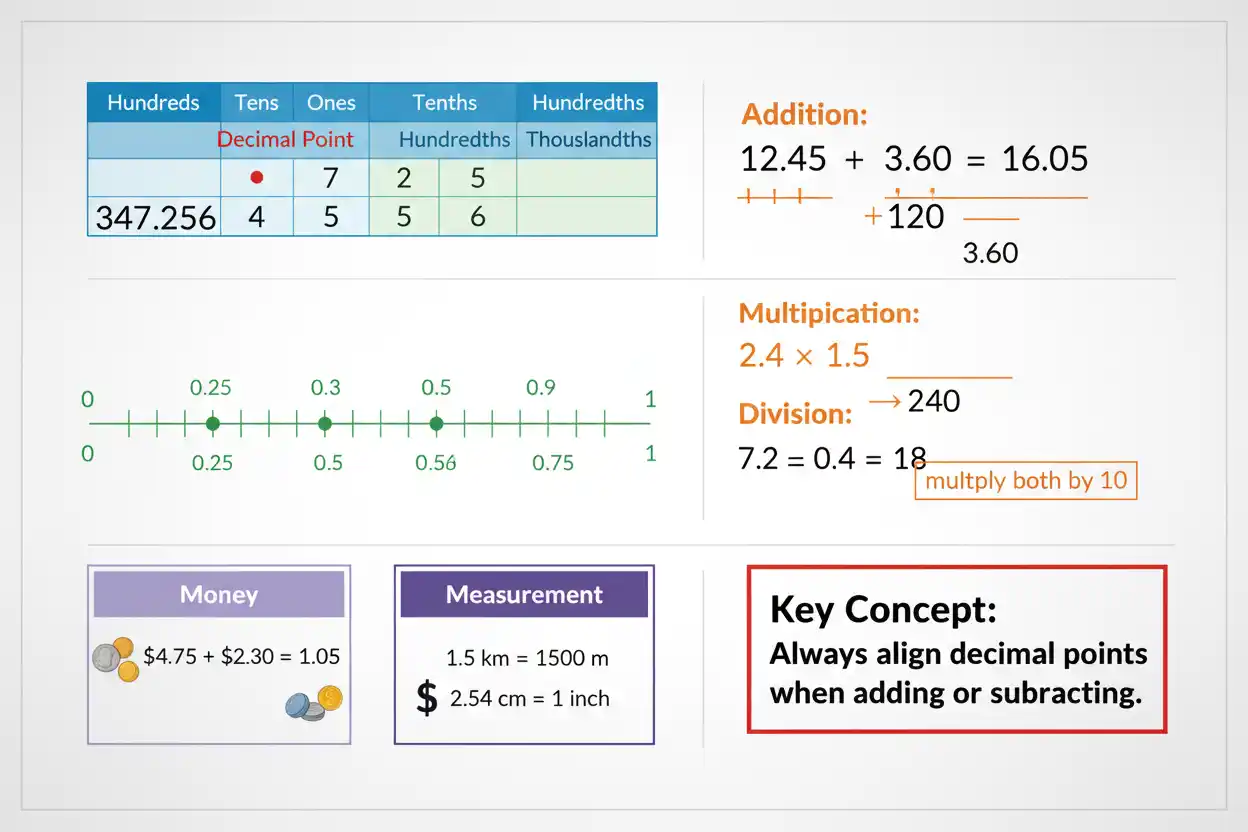
Decimal arithmetic is the process of calculating with numbers written in decimal notation. It includes working with whole-number places and fractional places such as tenths, hundredths, thousandths, and beyond.
For example:
12.47 + 3.806 = 16.276
The calculation follows ordinary addition, but place value must be preserved by aligning the decimal points correctly.
Decimal arithmetic is used extensively in money, measurements, percentages, science, statistics, engineering, and everyday calculations. It sits within the broader study of arithmetic and number theory.
What Is Decimal Arithmetic?
A decimal represents a number using powers of 10.
Consider:
347.582
The digits have different values according to their positions:
3 represents 300
4 represents 40
7 represents 7
5 represents 5/10
8 represents 8/100
2 represents 2/1000
So:
347.582 = 300 + 40 + 7 + 0.5 + 0.08 + 0.002
Decimal arithmetic works because calculations preserve these place values.
Decimal Place Value
To the left of the decimal point, place values increase by powers of 10:
ones, tens, hundreds, thousands, …
To the right, they decrease by powers of 10:
tenths, hundredths, thousandths, ten-thousandths, …
For example:
6.304
can be written as:
6 + 3/10 + 0/100 + 4/1000
or:
6 + 0.3 + 0.004
Understanding place value is the foundation for reliable decimal calculations.
Equivalent Decimal Forms
Trailing zeros to the right of the final nonzero decimal digit do not change the value.
For example:
4.5 = 4.50 = 4.500
Likewise:
0.7 = 0.70
These zeros can be useful for aligning place values during arithmetic.
However:
4.05
is not equal to:
4.5
because the zero between the decimal point and 5 changes the place value of the 5 from tenths to hundredths.
Adding Decimals
When adding decimal numbers, quantities with the same place value must be combined.
Consider:
12.47 + 3.806
Write the first number as:
12.470
Then align the decimal points:
12.470
- 3.806
= 16.276
Therefore:
12.47 + 3.806 = 16.276
The detailed procedural rules for addition and other calculations are developed further in decimal operations.
Why Decimal Points Must Align in Addition
Consider:
2.4 + 0.35
The first value means:
2 ones + 4 tenths
The second means:
3 tenths + 5 hundredths
Writing:
2.40 + 0.35
makes the place values clear.
Then:
2.40 + 0.35 = 2.75
Without correct alignment, digits from different place values could accidentally be combined.
Subtracting Decimals
The same place-value principle applies to subtraction.
Calculate:
20 – 7.385
Write 20 as:
20.000
Then subtract:
20.000 – 7.385 = 12.615
Therefore:
20 – 7.385 = 12.615
A useful check is:
12.615 + 7.385 = 20.000
which confirms the result.
Example: Money
Suppose an item costs:
$18.75
and the customer pays:
$25.00
The change is:
25.00 – 18.75 = 6.25
So the customer receives:
$6.25
Currency is one of the most familiar applications of decimal arithmetic because dollars and cents correspond naturally to units and hundredths.
Multiplying Decimals
A decimal multiplication can be understood by temporarily treating the numbers as integers and then restoring the appropriate scale.
Consider:
3.6 × 2.45
The first factor has one decimal place and the second has two, for a total of three decimal places.
Ignoring decimal points initially:
36 × 245 = 8820
Restore three decimal places:
8.820
Therefore:
3.6 × 2.45 = 8.82
The final trailing zero is unnecessary.
Why Decimal Multiplication Works
Write the numbers as fractions:
3.6 = 36 / 10
and:
2.45 = 245 / 100
Then:
3.6 × 2.45 = (36 × 245) / 1000
Since:
36 × 245 = 8820
we get:
8820 / 1000 = 8.82
The decimal-place rule is therefore a consequence of multiplying powers of 10 in the denominators.
Multiplying by Powers of 10
Multiplication by powers of 10 changes place value predictably.
For example:
4.726 × 10 = 47.26
4.726 × 100 = 472.6
4.726 × 1000 = 4726
Conceptually, each multiplication by 10 makes every digit worth ten times as much.
It is often described as moving the decimal point to the right, but the underlying reason is the change in place value.
Dividing Decimals
Consider:
12.6 ÷ 0.3
Multiply both numbers by 10:
126 ÷ 3
This preserves the quotient because both dividend and divisor were multiplied by the same nonzero value.
Now:
126 ÷ 3 = 42
Therefore:
12.6 ÷ 0.3 = 42
The same idea can convert a decimal divisor into an integer before division.
Another Division Example
Calculate:
7.35 ÷ 0.5
Multiply both numbers by 10:
73.5 ÷ 5
Then:
73.5 ÷ 5 = 14.7
Therefore:
7.35 ÷ 0.5 = 14.7
A quick reasonableness check helps here: dividing by 0.5 is equivalent to finding how many halves fit into the number, so the answer should be twice 7.35.
Dividing by Powers of 10
Dividing by powers of 10 makes each digit’s place value smaller.
For example:
583.2 ÷ 10 = 58.32
583.2 ÷ 100 = 5.832
583.2 ÷ 1000 = 0.5832
Again, the common instruction to “move the decimal point” is a shorthand for a place-value transformation.
Decimal Arithmetic With Negative Numbers
Decimals can be positive or negative.
For example:
-3.5 + 1.2 = -2.3
and:
-4.2 × 2 = -8.4
The sign rules are the same as for integer arithmetic.
For subtraction:
5.6 – (-2.4)
subtracting a negative is equivalent to adding:
5.6 + 2.4 = 8.0
So:
5.6 – (-2.4) = 8
Order of Operations With Decimals
Decimals follow the same mathematical precedence rules as other real numbers.
Consider:
5.2 + 3.4 × 2
Perform multiplication first:
3.4 × 2 = 6.8
Then add:
5.2 + 6.8 = 12
Therefore:
5.2 + 3.4 × 2 = 12
Changing the order would produce a different result, so the standard order of operations remains important when several operations appear together.
Parentheses Change the Calculation
Compare:
5.2 + 3.4 × 2 = 12
with:
(5.2 + 3.4) × 2
Evaluate the parentheses first:
5.2 + 3.4 = 8.6
Then:
8.6 × 2 = 17.2
Therefore:
(5.2 + 3.4) × 2 = 17.2
The same numbers can produce different answers depending on the structure of the expression.
Decimals and Fractions
Decimals and fractions are two ways of representing numbers.
For example:
0.5 = 1 / 2
0.25 = 1 / 4
0.75 = 3 / 4
A terminating decimal can be converted into a fraction using its place value.
For example:
0.375 = 375 / 1000
Simplify:
375 / 1000 = 3 / 8
The dedicated decimal to fraction topic covers terminating and repeating conversions more fully.
Fraction Arithmetic and Decimal Arithmetic
Some calculations can be performed in either representation.
For example:
0.5 + 0.25 = 0.75
The equivalent fraction calculation is:
1/2 + 1/4 = 3/4
Both represent the same value.
The techniques used when keeping numbers in fractional form belong to fraction operations, while decimal arithmetic works directly with decimal notation.
Terminating Decimals
A terminating decimal has a finite number of decimal digits.
Examples include:
0.5
2.75
0.0625
13.004
These values can be represented exactly with a finite decimal expansion.
For example:
0.0625 = 625 / 10000 = 1 / 16
Repeating Decimals
Some rational numbers have decimal expansions that continue indefinitely with a repeating pattern.
For example:
1 / 3 = 0.333…
and:
2 / 11 = 0.181818…
The repeating decimal represents an exact rational value even though writing a finite number of digits would create only an approximation.
This distinction becomes important when performing several calculations in sequence.
Exact Values vs. Rounded Values
Suppose:
1 / 3 = 0.333333…
If you replace it with:
0.33
you are no longer using the exact value.
For example:
0.33 × 3 = 0.99
whereas:
(1 / 3) × 3 = 1
The discrepancy is caused by rounding, not by the underlying arithmetic.
Whenever possible, avoid rounding intermediate values too early.
Rounding Decimals
Suppose a result is:
7.8462
Rounded to two decimal places:
7.85
The hundredths digit is 4, and the next digit is 6, so the hundredths digit increases from 4 to 5.
The detailed conventions for choosing and applying precision are covered by rounding rules.
Significant Figures and Decimal Arithmetic
Decimal places and significant figures are related but not identical concepts.
For example:
0.00450
has five digits after the decimal point, but it has three significant figures:
4, 5, 0
The leading zeros locate the decimal value but do not count as significant figures.
When numerical measurements are involved, significant figures can determine how much precision should be reported.
Decimal Arithmetic and Percentages
Percentages can often be handled efficiently in decimal form.
For example:
25% = 0.25
To find 25% of 80:
0.25 × 80 = 20
Therefore:
25% of 80 = 20
Likewise:
7.5% = 0.075
The broader relationship between parts per hundred and decimal representation is covered under percentage.
Example: Sales Calculation
Suppose an item costs:
$48.00
and a calculation requires 15% of the price.
Convert:
15% = 0.15
Then:
48 × 0.15 = 7.20
So:
15% of $48 = $7.20
Decimal arithmetic allows the percentage to be handled through ordinary multiplication.
Decimals and Ratios
A ratio can also produce a decimal when one quantity is divided by another.
Suppose:
3 / 8
Perform the division:
3 ÷ 8 = 0.375
So the ratio 3:8 corresponds numerically to:
0.375
The decimal expresses the quotient of the two terms.
Decimals in Scientific Notation
Very large or small decimals are often written compactly using powers of 10.
For example:
0.000045 = 4.5 × 10^-5
and:
3,200,000 = 3.2 × 10^6
Scientific notation changes how the number is written, but ordinary arithmetic relationships remain consistent.
For example:
4.5 × 10^-5 = 0.000045
represents exactly the same number.
Decimal Arithmetic and Real Numbers
Terminating and repeating decimals represent rational numbers, while nonterminating, nonrepeating decimal expansions represent irrational values.
For instance:
0.125
is rational because:
0.125 = 1 / 8
But the decimal expansion of √2 continues without terminating or repeating.
Both rational and irrational values belong to the broader real numbers system.
Decimal Approximations of Roots
Decimal arithmetic often appears after evaluating roots that do not produce exact integer values.
For example:
∛10 ≈ 2.154434…
The cube roots calculation determines the value, while decimal arithmetic may then be used to combine the approximation with other measurements or quantities.
The distinction matters because the rounded decimal is an approximation of the exact root.
Decimal Arithmetic and Composite Numbers
The prime or composite classification applies to integers rather than ordinary non-integer decimals.
For example:
12
is a composite number because it has positive factors besides 1 and itself.
But:
12.5
is not classified as prime or composite under the standard integer definition.
Decimal notation therefore does not extend every integer classification automatically to non-integer values.
Decimal Arithmetic in Algebra
Decimals can appear as coefficients and constants in equations.
For example:
0.5x + 1.2 = 3.7
Subtract 1.2:
0.5x = 2.5
Divide by 0.5:
x = 5
The decimal values do not change the underlying algebraic principles.
More specialized transformations, such as completing the square, may also contain decimal coefficients, but their primary purpose is algebraic rather than basic decimal calculation.
Converting Decimals to Integers Temporarily
Multiplying an equation or ratio by a power of 10 can sometimes simplify decimal arithmetic.
Consider:
0.3x = 2.1
Multiply both sides by 10:
3x = 21
Then:
x = 7
The transformation is valid because the same nonzero factor is applied consistently.
This technique can reduce visual complexity without changing the mathematical relationship.
Estimating Decimal Calculations
Estimation provides a useful error check.
Consider:
19.87 × 4.96
Round mentally:
19.87 ≈ 20
4.96 ≈ 5
So the result should be close to:
20 × 5 = 100
The exact calculation is:
19.87 × 4.96 = 98.5552
Since 98.5552 is close to 100, the result is plausible.
A result such as 9.85552 or 985.552 would suggest a misplaced decimal point.
Why Decimal-Point Errors Matter
A decimal-place error can change a value by a factor of 10, 100, 1000, or more.
Compare:
2.5
with:
0.25
The first is ten times the second:
2.5 = 10 × 0.25
Similarly:
45.6
is 100 times:
0.456
This is why checking magnitude is important in decimal arithmetic.
Practical Example: Unit Price
Suppose 6 identical items cost:
$17.70
The unit price is:
17.70 ÷ 6
= 2.95
Therefore:
Unit price = $2.95
Check:
2.95 × 6 = 17.70
The multiplication reproduces the original total.
Practical Example: Distance
A person travels:
12.75 km
in the morning and:
8.6 km
later.
Write:
8.6 = 8.60
Then:
12.75 + 8.60 = 21.35
The total distance is:
21.35 km
Units remain attached to the final result.
Practical Example: Average Cost
Suppose three purchases cost:
$12.40, $18.75, and $14.60
First find the total:
12.40 + 18.75 + 14.60 = 45.75
Then divide by 3:
45.75 ÷ 3 = 15.25
The average cost is:
$15.25
This example combines several ordinary decimal calculations while preserving cents throughout.
Common Decimal Arithmetic Mistakes
One frequent mistake is adding numbers without aligning place values.
For example:
4.5 + 0.27
should be viewed as:
4.50 + 0.27
which gives:
4.77
Another mistake is placing the decimal in a product based on visual alignment rather than total scale.
For:
0.2 × 0.3
the result is:
0.06
not:
0.6
because:
2/10 × 3/10 = 6/100
A third mistake is rounding too early in a multistep problem, causing accumulated error.
Division by a decimal also causes mistakes when only one number is scaled. If the divisor is multiplied by 10, the dividend must be multiplied by the same value to preserve the quotient.
How to Check Decimal Addition
Suppose:
8.375 + 4.62 = 12.995
Estimate:
8.4 + 4.6 ≈ 13
The exact answer 12.995 is close to 13, so its magnitude is reasonable.
You can also reverse the operation:
12.995 – 4.62 = 8.375
The original number is recovered.
How to Check Decimal Multiplication
Suppose:
6.4 × 2.5 = 16
Estimate:
6 × 2.5 ≈ 15
So 16 is plausible.
Verify with fractions:
6.4 = 64 / 10
2.5 = 25 / 10
Then:
(64 × 25) / 100 = 1600 / 100 = 16
The result is confirmed.
How to Check Decimal Division
Suppose:
9.45 ÷ 1.5 = 6.3
Reverse the operation:
6.3 × 1.5
= 9.45
Since multiplication recovers the dividend, the quotient is correct.
Decimal Arithmetic vs. Decimal Operations
The terms are closely related, but they can serve different levels of explanation.
Decimal arithmetic describes the broader numerical framework: decimal place value, representations, exact and approximate values, and how ordinary arithmetic behaves in decimal notation.
The dedicated decimal-operations topic can remain focused on procedural rules and worked calculations for adding, subtracting, multiplying, and dividing decimals.
Keeping that distinction prevents the two topics from becoming identical.
Frequently Asked Questions
What is decimal arithmetic?
Decimal arithmetic is calculation with numbers expressed in decimal notation, including values with tenths, hundredths, thousandths, and other powers of ten.
Why do decimal points need to line up when adding?
Alignment places digits with the same place value in the same column. Tenths must be added to tenths, hundredths to hundredths, and so on.
Does adding zeros change a decimal?
Trailing zeros to the right of a decimal do not change its value.
For example:
3.5 = 3.50 = 3.500
How do you multiply decimals?
Multiply the values according to ordinary multiplication and account for their powers-of-ten scale. For example:
0.4 × 0.3 = 0.12
because:
4/10 × 3/10 = 12/100
How do you divide by a decimal?
Scale the divisor by a power of 10 until it becomes an integer, and scale the dividend by the same amount.
For example:
4.8 ÷ 0.6 = 48 ÷ 6 = 8
Are decimals exact?
Some are. A terminating decimal such as 0.25 can represent a value exactly. A rounded decimal such as 1.41 used for √2 is only an approximation.
What is a repeating decimal?
A repeating decimal has a digit or sequence of digits that continues indefinitely.
For example:
0.333…
represents exactly:
1 / 3
Is 0.5 the same as 0.50?
Yes. Both represent five tenths.
Why does multiplying by 10 change decimal placement?
Multiplying by 10 makes every digit worth ten times as much, shifting each digit into the next larger place-value position.
Should intermediate decimal answers be rounded?
Usually, retain sufficient precision through intermediate steps and round at the end unless the problem specifies otherwise. Early rounding can alter the final result.
Final Example
Evaluate:
14.75 + 3.6 × 2.5
Apply multiplication first:
3.6 × 2.5 = 9.0
Then add:
14.75 + 9.0 = 23.75
Therefore:
14.75 + 3.6 × 2.5 = 23.75
The essential principle behind decimal arithmetic is place value. Once each digit’s position is preserved, ordinary arithmetic rules can be applied accurately to decimal numbers.