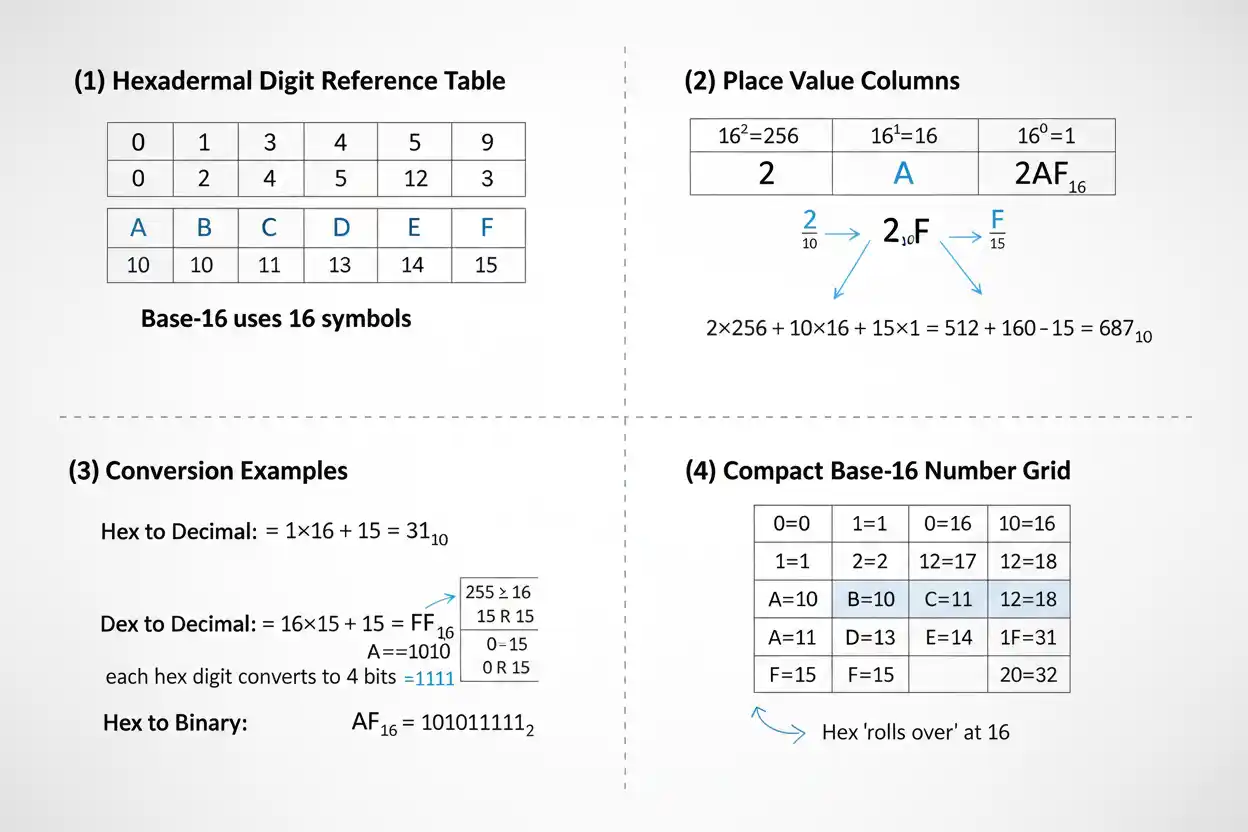

Hexadecimal is a base-16 numeral system that uses sixteen symbols to represent values. It uses the familiar digits 0–9, then the letters A–F for values ten through fifteen.
The hexadecimal digits are:
0, 1, 2, 3, 4, 5, 6, 7, 8, 9, A, B, C, D, E, F
Their decimal values are:
A = 10
B = 11
C = 12
D = 13
E = 14
F = 15
After F, the next hexadecimal number is:
10₁₆
which represents:
16₁₀
Hexadecimal is especially useful in computing because one hexadecimal digit corresponds exactly to four binary bits, making long binary values much easier to read.
What Is Hexadecimal?
Hexadecimal is a positional numeral system with base 16.
In ordinary decimal notation, each position represents a power of 10:
10⁰, 10¹, 10², 10³, …
In hexadecimal, each position represents a power of 16:
16⁰, 16¹, 16², 16³, …
So the hexadecimal number:
2F₁₆
means:
2 × 16¹ + F × 16⁰
Since:
F = 15
we get:
2 × 16 + 15
= 32 + 15
= 47
Therefore:
2F₁₆ = 47₁₀
The powers involved follow the same mathematical rules described under exponents.
Why Does Hexadecimal Use Letters?
A base-16 system needs sixteen distinct digit symbols.
Decimal already provides ten:
0 through 9
Six more are required.
Hexadecimal conventionally uses:
A, B, C, D, E, F
for:
10, 11, 12, 13, 14, 15
The letters are digits within the hexadecimal numeral. They are not algebraic variables.
For example:
C7₁₆
means:
12 × 16 + 7
not “C multiplied by 7.”
Hexadecimal Place Values
From right to left, hexadecimal integer positions represent:
16⁰ = 1
16¹ = 16
16² = 256
16³ = 4,096
16⁴ = 65,536
For example:
3A7₁₆
expands as:
3 × 16² + A × 16¹ + 7 × 16⁰
Replace A with 10:
3 × 256 + 10 × 16 + 7
= 768 + 160 + 7
= 935
Therefore:
3A7₁₆ = 935₁₀
Hexadecimal Digit Table
| Hexadecimal | Decimal | Binary |
|---|---|---|
| 0 | 0 | 0000 |
| 1 | 1 | 0001 |
| 2 | 2 | 0010 |
| 3 | 3 | 0011 |
| 4 | 4 | 0100 |
| 5 | 5 | 0101 |
| 6 | 6 | 0110 |
| 7 | 7 | 0111 |
| 8 | 8 | 1000 |
| 9 | 9 | 1001 |
| A | 10 | 1010 |
| B | 11 | 1011 |
| C | 12 | 1100 |
| D | 13 | 1101 |
| E | 14 | 1110 |
| F | 15 | 1111 |
This one-to-four relationship between hexadecimal and binary numbers is one of the main reasons hexadecimal is widely used in digital systems.
Counting in Hexadecimal
Decimal counting proceeds:
8, 9, 10, 11, 12, …
Hexadecimal counting proceeds:
8, 9, A, B, C, D, E, F, 10, 11, …
Remember:
F₁₆ = 15₁₀
and:
10₁₆ = 16₁₀
Continuing:
11₁₆ = 17₁₀
12₁₆ = 18₁₀
1F₁₆ = 31₁₀
20₁₆ = 32₁₀
The transition from F to 10 is analogous to decimal changing from 9 to 10.
Hexadecimal to Decimal Formula
For hexadecimal digits:
dₙdₙ₋₁…d₁d₀
the decimal value is:
Value = d₀ × 16⁰ + d₁ × 16¹ + d₂ × 16² + … + dₙ × 16ⁿ
Each letter digit must first be interpreted as its numerical value from 10 through 15.
Example: Convert 7B to Decimal
Expand:
7B₁₆ = 7 × 16¹ + B × 16⁰
Since:
B = 11
calculate:
7 × 16 + 11
= 112 + 11
= 123
Therefore:
7B₁₆ = 123₁₀
Example: Convert 1A4 to Decimal
Expand by place value:
1A4₁₆ = 1 × 16² + A × 16 + 4
Substitute:
A = 10
Then:
= 1 × 256 + 10 × 16 + 4
= 256 + 160 + 4
= 420
Therefore:
1A4₁₆ = 420₁₀
Example: Convert FFF to Decimal
Each F represents 15.
FFF₁₆ = 15 × 16² + 15 × 16 + 15
Calculate:
15 × 256 = 3,840
15 × 16 = 240
Then:
3,840 + 240 + 15 = 4,095
Therefore:
FFF₁₆ = 4,095₁₀
The next hexadecimal value is:
1000₁₆ = 4,096₁₀
Converting Decimal to Hexadecimal
To convert a positive decimal integer to hexadecimal, repeatedly divide by 16 and record the remainders.
The remainders must be interpreted as hexadecimal digits.
For example:
10 → A
11 → B
12 → C
13 → D
14 → E
15 → F
The repeated-division process uses the same quotient-and-remainder structure described under division and remainders.
Example: Convert 47 to Hexadecimal
Divide:
47 ÷ 16 = 2 remainder 15
The remainder 15 is:
F
The quotient is:
2
Therefore:
47₁₀ = 2F₁₆
Check:
2 × 16 + 15 = 47
Example: Convert 255 to Hexadecimal
Divide:
255 ÷ 16 = 15 remainder 15
Both 15 values become:
F
Therefore:
255₁₀ = FF₁₆
Check:
F × 16 + F
= 15 × 16 + 15
= 240 + 15
= 255
Example: Convert 1,000 to Hexadecimal
First divide:
1000 ÷ 16 = 62 remainder 8
Then:
62 ÷ 16 = 3 remainder 14
Remainder 14 is:
E
Finally:
3 ÷ 16 = 0 remainder 3
Read the remainders from last to first:
3E8
Therefore:
1000₁₀ = 3E8₁₆
Check:
3 × 256 + 14 × 16 + 8
= 768 + 224 + 8
= 1,000
Hexadecimal and Binary
Every hexadecimal digit corresponds to exactly four binary digits.
For example:
A₁₆ = 1010₂
F₁₆ = 1111₂
7₁₆ = 0111₂
Therefore:
7A₁₆
becomes:
0111 1010₂
Dropping the unnecessary leading zero:
7A₁₆ = 1111010₂
This direct grouping makes hexadecimal a compact representation of binary data.
Convert Hexadecimal to Binary
Convert:
3F9₁₆
Translate each digit separately:
3 = 0011
F = 1111
9 = 1001
Combine:
0011 1111 1001
Therefore:
3F9₁₆ = 001111111001₂
Leading zeros may be omitted when they are not needed to preserve a fixed bit width.
Convert Binary to Hexadecimal
Convert:
110101101011₂
Group from the right into sets of four:
1101 0110 1011
Translate:
1101 = D
0110 = 6
1011 = B
Therefore:
110101101011₂ = D6B₁₆
If the leftmost group has fewer than four bits, add leading zeros before translating.
Why Four Binary Bits Match One Hexadecimal Digit
Four binary bits can represent:
2⁴ = 16
different combinations.
Those combinations range from:
0000₂ = 0
through:
1111₂ = 15
Hexadecimal also contains exactly 16 digit values:
0 through F
Therefore one hexadecimal digit maps perfectly onto four binary bits.
Hexadecimal and Bytes
A byte contains:
8 bits
Since one hexadecimal digit represents 4 bits:
8 bits = 2 hexadecimal digits
So one byte can be written with two hexadecimal digits:
00 through FF
For example:
FF₁₆ = 255₁₀
and in binary:
11111111₂
The storage relationship between binary units is covered more directly under bits to bytes.
Hexadecimal Addition
Hexadecimal values can be added directly in base 16.
Consider:
A + 5
Since:
A = 10
we have:
10 + 5 = 15
and hexadecimal 15 is:
F
Therefore:
A + 5 = F
Now consider:
F + 1
Decimal equivalent:
15 + 1 = 16
In hexadecimal:
16₁₀ = 10₁₆
Therefore:
F + 1 = 10₁₆
A carry occurs after a column reaches sixteen rather than ten.
Hexadecimal Addition Example
Calculate:
2A₁₆ + 17₁₆
Rightmost digits:
A + 7 = 10 + 7 = 17 decimal
Seventeen decimal is:
11₁₆
So write:
1
and carry:
1
to the next hexadecimal position.
Next column:
2 + 1 + carried 1 = 4
Therefore:
2A₁₆ + 17₁₆ = 41₁₆
Check in decimal:
2A₁₆ = 42
17₁₆ = 23
42 + 23 = 65
and:
41₁₆ = 4 × 16 + 1 = 65
Hexadecimal Subtraction
Hexadecimal subtraction follows the same positional logic as decimal subtraction, but borrowing contributes:
16
rather than 10.
For example:
20₁₆ – 1₁₆ = 1F₁₆
Check:
32₁₀ – 1 = 31₁₀
and:
1F₁₆ = 16 + 15 = 31
The ordinary sign and operation rules remain part of integer operations; only the numeral representation has changed.
Representation Does Not Change the Number
The same integer may be written:
26₁₀
1A₁₆
11010₂
These are not three different values.
They are three representations of the same number.
Therefore mathematical properties such as divisibility, primality, factors, and the greatest common factor depend on the underlying value, not on the numeral system used to display it.
For example:
GCF(24,36) = 12
remains true even if those values are written in hexadecimal.
Hexadecimal Place Values Form a Geometric Pattern
The hexadecimal place values are:
1, 16, 256, 4096, …
Each term is obtained by multiplying the previous one by:
16
Therefore these place values form a geometric sequence with common ratio:
r = 16
This is a useful way to understand positional notation: moving one place left multiplies the place value by the base.
Hexadecimal Is Not a Harmonic Sequence
A harmonic sequence is defined by reciprocals that form an arithmetic sequence.
Hexadecimal is instead a numeral system.
The hexadecimal place values:
1, 16, 256, 4096, …
are geometric, not harmonic.
This distinction matters because “base-16” describes positional representation rather than a sequence type.
Hexadecimal Fractions
Hexadecimal can also represent values less than 1 using positions to the right of a radix point.
Those positions represent:
16^-1, 16^-2, 16^-3, …
For example:
0.8₁₆
means:
8 × 16^-1
= 8/16
= 1/2
Therefore:
0.8₁₆ = 0.5₁₀
Example: Hexadecimal Fraction 0.C
Since:
C = 12
we have:
0.C₁₆ = 12 × 16^-1
= 12/16
Simplify:
12/16 = 3/4
Therefore:
0.C₁₆ = 0.75₁₀
The reduction uses ordinary fraction simplification.
Multiple Fractional Hexadecimal Digits
Consider:
0.18₁₆
Expand:
1 × 16^-1 + 8 × 16^-2
That is:
1/16 + 8/256
Simplify:
8/256 = 1/32
Then:
1/16 + 1/32
= 2/32 + 1/32
= 3/32
As a decimal:
3/32 = 0.09375
Therefore:
0.18₁₆ = 0.09375₁₀
Improper Fractions and Hexadecimal
An improper fraction represents a rational value whose numerator is at least as large in magnitude as its positive denominator under the usual positive-fraction definition.
For example:
31/16
equals:
1 + 15/16
Because:
15 = F₁₆
the value can be represented in hexadecimal positional form as:
1.F₁₆
The improper-fraction concept describes the ratio; hexadecimal describes how the resulting number is represented.
Decimal Arithmetic and Hexadecimal Conversion
When converting a hexadecimal fractional value to decimal, ordinary decimal arithmetic may be used after evaluating the powers of 16.
For example:
A.B₁₆
equals:
10 + 11/16
and:
11/16 = 0.6875
Therefore:
A.B₁₆ = 10.6875₁₀
The base conversion determines the value; decimal arithmetic handles its decimal representation.
Hexadecimal and Powers of 16
Common powers are:
16⁰ = 1
16¹ = 16
16² = 256
16³ = 4,096
16⁴ = 65,536
16⁵ = 1,048,576
Recognizing these values makes larger hexadecimal-to-decimal conversions faster.
For example:
10000₁₆ = 16⁴
= 65,536₁₀
Leading Zeros
Leading zeros do not change the numerical value.
For example:
00AF₁₆ = AF₁₆
Both represent:
10 × 16 + 15
= 175
Leading zeros may still be retained when a fixed number of hexadecimal digits is useful, such as representing byte or memory values.
Uppercase vs. Lowercase Hexadecimal
The letters may be written in uppercase:
A, B, C, D, E, F
or lowercase:
a, b, c, d, e, f
Numerically:
A₁₆ = a₁₆ = 10₁₀
The choice of letter case is a notation convention rather than a mathematical difference.
Hexadecimal Prefixes
In computing contexts, hexadecimal values are sometimes marked with a prefix such as:
0x
For example:
0xFF
commonly indicates hexadecimal:
FF₁₆
which equals:
255₁₀
The prefix is not part of the numerical value. It identifies the base used to interpret the following digits.
Common Hexadecimal Mistake: Treating A–F as Decimal Digits
For:
2C₁₆
C does not represent 12 separate from place value in an arbitrary way. It is the digit value:
12
So:
2C₁₆ = 2 × 16 + 12
= 44
Common Mistake: Using Powers of 10
Hexadecimal place values use powers of 16, not powers of 10.
For:
123₁₆
the correct expansion is:
1 × 16² + 2 × 16 + 3
not:
1 × 100 + 2 × 10 + 3
Calculate:
256 + 32 + 3 = 291
Therefore:
123₁₆ = 291₁₀
Common Mistake: Reading 10₁₆ as Ten
The hexadecimal numeral:
10₁₆
represents:
1 × 16 + 0
= 16₁₀
It is pronounced according to context as hexadecimal ten or one-zero base sixteen, but its numerical value is sixteen decimal.
Common Mistake: Reading Remainders in the Wrong Order
When converting decimal to hexadecimal through repeated division by 16, remainders are read from the final division upward.
For example, converting 254:
254 ÷ 16 = 15 remainder 14
15 ÷ 16 = 0 remainder 15
The remainders are:
E, F
but read in reverse order:
FE
Therefore:
254₁₀ = FE₁₆
not EF₁₆.
How to Check a Hexadecimal Conversion
Suppose:
2D5₁₆ = 725₁₀
Expand:
2 × 256 + 13 × 16 + 5
= 512 + 208 + 5
= 725
The decimal value is recovered.
For a decimal-to-hexadecimal conversion, convert the hexadecimal result back to decimal using place values.
This reverse check catches misplaced digits and incorrectly interpreted A–F values.
Frequently Asked Questions
What is hexadecimal?
Hexadecimal is a base-16 numeral system using digits 0–9 and letters A–F.
What does A mean in hexadecimal?
A₁₆ = 10₁₀
What does F mean in hexadecimal?
F₁₆ = 15₁₀
What comes after F in hexadecimal?
10₁₆
which equals:
16₁₀
What is FF in decimal?
FF₁₆ = 15 × 16 + 15 = 255₁₀
How do you convert hexadecimal to decimal?
Multiply each hexadecimal digit by its corresponding power of 16 and add the results.
How do you convert decimal to hexadecimal?
Repeatedly divide by 16, record the remainders, convert remainders 10–15 to A–F, and read the remainders from last to first.
Why is hexadecimal useful with binary?
One hexadecimal digit corresponds exactly to four binary bits.
How many hexadecimal digits represent one byte?
Two hexadecimal digits represent eight bits, which is one byte.
Is hexadecimal a different type of number?
No. It is a different numeral system for representing numerical values.
Can hexadecimal represent fractions?
Yes. Positions to the right of the radix point use negative powers of 16.
What is 0.8 in hexadecimal as a decimal value?
0.8₁₆ = 8/16 = 0.5₁₀
Final Example
Convert:
4D2₁₆
to decimal and binary.
Decimal Conversion
Expand:
4D2₁₆ = 4 × 16² + D × 16 + 2
Since:
D = 13
calculate:
4 × 256 + 13 × 16 + 2
= 1,024 + 208 + 2
= 1,234
Therefore:
4D2₁₆ = 1,234₁₀
Binary Conversion
Translate each digit:
4 = 0100
D = 1101
2 = 0010
Combine:
4D2₁₆ = 010011010010₂
Hexadecimal is therefore a compact base-16 representation built on powers of 16, with its strongest practical advantage coming from the exact four-bit correspondence between each hexadecimal digit and binary.