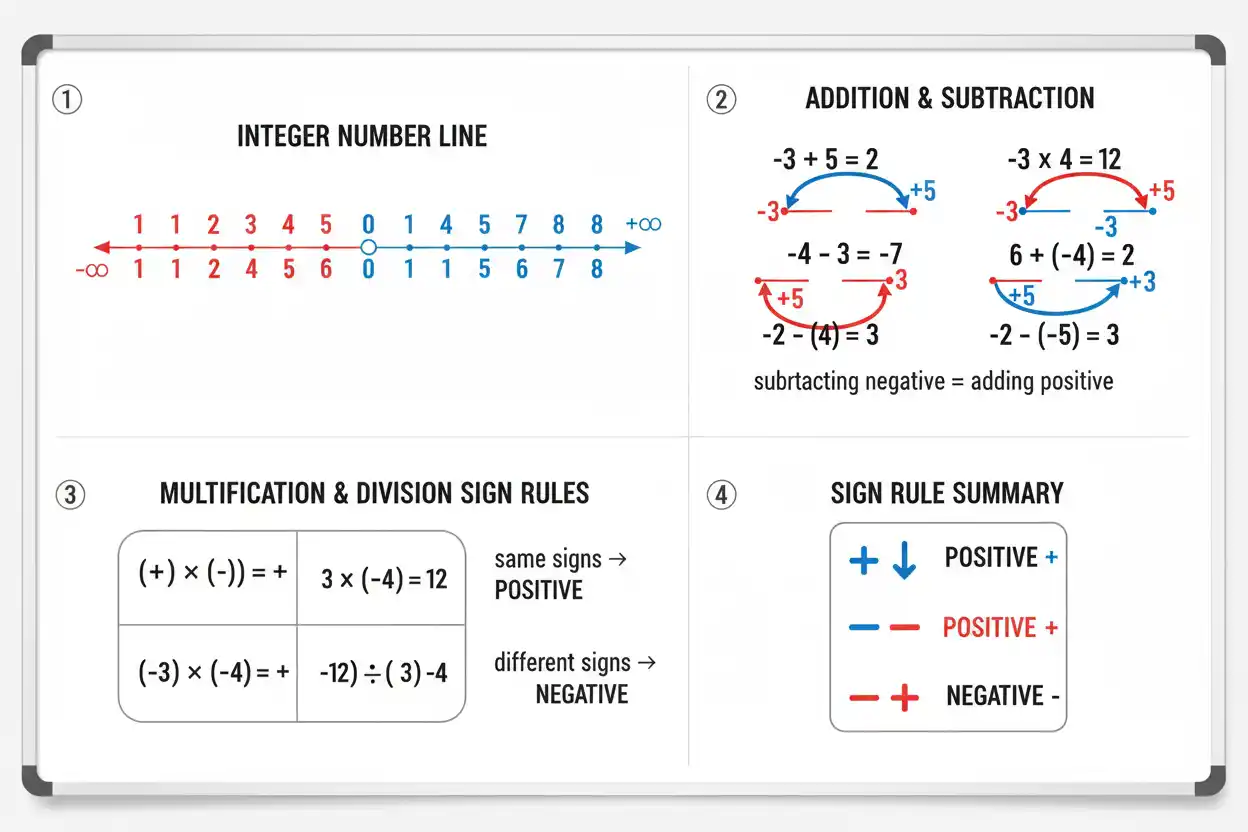
Integer operations are the rules for adding, subtracting, multiplying, and dividing positive whole numbers, negative whole numbers, and zero.
The integers are:
…, -5, -4, -3, -2, -1, 0, 1, 2, 3, 4, 5, …
For example:
7 + (-3) = 4
5 – 9 = -4
(-6)(4) = -24
(-20) ÷ (-5) = 4
The arithmetic itself is familiar, but negative signs make the rules especially important. Addition and subtraction depend on direction and magnitude, while multiplication and division use predictable sign patterns.
Integer operations form a core part of arithmetic and number theory and support calculations involving factors, fractions, sequences, coordinates, algebra, and numeral systems.
What Are Integers?
Integers are whole numbers and their negatives, including zero.
Examples:
-12
-3
0
8
147
Numbers such as:
1/2
3.7
√2
are not integers.
An integer has no nonzero fractional component.
The set of integers is often represented by:
{…, -2, -1, 0, 1, 2, …}
The Four Main Integer Operations
The four basic integer operations are:
Addition
a + b
Subtraction
a – b
Multiplication
a × b
Division
a ÷ b
Addition, subtraction, and multiplication of two integers always produce another integer.
Division is different.
For example:
8 ÷ 4 = 2
is an integer, but:
8 ÷ 3 = 8/3
is not.
So integers are closed under addition, subtraction, and multiplication, but not ordinary division.
Adding Two Positive Integers
When both integers are positive, add normally.
For example:
8 + 5 = 13
and:
24 + 17 = 41
The result is positive.
In general:
positive + positive = positive
Adding Two Negative Integers
When both integers are negative, add their absolute values and keep the negative sign.
For example:
-6 + (-4)
Add magnitudes:
6 + 4 = 10
Keep the negative sign:
-6 + (-4) = -10
Another example:
-15 + (-8) = -23
So:
negative + negative = negative
Adding Integers With Different Signs
When the signs differ, subtract the smaller absolute value from the larger absolute value.
Then keep the sign of the number with the greater absolute value.
Consider:
9 + (-4)
Subtract magnitudes:
9 – 4 = 5
Since 9 has the greater magnitude and is positive:
9 + (-4) = 5
Now consider:
-9 + 4
The magnitude calculation is still:
9 – 4 = 5
but the larger-magnitude number is negative.
Therefore:
-9 + 4 = -5
Integer Addition on a Number Line
A number line provides a useful interpretation.
For:
3 + 5
start at 3 and move five units right:
8
For:
3 + (-5)
start at 3 and move five units left:
-2
Therefore:
3 + (-5) = -2
Positive additions move right; negative additions move left.
Subtracting Integers
Subtraction can always be rewritten as addition of the opposite:
a – b = a + (-b)
This is the central rule for integer subtraction.
For example:
8 – 3
becomes:
8 + (-3)
so:
8 – 3 = 5
More importantly:
8 – (-3)
becomes:
8 + 3
Therefore:
8 – (-3) = 11
Subtracting a negative is equivalent to adding the corresponding positive number.
Example: Negative Minus Positive
Calculate:
-7 – 5
Rewrite:
-7 + (-5)
Add the negative integers:
-7 – 5 = -12
Example: Negative Minus Negative
Calculate:
-7 – (-5)
Rewrite:
-7 + 5
The signs differ, so subtract magnitudes:
7 – 5 = 2
The larger magnitude belongs to -7.
Therefore:
-7 – (-5) = -2
Multiplying Positive and Negative Integers
Integer multiplication follows a simple sign rule:
positive × positive = positive
positive × negative = negative
negative × positive = negative
negative × negative = positive
For example:
6 × 4 = 24
6 × (-4) = -24
(-6) × 4 = -24
(-6) × (-4) = 24
The magnitude is calculated normally; the signs determine whether the result is positive or negative.
Why Two Negatives Multiply to a Positive
The rule is required for consistency with the distributive property.
Consider:
0 = (-3) × 0
Since:
0 = 2 + (-2)
we have:
(-3)[2 + (-2)] = 0
Distribute:
(-3)(2) + (-3)(-2) = 0
Since:
(-3)(2) = -6
we need:
-6 + (-3)(-2) = 0
Therefore:
(-3)(-2) = 6
So the product of two negatives must be positive.
Multiplying More Than Two Signed Integers
Count the number of negative factors.
An even number of negative factors produces a positive product.
An odd number produces a negative product.
For example:
(-2)(-3)(4)
There are two negative factors, so the result is positive:
6 × 4 = 24
Therefore:
(-2)(-3)(4) = 24
Now:
(-2)(-3)(-4)
contains three negative factors.
Therefore:
(-2)(-3)(-4) = -24
Multiplication by Zero
For every integer a:
a × 0 = 0
and:
0 × a = 0
For example:
-875 × 0 = 0
Zero eliminates the magnitude and sign of the other factor in multiplication.
Multiplication by 1 and -1
Multiplying by 1 leaves an integer unchanged:
a × 1 = a
For example:
-17 × 1 = -17
Multiplying by -1 changes its sign:
a × (-1) = -a
For example:
12 × (-1) = -12
and:
-12 × (-1) = 12
Dividing Integers
The sign rules for integer division match multiplication:
positive ÷ positive = positive
negative ÷ negative = positive
positive ÷ negative = negative
negative ÷ positive = negative
For example:
24 ÷ 6 = 4
-24 ÷ 6 = -4
24 ÷ -6 = -4
-24 ÷ -6 = 4
Integer Division Does Not Always Produce an Integer
Consider:
17 ÷ 5
The exact quotient is:
17/5
or:
3.4
Neither result is an integer.
In quotient-and-remainder form:
17 = 5 × 3 + 2
so:
17 ÷ 5 = 3 remainder 2
This is why ordinary integer sets are not closed under division.
Division by Zero
No integer can be divided by zero.
Expressions such as:
8 ÷ 0
-15 ÷ 0
0 ÷ 0
do not have ordinary division values.
For nonzero integer a:
a ÷ 0 is undefined
But:
0 ÷ a = 0
when:
a ≠ 0
Absolute Value
The absolute value of an integer is its distance from zero.
Therefore:
|7| = 7
and:
|-7| = 7
Absolute value is always nonnegative.
It is useful when comparing magnitudes during signed addition.
For example:
-12 + 5
Since:
|-12| > |5|
the result takes the negative sign.
Subtract magnitudes:
12 – 5 = 7
Therefore:
-12 + 5 = -7
Opposite Integers
Two integers are opposites when they have the same magnitude but different signs.
Examples:
8 and -8
21 and -21
Their sum is zero:
a + (-a) = 0
For example:
13 + (-13) = 0
This relationship makes each integer’s negative its additive inverse.
Integer Addition Is Commutative
Changing the order of addition does not change the result:
a + b = b + a
For example:
-4 + 9 = 5
and:
9 + (-4) = 5
Therefore integer addition is commutative.
Integer Multiplication Is Commutative
Similarly:
ab = ba
For example:
(-3)(8) = -24
and:
8(-3) = -24
So multiplication is commutative.
Subtraction Is Not Commutative
For subtraction:
a – b ≠ b – a
in general.
For example:
9 – 4 = 5
but:
4 – 9 = -5
Therefore subtraction is not commutative.
Division Is Not Commutative
Likewise:
a ÷ b
is generally not equal to:
b ÷ a
For example:
12 ÷ 3 = 4
but:
3 ÷ 12 = 1/4
Changing the order changes the result.
Associative Property of Addition
Integer addition is associative:
(a + b) + c = a + (b + c)
For example:
(-2 + 5) + 7
= 3 + 7
= 10
and:
-2 + (5 + 7)
= -2 + 12
= 10
Associative Property of Multiplication
Multiplication is also associative:
(ab)c = a(bc)
For example:
[(-2)(3)]4
= (-6)4
= -24
and:
(-2)(3 × 4)
= (-2)(12)
= -24
Subtraction and Division Are Not Associative
Consider subtraction:
(10 – 6) – 2 = 2
but:
10 – (6 – 2) = 6
So subtraction is not associative.
For division:
(24 ÷ 6) ÷ 2 = 2
but:
24 ÷ (6 ÷ 2) = 8
So division is not associative either.
Distributive Property
Multiplication distributes over addition:
a(b + c) = ab + ac
For example:
-3(4 + 2)
Calculate inside first:
-3 × 6 = -18
Or distribute:
(-3)(4) + (-3)(2)
= -12 – 6
= -18
Both routes agree.
Multiplication also distributes over subtraction:
a(b – c) = ab – ac
Order of Operations With Integers
Expressions containing several integer operations follow the standard order of operations.
Consider:
-4 + 3 × 6
Multiply first:
3 × 6 = 18
Then:
-4 + 18 = 14
Therefore:
-4 + 3 × 6 = 14
It would be incorrect to add -4 + 3 first unless parentheses required it.
Example With Parentheses
Evaluate:
(-4 + 3) × 6
Calculate inside parentheses:
-4 + 3 = -1
Then:
-1 × 6 = -6
Therefore:
(-4 + 3) × 6 = -6
Compare this with:
-4 + 3 × 6 = 14
The parentheses completely change the result.
Negative Signs and Exponents
A negative sign and an exponent require careful grouping.
Compare:
(-3)²
with:
-3²
The first gives:
(-3)(-3) = 9
But standard order of operations interprets:
-3² = -(3²)
so:
-3² = -9
The exponents apply before an ungrouped leading negative sign.
Integer Operations With Improper Fractions
An improper fraction is not itself necessarily an integer, but integer operations are used extensively in its numerator, denominator, and quotient-remainder conversion.
For example:
17/5
uses integer division:
17 = 5 × 3 + 2
Therefore:
17/5 = 3 2/5
The values 17, 5, 3, and 2 are integers, while the overall fraction is rational but not an integer.
Integers vs. Irrational Numbers
irrational numbers such as:
√2
and:
π
are not integers.
However, integers can appear in calculations with irrational values.
For example:
3 + √2
is irrational.
Likewise:
5√2
is irrational.
Integer operations describe calculations inside the integer set; introducing an irrational operand generally moves the result into the broader real-number system.
Integer Operations in Hexadecimal
hexadecimal is a different numeral system, but its whole-number values are still integers.
For example:
A₁₆ = 10₁₀
and:
F₁₆ = 15₁₀
So:
A₁₆ + 5₁₆ = F₁₆
This is simply:
10 + 5 = 15
expressed in base 16.
The underlying integer operation is unchanged by the numeral system.
Integer Operations and Lattice Points
A lattice point has integer coordinates.
For example:
(3, -2)
is a lattice point because both coordinates are integers.
Operations on coordinates frequently use integer arithmetic.
If:
P = (3, -2)
and:
Q = (-5, 7)
then their coordinate difference is:
Q – P = (-5 – 3, 7 – (-2))
= (-8, 9)
Both resulting coordinates remain integers.
Integer Operations in Harmonic Sequences
A harmonic sequence may have reciprocal denominators generated by integer arithmetic.
For example:
1/3, 1/7, 1/11, 1/15, …
has reciprocals:
3, 7, 11, 15, …
Their common difference is:
7 – 3 = 4
11 – 7 = 4
15 – 11 = 4
The harmonic terms are fractions, but the reciprocal arithmetic can be driven by integer operations.
Integer Operations and Factors
A factor of an integer divides it exactly.
For example:
6 is a factor of 42
because:
42 ÷ 6 = 7
Both the dividend and quotient are integers.
Factor relationships therefore depend directly on exact integer division.
Integer Operations and Divisibility
Divisibility rules provide shortcuts for determining whether integer division produces remainder zero.
For example, test:
4,572
for divisibility by 3.
Digit sum:
4 + 5 + 7 + 2 = 18
Since:
18 ÷ 3 = 6
the original number is divisible by 3.
Therefore:
4,572 ÷ 3
produces an integer.
Integer Operations With Zero
Zero behaves in several important ways:
Addition:
a + 0 = a
Subtraction:
a – 0 = a
Multiplication:
a × 0 = 0
Division:
0 ÷ a = 0
for:
a ≠ 0
But:
a ÷ 0
is undefined.
These rules make zero both the additive identity and the absorbing element for multiplication.
Closure of Integer Operations
Integers are closed under an operation when applying that operation to any two integers always produces another integer.
Addition:
integer + integer = integer
Subtraction:
integer – integer = integer
Multiplication:
integer × integer = integer
Division does not have closure.
For example:
1 ÷ 2 = 1/2
and 1/2 is not an integer.
Sign Rules at a Glance
| Operation | Signs | Result sign |
|---|---|---|
| Addition | Same positive | Positive |
| Addition | Same negative | Negative |
| Addition | Different | Sign of larger magnitude |
| Multiplication | Same | Positive |
| Multiplication | Different | Negative |
| Division | Same | Positive |
| Division | Different | Negative |
For subtraction, first rewrite:
a – b = a + (-b)
and then use the addition rule.
Practical Example: Temperature Change
Suppose the temperature begins at:
-4°C
and falls another:
7°C
The calculation is:
-4 + (-7)
= -11
Therefore:
New temperature = -11°C
Now suppose the temperature rises 9°C from -11°C:
-11 + 9 = -2
So:
New temperature = -2°C
Signed integers naturally represent movement above and below a reference point.
Practical Example: Account Change
Suppose a balance is represented relative to zero.
Starting balance:
50
A withdrawal of 80 can be represented as:
-80
Then:
50 + (-80) = -30
The resulting signed value is:
-30
The negative sign indicates the balance lies 30 units below zero.
Practical Example: Elevation
Suppose a diver is at:
-18 m
relative to sea level and rises:
7 m
Calculate:
-18 + 7 = -11
The diver is now:
11 m below sea level
or:
-11 m
Common Integer Addition Mistake
A frequent error is adding signs mechanically.
For:
-8 + 3
the result is not:
-11
because the signs differ.
Subtract magnitudes:
8 – 3 = 5
and keep the sign of the larger magnitude:
-5
Common Integer Subtraction Mistake
For:
6 – (-4)
two negative signs appear next to each other because one is the subtraction operation and the other belongs to the integer -4.
Rewrite:
6 + 4
Therefore:
6 – (-4) = 10
Do not incorrectly treat it as:
6 – 4 = 2
Common Multiplication Mistake
For:
(-5)(-3)
two negative factors produce a positive result:
15
The rule is not based on whichever number has the larger magnitude. That comparison rule applies to addition with unlike signs, not multiplication.
Common Division Mistake
For:
-36 ÷ -6
same signs produce a positive result:
6
Another error is assuming every integer division gives an integer. For example:
10 ÷ 4 = 2.5
which is not an integer.
How to Check Integer Addition
For:
-13 + 8 = -5
reverse the addition:
-5 – 8 = -13
or inspect movement on a number line.
Starting at -13 and moving eight places right ends at:
-5
How to Check Integer Multiplication
Suppose:
(-7)(6) = -42
Check the magnitude:
7 × 6 = 42
There is one negative factor, so the sign must be negative.
Therefore:
-42
is correct.
Frequently Asked Questions
What are integer operations?
Integer operations are addition, subtraction, multiplication, and division involving positive integers, negative integers, and zero.
What are integers?
Integers are whole numbers, their negatives, and zero:
…, -2, -1, 0, 1, 2, …
How do you add two negative integers?
Add their absolute values and keep the negative sign.
For example:
-4 + (-7) = -11
How do you add integers with different signs?
Subtract the smaller absolute value from the larger one and use the sign of the number with the greater absolute value.
What happens when you subtract a negative integer?
Subtracting a negative is equivalent to adding a positive:
a – (-b) = a + b
What is a negative times a negative?
Positive.
For example:
(-4)(-5) = 20
What is a positive times a negative?
Negative.
4(-5) = -20
What is a negative divided by a negative?
Positive.
-20 ÷ -5 = 4
Are integers closed under division?
No.
For example:
5 ÷ 2 = 2.5
which is not an integer.
Can you divide an integer by zero?
No. Division by zero is undefined.
Is zero an integer?
Yes.
Is 3/2 an integer?
No. It is rational, but it is not a whole number.
Final Example
Evaluate:
-8 + 3[4 – (-2)] ÷ 2
Follow the order of operations.
First calculate inside the brackets:
4 – (-2) = 4 + 2
= 6
The expression becomes:
-8 + 3 × 6 ÷ 2
Perform multiplication and division from left to right:
3 × 6 = 18
Then:
18 ÷ 2 = 9
Finally:
-8 + 9 = 1
Therefore:
-8 + 3[4 – (-2)] ÷ 2 = 1
The essential integer-operation rules are consistent: subtraction becomes addition of an opposite, same-sign products and quotients are positive, different-sign products and quotients are negative, and addition with different signs is determined by the larger magnitude.