
Percent error measures how far an observed, measured, or experimental value is from an accepted or reference value, expressed as a percentage of the reference value.
The standard formula is:
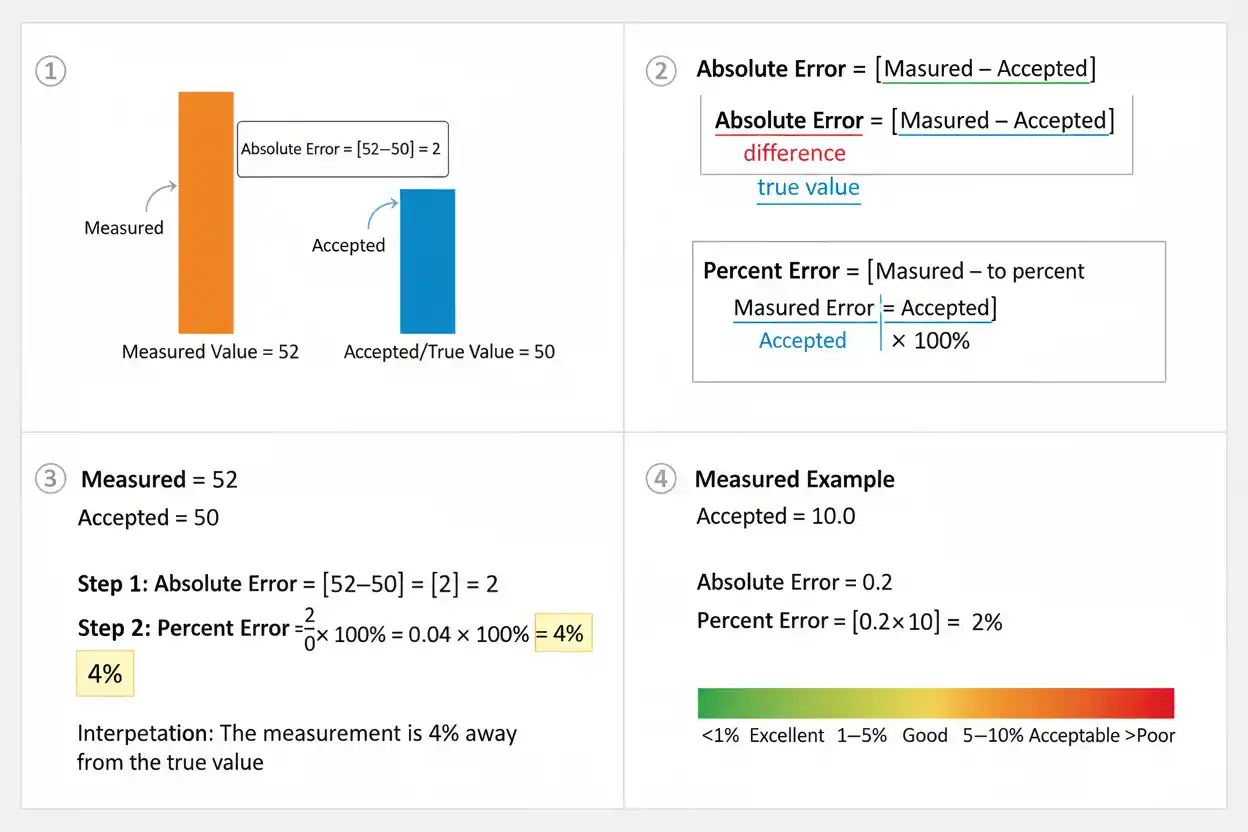
Percent Error = |Measured Value – Accepted Value| / |Accepted Value| × 100%
For example, suppose a measurement gives:
Measured value = 52
while the accepted value is:
Accepted value = 50
First find the absolute error:
|52 – 50| = 2
Divide by the accepted value:
2 / 50 = 0.04
Convert to a percentage:
0.04 × 100% = 4%
Therefore:
Percent Error = 4%
A smaller percent error generally means the measured value is closer to the reference value relative to its size.
What Is Percent Error?
Percent error compares the magnitude of an error with the value being used as the accepted standard.
Suppose:
A = accepted value
M = measured value
The absolute error is:
|M – A|
Percent error scales that error relative to A:
Percent Error = |M – A| / |A| × 100%
The absolute-value bars ensure that the usual percent error is nonnegative.
This makes measurements of different sizes easier to compare. An error of 5 units may be substantial when the true value is 20 but minor when the true value is 10,000.
Percent error belongs to the broader percentage framework within arithmetic and number theory.
Percent Error Formula
The formula is:
Percent Error = |Experimental – Accepted| / |Accepted| × 100%
Equivalent terminology includes:
Percent Error = |Observed – Actual| / |Actual| × 100%
or:
Percent Error = |Measured – Reference| / |Reference| × 100%
The wording can vary by context, but the denominator is the accepted, actual, theoretical, or reference value—not the measured value.
Variables in the Formula
Let:
M = measured or experimental value
A = accepted, actual, or reference value
E = absolute error
Then:
E = |M – A|
and:
Percent Error = E / |A| × 100%
For positive accepted values, this is simply:
Percent Error = E / A × 100%
Why Absolute Value Is Used
Suppose:
Measured = 48
Accepted = 50
The raw difference is:
48 – 50 = -2
But ordinary percent error describes the magnitude of the discrepancy.
Therefore:
|-2| = 2
and:
Percent Error = 2/50 × 100%
= 4%
Now suppose the measurement were:
52
The difference would be:
+2
and the percent error would again be:
4%
Both measurements are equally far from the accepted value.
Example: Measured Value Below Accepted Value
Suppose:
Measured = 96
Accepted = 100
Find the difference:
96 – 100 = -4
Take absolute value:
|-4| = 4
Then:
Percent Error = 4/100 × 100%
= 4%
Therefore:
Percent Error = 4%
Example: Measured Value Above Accepted Value
Suppose:
Measured = 108
Accepted = 100
Absolute error:
|108 – 100| = 8
Then:
8/100 × 100% = 8%
Therefore:
Percent Error = 8%
The measured value being above the accepted value does not make the standard percent error negative.
Step-by-Step Percent Error Method
For most problems, the calculation can be organized as:
Difference = Measured – Accepted
Then:
Absolute Error = |Difference|
Then:
Relative Error = Absolute Error / |Accepted|
Finally:
Percent Error = Relative Error × 100%
The order of operations matters because the subtraction and absolute value must be handled before division and multiplication by 100%.
Example: 72 vs. 75
Suppose:
Measured value = 72
Accepted value = 75
Absolute error:
|72 – 75| = 3
Relative error:
3/75 = 0.04
Convert to percentage:
0.04 × 100% = 4%
Therefore:
Percent Error = 4%
Example: 47.5 vs. 50
Calculate:
|47.5 – 50| = 2.5
Then:
2.5/50 = 0.05
Convert:
0.05 × 100% = 5%
Therefore:
Percent Error = 5%
The same formula works with decimal measurements.
Example With a Small Accepted Value
Suppose:
Measured = 0.48
Accepted = 0.50
Absolute error:
|0.48 – 0.50| = 0.02
Then:
0.02/0.50 = 0.04
Therefore:
Percent Error = 4%
An absolute error of only 0.02 still represents a 4% error because the reference value itself is small.
Example With Large Numbers
Suppose:
Measured = 9,850
Accepted = 10,000
Absolute error:
|9,850 – 10,000| = 150
Relative error:
150/10,000 = 0.015
Therefore:
Percent Error = 1.5%
A 150-unit discrepancy may sound large, but relative to 10,000 it is only 1.5%.
Percent Error as Relative Error
Before multiplying by 100%, the quantity:
|M-A|/|A|
is the relative error.
For example:
Relative Error = 0.025
means the error equals:
2.5%
of the reference value.
So:
Percent Error = Relative Error × 100%
This is the same decimal-to-percentage relationship used throughout percentage calculations.
Absolute Error vs. Percent Error
Absolute error measures the difference in the original units:
Absolute Error = |Measured – Accepted|
Percent error measures that difference relative to the accepted value:
Percent Error = Absolute Error / |Accepted| × 100%
Suppose:
Measured = 198 cm
Accepted = 200 cm
Absolute error:
2 cm
Percent error:
2/200 × 100%
= 1%
Therefore the error can be described as:
2 cm absolute error
or:
1% percent error
depending on which comparison is useful.
Why Percent Error Is Useful
Absolute differences alone can be misleading when comparing measurements on different scales.
Suppose Measurement A misses a target by:
2 units out of 20
and Measurement B misses by:
5 units out of 500
For A:
2/20 × 100% = 10%
For B:
5/500 × 100% = 1%
Although B has the larger absolute error, its percent error is much smaller.
Percent Error vs. Percentage
A percentage expresses one quantity as a fraction of 100.
Percent error is a specific percentage calculation where the numerator is the absolute difference between measured and accepted values.
The general percentage formula is:
Percentage = Part / Whole × 100%
For percent error:
Part = Absolute Error
Whole = |Accepted Value|
Therefore percent error is a specialized application of the broader percentage relationship.
Percent Error vs. Percentage Change
Percent error and percentage change answer different questions.
Percent error asks:
How far is a measured value from an accepted reference?
Its denominator is:
accepted/reference value
Percentage change asks:
How much did a quantity change from an original value?
Its denominator is:
original value
The formulas may look similar, but their interpretations differ.
Percent Error vs. Percent Off
Percent off measures a reduction from an original price or amount.
For example:
20% off
means the discount is 20% of the original price.
Percent error instead measures disagreement with a reference value.
A product reduced from $100 to $80 has:
20% off
but calling that a 20% “error” would be inappropriate because the decrease is intentional.
Percent Error vs. Percentage Difference
When two experimental values are being compared and neither is considered the accepted or true reference, percentage difference is often more appropriate.
Percent error requires one value to play a reference role.
For example:
Experimental result A = 48
Experimental result B = 52
If neither is the accepted value, choosing one arbitrarily as the percent-error denominator creates an asymmetric comparison.
A percentage-difference calculation instead typically uses an average-based denominator.
Finding the Measured Value From Percent Error
If the accepted value and percent error are known, the magnitude of the permitted error can be calculated.
Suppose:
Accepted = 200
Percent Error = 3%
Convert:
3% = 0.03
Absolute error:
E = 200 × 0.03
= 6
Therefore a value with exactly 3% error can lie:
6 units below
or:
6 units above
the accepted value.
So:
Measured = 194
or:
Measured = 206
Both have 3% percent error.
Formula for Error Tolerance
If:
p = percent error as a decimal
and:
A = accepted value
then:
Absolute Error = p|A|
Therefore the measured value can be written:
M = A ± p|A|
For a positive accepted value:
M = A(1 ± p)
This gives the upper and lower boundaries corresponding to a specified percent error.
Example: 5% Error Around 80
Suppose:
Accepted = 80
Allowed percent error:
5%
Convert:
5% = 0.05
Absolute tolerance:
80 × 0.05 = 4
Therefore the endpoints are:
80 – 4 = 76
and:
80 + 4 = 84
So values from 76 through 84 are within 5% of 80, with the endpoints having exactly:
5% error
Finding the Accepted Value
Suppose the absolute error and percent error are known.
From:
Percent Error = Error / |Accepted| × 100%
solve:
|Accepted| = Error × 100 / Percent Error
For example:
Absolute error = 6
Percent error = 3%
Then:
Accepted = 6 × 100 / 3
= 200
for a positive reference quantity.
Therefore:
Accepted value = 200
Percent Error Greater Than 100%
Percent error can exceed 100%.
Suppose:
Accepted = 10
Measured = 25
Absolute error:
|25 – 10| = 15
Then:
15/10 × 100%
= 150%
Therefore:
Percent Error = 150%
There is no general rule limiting percent error to 100%.
Can Percent Error Equal 100%?
Yes.
For a positive accepted value:
Accepted = 50
Measured = 0
Absolute error:
50
Then:
50/50 × 100% = 100%
Another measured value:
100
also differs from 50 by 50, producing:
100%
percent error.
Can Percent Error Be Zero?
Yes.
If:
Measured = Accepted
then:
|M-A| = 0
Therefore:
Percent Error = 0%
For example:
Measured = 42
Accepted = 42
gives:
0/42 × 100% = 0%
A zero percent error means the two values agree exactly at the precision being used.
What If the Accepted Value Is Zero?
The ordinary percent error formula becomes:
|Measured – 0| / 0 × 100%
which requires division by zero.
Therefore:
standard percent error is undefined when the accepted value is zero
An absolute error or another context-specific error metric should be used instead.
This is an important limitation of relative and percentage error measures.
Negative Accepted Values
For quantities that can legitimately have negative reference values, using the magnitude of the denominator avoids a negative percent error:
Percent Error = |M-A| / |A| × 100%
For example:
Measured = -19
Accepted = -20
Absolute error:
|-19 – (-20)| = 1
Reference magnitude:
|-20| = 20
Therefore:
1/20 × 100% = 5%
So:
Percent Error = 5%
Rounding Percent Error
Suppose:
Measured = 99
Accepted = 103
Calculate:
|99-103| = 4
Then:
4/103 × 100%
≈ 3.883495%
Depending on required precision, this may be reported as:
3.88%
or:
3.9%
Avoid excessive rounding before the final step because intermediate rounding can slightly alter the reported result.
Decimal Arithmetic in Percent Error
Accurate decimal arithmetic is important when measured values are not integers.
Suppose:
M = 12.46
A = 12.50
Absolute error:
|12.46 – 12.50| = 0.04
Then:
0.04/12.50 = 0.0032
Multiply:
0.0032 × 100% = 0.32%
Therefore:
Percent Error = 0.32%
Fraction Form of Percent Error
The relative-error portion is often naturally a fraction.
Suppose:
M = 18
A = 20
Then:
|18-20|/20 = 2/20
Simplify:
2/20 = 1/10
Convert using the same relationship as fractions to percent:
1/10 = 10%
Therefore:
Percent Error = 10%
Measurements of Slopes
Percent error can be applied to measured slopes in coordinate geometry.
Suppose the theoretical slope of a line is:
2.00
but an experiment estimates:
1.94
Then:
Percent Error = |1.94 – 2.00|/2.00 × 100%
= 0.06/2 × 100%
= 3%
Therefore the measured slope has:
3% error relative to the theoretical slope
For exact parallel and perpendicular lines, slopes must satisfy exact mathematical relationships. Percent error instead becomes useful when real measurements approximate those theoretical slopes.
Percent Error Across a Number Sequence
Suppose an expected number sequence contains:
10, 20, 30, 40
but the third measured term is:
29
Using the expected third term as the reference:
Percent Error = |29 – 30|/30 × 100%
= 1/30 × 100%
≈ 3.33%
Therefore:
The measured third term has approximately 3.33% error
Percent error can be applied term by term when a theoretical sequence provides reference values.
Average Percent Error
When several observations are available, individual percent errors can be calculated and then summarized.
Suppose the individual errors are:
2%
3%
5%
Their arithmetic mean is:
(2 + 3 + 5)/3
= 10/3
≈ 3.33%
So the mean of the individual percent errors is:
approximately 3.33%
However, this should not automatically be treated as equivalent to computing one percent error from averaged raw measurements. The two procedures can answer different statistical questions.
Percent Error and Accuracy
A smaller percent error often indicates a measurement closer to the accepted value.
For example:
Experiment A:
2% error
Experiment B:
8% error
Relative to the same type of accepted reference, Experiment A is closer.
However, percent error alone does not describe precision, repeatability, uncertainty, bias, or the full quality of an experimental method.
It measures one specific relative discrepancy.
Common Mistake: Using the Measured Value in the Denominator
Suppose:
Measured = 48
Accepted = 50
The standard calculation is:
|48-50|/50 × 100%
not:
|48-50|/48 × 100%
The reference value belongs in the denominator.
Using a different denominator changes the metric.
Common Mistake: Forgetting Absolute Value
Suppose:
Measured = 90
Accepted = 100
Without absolute value:
(90-100)/100 × 100% = -10%
The negative sign indicates direction, not error magnitude.
Standard percent error is:
|-10|/100 × 100%
= 10%
Therefore:
Percent Error = 10%
Common Mistake: Forgetting to Multiply by 100%
If:
Relative Error = 0.04
then:
Percent Error = 4%
not:
0.04%
Multiplying by 100 converts a decimal ratio into percentage form.
Common Mistake: Dividing by the Difference
The denominator is not the error itself.
For:
Measured = 52
Accepted = 50
the correct formula is:
2/50 × 100%
not:
50/2 × 100%
The reference quantity establishes the comparison scale.
Common Mistake: Calling Every Difference a Percent Error
Percent error is appropriate when one value serves as an accepted or reference value.
A sale reduction is better described with percent off.
A change over time is better described with percentage change.
Two peer measurements with no reference may call for percentage difference.
Choosing the correct denominator depends on the question being asked.
How to Check a Percent Error
Suppose:
Measured = 77
Accepted = 80
Proposed percent error:
3.75%
Check the absolute error:
|77-80| = 3
Find 3.75% of the accepted value:
0.0375 × 80
= 3
The calculated error matches the actual 3-unit difference.
Therefore:
3.75% is correct
Frequently Asked Questions
What is percent error?
Percent error measures the absolute difference between a measured value and an accepted value as a percentage of the accepted value.
What is the percent error formula?
Percent Error = |Measured – Accepted| / |Accepted| × 100%
Why is absolute value used in percent error?
It makes the standard error measure nonnegative and focuses on the size of the discrepancy rather than whether the measurement is above or below the reference.
What is the percent error of 48 when the accepted value is 50?
|48-50|/50 × 100%
= 2/50 × 100%
= 4%
What is the percent error of 105 when the actual value is 100?
5/100 × 100% = 5%
Can percent error be greater than 100%?
Yes. If the absolute error exceeds the magnitude of the accepted value, percent error exceeds 100%.
Can percent error be zero?
Yes. It is zero when the measured and accepted values are equal.
Can percent error be negative?
Standard absolute percent error is nonnegative because absolute value is used.
What happens if the accepted value is zero?
The standard percent error formula is undefined because it would require division by zero.
Is percent error the same as percentage change?
No. Percent error compares a measured value with a reference value. Percentage change compares a new value with an original value.
Is percent error the same as percent off?
No. Percent off measures an intentional reduction from an original amount or price.
Final Example
A laboratory measurement gives:
248.5
while the accepted value is:
250
Find the percent error.
First calculate the difference:
248.5 – 250 = -1.5
Take absolute value:
|-1.5| = 1.5
Divide by the accepted value:
1.5/250 = 0.006
Convert to percentage:
0.006 × 100% = 0.6%
Therefore:
Percent Error = 0.6%
The core relationship is:
Percent Error = |Measured – Accepted| / |Accepted| × 100%
It measures the size of a discrepancy relative to the reference value, making errors comparable across quantities of different scales.