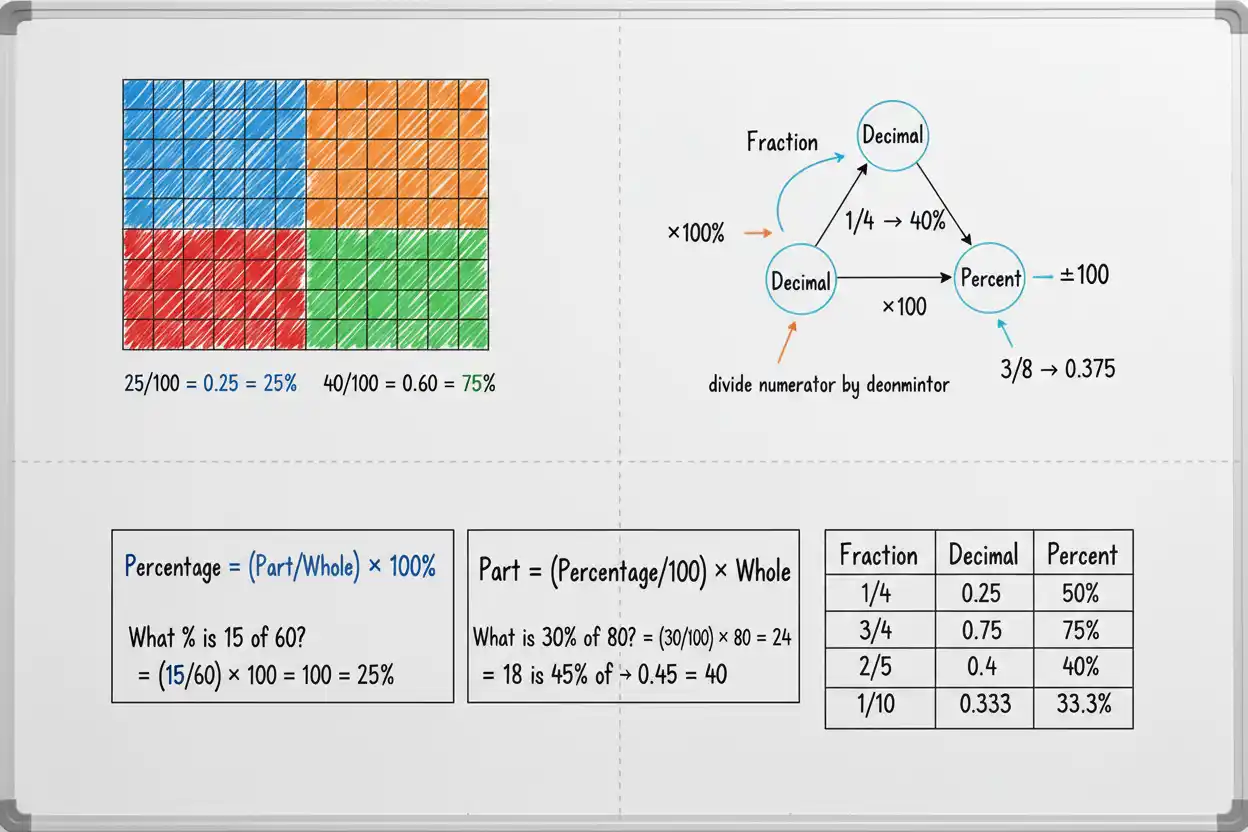

A percentage expresses a quantity as a proportion of 100. The symbol:
%
means:
per hundred
So:
25% = 25/100 = 0.25
and:
80% = 80/100 = 0.8
The basic percentage formula is:
Percentage = Part / Whole × 100%
For example, if 18 out of 24 items meet a condition:
Percentage = 18/24 × 100%
= 0.75 × 100%
= 75%
Therefore:
18 is 75% of 24
Percentage calculations appear throughout arithmetic and number theory because they provide a standardized way to compare proportions, fractions, rates, discounts, errors, changes, and many other quantities.
What Is a Percentage?
A percentage is a dimensionless ratio expressed relative to:
100
For example:
37%
means:
37 out of every 100
or:
37/100
which simplifies numerically to:
0.37
Likewise:
5% = 5/100 = 0.05
125% = 125/100 = 1.25
Percentages are not restricted to values from 0% through 100%. A percentage can exceed 100% when the part is larger than the reference whole.
Percentage Formula
The standard formula is:
Percentage = Part / Whole × 100%
where the whole is nonzero.
Let:
P = percentage
A = part
W = whole
Then:
P = A/W × 100%
For example:
A = 30
W = 120
Then:
P = 30/120 × 100%
= 0.25 × 100%
= 25%
Therefore:
30 is 25% of 120
Finding the Part
If the percentage and whole are known:
Part = Percentage × Whole
The percentage must first be converted to decimal form.
If:
p%
is the percentage, then:
p% = p/100
Therefore:
Part = (p/100) × Whole
Example
Find:
35% of 240
Convert:
35% = 0.35
Multiply:
240 × 0.35 = 84
Therefore:
35% of 240 is 84
Finding the Whole
If the part and percentage are known:
Whole = Part / Percentage
with the percentage written as a decimal.
For example:
45 is 30% of what number?
Convert:
30% = 0.30
Then:
Whole = 45/0.30
= 150
Therefore:
45 is 30% of 150
Three Core Percentage Formulas
The three basic relationships are:
Percentage = Part / Whole × 100%
Part = Percentage as a decimal × Whole
Whole = Part / Percentage as a decimal
These formulas are rearrangements of the same proportion.
Knowing any two quantities normally allows the third to be calculated.
Percentage as a Fraction
Any percentage can be written over 100:
p% = p/100
For example:
20% = 20/100
Simplify:
20/100 = 1/5
Therefore:
20% = 1/5
Similarly:
25% = 1/4
50% = 1/2
75% = 3/4
The reverse process is developed more specifically under fractions to percent.
Percentage as a Decimal
To convert a percentage to decimal form, divide by 100.
For example:
45% = 45/100
= 0.45
Likewise:
8% = 0.08
0.5% = 0.005
125% = 1.25
A practical way to think about this conversion is moving the decimal point two places to the left.
Decimal to Percentage
To convert a decimal to a percentage, multiply by:
100%
For example:
0.36 × 100% = 36%
Therefore:
0.36 = 36%
Likewise:
0.8 = 80%
0.025 = 2.5%
1.4 = 140%
Accurate decimal arithmetic is especially useful when percentages include decimal values.
Fraction to Percentage Example
Convert:
3/8
to a percentage.
Divide:
3 ÷ 8 = 0.375
Multiply by 100%:
0.375 × 100% = 37.5%
Therefore:
3/8 = 37.5%
Improper Fractions as Percentages
A fraction larger than 1 produces a percentage above 100%.
For example:
5/4 = 1.25
Then:
1.25 × 100% = 125%
Therefore:
5/4 = 125%
This does not indicate an error. It means the value is:
1.25 times
the reference whole.
Mixed Numbers as Percentages
A mixed number can also be converted to a percentage.
Consider:
1 1/2
Convert:
1 1/2 = 3/2
Then:
3/2 = 1.5
Multiply:
1.5 × 100% = 150%
Therefore:
1 1/2 = 150%
What Is 10% of a Number?
Ten percent is:
10/100 = 0.1
Therefore:
10% of x = 0.1x
For example:
10% of 360 = 36
because:
360 × 0.1 = 36
This is particularly useful for mental percentage calculations.
What Is 1% of a Number?
One percent is:
1/100 = 0.01
Therefore:
1% of x = x/100
For example:
1% of 750 = 7.5
Once 1% is known, many other percentages can be built from it.
What Is 5% of a Number?
Five percent is half of 10%.
For:
280
10% is:
28
Therefore 5% is:
14
So:
5% of 280 = 14
What Is 15% of a Number?
Fifteen percent can be separated into:
10% + 5%
For:
200
10%:
20
5%:
10
Add:
20 + 10 = 30
Therefore:
15% of 200 = 30
What Is 20% of a Number?
Twenty percent is:
1/5
because:
20/100 = 1/5
Therefore:
20% of 350
can be calculated:
350/5 = 70
So:
20% of 350 = 70
What Is 25% of a Number?
Twenty-five percent is:
1/4
Therefore:
25% of 160
is:
160/4 = 40
So:
25% of 160 = 40
What Is 50% of a Number?
Fifty percent is:
1/2
Therefore:
50% of 84 = 42
Half of any quantity is 50% of that quantity.
What Is 75% of a Number?
Seventy-five percent is:
3/4
For:
120
calculate:
120 × 3/4
= 90
Therefore:
75% of 120 = 90
Finding a Percentage of a Number
Find:
18% of 450
Convert:
18% = 0.18
Multiply:
450 × 0.18
= 81
Therefore:
18% of 450 = 81
The phrase:
“18% of 450”
translates directly into multiplication.
Finding What Percentage One Number Is of Another
Suppose:
42 is what percentage of 120?
Use:
Percentage = Part/Whole × 100%
Substitute:
42/120 × 100%
Simplify:
0.35 × 100%
= 35%
Therefore:
42 is 35% of 120
Example: 18 Is What Percent of 72?
Calculate:
18/72 = 1/4
Then:
1/4 × 100%
= 25%
Therefore:
18 is 25% of 72
Finding the Whole From a Percentage
Suppose:
24 is 15% of what number?
Let the whole be W.
Then:
0.15W = 24
Divide:
W = 24/0.15
= 160
Therefore:
24 is 15% of 160
Solving Percentage Problems With Proportions
A percentage can be written as a proportion:
Part/Whole = Percent/100
For example:
x/80 = 35/100
Cross-multiply:
100x = 80 × 35
100x = 2,800
Divide:
x = 28
Therefore:
35% of 80 is 28
This proportion method is equivalent to decimal multiplication.
Percentage and Ratios
Suppose a ratio is:
3:5
Interpreting the first quantity relative to the second gives:
3/5
Convert:
3/5 = 0.6
Then:
0.6 × 100% = 60%
Therefore the first quantity is:
60% of the second quantity
The reference quantity must be clear because reversing the ratio changes the percentage.
Percentage of a Percentage
Suppose:
40%
of a group has one characteristic, and:
25%
of that subgroup has another.
The second characteristic applies to:
25% of 40%
Calculate:
0.25 × 0.40
= 0.10
Therefore:
10% of the original group
has both characteristics under those assumptions.
Percentages applied successively are multiplied, not added.
Example: 30% of 60%
Calculate:
0.30 × 0.60
= 0.18
Convert:
18%
Therefore:
30% of 60% = 18%
Percentages Greater Than 100%
A percentage above 100% means the part exceeds the reference whole.
For example:
150%
means:
150/100
= 1.5
So:
150% of 80
is:
1.5 × 80
= 120
Therefore:
150% of 80 = 120
200% of a Number
Two hundred percent is:
200/100 = 2
Therefore:
200% of x = 2x
For:
x = 45
we get:
200% of 45 = 90
A value equal to 200% of another is twice as large.
Percentages Below 1%
A percentage can also be less than 1%.
For example:
0.5%
means:
0.5/100
= 0.005
Therefore:
0.5% of 2,000
is:
2,000 × 0.005
= 10
So:
0.5% of 2,000 = 10
0.01% of a Number
Convert:
0.01% = 0.0001
Therefore:
0.01% of 50,000
is:
50,000 × 0.0001
= 5
So:
0.01% of 50,000 = 5
The % symbol always introduces division by 100, even when the percentage itself already contains a decimal.
Percent Off as a Percentage Application
A percent off calculation uses an original amount as the whole and a discount as the percentage.
For example:
25% off $80
means the discount is:
80 × 0.25 = 20
so the remaining amount is:
80 – 20 = 60
The general percentage page provides the underlying part-whole mathematics, while the discount page handles sale-price formulas and successive discounts in detail.
Percentage Change
A percentage change compares a new value with an original value.
For a positive nonzero starting value, the basic relationship is:
(New – Original)/Original × 100%
For example:
100 → 120
represents:
20/100 × 100%
= 20%
increase.
That calculation uses the original value as the reference whole.
Percent Error
Percent error is another specialized percentage.
It compares an observed or measured value with an accepted reference:
|Measured – Accepted| / |Accepted| × 100%
The absolute difference forms the part, while the accepted value supplies the comparison scale.
The percentage framework is the same, but the interpretation of the numerator and denominator is specific to error measurement.
Percentage Difference
When two peer values are compared and neither is naturally the original or accepted reference, percentage difference uses a different denominator convention.
This distinction matters because:
Part/Whole × 100%
is meaningful only after the appropriate “whole” or reference quantity has been identified.
Percentage formulas are therefore not interchangeable merely because they contain division and multiplication by 100.
Percentages and Parallel Lines
Percentages can describe numerical changes in geometric quantities, but exact parallel and perpendicular lines are classified through slope relationships rather than percentages.
For example, if a slope changes from:
2
to:
2.2
the new slope is:
110%
of the original.
But two distinct nonvertical lines are exactly parallel only when their slopes are equal, not when their slopes differ by a small percentage.
Percentage Points vs. Percentage Change
Suppose a rate rises from:
20%
to:
25%
The difference in percentage points is:
25% – 20% = 5 percentage points
But the relative percentage increase is:
(25 – 20)/20 × 100%
= 25%
Therefore:
20% → 25% is an increase of 5 percentage points but a 25% relative increase
These measurements answer different questions.
Percentage of a Total
Suppose a class has:
32 students
and:
20
are present.
The percentage present is:
20/32 × 100%
= 62.5%
Therefore:
62.5% are present
The percentage absent can be calculated from the remainder:
100% – 62.5%
= 37.5%
The two percentages total:
100%
because they partition the same whole.
Percentages That Sum to 100%
When categories are mutually exclusive and collectively include the entire group, their percentages total:
100%
For example:
Category A = 25%
Category B = 35%
Category C = 40%
Then:
25% + 35% + 40% = 100%
If categories overlap, however, adding their percentages may exceed 100%.
The interpretation depends on whether each observation can belong to more than one category.
Percentage Probability
A probability expressed as:
0.72
can also be represented as:
72%
because:
0.72 × 100% = 72%
Likewise:
probability = 1
corresponds to:
100%
and:
probability = 0
corresponds to:
0%
In ordinary probability, valid probabilities range from 0% through 100%.
Percentage and Fraction Operations
During fraction operations, a percentage may be converted to a fraction or decimal before combining it with other values.
For example:
25% × 3/5
Convert:
25% = 1/4
Then:
1/4 × 3/5
= 3/20
Convert back:
3/20 = 15%
Therefore:
25% of 3/5 = 15%
Percentage and Rational Numbers
A finite percentage such as:
37.5%
is a rational number because:
37.5% = 0.375 = 3/8
Indeed, any terminating percentage written with finitely many decimal digits represents a rational value.
A percentage is a representation of a number, not a separate number system.
Repeated Percentage Multipliers
Suppose a quantity retains:
90%
of its value each period.
The multiplier is:
0.90
After two periods:
Original × 0.90²
After n periods:
Original × 0.90ⁿ
Repeated percentage multipliers can therefore produce a geometric sequence when the same percentage factor is applied at each step.
Percentage Problems and Order of Operations
A formula such as:
Part/Whole × 100%
should be evaluated using the normal order of operations.
For:
18/24 × 100%
first calculate:
18/24 = 0.75
Then:
0.75 × 100% = 75%
Parentheses are especially useful in more complicated percentage formulas to make the intended numerator and denominator explicit.
Common Percentage Equivalents
| Percentage | Decimal | Fraction |
|---|---|---|
| 1% | 0.01 | 1/100 |
| 5% | 0.05 | 1/20 |
| 10% | 0.10 | 1/10 |
| 12.5% | 0.125 | 1/8 |
| 20% | 0.20 | 1/5 |
| 25% | 0.25 | 1/4 |
| 33 1/3% | 0.333… | 1/3 |
| 50% | 0.50 | 1/2 |
| 75% | 0.75 | 3/4 |
| 100% | 1 | 1 |
| 125% | 1.25 | 5/4 |
| 200% | 2 | 2 |
Recognizing common equivalents can make calculations much faster.
Common Mistake: Dividing the Wrong Way
To find what percentage 20 is of 80:
Part/Whole
is:
20/80
not:
80/20
The correct result is:
0.25 × 100%
= 25%
Reversing the fraction gives 400%, which answers a different comparison.
Common Mistake: Forgetting to Divide by 100
For:
30% of 200
you cannot calculate:
30 × 200
The percentage must first become:
30/100 = 0.30
Then:
0.30 × 200 = 60
Therefore:
30% of 200 = 60
Common Mistake: Confusing 0.5 With 0.5%
The decimal:
0.5
equals:
50%
But:
0.5%
equals:
0.005
These values differ by a factor of:
100
For example:
0.5 × 1,000 = 500
while:
0.005 × 1,000 = 5
Common Mistake: Assuming Percentages Cannot Exceed 100%
If:
Part = 150
Whole = 100
then:
150/100 × 100%
= 150%
Therefore:
150 is 150% of 100
Percentages above 100% are entirely valid whenever the compared part exceeds the reference whole.
Common Mistake: Assuming the Reference Is Always Obvious
Consider:
40 and 50
The statement:
“40 is what percent of 50?”
uses:
50
as the whole.
Answer:
80%
But:
“50 is what percent of 40?”
uses:
40
as the whole.
Answer:
125%
Changing the reference changes the percentage.
Common Mistake: Adding Sequential Percentages
If a quantity increases by 20% and then by another 20%, the total increase is not simply 40%.
Start with:
100
First increase:
100 × 1.20 = 120
Second:
120 × 1.20 = 144
The final value is:
144%
of the original.
Therefore the total increase is:
44%
Successive percentage changes use changing reference amounts.
How to Check a Percentage Answer
Suppose:
35% of 240 = 84
Check by reversing the relationship:
84/240
= 0.35
Convert:
0.35 × 100%
= 35%
The original percentage is recovered.
How to Estimate a Percentage
Suppose you need:
19% of 498
For a quick estimate:
20% of 500 = 100
So the exact result should be slightly below:
100
Calculate:
498 × 0.19
= 94.62
The estimate confirms the result is reasonable.
Frequently Asked Questions
What is a percentage?
A percentage expresses a quantity as a proportion of 100.
What does the percent sign mean?
The symbol % means:
per hundred
So:
25% = 25/100
What is the basic percentage formula?
Percentage = Part / Whole × 100%
How do you find a percentage of a number?
Convert the percentage to decimal form and multiply by the number.
How do you find what percentage one number is of another?
Divide the part by the reference whole and multiply by 100%.
How do you find the whole from a percentage?
Divide the known part by the percentage written as a decimal.
What is 20% as a decimal?
0.20
What is 0.75 as a percentage?
75%
What is 25% as a fraction?
1/4
Can a percentage be above 100%?
Yes. For example:
150% = 1.5
Can a percentage be below 1%?
Yes.
For example:
0.5% = 0.005
Is 100% always equal to the whole?
Yes. Relative to the stated reference quantity:
100% = 1 × whole
Is a percentage the same as a percentage point?
No. Percentage points measure the direct difference between two percentages, while percentage change measures relative change from a reference percentage.
Final Example
A group contains:
480 items
and:
156
belong to a particular category.
Find the percentage.
Use:
Percentage = Part/Whole × 100%
Substitute:
Percentage = 156/480 × 100%
Simplify:
156/480 = 13/40
Convert:
13/40 = 0.325
Then:
0.325 × 100%
= 32.5%
Therefore:
156 is 32.5% of 480
Now reverse the calculation to check:
32.5% of 480
= 0.325 × 480
= 156
The original part is recovered.
The three central percentage relationships are:
Percentage = Part / Whole × 100%
Part = Percentage as a decimal × Whole
Whole = Part / Percentage as a decimal
Once the correct reference whole is identified, most percentage problems reduce to one of these three forms.