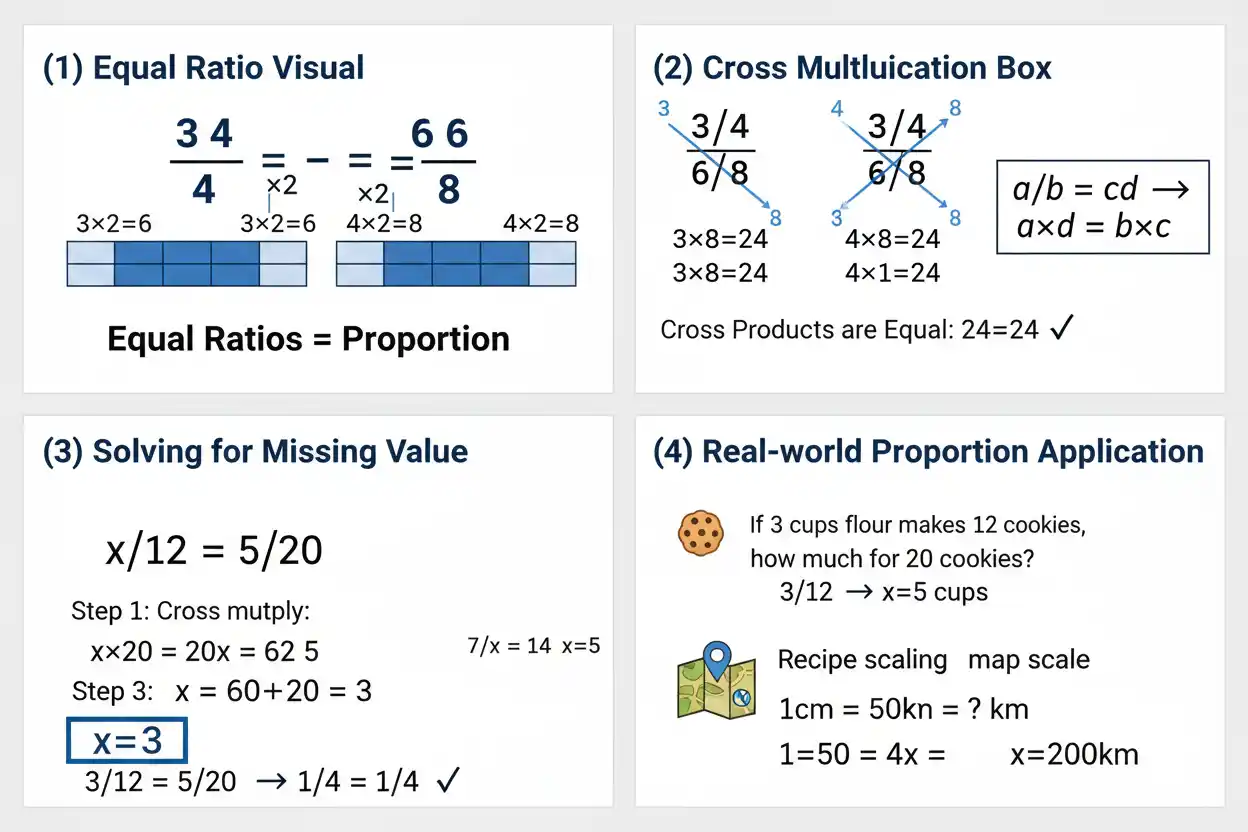

A proportion is an equation stating that two ratios are equal.
The basic form is:
a/b = c/d
where:
b ≠ 0
and:
d ≠ 0
For example:
3/4 = 6/8
is a proportion because both ratios equal:
0.75
A proportion can also be verified by cross multiplication:
ad = bc
For:
3/4 = 6/8
cross multiply:
3 × 8 = 24
4 × 6 = 24
Since the cross products are equal:
3/4 = 6/8 is a true proportion
Proportions are used to solve missing-value problems involving equivalent ratios, scaling, rates, measurements, percentages, maps, recipes, and similar relationships.
What Is a Proportion?
A proportion states that:
one ratio equals another ratio
For example:
2/3 = 8/12
Both fractions simplify to:
2/3
Therefore they form a true proportion.
The underlying concept begins with a ratio, which compares two quantities. A proportion equates two such comparisons.
Proportion Formula
The standard form is:
a/b = c/d
If:
b ≠ 0
and:
d ≠ 0
then this proportion is equivalent to:
ad = bc
The quantities:
a and d
are sometimes called the extremes.
The quantities:
b and c
are sometimes called the means.
Thus the traditional rule can be stated:
Product of the extremes = product of the means
Why Cross Multiplication Works
Start with:
a/b = c/d
Multiply both sides by:
bd
Then:
bd × a/b = bd × c/d
Cancel:
ad = bc
Therefore:
a/b = c/d ⇔ ad = bc
provided the denominators are nonzero.
Cross multiplication is not a separate mathematical rule; it follows from multiplying both sides of an equation by the denominators.
Example: Is 4/6 = 10/15 a Proportion?
Cross multiply:
4 × 15 = 60
and:
6 × 10 = 60
The cross products are equal.
Therefore:
4/6 = 10/15
is a true proportion.
You can also simplify:
4/6 = 2/3
and:
10/15 = 2/3
The same equivalence is confirmed.
Example: Is 3/5 = 8/12 a Proportion?
Cross multiply:
3 × 12 = 36
5 × 8 = 40
Since:
36 ≠ 40
the ratios are not equal.
Therefore:
3/5 = 8/12 is not a true proportion
Solving a Proportion for x
Suppose:
x/12 = 5/20
Cross multiply:
20x = 12 × 5
20x = 60
Divide:
x = 3
Therefore:
x = 3
Check:
3/12 = 1/4
and:
5/20 = 1/4
The ratios are equal.
Example: 4/7 = x/21
Cross multiply:
4 × 21 = 7x
84 = 7x
Divide:
x = 12
Therefore:
4/7 = 12/21
Check:
12/21
simplifies to:
4/7
Example: 9/x = 3/5
Cross multiply:
9 × 5 = 3x
45 = 3x
Divide:
x = 15
Therefore:
x = 15
Check:
9/15 = 3/5
Example: x/18 = 7/9
Cross multiply:
9x = 18 × 7
9x = 126
Divide:
x = 14
Therefore:
x = 14
Solving When x Appears in a Denominator
Suppose:
5/x = 15/24
Cross multiply:
5 × 24 = 15x
120 = 15x
Divide:
x = 8
Because x is a denominator in the original equation, it also must satisfy:
x ≠ 0
The solution 8 is valid.
Solving a Proportion With Decimals
Suppose:
x/8 = 1.5/6
Cross multiply:
6x = 8 × 1.5
6x = 12
Therefore:
x = 2
So:
x = 2
Check:
2/8 = 0.25
and:
1.5/6 = 0.25
Accurate decimal arithmetic is useful when proportions contain noninteger quantities.
Solving a Proportion With Fractions
Consider:
x/(3/4) = 8/3
Cross multiply carefully:
3x = 8 × 3/4
Then:
3x = 6
Therefore:
x = 2
The same proportion can be manipulated through ordinary fraction operations as long as denominators remain nonzero.
Equivalent Ratios
A proportion often comes from multiplying or dividing both terms of one ratio by the same nonzero value.
Start:
3/5
Multiply numerator and denominator by 4:
(3 × 4)/(5 × 4)
= 12/20
Therefore:
3/5 = 12/20
This produces an equivalent ratio and hence a proportion.
Scaling a Ratio
Suppose the ratio is:
2:7
Multiply both parts by:
5
giving:
10:35
In fraction form:
2/7 = 10/35
Therefore:
2:7 and 10:35 are proportional
The scale factor is:
5
Finding the Scale Factor
Suppose:
4/9 = 20/45
Compare numerators:
20/4 = 5
Compare denominators:
45/9 = 5
Both parts were multiplied by the same scale factor.
Therefore the ratios form a proportion.
Proportion and Fraction Simplification
Fraction simplification provides another way to test a proportion.
Consider:
18/24 = 21/28
Simplify the first:
18/24 = 3/4
Simplify the second:
21/28 = 3/4
Therefore:
18/24 = 21/28
and the proportion is true.
Cross Multiplication vs. Simplification
For:
24/36 = 10/15
you can simplify:
24/36 = 2/3
10/15 = 2/3
or cross multiply:
24 × 15 = 360
36 × 10 = 360
Both methods test the same equality.
Simplification may be faster when common factors are obvious; cross multiplication is especially useful when solving for an unknown.
Prime Factorization in Proportions
Prime factorization can expose equivalent ratios efficiently.
Consider:
84/126
Factor:
84 = 2² × 3 × 7
126 = 2 × 3² × 7
Cancel common prime factors:
84/126 = 2/3
Now compare:
50/75
Factor or simplify:
50/75 = 2/3
Therefore:
84/126 = 50/75
Prime-factor structure is useful when the numbers are large or share substantial common factors.
Prime Numbers in a Proportion
Prime numbers can appear as any terms in a proportion.
For example:
3/5 = 21/35
Here 3 and 5 are prime, while 21 and 35 are composite.
The proportional relationship depends on equal ratios, not on whether the individual terms are prime.
Indeed:
21 = 3 × 7
35 = 5 × 7
The second ratio is simply the first scaled by 7.
Direct Proportion
Two varying quantities are in direct proportion when their ratio remains constant.
If:
y/x = k
then:
y = kx
For example, if:
3 notebooks cost $12
then cost per notebook is:
12/3 = 4
If price remains directly proportional to quantity:
Cost = 4 × Quantity
For 8 notebooks:
Cost = 4 × 8
= $32
Thus:
3/12 = 8/32
when quantity and cost are placed consistently.
The dedicated direct-variation treatment can explore the function relationship more deeply; the core proportion calculation is simply equality of corresponding ratios.
Example: Recipe Scaling
A recipe uses:
2 cups of an ingredient for 5 servings.
How much is needed for 20 servings?
Set corresponding quantities:
2/5 = x/20
Cross multiply:
5x = 40
Therefore:
x = 8
So:
8 cups are needed for 20 servings
The serving count increased by a factor of:
20/5 = 4
and the ingredient amount increased by the same factor:
2 × 4 = 8
Example: Map Scale
Suppose:
3 cm
on a map represents:
12 km
How many kilometers does:
8 cm
represent?
Set:
3/12 = 8/x
Cross multiply:
3x = 96
Therefore:
x = 32
So:
8 cm represents 32 km
Consistency of units and corresponding positions is essential.
Example: Unit Price
Suppose:
6 items cost $15
At the same unit price, what do 14 items cost?
Set:
6/15 = 14/x
Cross multiply:
6x = 210
Divide:
x = 35
Therefore:
14 items cost $35
Check unit rates:
15/6 = 2.5
and:
35/14 = 2.5
The proportional relationship is confirmed.
Example: Distance at Constant Speed
Suppose a vehicle travels:
180 km in 3 hours
At the same constant speed, how far will it travel in:
5 hours?
Set:
180/3 = x/5
Cross multiply:
3x = 900
x = 300
Therefore:
300 km
The constant ratio is:
60 km per hour
Example: Similar Scale
Suppose one drawing has:
width = 6 cm
and:
height = 9 cm
A proportional enlargement has width:
10 cm
Find its height h.
Set:
6/9 = 10/h
Cross multiply:
6h = 90
Then:
h = 15
Therefore:
The enlarged height is 15 cm
Both dimensions were scaled by:
10/6 = 5/3
Percentage as a Proportion
A percentage is naturally a proportion with denominator:
100
For example:
18 is what percentage of 60?
Write:
18/60 = p/100
Cross multiply:
60p = 1,800
Divide:
p = 30
Therefore:
18 is 30% of 60
This is equivalent to the standard percentage formula:
Part/Whole × 100%
Finding a Percentage With a Proportion
Find:
35% of 240
Write:
x/240 = 35/100
Cross multiply:
100x = 8,400
Therefore:
x = 84
So:
35% of 240 = 84
The proportion method and decimal method produce the same result.
Ratios Must Be Written in Consistent Order
Suppose:
3 red objects correspond to 5 blue objects
and a second group contains:
12 red objects and x blue objects
A consistent proportion is:
red/blue = red/blue
so:
3/5 = 12/x
Cross multiply:
3x = 60
x = 20
Therefore:
20 blue objects
Writing one ratio as red/blue and the other as blue/red would create the wrong equation.
Units Must Correspond
Suppose:
4 meters correspond to 10 seconds
and:
x meters correspond to 25 seconds
Write:
meters/seconds = meters/seconds
Then:
4/10 = x/25
Cross multiply:
10x = 100
x = 10
Therefore:
x = 10 meters
Keeping like units in corresponding positions makes a proportion much easier to interpret.
Proportion as a Linear Relationship
If:
y/x = k
then:
y = kx
This is a straight-line relationship through the origin.
For example:
y = 3x
generates:
x = 1 → y = 3
x = 2 → y = 6
x = 5 → y = 15
Each pair satisfies:
y/x = 3
So the quantities are directly proportional.
Constant of Proportionality
In:
y = kx
the value:
k
is the constant of proportionality.
It can be found:
k = y/x
For:
y = 28
when:
x = 7
we get:
k = 28/7
= 4
Therefore the proportional rule is:
y = 4x
If:
x = 13
then:
y = 52
Proportion vs. Ratio
A ratio is one comparison:
a/b
A proportion is an equation between two ratios:
a/b = c/d
Therefore:
ratio → one comparison
proportion → equality of two comparisons
This distinction prevents the terms from being used interchangeably.
Proportion vs. Proportions
The singular proportion page focuses on the core equation:
a/b = c/d
and solving it through equivalent ratios and cross multiplication.
The neighboring proportions topic treats the broader family of proportion statements and applications while retaining the same underlying equality-of-ratios principle.
For a single missing-value equation, the central tool remains:
ad = bc
Proportion and Permutations and Combinations
A useful identity from permutations and combinations can itself generate proportional relationships.
For example:
nPr = nCr × r!
Therefore:
nPr/nCr = r!
For:
5P3 = 60
and:
5C3 = 10
we have:
60/10 = 6
and:
3! = 6
So the ratio:
60:10
simplifies to:
6:1
The combinatorial formulas determine the numbers; proportion methods can then compare those resulting quantities.
Proportion and Fractions
Every ordinary proportion can be viewed as an equality between fractions.
For example:
5/8 = 15/24
The two fractions represent the same rational number.
This is why fraction rules, simplification, common factors, and cross multiplication all interact naturally with proportions.
Proportion With Mixed Numbers
Suppose:
1 1/2 / 3 = x/8
Convert:
1 1/2 = 3/2
Then:
(3/2)/3 = x/8
Simplify the left:
3/2 × 1/3 = 1/2
So:
1/2 = x/8
Cross multiply:
8 = 2x
Therefore:
x = 4
The mixed numbers conversion should be completed before cross multiplication if it makes the equation clearer.
Proportion With Negative Values
A proportion can include negative quantities algebraically.
For example:
-2/5 = x/20
Cross multiply:
5x = -40
Therefore:
x = -8
Check:
-8/20 = -2/5
The equation is valid.
Whether negative quantities make practical sense depends on the application.
Zero in a Proportion
Zero can appear in a numerator.
For example:
0/5 = 0/12
Both ratios equal zero.
So the proportion is true.
However, zero cannot appear as a denominator because division by zero is undefined.
Therefore in:
a/b = c/d
we require:
b ≠ 0 and d ≠ 0
Cross Products Can Be Used as a Test
Suppose:
14/21
and:
18/27
Are they proportional?
Cross products:
14 × 27 = 378
21 × 18 = 378
Therefore:
14/21 = 18/27
No decimal conversion is necessary.
Solving a Multi-Step Proportion
Solve:
(x+2)/6 = 5/10
Simplify the right:
5/10 = 1/2
Then:
(x+2)/6 = 1/2
Cross multiply:
2(x+2) = 6
Divide by 2:
x + 2 = 3
Therefore:
x = 1
Check:
(1+2)/6 = 3/6 = 1/2
The solution is correct.
Another Algebraic Proportion
Solve:
4/(x-1) = 2/5
Cross multiply:
4 × 5 = 2(x-1)
20 = 2x – 2
Add 2:
22 = 2x
x = 11
Check the denominator restriction:
x – 1 ≠ 0
Since:
11 – 1 = 10
the solution is valid.
Proportional Scaling Up
Suppose:
7/9 = x/45
The denominator has been multiplied by:
5
because:
9 × 5 = 45
Apply the same scale factor to the numerator:
7 × 5 = 35
Therefore:
x = 35
Cross multiplication gives the same answer, but recognizing scale factors can be faster.
Proportional Scaling Down
Suppose:
18/30 = x/5
The denominator:
30
was divided by:
6
to become:
5
Therefore divide the numerator by 6:
18/6 = 3
So:
x = 3
Again:
18/30 = 3/5
Inverse Relationships Are Not Ordinary Proportions of the Same Form
If one quantity increases while another decreases so that their product stays constant:
xy = k
the variables are inversely related.
For example:
y = k/x
This differs from direct proportion:
y = kx
A standard proportion can still be used to solve inverse-variation problems after arranging the relationship correctly, but the corresponding quantities should not be assumed to scale in the same direction.
Common Mistake: Cross Multiplying the Wrong Terms
For:
a/b = c/d
the correct cross products are:
a × d
and:
b × c
not:
a × c
and:
b × d
For:
3/4 = 6/8
correct:
3 × 8 = 4 × 6
24 = 24
Common Mistake: Reversing One Ratio Only
Suppose:
3 books cost $12
and:
5 books cost
x.
Correct:
3/12 = 5/x
or equivalently:
12/3 = x/5
Both keep the units in consistent order.
Incorrect:
3/12 = x/5
because the second ratio reverses the positions.
Common Mistake: Adding Numerators and Denominators
From:
2/3 = 4/6
you cannot create an equivalent ratio by simply adding the same number to numerator and denominator.
For example:
(2+1)/(3+1) = 3/4
but:
3/4 ≠ 2/3
Equivalent ratios are produced by multiplying or dividing both terms by the same nonzero factor.
Common Mistake: Dividing by Zero
An expression such as:
3/0
is undefined.
Therefore a proposed proportion containing a zero denominator is invalid.
Always check denominator restrictions when solving algebraic proportions.
Common Mistake: Assuming Similar-Looking Ratios Are Equal
Consider:
4/7
and:
8/15
The numerator doubled from 4 to 8, but the denominator would also need to double:
7 × 2 = 14
not 15.
Cross multiplication confirms:
4 × 15 = 60
7 × 8 = 56
Therefore the ratios are not proportional.
Common Mistake: Using Addition Instead of Multiplicative Scaling
A proportion preserves multiplicative relationships.
If:
2/5 = 6/15
the second ratio is obtained by multiplying both terms by:
3
The fact that the numerator increased by 4 and denominator by 10 is not the defining relationship.
Equal ratios are based on common multiplication or division, not equal additive changes.
How to Check a Solved Proportion
Suppose:
x/14 = 6/21
and a solution claims:
x = 4
Substitute:
4/14
Simplify:
2/7
Other side:
6/21 = 2/7
The ratios match.
Cross-product check:
4 × 21 = 84
14 × 6 = 84
Therefore:
x = 4 is correct
Frequently Asked Questions
What is a proportion?
A proportion is an equation stating that two ratios are equal.
What is the basic proportion formula?
a/b = c/d
with nonzero denominators.
What is the cross-multiplication rule?
If:
a/b = c/d
then:
ad = bc
How do you solve a proportion?
Cross multiply, solve the resulting equation, and check denominator restrictions.
Is 2/3 = 8/12 a proportion?
Yes.
Both ratios simplify to:
2/3
Is 3/4 = 8/10 a proportion?
No.
Cross products are:
3 × 10 = 30
and:
4 × 8 = 32
Solve x/12 = 5/20.
20x = 60
so:
x = 3
Solve 6/9 = x/15.
Cross multiply:
9x = 90
so:
x = 10
What is the difference between a ratio and proportion?
A ratio compares two quantities. A proportion states that two ratios are equal.
Can proportions contain decimals?
Yes.
Can proportions contain fractions?
Yes.
Can a denominator equal zero?
No. Division by zero is undefined.
Can percentages be solved with proportions?
Yes. Write the percentage over 100:
Part/Whole = Percent/100
Does cross multiplication prove two ratios are equal?
Yes, provided the denominators are nonzero. Equal cross products are equivalent to equality of the two fractions.
Final Example
A machine produces:
18 parts in 12 minutes
at a constant rate.
How many parts will it produce in:
50 minutes?
Let the unknown number of parts be:
x
Keep units in corresponding positions:
18/12 = x/50
Cross multiply:
12x = 18 × 50
12x = 900
Divide:
x = 75
Therefore:
75 parts
Check using the unit rate:
18/12 = 1.5 parts per minute
Then:
1.5 × 50 = 75
The results agree.
The central proportion relationship is:
a/b = c/d
with:
ad = bc
for nonzero denominators.
When two ratios describe the same multiplicative relationship, cross multiplication, simplification, or a common scale factor can be used to verify the proportion or solve its missing value.