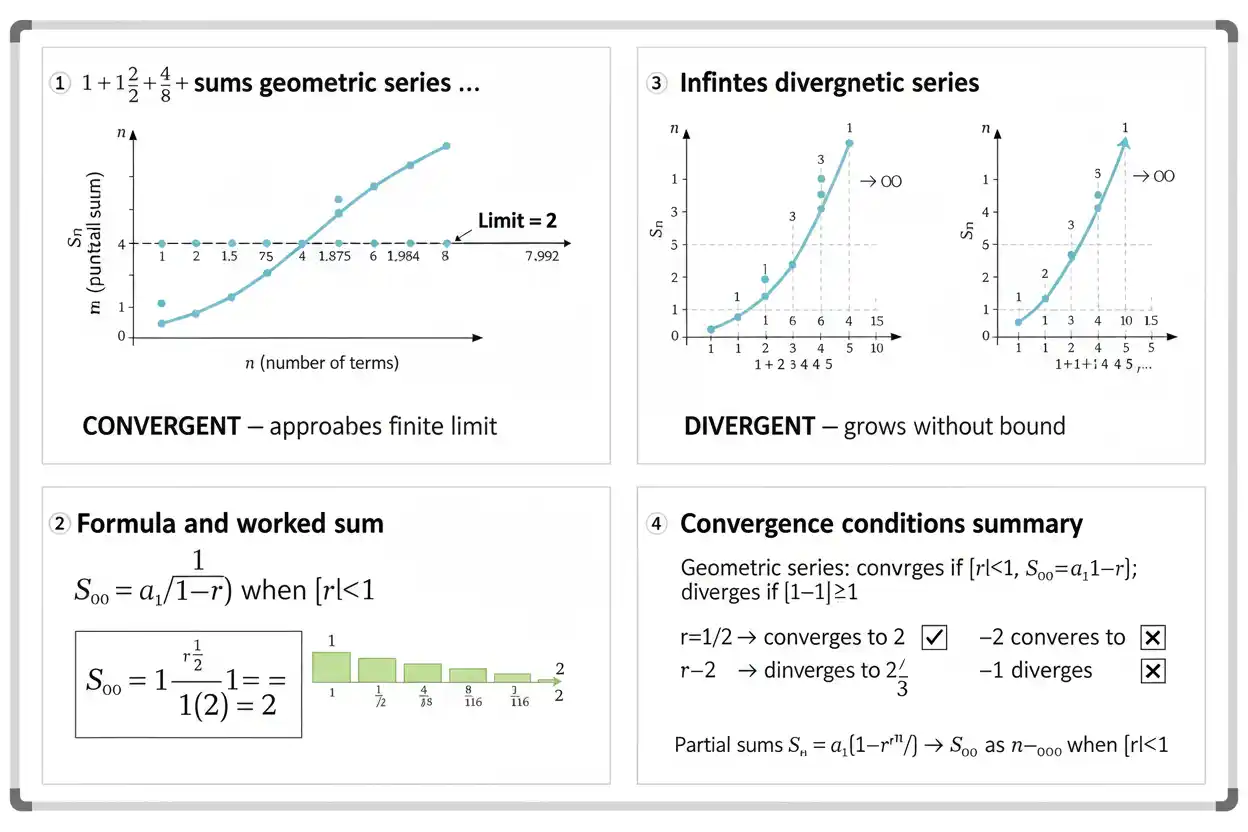

Series convergence describes whether the partial sums of an infinite series approach a finite limit.
An infinite series has the form:
Σ aₙ = a₁ + a₂ + a₃ + …
Define its nth partial sum:
Sₙ = a₁ + a₂ + … + aₙ
The series converges to S if:
lim Sₙ = S as n → ∞
If the partial sums do not approach one finite value, the series diverges.
For example:
1 + 1/2 + 1/4 + 1/8 + …
has partial sums:
1
1.5
1.75
1.875
…
These approach:
2
Therefore:
1 + 1/2 + 1/4 + … = 2
in the sense of series convergence.
What Is an Infinite Series?
A sequence gives terms:
a₁, a₂, a₃, …
A series adds those terms:
a₁ + a₂ + a₃ + …
The distinction is important.
A sequence asks how individual terms behave.
A series asks how accumulated totals behave.
The finite totals leading toward an infinite series are the sequence sums called partial sums.
Partial Sums Define Convergence
Suppose:
Σ aₙ
is an infinite series.
Its partial sums are:
S₁ = a₁
S₂ = a₁+a₂
S₃ = a₁+a₂+a₃
and generally:
Sₙ = Σ aₖ, from k=1 to n
If:
Sₙ → S
as:
n → ∞
then:
Σ aₙ converges to S
The infinite sum is therefore defined through the limit of finite sums.
Convergent Series Example
Consider:
1/2 + 1/4 + 1/8 + 1/16 + …
Its partial sums are:
S₁ = 1/2
S₂ = 3/4
S₃ = 7/8
S₄ = 15/16
A pattern appears:
Sₙ = 1 – 1/2ⁿ
As:
n → ∞
we have:
1/2ⁿ → 0
Therefore:
Sₙ → 1
So:
1/2 + 1/4 + 1/8 + … = 1
Divergent Series Example
Consider:
1 + 1 + 1 + 1 + …
The partial sums are:
1, 2, 3, 4, …
They increase without bound.
There is no finite limit.
Therefore:
1 + 1 + 1 + … diverges
Another Divergent Example
Consider:
1 – 1 + 1 – 1 + …
Partial sums are:
1, 0, 1, 0, 1, 0, …
They oscillate rather than approaching one value.
Therefore the series diverges under the ordinary definition of convergence.
Necessary Condition for Convergence
If:
Σ aₙ
converges, then its individual terms must satisfy:
aₙ → 0
Why?
Since:
aₙ = Sₙ – Sₙ₋₁
and both partial sums approach the same limit S, their difference approaches:
0
Therefore:
Series convergence requires aₙ → 0
But aₙ → 0 Is Not Sufficient
A common error is to assume that terms approaching zero guarantee convergence.
They do not.
The harmonic series:
1 + 1/2 + 1/3 + 1/4 + …
has:
1/n → 0
but the series diverges.
Therefore:
aₙ → 0 is necessary, but not sufficient
for convergence.
nth-Term Divergence Test
If:
aₙ
does not approach zero, then:
Σ aₙ
must diverge.
For example:
aₙ = (n+1)/n
Then:
aₙ = 1 + 1/n
so:
aₙ → 1
Since the terms do not approach zero:
Σ (n+1)/n diverges
No additional convergence test is needed.
Geometric Series
One of the most important infinite series is:
a + ar + ar² + ar³ + …
This is an infinite geometric series.
It converges exactly when:
|r| < 1
When it converges:
S = a/(1-r)
This is the infinite counterpart of the finite geometric-sum formula.
Why the Infinite Geometric Formula Works
The finite geometric partial sum is:
Sₙ = a(1-rⁿ)/(1-r)
If:
|r| < 1
then:
rⁿ → 0
as:
n → ∞
Therefore:
Sₙ → a(1-0)/(1-r)
So:
S = a/(1-r)
Geometric Series Example
Evaluate:
3 + 1.5 + 0.75 + 0.375 + …
First term:
a = 3
Common ratio:
r = 1/2
Since:
|1/2| < 1
the series converges.
Use:
S = a/(1-r)
Then:
S = 3/(1-1/2)
= 3/(1/2)
= 6
Therefore:
3 + 1.5 + 0.75 + … = 6
Geometric Series With Negative Ratio
Consider:
1 – 1/2 + 1/4 – 1/8 + …
Here:
a = 1
r = -1/2
Since:
|-1/2| < 1
the series converges.
Use:
S = 1/[1-(-1/2)]
= 1/(3/2)
= 2/3
Therefore:
1 – 1/2 + 1/4 – 1/8 + … = 2/3
Geometric Series With r = 1
Consider:
5 + 5 + 5 + …
Here:
r = 1
The partial sums are:
5,10,15,20,…
They grow without bound.
Therefore the series diverges.
The formula:
a/(1-r)
cannot be used because its denominator becomes zero.
Geometric Series With r = -1
Consider:
1 – 1 + 1 – 1 + …
Here:
r = -1
and:
|r| = 1
The partial sums oscillate.
Therefore the series diverges.
Geometric Series With |r| > 1
Consider:
1 + 2 + 4 + 8 + …
Here:
r = 2
The terms themselves do not approach zero.
The partial sums grow rapidly.
Therefore:
The series diverges
The convergence condition is strictly:
|r| < 1
not:
|r| ≤ 1
Harmonic Series
The harmonic series is:
1 + 1/2 + 1/3 + 1/4 + …
Its terms approach zero:
1/n → 0
but the series diverges.
One way to see this is to group terms:
1
- 1/2
- (1/3 + 1/4)
- (1/5 + 1/6 + 1/7 + 1/8)
- …
Each grouped block after the first contributes at least:
1/2
So the partial sums eventually exceed any fixed bound.
p-Series
A p-series has form:
Σ 1/nᵖ
for:
n = 1,2,3,…
Its convergence rule is:
p > 1 → converges
p ≤ 1 → diverges
Examples:
Σ 1/n² converges
Σ 1/n diverges
Σ 1/√n diverges because p = 1/2
This is an important benchmark for comparison with other positive-term series.
Example: Σ 1/n²
The series:
1 + 1/4 + 1/9 + 1/16 + …
is a p-series with:
p = 2
Since:
2 > 1
it converges.
Its exact value is:
π²/6
but recognizing convergence does not require knowing that exact sum.
Example: Σ 1/n³
Here:
p = 3
Since:
p > 1
the series converges.
A simple p-series test identifies the behavior immediately.
Comparison Test
Suppose:
0 ≤ aₙ ≤ bₙ
for sufficiently large n.
If:
Σ bₙ
converges, then:
Σ aₙ converges
because the smaller nonnegative terms cannot accumulate faster than a known convergent comparison series.
Conversely, if:
0 ≤ bₙ ≤ aₙ
and:
Σ bₙ
diverges, then:
Σ aₙ diverges
Comparison Example
Consider:
Σ 1/(n²+1)
For positive n:
n²+1 > n²
Therefore:
1/(n²+1) < 1/n²
Since:
Σ 1/n²
converges, the comparison test gives:
Σ 1/(n²+1) converges
Limit Comparison Idea
If positive-term sequences aₙ and bₙ satisfy:
lim (aₙ/bₙ) = L
where:
0 < L < ∞
then the series:
Σ aₙ
and:
Σ bₙ
have the same convergence behavior.
This is useful when terms resemble a familiar benchmark such as 1/nᵖ but are not directly bounded in an obvious way.
Ratio Test
For a series:
Σ aₙ
consider:
L = lim |aₙ₊₁/aₙ|
If:
L < 1
the series converges absolutely.
If:
L > 1
or the ratio tends to infinity, the series diverges.
If:
L = 1
the ratio test gives no conclusion.
The test is especially useful for terms containing factorials or exponentials.
Ratio Test Example
Consider:
Σ 1/n!
Then:
aₙ = 1/n!
and:
aₙ₊₁/aₙ = n!/(n+1)!
= 1/(n+1)
As:
n → ∞
we get:
L = 0
Since:
0 < 1
the series converges.
Root Test
The root test uses:
L = limsup |aₙ|^(1/n)
If:
L < 1
the series converges absolutely.
If:
L > 1
the series diverges.
If:
L = 1
the test is inconclusive.
It is particularly useful when terms contain expressions raised to the nth power.
Absolute Convergence
A series:
Σ aₙ
is absolutely convergent if:
Σ |aₙ|
converges.
Absolute convergence guarantees ordinary convergence.
For example:
Σ (-1)ⁿ/n²
converges absolutely because:
Σ 1/n²
converges.
Conditional Convergence
A series is conditionally convergent when:
Σ aₙ
converges
but:
Σ |aₙ|
diverges.
A standard example is the alternating harmonic series:
1 – 1/2 + 1/3 – 1/4 + …
It converges, but the absolute-value series becomes:
1 + 1/2 + 1/3 + 1/4 + …
which is the divergent harmonic series.
Alternating Series Test
A common alternating series has form:
Σ (-1)^(n-1)bₙ
with:
bₙ ≥ 0
If:
bₙ
eventually decreases
and:
bₙ → 0
then the alternating series converges.
For example:
1 – 1/2 + 1/3 – 1/4 + …
satisfies these conditions.
Telescoping Series
A telescoping series has terms that cancel across consecutive partial sums.
Consider:
Σ [1/n – 1/(n+1)]
Its nth partial sum is:
(1-1/2) + (1/2-1/3) + … + (1/n – 1/(n+1))
Intermediate terms cancel, leaving:
Sₙ = 1 – 1/(n+1)
As:
n → ∞
the final fraction tends to zero.
Therefore:
Sₙ → 1
and the series converges to:
1
Convergence Is About Partial Sums
A series can have terms that become extremely small yet still diverge.
The deciding question is not simply:
“Do the terms get small?”
It is:
“Do the accumulated partial sums approach one finite value?”
This distinction is the foundation of series convergence.
Bounded Does Not Always Mean Convergent
A sequence of partial sums can remain bounded yet fail to converge.
For:
1 – 1 + 1 – 1 + …
the partial sums are:
1,0,1,0,…
They remain between:
0 and 1
but do not approach a single limit.
Therefore boundedness alone is not enough.
Monotone and Bounded Partial Sums
For a positive-term series:
aₙ ≥ 0
the partial sums satisfy:
Sₙ₊₁ ≥ Sₙ
so they are nondecreasing.
If these partial sums are also bounded above, they converge.
This gives a useful conceptual criterion for positive series.
Infinite Decimal as a Convergent Series
A repeating or terminating decimal can be interpreted through a convergent series.
For example:
0.333…
means:
3/10 + 3/100 + 3/1000 + …
This is geometric with:
a = 3/10
r = 1/10
Therefore:
S = (3/10)/(1-1/10)
= (3/10)/(9/10)
= 1/3
Thus:
0.333… = 1/3
Another Repeating Decimal
Consider:
0.121212…
This can be written:
12/100 + 12/10,000 + 12/1,000,000 + …
The first term is:
0.12
and ratio:
0.01
Therefore:
S = 0.12/(1-0.01)
= 0.12/0.99
= 12/99
= 4/33
So:
0.121212… = 4/33
Series in Scientific Notation
Terms in numerical series may become extremely small, making scientific notation useful.
Suppose later terms are:
2.5 × 10^-6
1.25 × 10^-6
6.25 × 10^-7
The ratio is:
1/2
so the terms form a geometric pattern.
Scientific notation makes their decreasing scale easier to recognize.
Numerical Convergence and Rounding
Suppose partial sums are:
1.9991
1.99955
1.999775
1.9998875
They appear to approach:
2
If reporting only three decimal places, several later partial sums may all appear as:
2.000
under ordinary rounding rules.
That numerical stability is useful evidence but is not itself a proof of convergence. A mathematical convergence argument must justify the limiting behavior.
Significant Figures and Convergent Approximations
When a convergent series is used to approximate a measured or computed quantity, significant figures determine how much of the approximation should be reported.
For example, a partial sum might be:
3.1415924
while the application requires:
5 significant figures
Then report:
3.1416
The convergence calculation and reporting precision are separate issues.
Scientific Functions and Series
scientific functions frequently have series representations.
For example, exponential, logarithmic, and trigonometric functions can be represented by infinite power series under suitable conditions.
A numerical calculator may evaluate these functions using sophisticated approximations internally, but the mathematical meaning of the function does not depend on the implementation method.
Convergence in a Travel-Distance Example
A speed distance time setting can illustrate geometric convergence.
Suppose a traveler covers:
8 km
on the first stage, then half as much on every following stage:
8, 4, 2, 1, 1/2, …
The total distance after infinitely many stages is:
8 + 4 + 2 + 1 + …
This is geometric with:
a = 8
r = 1/2
Therefore:
S = 8/(1-1/2)
= 16
So the infinitely many shrinking stages have finite total distance:
16 km
The number of stages is infinite, but the accumulated distance converges.
Convergent Series Can Have Infinitely Many Nonzero Terms
The geometric series:
1 + 1/2 + 1/4 + …
never reaches a term equal to zero.
Nevertheless, the cumulative total approaches:
2
Therefore an infinite number of nonzero terms can still have a finite sum.
The terms merely need to decrease in a way that allows their accumulated contribution to remain finite.
Divergence to Infinity
Some series have partial sums satisfying:
Sₙ → ∞
For example:
1 + 2 + 3 + 4 + …
The partial sums are:
n(n+1)/2
which grow without bound.
Such a series is divergent.
Saying it “equals infinity” is generally not the same as ordinary convergence to a real number; rather, its partial sums diverge to positive infinity.
Divergence by Oscillation
Other series diverge because partial sums oscillate.
For:
1 – 1 + 1 – 1 + …
partial sums alternate:
1,0,1,0,…
Neither value becomes the unique limiting total.
This is a different divergence mechanism from unbounded growth.
Choosing a Convergence Test
The form of the terms often suggests the method.
A geometric expression suggests the geometric criterion.
A term similar to 1/nᵖ suggests a p-series comparison.
Factorials and exponentials often suit the ratio test.
nth powers may make the root test convenient.
Alternating signs suggest checking an alternating-series condition and absolute convergence.
Cancellation suggests telescoping.
No single test is best for every series.
Common Mistake: Assuming aₙ → 0 Proves Convergence
The harmonic series shows why this fails:
1/n → 0
but:
Σ 1/n
diverges.
Use the nth-term test only to prove divergence when the terms fail to approach zero.
Common Mistake: Using the Infinite Geometric Formula When |r| ≥ 1
The formula:
S = a/(1-r)
applies to an infinite geometric series only when:
|r| < 1
For:
1 + 2 + 4 + …
plugging r=2 into the formula would produce:
-1
which is not the ordinary infinite-series sum.
The convergence condition must be checked first.
Common Mistake: Confusing the Sequence With Its Series
For:
aₙ = 1/n
the sequence:
1,1/2,1/3,…
converges to:
0
But its series:
1 + 1/2 + 1/3 + …
diverges.
Sequence convergence and series convergence are different questions.
Common Mistake: Deciding From a Few Partial Sums
A handful of numerical values may suggest a limit but cannot by themselves establish convergence.
Some series can appear stable for a long time before their behavior becomes clear.
Use an algebraic formula or valid convergence criterion whenever an exact conclusion is required.
Common Mistake: Ignoring Absolute Values in the Geometric Criterion
A ratio:
r = -1/2
still satisfies:
|r| = 1/2 < 1
so the series converges.
The sign creates alternating terms but does not prevent convergence when the magnitude is below 1.
How to Check an Infinite Geometric Series
Suppose:
12 + 3 + 0.75 + …
Find the ratio:
3/12 = 1/4
and:
0.75/3 = 1/4
Therefore:
r = 1/4
Check:
|r| < 1
so the series converges.
Then:
S = 12/(1-1/4)
= 12/(3/4)
= 16
Therefore:
The series converges to 16
Frequently Asked Questions
What is series convergence?
Series convergence means the sequence of partial sums approaches one finite limit.
What is the convergence definition?
If:
Sₙ = a₁ + … + aₙ
and:
lim Sₙ = S
as n → ∞, then:
Σ aₙ converges to S
What is a partial sum?
A partial sum adds only the first n terms of an infinite series.
Does aₙ → 0 mean Σaₙ converges?
No. It is necessary but not sufficient.
What happens if aₙ does not approach zero?
The series diverges.
When does an infinite geometric series converge?
When:
|r| < 1
What is the infinite geometric-series formula?
S = a/(1-r)
when:
|r| < 1
Does the harmonic series converge?
No.
Σ 1/n diverges
When does a p-series converge?
Σ 1/nᵖ converges when p > 1
and diverges when:
p ≤ 1
What is absolute convergence?
A series converges absolutely when the series of absolute values converges.
Can a series converge conditionally?
Yes. An alternating series can converge even though its absolute-value series diverges.
Can infinitely many positive terms add to a finite value?
Yes. For example:
1/2 + 1/4 + 1/8 + … = 1
Final Example
Determine whether:
10 + 5 + 2.5 + 1.25 + …
converges and, if so, find its sum.
This is geometric.
First term:
a = 10
Common ratio:
r = 5/10
= 1/2
Check convergence:
|r| = 1/2 < 1
Therefore the series converges.
Use:
S = a/(1-r)
Then:
S = 10/(1-1/2)
= 10/(1/2)
= 20
Therefore:
10 + 5 + 2.5 + 1.25 + … = 20
The central definition of series convergence is:
Σ aₙ converges to S when its partial sums Sₙ approach S
For geometric series, the decisive condition is:
|r| < 1
More general series require convergence tests suited to their structure, but every valid method ultimately answers the same question: whether the accumulated finite partial sums approach one finite limit.