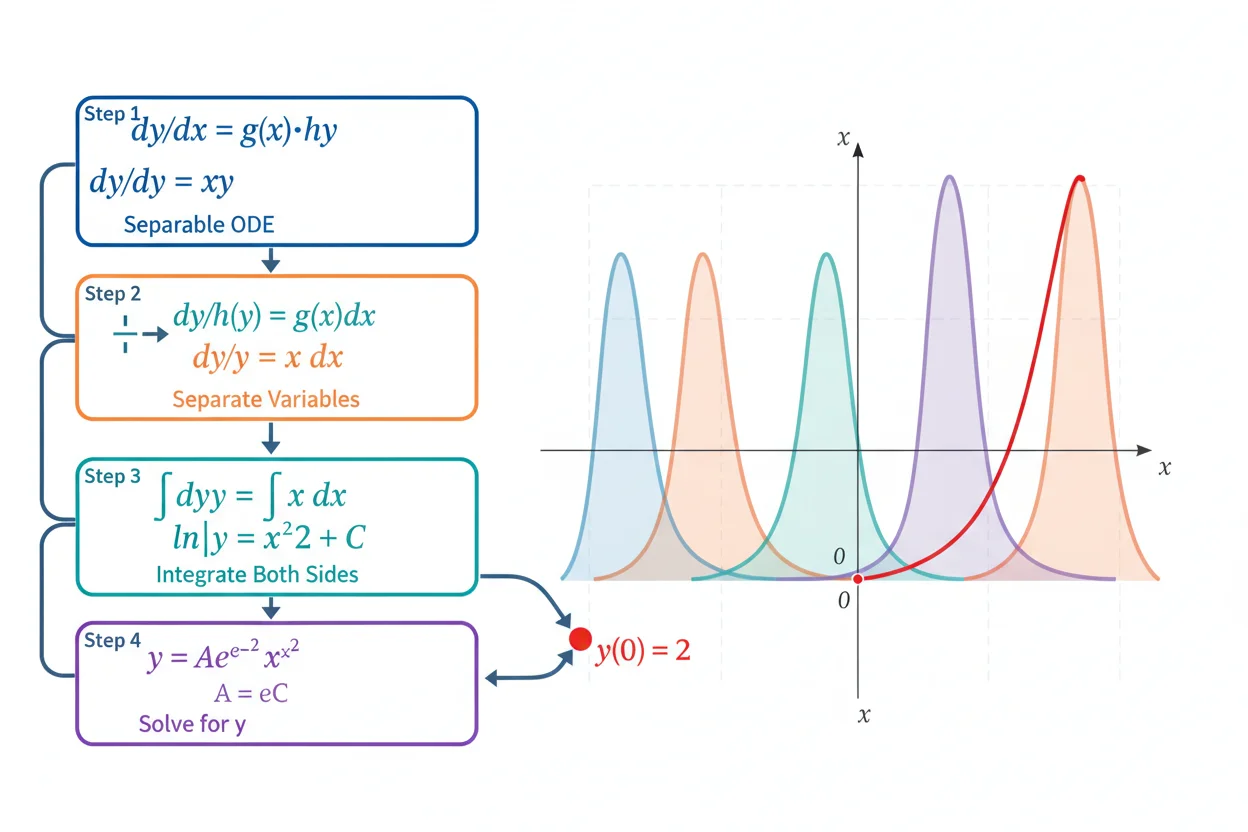

A separable differential equation is a first-order differential equation whose x-dependent and y-dependent factors can be placed on opposite sides of the equation. A common form is dy/dx = g(x)h(y), which can be rearranged as dy/h(y) = g(x)dx when h(y) is nonzero. Both sides are then integrated, producing an implicit or explicit family of solutions. Initial conditions can determine the arbitrary constant and select one particular solution. Separable equations include many exponential growth and decay models, population equations, cooling-type models, and other first-order systems. An important detail is that dividing by a function of y can temporarily exclude equilibrium solutions where that function equals zero, so those constant solutions must be checked separately. Separation of variables is therefore more than moving symbols across an equation: the rearrangement, integration, domain restrictions, equilibrium solutions, and initial conditions all matter.
What Is a Separable Differential Equation?
A first-order equation is separable when it can be written as:
dy/dx = g(x)h(y)
with the x-dependent and y-dependent parts factorized.
Assuming:
h(y) ≠ 0
divide by h(y):
1/h(y) dy/dx = g(x)
Then write:
dy/h(y) = g(x)dx
Now the variables are separated.
Integrate:
∫1/h(y) dy = ∫g(x) dx
The resulting equation describes the solution family.
This is one important class within the broader topic of differential equations.
Separable Differential Equation Formula
The standard pattern is:
dy/dx = g(x)h(y)
Separate:
dy/h(y) = g(x)dx
Integrate:
∫1/h(y) dy = ∫g(x)dx + C
The constant can be written on only one side because two integration constants combine into a single arbitrary constant.
After integration, solve for y if practical.
Sometimes the implicit equation is already the cleanest form.
How to Recognize a Separable Equation
Consider:
dy/dx = x y²
The right side factors into:
x × y²
so the equation is separable.
By contrast:
dy/dx = x + y
cannot be written directly as a product of a function only of x and a function only of y.
It is therefore not separable in its current form.
Another equation:
dy/dx = x/(1 + y²)
is separable because:
(1 + y²)dy = x dx
The visual appearance of the original fraction does not determine separability; the question is whether all y-dependence and all x-dependence can be isolated on opposite sides.
Basic Example
Solve:
dy/dx = xy
For:
y ≠ 0
divide by y:
1/y dy = x dx
Integrate:
∫1/y dy = ∫x dx
Therefore:
ln|y| = x²/2 + C
Exponentiate:
|y| = e^C e^(x²/2)
Absorb the constant and sign into a new constant:
y = Ce^(x²/2)
Thus the solution family can be written:
y = Ce^(x²/2)
The constant solution:
y = 0
also satisfies the original equation and is included when C = 0 in this final expression.
Verify the Solution
Take:
y = Ce^(x²/2)
Differentiate using the chain rule:
dy/dx = Ce^(x²/2) · x
Since:
y = Ce^(x²/2)
we have:
dy/dx = xy
which matches the original equation.
Differentiating the proposed solution is one of the strongest checks for a differential-equation calculation.
Initial Value Problem
Solve:
dy/dx = 2xy
subject to:
y(0) = 3
Separate:
dy/y = 2x dx
Integrate:
ln|y| = x² + C
Exponentiate:
y = Ae^(x²)
Use:
y(0) = 3
Then:
3 = Ae⁰
so:
A = 3
Therefore the particular solution is:
y = 3e^(x²)
The initial condition chooses one curve from the full family of solutions.
Why the Constant Changes Form
After integration you might obtain:
ln|y| = x² + C
Exponentiating gives:
|y| = e^(x²+C)
Using exponent rules:
|y| = e^C e^(x²)
Since:
e^C
is a positive constant, it is customary to absorb it, together with the possible sign of y, into another arbitrary constant A:
y = Ae^(x²)
The symbol used for the constant can change because its numerical meaning has changed.
Example With Powers of y
Solve:
dy/dx = xy²
Separate:
y⁻²dy = x dx
Integrate:
∫y⁻²dy = ∫x dx
Using the reverse power relationship:
−y⁻¹ = x²/2 + C
So:
−1/y = x²/2 + C
Multiply by −1 and absorb the sign into the constant:
1/y = C − x²/2
Therefore:
y = 1/(C − x²/2)
An equivalent form is:
y = 2/(C₁ − x²)
where C₁ is another arbitrary constant.
The equilibrium solution:
y = 0
must also be considered because dividing by y² excluded it during separation.
Equilibrium Solutions
Suppose:
dy/dx = g(x)h(y)
A constant solution:
y = c
can occur when:
h(c) = 0
because then:
dy/dx = 0
for all x.
If you divide the equation by h(y), these values cannot remain in the algebra.
Therefore the safe procedure is to solve:
h(y) = 0
before or alongside separation and record any resulting equilibrium solutions separately.
This is one of the most important technical details in separable equations.
Autonomous Separable Equation
An autonomous equation has form:
dy/dx = h(y)
There is no explicit x-dependence on the right.
It is automatically separable:
dy/h(y) = dx
provided h(y) ≠ 0.
For example:
dy/dx = y(1 − y)
has equilibrium solutions:
y = 0
and:
y = 1
For other solutions:
dy/[y(1 − y)] = dx
The left side can be integrated after decomposing it into simpler fractions.
Logistic Differential Equation
A standard logistic equation is:
dy/dt = ky(1 − y/M)
where:
k
is a growth-rate constant and M is a limiting level.
Equilibrium solutions satisfy:
y = 0
or:
y = M
For other solutions:
dy/[y(1 − y/M)] = k dt
Because the y-side is rational, partial fraction integration can be used.
After integration and algebra, the non-equilibrium solutions have form:
y(t) = M/[1 + Ae^(−kt)]
where A is determined by an initial condition.
Exponential Growth
The simplest growth equation is:
dy/dt = ky
Separate:
dy/y = k dt
Integrate:
ln|y| = kt + C
Exponentiate:
y = Ae^(kt)
If:
k > 0
nonzero positive solutions grow exponentially.
For:
y(0) = y₀
we obtain:
y₀ = A
so:
y = y₀e^(kt)
This equation is both separable and a special case of a first-order linear differential equation.
Exponential Decay
The same formula describes decay when:
k < 0
It is often written:
dy/dt = −ky
with:
k > 0
Then:
y = y₀e^(−kt)
The quantity decreases exponentially toward zero.
The differential equation describes the instantaneous rate:
rate of change ∝ current amount
which is why exponential behavior appears.
Example With x and y Powers
Solve:
dy/dx = x²/y
Multiply by y:
y dy = x² dx
Integrate:
y²/2 = x³/3 + C
Multiply by 2:
y² = 2x³/3 + C
Therefore:
y = ±√(2x³/3 + C)
on intervals where the expression under the square root is nonnegative and a consistent branch is chosen.
The implicit form:
y² = 2x³/3 + C
is often preferable because it represents both branches at once.
Implicit Solutions
A separable equation does not always produce a convenient explicit y = f(x).
Consider:
dy/dx = (1 + x²)/(1 + y²)
Separate:
(1 + y²)dy = (1 + x²)dx
Integrate:
y + y³/3 = x + x³/3 + C
Solving this cubic equation explicitly for y would make the result much less readable.
Therefore:
y + y³/3 = x + x³/3 + C
is a perfectly valid implicit solution.
Separation and Integration by Substitution
After variables are separated, one side may still require another integration technique.
For example:
dy/dx = x e^(−y²)
Rearrange:
e^(y²)dy = x dx
The right side is elementary, while the left does not have an elementary antiderivative.
So separability alone does not guarantee that both resulting integrals have simple closed forms.
In other cases, a separated integral may simplify through integration by substitution.
Separation determines the structure; the integral itself determines the next technique.
Example With a Direct Substitution
Suppose:
dy/dx = (2x + 1)(1 + y²)
Separate:
dy/(1 + y²) = (2x + 1)dx
Integrate:
arctan y = x² + x + C
Solve for y:
y = tan(x² + x + C)
The right integral is straightforward because:
∫(2x + 1)dx = x² + x
The left uses the standard inverse-tangent antiderivative.
Separable Equation With Sine
Solve:
dy/dx = x sin y
Separate:
dy/sin y = x dx
or:
csc y dy = x dx
Integrating:
ln|tan(y/2)| = x²/2 + C
This leads to an implicit or explicit solution depending on how far the algebra is carried.
The equation also has equilibrium solutions wherever:
sin y = 0
so:
y = nπ
for integers n.
These must be retained because dividing by sin y excludes them.
Domain Restrictions
Every algebraic step can introduce restrictions that matter to the final solution.
If you divide by:
y
you temporarily assume:
y ≠ 0
If you take:
ln|y|
you remain on an interval where y does not cross zero.
If the final expression contains:
1/(C − x²)
then the solution cannot pass through points where the denominator vanishes.
Differential-equation solutions are generally considered on intervals where the formula remains defined and differentiable.
Why Solutions May Be Interval-Specific
Consider:
y = 1/(C − x²)
The denominator can vanish at finite x-values.
A solution curve cannot simply continue through a vertical singularity using the same differentiable formula.
Thus the maximal interval of a solution is determined not only by the differential equation but also by the singularities created by the particular constant.
This is why a correct formula should be interpreted together with its domain.
Initial Conditions and Constants
Suppose the general solution is:
y² = x² + C
and:
y(0) = 4
Then:
4² = 0² + C
so:
C = 16
Therefore:
y² = x² + 16
Because the initial value is positive:
y = √(x² + 16)
is the branch satisfying the condition.
The negative branch:
y = −√(x² + 16)
belongs to the same implicit family but does not satisfy y(0) = 4.
Separable Versus First-Order Linear Equations
A First-Order Linear Differential Equation has form:
y′ + P(x)y = Q(x)
A separable equation has a factorable form such as:
y′ = g(x)h(y)
These categories overlap, but neither contains all of the other.
For example:
y′ = ky
is both linear and separable.
But:
y′ + y = x
is linear and generally not directly separable.
Meanwhile:
y′ = xy²
is separable but nonlinear in y.
Recognizing the equation type helps select the shortest method.
Separable Versus Euler Method
A separable equation with elementary antiderivatives can often be solved exactly.
The Euler Method instead produces approximate numerical values from an initial condition:
yₙ₊₁ = yₙ + hf(xₙ, yₙ)
Euler’s method can be useful when an exact solution is unavailable or unnecessary.
If a separable equation can be integrated cleanly, the exact separation method normally provides more information about the solution family.
Separable Equations and Related Rates
Related Rates also involves derivatives, but the objective is different.
A related-rates problem usually gives a geometric or physical constraint and asks for an instantaneous derivative such as:
dr/dt
or:
dV/dt
A separable differential equation instead specifies a rate law and asks for the unknown function over an interval.
For example:
dy/dt = ky
asks for y(t), whereas a related-rates problem might provide y and dy/dt at one instant and ask for the rate of another connected quantity.
Separable Equations Versus Matrix Row Reduction
A first-order separable equation is solved through algebraic separation and integration, not through row reduction.
Similarly, RREF: Gauss–Jordan Elimination addresses matrices and linear systems rather than nonlinear differential relationships.
Systems of linear differential equations can eventually involve matrices, but a scalar equation such as:
y′ = xy²
does not become simpler by putting coefficients into an augmented matrix.
The mathematical structure determines the appropriate method.
Separable Equations and Higher-Dimensional Integration
A triple integral accumulates a function over a three-dimensional region, while separation of variables here splits a first-order differential equation so that each side can be integrated in one variable.
The word “separable” should not be confused with merely evaluating several independent integrals.
Likewise, a geometric integral such as Surface Area Of Revolution uses an integral to measure a generated surface, not to solve a rate equation.
All use integration, but the quantities and goals are different.
Separable Equations and Indefinite Integrals
After separation, the central calculation is usually an indefinite integral:
∫M(y)dy = ∫N(x)dx
The arbitrary constant appears because differentiation destroys additive constants.
If an initial condition is supplied, that constant can be determined.
Thus indefinite integration converts the derivative relationship into a family of solution curves.
General Separation Pattern
Consider:
M(y)dy/dx = N(x)
Multiply by dx:
M(y)dy = N(x)dx
Integrate:
∫M(y)dy = ∫N(x)dx
This form is equivalent to the earlier:
y′ = g(x)h(y)
representation.
The exact algebra used to separate the variables depends on how the original equation is written.
Checking Whether Separation Is Valid
Take:
y′ = xy + x
Factor the right side:
y′ = x(y + 1)
Now it is visibly separable:
dy/(y + 1) = x dx
So an equation that initially looks like a sum may become separable after factoring.
By contrast:
y′ = xy + 1
has no comparable factorization into:
g(x)h(y)
and is not directly separable.
Algebraic simplification should therefore occur before classifying the equation.
Example From a Factored Equation
Solve:
y′ = x(y + 1)
Separate:
dy/(y + 1) = x dx
Integrate:
ln|y + 1| = x²/2 + C
Exponentiate:
y + 1 = Ae^(x²/2)
Therefore:
y = Ae^(x²/2) − 1
The equilibrium solution:
y = −1
is included by:
A = 0
in the final expression.
Common Separable Differential Equation Mistakes
A frequent error is moving terms across the equation without preserving their algebraic factors.
Another is dividing by h(y) and then forgetting solutions satisfying:
h(y) = 0
These equilibrium solutions should be checked separately.
The differential symbols should not be manipulated without understanding that the separation is justified through the chain-rule structure of the differential equation.
After integrating:
1/y
the result is:
ln|y|
not simply ln y on every real interval.
Initial conditions should be applied after obtaining a valid general or implicit solution unless an equivalent constant-handling method is used carefully.
Another mistake is forcing an explicit y-form when an implicit solution is clearer.
Finally, always differentiate the final expression when practical. A sign error during separation or integration can otherwise remain hidden.
Frequently Asked Questions
What is a separable differential equation?
It is a differential equation that can be rearranged so that all y-dependent factors are on one side and all x-dependent factors are on the other.
What is the standard separable form?
A common form is:
dy/dx = g(x)h(y)
which becomes:
dy/h(y) = g(x)dx
when h(y) ≠ 0.
How do you solve a separable differential equation?
Separate the variables, integrate both sides, include the arbitrary constant, and solve for y when practical.
Why must equilibrium solutions be checked separately?
Dividing by a function h(y) can exclude values where:
h(y) = 0
even though those values can produce valid constant solutions.
Is dy/dx = ky separable?
Yes:
dy/y = k dx
which gives:
y = Ce^(kx)
including y = 0 when C = 0.
Is every first-order differential equation separable?
No. Separation requires the x- and y-dependence to factor into suitable independent parts.
Can a differential equation be both linear and separable?
Yes. For example:
y′ = ky
is both.
Do separable equations always have explicit solutions?
No. The integration may lead naturally to an implicit equation, or one of the integrals may lack an elementary antiderivative.
How is an initial condition used?
Substitute the given point into the general solution to determine the arbitrary constant and select the appropriate branch.
Why does ln|y| appear?
Because:
∫1/y dy = ln|y| + C
on intervals not crossing y = 0.
Can separation of variables produce singularities?
Yes. A particular solution may have denominators, roots, or logarithms that restrict the interval on which the solution exists.
How can I verify a separable-equation solution?
Differentiate the proposed solution and substitute both y and y′ into the original differential equation. Also verify the initial condition if one was given.