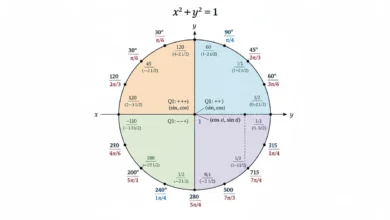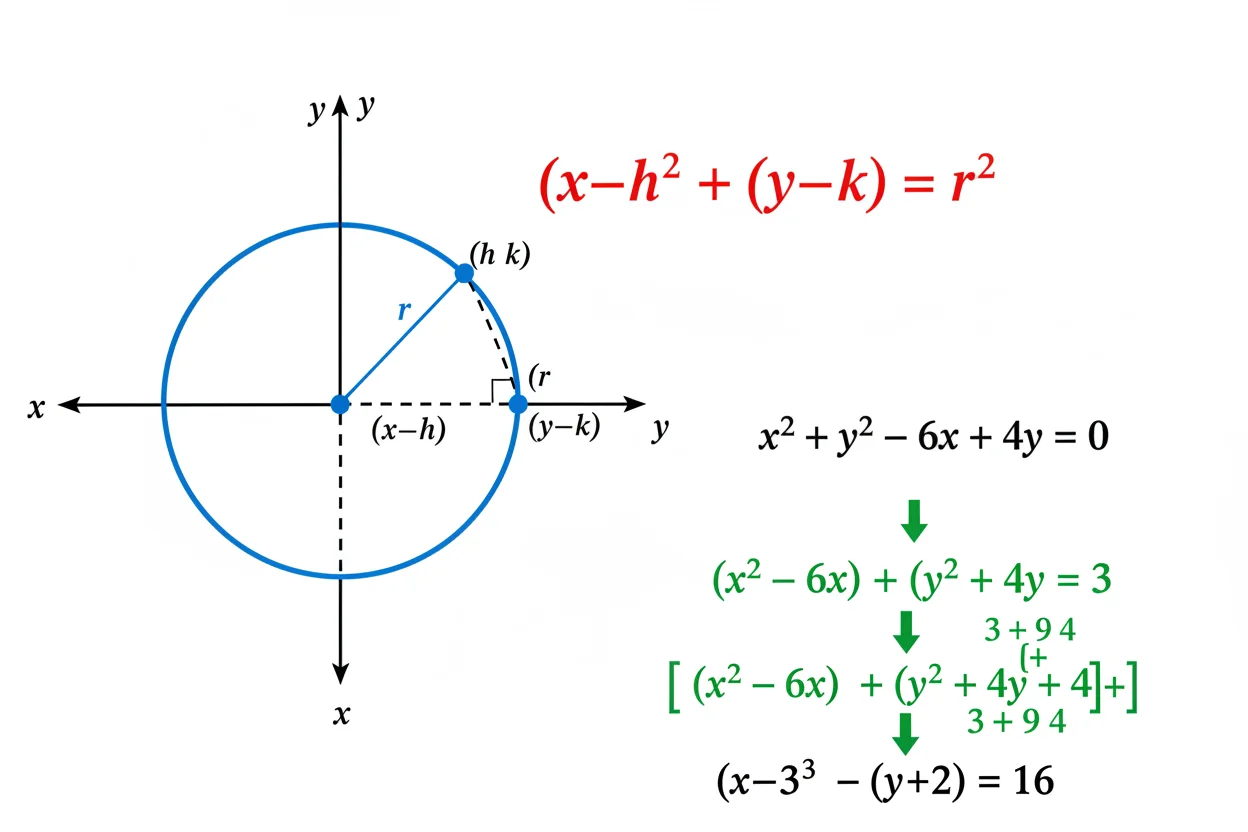

A circle equation describes all coordinate points located the same distance from a fixed center. For a circle centered at (h, k) with radius r, the standard equation is (x − h)² + (y − k)² = r². If the center is at the origin, the equation simplifies to x² + y² = r². The formula comes directly from the distance relationship between the center and any point on the circle. Circle equations can also appear in expanded form, such as x² + y² + Dx + Ey + F = 0. Completing the square converts that form into center-radius form, revealing both the center and radius. A circle equation can be constructed from a center and radius, a center and one point on the circle, diameter endpoints, or other equivalent geometric information. It can also determine whether a point lies inside, on, or outside a circle.
What Is a Circle Equation?
A circle is the set of all points a fixed distance from one center.
Let the center be:
(h, k)
Let a general point on the circle be:
(x, y)
The fixed distance between these points is the radius:
r
Using the Distance Formula:
√[(x − h)² + (y − k)²] = r
Square both sides:
(x − h)² + (y − k)² = r²
This is the standard circle equation.
It turns the geometric definition of a circle into an algebraic relationship.
Standard Circle Equation Formula
The center-radius form is:
(x − h)² + (y − k)² = r²
where:
center = (h, k)
and:
radius = r
For example:
(x − 3)² + (y + 2)² = 25
has center:
(3, −2)
and radius:
5
Notice that:
y + 2 = y − (−2)
so the y-coordinate of the center is −2.
Reading the Center Correctly
The signs inside the equation are opposite the coordinates of the center.
If:
(x − 4)² + (y − 7)² = 36
then:
center = (4, 7)
If:
(x + 4)² + (y − 7)² = 36
then:
center = (−4, 7)
If:
(x + 4)² + (y + 7)² = 36
then:
center = (−4, −7)
A common error is copying the signs directly instead of interpreting the expression as:
x − h
and:
y − k
Reading the Radius
The right side is:
r²
not r.
For:
(x − 2)² + (y + 3)² = 49
we have:
r² = 49
so:
r = 7
The geometric radius is nonnegative.
Do not report:
r = 49
unless the right side is actually:
49²
Circle Centered at the Origin
When:
h = 0
and:
k = 0
the equation becomes:
x² + y² = r²
For example:
x² + y² = 64
has center:
(0, 0)
and radius:
8
This is the simplest circle equation.
Basic Circle Equation Example
Find the equation of a circle with:
center = (2, −5)
radius = 4
Start with:
(x − h)² + (y − k)² = r²
Substitute:
h = 2
k = −5
r = 4
Then:
(x − 2)² + (y + 5)² = 16
That is the circle equation in standard form.
Circle Equation From Center and Point
Suppose a circle has center:
(1, 2)
and passes through:
(4, 6)
First find the radius using distance:
r = √[(4 − 1)² + (6 − 2)²]
= √(9 + 16)
= 5
Therefore:
r² = 25
The equation is:
(x − 1)² + (y − 2)² = 25
Check the Given Point
Substitute:
(4, 6)
into:
(x − 1)² + (y − 2)² = 25
Then:
(4 − 1)² + (6 − 2)²
= 3² + 4²
= 9 + 16
= 25
The point satisfies the equation, confirming that it lies on the circle.
Circle Equation From Radius and Origin
Suppose:
center = (0, 0)
radius = 12
Then:
x² + y² = 12²
Therefore:
x² + y² = 144
The Circle Circumference is:
C = 24π
and the Circle Area is:
A = 144π
Both measurements can be read indirectly once the radius is known.
Circle Equation From Diameter Endpoints
Suppose the endpoints of a diameter are:
A = (−2, 1)
and:
B = (6, 7)
First find the center with the Midpoint Formula:
h = (−2 + 6)/2 = 2
k = (1 + 7)/2 = 4
So the center is:
(2, 4)
Now find the diameter:
d = √[(6 − (−2))² + (7 − 1)²]
= √(8² + 6²)
= √100
= 10
Therefore:
r = 5
The circle equation is:
(x − 2)² + (y − 4)² = 25
Faster Radius From One Diameter Endpoint
Once the center is known:
(2, 4)
you can calculate the radius from either endpoint.
Using:
A = (−2, 1)
we have:
r² = (−2 − 2)² + (1 − 4)²
= 16 + 9
= 25
So:
r = 5
This avoids calculating the full diameter first.
Expanded Circle Equation
A circle can also appear as:
x² + y² + Dx + Ey + F = 0
For example:
x² + y² − 6x + 4y − 12 = 0
The center and radius are not immediately visible.
Complete the square in x and y to convert the equation into standard form.
Completing the Square
Start with:
x² + y² − 6x + 4y − 12 = 0
Move the constant:
x² − 6x + y² + 4y = 12
Group the x- and y-expressions:
(x² − 6x) + (y² + 4y) = 12
For:
x² − 6x
half of −6 is:
−3
square it:
9
For:
y² + 4y
half of 4 is:
2
square it:
4
Add both values to both sides:
x² − 6x + 9 + y² + 4y + 4 = 12 + 9 + 4
Factor:
(x − 3)² + (y + 2)² = 25
Therefore:
center = (3, −2)
radius = 5
Why You Add to Both Sides
Completing the square changes each grouped expression by adding a constant.
To preserve equality, the same total amount must be added to the other side.
In the previous example, we added:
9 + 4 = 13
to the left.
Therefore 13 must also be added to the right.
Failing to balance the equation changes the circle.
General Expanded-Form Center
For:
x² + y² + Dx + Ey + F = 0
the center is:
(−D/2, −E/2)
The radius satisfies:
r² = (D² + E²)/4 − F
Therefore:
r = √[(D² + E²)/4 − F]
provided the quantity under the square root is positive.
These formulas follow directly from completing the square.
Example Using the General Formula
Consider:
x² + y² + 8x − 10y + 5 = 0
Here:
D = 8
E = −10
F = 5
Center:
(−8/2, −(−10)/2)
= (−4, 5)
Radius squared:
r² = (8² + (−10)²)/4 − 5
= (64 + 100)/4 − 5
= 41 − 5
= 36
Therefore:
r = 6
Standard form is:
(x + 4)² + (y − 5)² = 36
Expanded Form From Standard Form
Start with:
(x − 2)² + (y + 3)² = 16
Expand:
x² − 4x + 4 + y² + 6y + 9 = 16
Combine terms:
x² + y² − 4x + 6y + 13 = 16
Move everything to one side:
x² + y² − 4x + 6y − 3 = 0
Thus the same circle can be represented in either standard or expanded form.
Standard Form Versus Expanded Form
Standard form:
(x − h)² + (y − k)² = r²
makes the center and radius immediately visible.
Expanded form:
x² + y² + Dx + Ey + F = 0
can be convenient for algebraic manipulation, intersections, and equation systems.
Neither form changes the geometric circle.
They are algebraically equivalent representations.
How to Recognize a Circle From a General Quadratic
A simple unrotated circle equation has equal coefficients on:
x²
and:
y²
and no:
xy
term after suitable common scaling.
For example:
2x² + 2y² − 8x + 12y − 10 = 0
can be divided by 2:
x² + y² − 4x + 6y − 5 = 0
which may describe a circle.
By contrast:
x² + 4y² = 16
has unequal squared coefficients and describes an ellipse rather than a circle.
Does Every Expanded Equation Represent a Real Circle?
No.
After completing the square, consider:
(x − h)² + (y − k)² = r²
If:
r² > 0
the equation represents a real circle.
If:
r² = 0
the circle degenerates to one point.
If:
r² < 0
there are no real points satisfying the equation because a sum of real squares cannot be negative.
Example With No Real Circle
Consider:
x² + y² + 4x − 2y + 10 = 0
Complete the square:
x² + 4x + y² − 2y = −10
Add:
4
and:
1
to both sides:
(x + 2)² + (y − 1)² = −5
The left side is always nonnegative for real x and y.
Therefore no real circle exists.
Point on a Circle
For circle:
(x − h)² + (y − k)² = r²
a point:
(x₀, y₀)
lies on the circle if:
(x₀ − h)² + (y₀ − k)² = r²
This is simply a squared-distance test.
Point Inside or Outside a Circle
Define:
D² = (x₀ − h)² + (y₀ − k)²
Then:
D² < r² → point is inside
D² = r² → point is on the circle
D² > r² → point is outside
Using squared distances avoids unnecessary square roots.
Point Classification Example
Consider:
(x − 2)² + (y − 1)² = 25
Test point:
P = (5, 5)
Calculate:
(5 − 2)² + (5 − 1)²
= 9 + 16
= 25
Therefore P lies:
on the circle
Now test:
Q = (2, 2)
Then:
0² + 1² = 1 < 25
so Q lies inside.
x-Intercepts of a Circle
To find x-intercepts, set:
y = 0
For:
x² + y² = 25
we obtain:
x² = 25
so:
x = ±5
The x-intercepts are:
(−5, 0)
and:
(5, 0)
These are the endpoints of a diameter along the x-axis.
y-Intercepts of a Circle
Set:
x = 0
For:
x² + y² = 25
we get:
y² = 25
so:
y = ±5
The y-intercepts are:
(0, −5)
and:
(0, 5)
A shifted circle may have zero, one, or two intercepts with either coordinate axis.
Circle and Line Intersections
Suppose:
x² + y² = 25
and:
y = 4
Substitute y = 4:
x² + 16 = 25
so:
x² = 9
Therefore:
x = ±3
The intersection points are:
(−3, 4)
and:
(3, 4)
The segment between them is a Chord Length of:
6
Tangent Line Intersection
If a line meets a circle at exactly one point, it is tangent.
For:
x² + y² = 25
consider:
y = 5
Substitute:
x² + 25 = 25
so:
x² = 0
Thus:
x = 0
There is only one intersection point:
(0, 5)
Therefore:
y = 5
is tangent to the circle.
No Intersection
For the same circle:
x² + y² = 25
consider:
y = 6
Then:
x² + 36 = 25
so:
x² = −11
There are no real x-values.
Therefore the line lies outside the circle and does not intersect it.
Circle Equation and Chord Length
Suppose:
x² + y² = r²
and a horizontal chord is:
y = d
Then:
x² + d² = r²
so:
x = ±√(r² − d²)
The endpoints are separated by:
c = 2√(r² − d²)
This reproduces the standard chord formula based on center-to-chord distance.
The circle equation therefore provides an algebraic derivation of a geometric chord relationship.
Circle Equation and Circle Area
Once radius is identified:
A = πr²
For:
(x − 4)² + (y + 1)² = 81
we have:
r = 9
Therefore:
A = 81π
The center:
(4, −1)
changes the circle’s position but not its area.
Circle Equation and Circumference
For the same circle:
r = 9
so:
C = 2πr
= 18π
The Circle Circumference depends only on radius, not center location.
Two circles with equal radii but different centers have identical area and circumference.
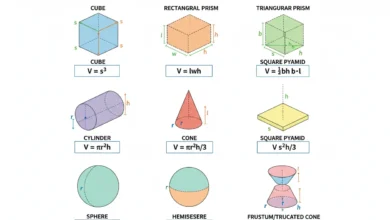
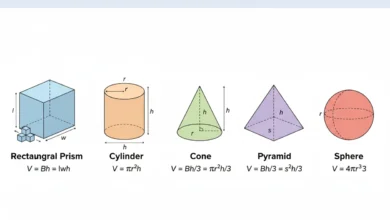
Circle Equation and Cone Geometry
A circular base also appears in three-dimensional solids such as cones.
The Cone Surface Area uses the base radius in:
S = πr² + πrℓ
If the base circle is described in coordinates by:
(x − h)² + (y − k)² = r²
the equation’s radius can supply the r used in the surface-area formula.
The circle equation describes the planar base, while the cone formula incorporates the third dimension through slant height ℓ.
Circle Equation From Area
Suppose a circle has:
center = (3, −4)
and:
area = 49π
Use:
A = πr²
Then:
r² = 49
Therefore the equation is:
(x − 3)² + (y + 4)² = 49
The area supplies r² directly when it is expressed as a multiple of π.
Circle Equation From Circumference
Suppose:
center = (−2, 5)
and:
circumference = 12π
Use:
C = 2πr
Then:
12π = 2πr
so:
r = 6
Therefore:
r² = 36
and the equation is:
(x + 2)² + (y − 5)² = 36
Circle Equation From a Diameter
Suppose the center is:
(1, −3)
and diameter is:
16
Then:
r = 8
so:
r² = 64
The equation is:
(x − 1)² + (y + 3)² = 64
Always halve the diameter before using it as r.
Circle Equation From a Radius Segment
Suppose center:
C = (−1, 2)
and a point:
P = (2, 6)
lies on the circle.
Radius squared can be calculated directly:
r² = (2 − (−1))² + (6 − 2)²
= 3² + 4²
= 25
Therefore:
(x + 1)² + (y − 2)² = 25
There is no need to calculate r = 5 first if the equation only requires r².
Circle Equation and Scaling
Suppose:
(x − h)² + (y − k)² = r²
and the radius is scaled by factor k_s.
The new equation with the same center becomes:
(x − h)² + (y − k)² = (k_s r)²
or:
(x − h)² + (y − k)² = k_s²r²
Doubling the radius therefore multiplies the right side by:
4
not by 2.
Example of Radius Scaling
Original circle:
(x − 2)² + (y − 3)² = 16
has:
r = 4
Double the radius:
r_new = 8
Then:
r_new² = 64
The new equation is:
(x − 2)² + (y − 3)² = 64
The center remains unchanged.
Translating a Circle
A translation changes the center but not the radius.
Suppose:
x² + y² = 25
is shifted:
3 units right
and:
2 units down
The new center is:
(3, −2)
while:
r = 5
Therefore:
(x − 3)² + (y + 2)² = 25
Area and circumference remain unchanged because the size did not change.
Circle Equation and Geometry
The broader Circles: Radius, Diameter, Area framework explains the geometric quantities represented in the equation.
The center gives position.
The radius gives size.
The equation then identifies exactly which coordinate points lie at that radius from the center.
This makes the circle equation a bridge between classical circle geometry and analytic geometry.
Circle Equation and Polar Coordinates
A circle centered at the origin:
x² + y² = R²
simplifies in Polar and Rectangular Form because:
x² + y² = r²
Thus:
r² = R²
and for ordinary nonnegative polar radius:
r = R
A circle centered at the origin therefore has an especially simple polar equation.
Shifted circles generally produce angle-dependent polar equations.
Circle Equation and Distance
The formula:
(x − h)² + (y − k)² = r²
is fundamentally a squared-distance equation.
The left side is the square of the distance from:
(x, y)
to:
(h, k)
Therefore every point satisfying the equation has exactly the same distance r from the center.
This is why the equation perfectly matches the geometric definition of a circle.
Circle Equation Versus Circle Area
The circle equation describes:
location + size
The circle area formula describes:
size only
For two circles:
(x − 1)² + (y − 2)² = 25
and:
(x + 8)² + (y − 7)² = 25
the centers differ, but both have:
r = 5
so both have:
area = 25π
Their equations distinguish their locations.
Circle Equation Versus Circumference
The same distinction applies to circumference.
A circle equation provides its center and radius.
Circumference then uses:
C = 2πr
Changing h or k alone moves the circle without changing its circumference.
Only changing r changes the boundary length.
Common Circle Equation Mistakes
A common mistake is reading the center signs incorrectly.
In:
(x + 4)² + (y − 2)² = 9
the center is:
(−4, 2)
not:
(4, −2)
Another mistake is treating the right side as r rather than r².
When completing the square, add the same values to both sides of the equation.
A valid ordinary circle has equal coefficients on x² and y² after common scaling and no xy term.
If the completed equation gives:
r² < 0
there is no real circle.
When constructing a circle from diameter endpoints, use the midpoint for the center and half the endpoint distance for radius.
Finally, when testing a point, substitute both coordinates into the equation rather than comparing one coordinate individually with the radius.
Frequently Asked Questions
What is the standard circle equation?
(x − h)² + (y − k)² = r²
What do h and k represent?
They are the coordinates of the center:
(h, k)
What does r represent?
r is the circle’s radius.
What is the equation of a circle centered at the origin?
x² + y² = r²
What is the center of (x − 3)² + (y + 5)² = 16?
(3, −5)
What is its radius?
r = 4
How do you convert an expanded circle equation to standard form?
Group the x- and y-terms and complete the square for each variable.
What is the general expanded form?
x² + y² + Dx + Ey + F = 0
after normalizing the common squared coefficient to 1.
How do you find a circle equation from a center and point?
Calculate the squared distance from the center to the point to obtain r², then substitute h, k, and r² into standard form.
How do you find the circle equation from diameter endpoints?
Find the midpoint for the center, calculate half the endpoint distance for radius, and substitute into standard form.
How can you tell whether a point lies inside a circle?
Calculate its squared distance from the center. If it is less than r², the point lies inside.
How can you tell whether a line is tangent to a circle?
After substituting the line into the circle equation, a tangent produces exactly one real intersection point.
Does moving the center change circle area?
No. Area depends only on radius.
Does moving the center change circumference?
No. Circumference also depends only on radius.
How can I check a circle equation?
Read the center and radius from standard form, then substitute a known point on the circle and verify that the left side equals r².