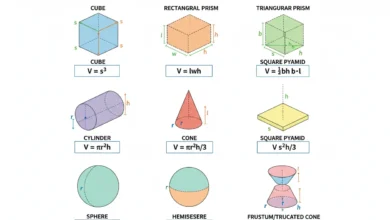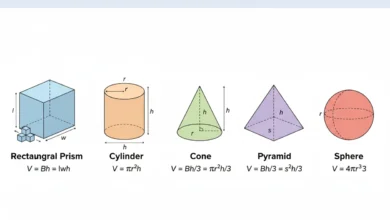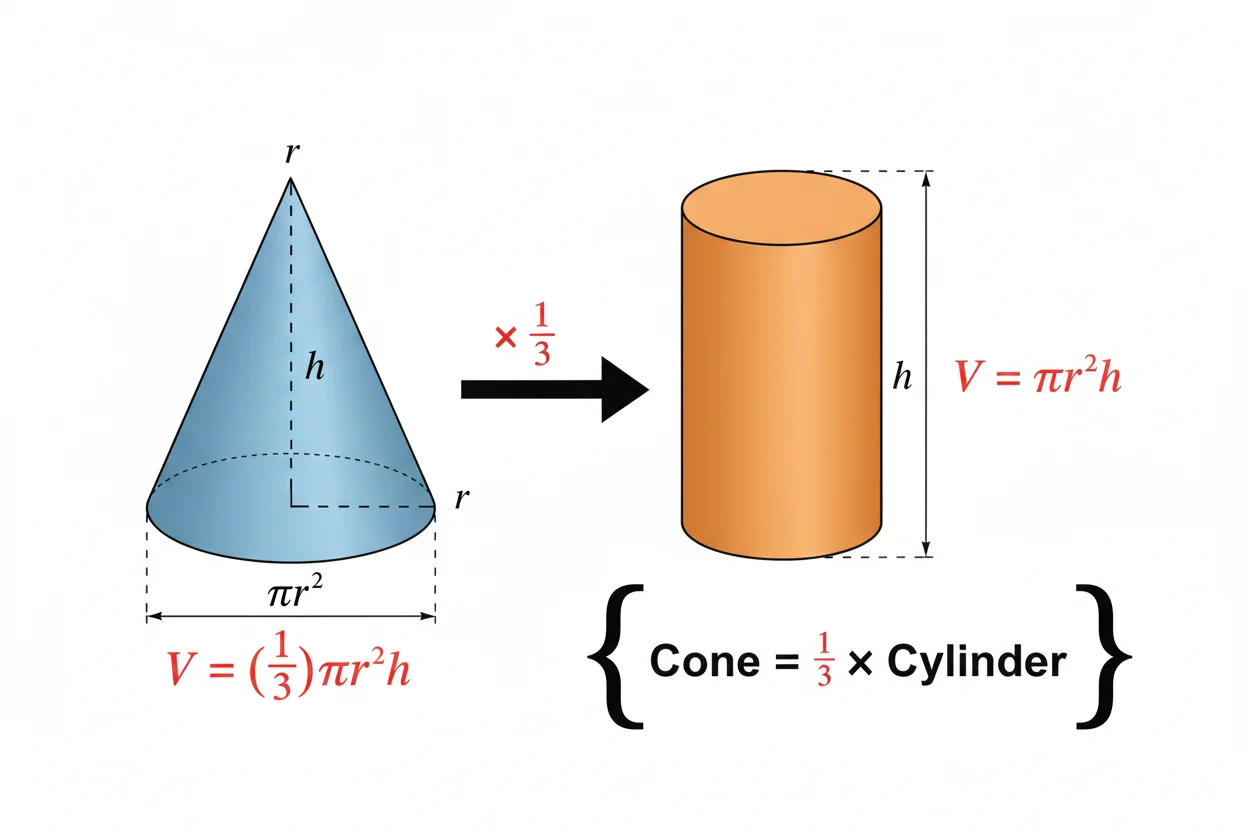

Cone volume measures the three-dimensional space inside a cone. For a right circular cone with base radius r and perpendicular height h, the formula is V = πr²h/3. The expression πr² is the area of the circular base, while h measures the perpendicular distance from the base plane to the apex. The factor 1/3 means that a cone has one-third the volume of a cylinder with the same base area and height. The slant height does not replace h in the volume formula, although it can be used with the radius to calculate h. Cone volume is measured in cubic units such as cm³, m³, ft³, or in³. The same base-area-times-height principle also extends to cones with noncircular bases when the appropriate base area is known.
Cone Volume Formula
For a right circular cone:
V = πr²h/3
where:
V = volume
r = base radius
h = perpendicular height
π ≈ 3.14159
The formula can also be written:
V = (1/3)Bh
where:
B = base area
For a circular base:
B = πr²
so:
V = Bh/3 = πr²h/3
The circular relationships behind the base are covered in Circles: Radius, Diameter, Area.
Basic Cone Volume Example
Suppose:
r = 3
h = 8
Then:
V = π(3²)(8)/3
= π(9)(8)/3
= 72π/3
Therefore:
V = 24π
Approximately:
V ≈ 75.40
cubic units.
Why Cone Volume Has a Factor of 1/3
Compare a cone and cylinder with the same:
base radius r
and:
perpendicular height h
The cylinder volume is:
V_cylinder = πr²h
The cone volume is:
V_cone = πr²h/3
Therefore:
V_cone = V_cylinder/3
So three cones with the same base area and height have the same total volume as one corresponding cylinder.
This one-third relationship is also shared by pyramids.
Base Area Method
Sometimes the base area is already known.
Use:
V = Bh/3
Suppose:
B = 54 cm²
h = 10 cm
Then:
V = 54(10)/3
= 180 cm³
There is no need to calculate radius when the base area has already been supplied.
Cone Volume From Radius and Height
Suppose:
r = 5 cm
h = 12 cm
Then:
V = π(5²)(12)/3
= π(25)(12)/3
= 100π cm³
Approximately:
V ≈ 314.16 cm³
The radius is squared because the base is two-dimensional.
Cone Volume From Diameter
If diameter d is given:
r = d/2
Therefore:
V = π(d/2)²h/3
Simplify:
V = πd²h/12
This is a useful direct formula when diameter is known.
For:
d = 10
h = 9
we get:
V = π(10²)(9)/12
= 900π/12
= 75π
Radius Versus Diameter
A common error is placing diameter directly into:
πr²h/3
If:
d = 14
then:
r = 7
The squared term must use:
7²
not:
14²
Since diameter is twice the radius, using diameter as r would make the base area four times too large.
Perpendicular Height Versus Slant Height
Cone volume requires the perpendicular height:
h
not the slant height:
ℓ
The slant height runs from the apex to the edge of the base along the cone’s surface.
The perpendicular height runs from the apex directly to the center of the base in a right circular cone.
These quantities are related by:
ℓ² = r² + h²
This right-triangle relationship follows from the Pythagorean Theorem.
Find Height From Slant Height
If:
r = 5
ℓ = 13
then:
h = √(ℓ² − r²)
= √(13² − 5²)
= √(169 − 25)
= √144
Therefore:
h = 12
The volume is:
V = π(5²)(12)/3
= 100π
Cone Volume From Radius and Slant Height
Combining:
h = √(ℓ² − r²)
with:
V = πr²h/3
gives:
V = πr²√(ℓ² − r²)/3
provided:
ℓ ≥ r
For:
r = 6
ℓ = 10
we find:
h = √(100 − 36)
= 8
Then:
V = π(36)(8)/3
= 96π
Cone Volume and Surface Area
The Cone Surface Area formula is:
S = πr² + πrℓ
while cone volume is:
V = πr²h/3
The surface-area formula uses:
slant height ℓ
The volume formula uses:
perpendicular height h
The difference reflects what each quantity measures.
Surface area covers the cone’s boundary.
Volume measures the space inside it.
Example Comparing Volume and Surface Area
Suppose:
r = 3
h = 4
Then:
ℓ = 5
Volume:
V = π(3²)(4)/3
= 12π
Total surface area:
S = π(3²) + π(3)(5)
= 24π
The numerical coefficients happen to differ by a factor of two, but the quantities have different dimensions:
volume → cubic units
surface area → square units
Find Height From Cone Volume
Start with:
V = πr²h/3
Multiply by 3:
3V = πr²h
Divide by:
πr²
to get:
h = 3V/(πr²)
Suppose:
V = 120π
r = 6
Then:
h = 3(120π)/(π·36)
= 360/36
Therefore:
h = 10
Find Radius From Cone Volume
Starting from:
V = πr²h/3
solve for r²:
r² = 3V/(πh)
Therefore:
r = √[3V/(πh)]
Suppose:
V = 192π
h = 16
Then:
r = √[3(192π)/(16π)]
= √36
Therefore:
r = 6
Only the positive square root represents a geometric radius.
Find Diameter From Cone Volume
Once radius is known:
d = 2r
Combining the formulas gives:
d = 2√[3V/(πh)]
Suppose:
V = 75π
h = 9
Then:
r = √[225π/(9π)]
= √25
= 5
Therefore:
d = 10
Cone Volume From Base Circumference
If the base circumference C is known:
C = 2πr
so:
r = C/(2π)
Substitute into the cone formula:
V = π[C/(2π)]²h/3
Simplify:
V = C²h/(12π)
This allows volume to be found without explicitly leaving circumference in the final calculation.
Circumference Example
Suppose:
C = 12π
h = 9
First:
r = 12π/(2π)
= 6
Then:
V = π(36)(9)/3
= 108π
The mapped Circle Circumference relationship provides the radius needed for the base.
Cone Volume From Base Circle Area
The Circle Area formula is:
B = πr²
Therefore cone volume can be written:
V = Bh/3
Suppose the base area is:
81π
and:
h = 12
Then:
V = (81π)(12)/3
= 324π
This approach avoids solving for radius when the base area itself is already known.
Cone Volume From a Circle Equation
Suppose the base circle is:
(x − 2)² + (y + 3)² = 25
The Circle Equation shows:
r² = 25
so:
r = 5
If cone height is:
h = 9
then:
V = π(25)(9)/3
Therefore:
V = 75π
The center coordinates do not affect the volume if the radius and height stay the same.
Cone Volume From an Expanded Circle Equation
Suppose the base is:
x² + y² − 6x + 4y − 12 = 0
Complete the square:
(x − 3)² + (y + 2)² = 25
Thus:
r = 5
If:
h = 6
then:
V = π(25)(6)/3
= 50π
Coordinate information therefore can supply the circular base radius before the solid formula is applied.
Cone Volume and Right Triangles
A cross section through the axis of a right circular cone produces an isosceles triangle.
Splitting it through the perpendicular height produces two congruent right triangles with side lengths:
r
h
ℓ
This is why:
r² + h² = ℓ²
The Congruent Triangles in that axial cross section also explain the cone’s left-right symmetry.
Axial Cross-Section Example
Suppose the axial cross section has:
base = 16
equal slant sides = 10
Half the cross-sectional base is:
r = 8
The height divides the isosceles triangle into two congruent right triangles.
Use:
h = √(10² − 8²)
= √36
= 6
Therefore:
V = π(8²)(6)/3
= 128π
Cone Volume and Trigonometry
If an angle and one cone dimension are known, trigonometry can determine r or h before volume is calculated.
Suppose θ is the angle between the cone axis and slant side.
In the axial right triangle:
tanθ = r/h
sinθ = r/ℓ
cosθ = h/ℓ
These relationships can convert angular information into the dimensions needed for:
V = πr²h/3
Trigonometric Cone Example
Suppose:
h = 10
and the angle between the axis and slant side is:
30°
Then:
tan30° = r/10
so:
r = 10tan30°
= 10/√3
The volume is:
V = πr²h/3
= π(100/3)(10)/3
Therefore:
V = 1000π/9
This example shows why trigonometry can be an intermediate step rather than part of the volume formula itself.
Reciprocal Trigonometric Functions
In some triangle setups, a reciprocal function such as Cosecant may appear.
For example:
cscθ = ℓ/r
when θ is the angle opposite radius r in the axial right triangle.
However, sine or cosine is usually more direct when finding cone dimensions.
The cone-volume formula itself remains:
V = πr²h/3
regardless of which trigonometric relationship was used to obtain r or h.
Cone Versus Cylinder Volume
For identical radius and height:
V_cone = πr²h/3
V_cylinder = πr²h
Therefore:
V_cylinder = 3V_cone
For:
r = 4
h = 9
cone:
V = 48π
cylinder:
V = 144π
The cylinder has exactly three times the cone’s volume.
Cone Versus Pyramid Volume
A pyramid with base area B and height h has:
V = Bh/3
A cone follows the same general formula:
V = Bh/3
The difference is the base shape.
For a right circular cone:
B = πr²
For a square pyramid:
B = s²
Both solids taper from a base toward an apex.
Cone Versus Frustum Volume
A frustum is created by cutting a cone with a plane parallel to its base and removing the smaller cone at the top.
Its volume requires two radii:
R
and:
r
The conical frustum formula is:
V = πh(R² + Rr + r²)/3
This is not the same as applying the full cone formula with only the larger radius.
The Frustum Volume relationship should be used when the apex has been removed.
Frustum as Difference of Two Cones
A frustum can also be interpreted as:
large cone − small similar cone
If both cone dimensions can be determined:
V_frustum = V_large − V_small
This method illustrates why similarity relationships are important in truncated-cone geometry.
The direct frustum formula combines that subtraction into one expression.
Oblique Cone Volume
A cone does not need its apex directly above the center of the base.
For an oblique cone, the same general volume relationship holds:
V = Bh/3
where h is the perpendicular distance from the apex to the plane containing the base.
For a circular base:
V = πr²h/3
The slanted position of the apex does not replace the perpendicular height.
Scaling Cone Volume
If every linear dimension is multiplied by scale factor k:
r → kr
h → kh
Then:
V_new = π(kr)²(kh)/3
= k³πr²h/3
Therefore:
V_new = k³V_old
Cone volume scales with the cube of the linear scale factor.
Scaling Example
Suppose a cone has volume:
20π
and every dimension is doubled.
Then:
k = 2
so:
V_new = 2³(20π)
= 160π
The volume becomes eight times as large.
Meanwhile, the cone’s surface area becomes four times as large because surface area scales with k².
Radius Scaling Alone
If only radius changes by factor k while height stays fixed:
V_new = k²V_old
because r is squared.
If radius doubles:
volume × 4
provided height is unchanged.
If height alone doubles:
volume × 2
because h appears to the first power.
Example: Double the Radius
Original cone:
r = 3
h = 10
Volume:
V = 30π
Double radius:
r = 6
with the same height.
New volume:
V = π(36)(10)/3
= 120π
Therefore the volume quadruples:
120π/30π = 4
Example: Double the Height
Keep:
r = 3
but increase height from:
10
to:
20
New volume:
V = π(9)(20)/3
= 60π
The original was:
30π
so volume doubles.
Similar Cones
Similar cones have corresponding linear dimensions in the same ratio.
If:
r₂/r₁ = k
then:
h₂/h₁ = k
and:
ℓ₂/ℓ₁ = k
Their volume ratio is:
V₂/V₁ = k³
For a scale factor of:
3/2
the volume factor is:
(3/2)³ = 27/8
Cone Capacity
A cone-shaped container’s ideal geometric capacity can be modeled with:
V = πr²h/3
For example, a conical vessel with:
r = 10 cm
h = 30 cm
has:
V = π(100)(30)/3
= 1000π cm³
Approximately:
V ≈ 3141.59 cm³
Since:
1000 cm³ = 1 L
this idealized volume is approximately:
3.142 L
assuming dimensions describe the interior.
Units of Cone Volume
If r and h are measured in centimeters:
r² → cm²
Multiplying by h:
cm² × cm = cm³
Therefore:
V → cm³
Similarly:
meters → m³
feet → ft³
inches → in³
A surface-area answer in square units should not be reported as a volume.
Converting Cubic Units
Volume conversions require cubing the linear conversion factor.
Since:
1 m = 100 cm
then:
1 m³ = 100³ cm³
= 1,000,000 cm³
This differs from area conversion, which squares the conversion factor.
Exact Versus Approximate Cone Volume
Suppose:
V = 48π
This is an exact result.
Using:
π ≈ 3.14159
gives:
V ≈ 150.80
If a problem does not require a decimal, retaining π is usually preferable.
Round only at the final step when an approximation is needed.
Checking Cone Volume With a Cylinder
If the same radius and height define a matching cylinder, calculate:
V_cylinder = πr²h
Then verify:
V_cone = V_cylinder/3
For:
r = 5
h = 6
cylinder:
V = 150π
cone:
V = 50π
The one-third relationship provides a useful arithmetic check.
Common Cone Volume Mistakes
A common mistake is forgetting the factor:
1/3
Another is using diameter in place of radius.
The volume formula requires perpendicular height h, not slant height ℓ.
If slant height is given, first find h using:
h = √(ℓ² − r²)
provided the geometry is a right circular cone.
Volume uses cubic units.
Do not include the cone’s surface area in the volume calculation.
For a truncated cone, use the frustum formula rather than the full cone formula.
Finally, when dimensions come from a diagram, confirm that the labeled segment is actually a radius, height, or slant height before substitution.
Frequently Asked Questions
What is the cone volume formula?
For a right circular cone:
V = πr²h/3
What is the general cone volume formula?
V = Bh/3
where B is the base area.
Why is cone volume divided by 3?
A cone has one-third the volume of a cylinder with the same base area and perpendicular height.
Does cone volume use slant height?
Not directly. It uses perpendicular height h.
How do you find height from slant height?
For a right circular cone:
h = √(ℓ² − r²)
How do you find radius from volume?
r = √[3V/(πh)]
How do you find height from volume?
h = 3V/(πr²)
What if diameter is given?
Use:
r = d/2
before calculating volume.
What is the volume formula using diameter?
V = πd²h/12
How is cone volume related to cylinder volume?
V_cone = V_cylinder/3
for equal radius and height.
How does cone volume scale?
If every linear dimension is multiplied by k:
volume is multiplied by k³
What units does cone volume use?
Cubic units such as:
cm³, m³, ft³, in³
Is a frustum calculated with the cone formula?
Not directly. A frustum has its own formula or can be calculated as the difference between two similar cones.
How can I check a cone volume answer?
Confirm the radius and perpendicular height, include the factor 1/3, verify cubic units, and compare the result with one-third of the matching cylinder volume when possible.