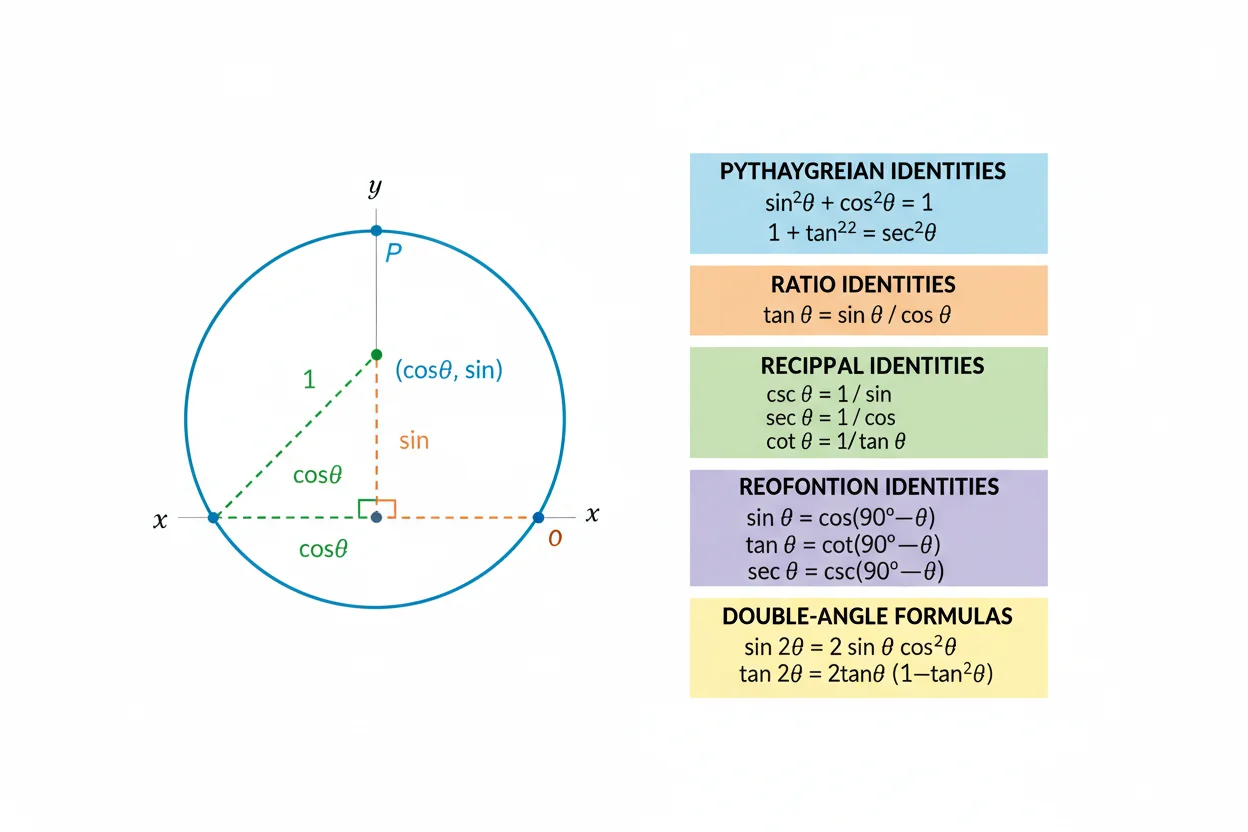

Trigonometric identities are equations involving trigonometric functions that are true for every angle in their common domain. Fundamental examples include sin²θ + cos²θ = 1, tanθ = sinθ/cosθ, secθ = 1/cosθ, and 1 + tan²θ = sec²θ. Unlike a trigonometric equation that may be true only for particular angles, an identity expresses a general relationship between functions. Identities are used to simplify expressions, prove equivalence, transform formulas, solve equations, evaluate exact values, and connect geometric and algebraic forms of trigonometry. The major families include reciprocal identities, quotient identities, Pythagorean identities, even-odd identities, cofunction identities, sum-and-difference formulas, double-angle formulas, half-angle formulas, and product or power-reduction relationships. Domain restrictions remain important because expressions involving division are undefined whenever their denominator is zero.
What Is a Trigonometric Identity?
An identity is an equation that holds for every permitted value of its variable.
For example:
sin²θ + cos²θ = 1
is true for every real θ.
By contrast:
sinθ = 1/2
is an equation true only for particular angles.
That distinction is fundamental:
identity → universally true on its domain
equation → true only for specific solutions
Fundamental Pythagorean Identity
The most important trigonometric identity is:
sin²θ + cos²θ = 1
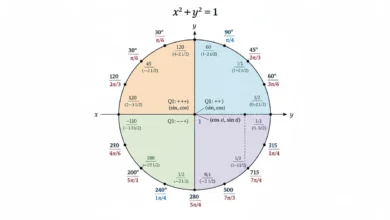
This comes directly from the Unit Circle.
A unit-circle point has coordinates:
(cosθ, sinθ)
The circle equation is:
x² + y² = 1
Substitute:
x = cosθ
y = sinθ
Therefore:
cos²θ + sin²θ = 1
Rearranged Pythagorean Forms
From:
sin²θ + cos²θ = 1
we can write:
sin²θ = 1 − cos²θ
and:
cos²θ = 1 − sin²θ
These forms are useful when an expression contains only one function and its square.
Example: Find Cosine Magnitude From Sine
Suppose:
sinθ = 3/5
Then:
cos²θ = 1 − 9/25
= 16/25
Therefore:
cosθ = ±4/5
The quadrant determines the correct sign.
The identity determines magnitude but not always sign.
Reciprocal Identities
The reciprocal identities are:
cscθ = 1/sinθ
secθ = 1/cosθ
cotθ = 1/tanθ
Equivalent forms are:
sinθ = 1/cscθ
cosθ = 1/secθ
tanθ = 1/cotθ
These formulas apply wherever both sides are defined.
Secant Example
If:
cosθ = 4/5
then:
secθ = 5/4
The Secant function therefore contains the reciprocal information of cosine.
Cosecant Example
If:
sinθ = −2/3
then:
cscθ = −3/2
Taking a reciprocal preserves the sign of a nonzero value.
Quotient Identities
The two standard quotient identities are:
tanθ = sinθ/cosθ
and:
cotθ = cosθ/sinθ
These can be derived from right-triangle ratios or unit-circle coordinates.
Tangent Quotient Derivation
In a right triangle:
sinθ = opposite/hypotenuse
cosθ = adjacent/hypotenuse
Divide:
sinθ/cosθ
= (opposite/hypotenuse)/(adjacent/hypotenuse)
The hypotenuse factors cancel:
= opposite/adjacent
Therefore:
tanθ = sinθ/cosθ
This connects Sine, cosine, and Tangent.
Second Pythagorean Identity
Start with:
sin²θ + cos²θ = 1
Divide every term by:
cos²θ
Then:
sin²θ/cos²θ + 1 = 1/cos²θ
Therefore:
tan²θ + 1 = sec²θ
So:
1 + tan²θ = sec²θ
Equivalent rearrangement:
sec²θ − tan²θ = 1
Third Pythagorean Identity
Again start with:
sin²θ + cos²θ = 1
Divide by:
sin²θ
Then:
1 + cos²θ/sin²θ = 1/sin²θ
Therefore:
1 + cot²θ = csc²θ
Equivalent form:
csc²θ − cot²θ = 1
Three Main Pythagorean Identities
The complete set is:
sin²θ + cos²θ = 1
1 + tan²θ = sec²θ
1 + cot²θ = csc²θ
Knowing the first allows the other two to be derived rather than memorized independently.
Example Using Secant and Tangent
Suppose:
tanθ = 3/4
Then:
sec²θ = 1 + 9/16
= 25/16
Therefore:
secθ = ±5/4
The sign depends on the quadrant.
Example Using Cosecant and Cotangent
Suppose:
cotθ = 5/12
Then:
csc²θ = 1 + 25/144
= 169/144
Therefore:
cscθ = ±13/12
Again, quadrant information supplies the sign.
Even and Odd Identities
Cosine is even:
cos(−θ) = cosθ
Sine is odd:
sin(−θ) = −sinθ
Tangent is odd:
tan(−θ) = −tanθ
Secant is even:
sec(−θ) = secθ
Cosecant and cotangent are odd:
csc(−θ) = −cscθ
cot(−θ) = −cotθ
Why Even and Odd Identities Matter
These identities simplify negative angles.
For example:
sin(−30°) = −sin30°
Therefore:
sin(−30°) = −1/2
For cosine:
cos(−60°) = cos60°
Therefore:
cos(−60°) = 1/2
Periodic Identities
Sine and cosine have period:
2π
Therefore:
sin(θ + 2π) = sinθ
cos(θ + 2π) = cosθ
Tangent and cotangent have period:
π
Therefore:
tan(θ + π) = tanθ
cot(θ + π) = cotθ
Secant and cosecant repeat every:
2π
Degree Versions
In degrees:
sin(θ + 360°) = sinθ
cos(θ + 360°) = cosθ
tan(θ + 180°) = tanθ
The Degrees and Radians measurement system changes the numerical angle notation but not the underlying identity.
Cofunction Identities
Complementary-angle relationships include:
sinθ = cos(90° − θ)
cosθ = sin(90° − θ)
tanθ = cot(90° − θ)
cotθ = tan(90° − θ)
secθ = csc(90° − θ)
cscθ = sec(90° − θ)
In radians, replace:
90°
with:
π/2
Cofunction Example
Since:
90° − 30° = 60°
we have:
sin30° = cos60°
Both equal:
1/2
Likewise:
tan30° = cot60°
Why Cofunction Identities Work
The two acute angles of a Right Triangle are complementary.
A side opposite one acute angle is adjacent to the other.
Therefore sine for one angle becomes cosine for its complement.
The same side-switching explains the other cofunction identities.
Supplementary-Angle Identities
For angle θ:
sin(180° − θ) = sinθ
cos(180° − θ) = −cosθ
tan(180° − θ) = −tanθ
In radians:
sin(π − θ) = sinθ
cos(π − θ) = −cosθ
tan(π − θ) = −tanθ
These are useful for Quadrant II angles.
Example With 150°
Because:
150° = 180° − 30°
we have:
sin150° = sin30° = 1/2
cos150° = −cos30° = −√3/2
tan150° = −tan30° = −√3/3
Sum Formula for Sine
The sine addition identity is:
sin(A + B) = sinA cosB + cosA sinB
The subtraction version is:
sin(A − B) = sinA cosB − cosA sinB
These formulas can generate exact values for angles not directly present in standard tables.
Example: sin75°
Write:
75° = 45° + 30°
Then:
sin75° = sin45°cos30° + cos45°sin30°
Substitute:
= (√2/2)(√3/2) + (√2/2)(1/2)
Therefore:
sin75° = (√6 + √2)/4
Sum Formula for Cosine
The cosine addition identity is:
cos(A + B) = cosA cosB − sinA sinB
The subtraction identity is:
cos(A − B) = cosA cosB + sinA sinB
Notice that cosine uses the opposite sign between terms compared with the sign inside the angle.
Example: cos75°
Using:
75° = 45° + 30°
we get:
cos75° = cos45°cos30° − sin45°sin30°
Therefore:
cos75° = (√6 − √2)/4
Sum Formula for Tangent
For appropriate domains:
tan(A + B) = (tanA + tanB)/(1 − tanA tanB)
and:
tan(A − B) = (tanA − tanB)/(1 + tanA tanB)
The denominator must be nonzero.
Example: tan75°
Use:
75° = 45° + 30°
Then:
tan75° = [1 + √3/3]/[1 − √3/3]
Simplifying gives:
tan75° = 2 + √3
Double-Angle Identity for Sine
Set:
A = B = θ
in the sine addition formula:
sin(2θ) = sinθ cosθ + cosθ sinθ
Therefore:
sin2θ = 2sinθ cosθ
Double-Angle Identities for Cosine
Starting with:
cos2θ = cos²θ − sin²θ
and using:
sin²θ + cos²θ = 1
we obtain two additional forms:
cos2θ = 2cos²θ − 1
and:
cos2θ = 1 − 2sin²θ
All three are equivalent.
Choosing a Cosine Double-Angle Form
Use:
cos²θ − sin²θ
when both sine and cosine appear naturally.
Use:
2cos²θ − 1
when the expression contains cosine only.
Use:
1 − 2sin²θ
when it contains sine only.
Selecting the convenient form can substantially shorten a simplification.
Double-Angle Identity for Tangent
From the tangent addition formula:
tan2θ = 2tanθ/(1 − tan²θ)
where:
1 − tan²θ ≠ 0
and tangent must be defined at the relevant angles.
Double-Angle Example
Suppose:
sinθ = 3/5
cosθ = 4/5
Then:
sin2θ = 2(3/5)(4/5)
Therefore:
sin2θ = 24/25
Also:
cos2θ = 16/25 − 9/25
Therefore:
cos2θ = 7/25
Half-Angle Identities
From the cosine double-angle formulas:
sin²(θ/2) = (1 − cosθ)/2
cos²(θ/2) = (1 + cosθ)/2
Therefore:
sin(θ/2) = ±√[(1 − cosθ)/2]
cos(θ/2) = ±√[(1 + cosθ)/2]
The sign depends on the quadrant containing θ/2.
Tangent Half-Angle Forms
Useful forms include:
tan(θ/2) = sinθ/(1 + cosθ)
and:
tan(θ/2) = (1 − cosθ)/sinθ
where the relevant denominators are nonzero.
These forms can simplify certain equations and exact-value calculations.
Power-Reduction Identities
Rearranging the half-angle relationships gives:
sin²θ = (1 − cos2θ)/2
cos²θ = (1 + cos2θ)/2
These are useful when an expression contains squared trigonometric functions.
They are especially important in calculus integrals involving powers of sine and cosine.
Example of Power Reduction
Simplify:
2sin²θ
Use:
sin²θ = (1 − cos2θ)/2
Therefore:
2sin²θ = 1 − cos2θ
Product-to-Sum Identities
Common product-to-sum formulas include:
sinA sinB = [cos(A−B) − cos(A+B)]/2
cosA cosB = [cos(A−B) + cos(A+B)]/2
sinA cosB = [sin(A+B) + sin(A−B)]/2
These transform products into sums or differences.
Sum-to-Product Example
One corresponding relationship is:
sinA + sinB = 2sin[(A+B)/2]cos[(A−B)/2]
Such transformations can reveal zeros, factors, or wave combinations that are not obvious in the original expression.
Proving an Identity
When proving an identity, begin with one side and transform it until it matches the other.
A reliable strategy is to:
rewrite secant, cosecant, tangent, and cotangent using sine and cosine
then:
use the Pythagorean identity
then:
factor or combine fractions
Avoid changing both sides independently unless the logic remains completely reversible and clear.
Identity Proof Example 1
Prove:
(1 − sin²θ)/cosθ = cosθ
Start with the left side.
Use:
1 − sin²θ = cos²θ
Then:
cos²θ/cosθ
Therefore:
= cosθ
where:
cosθ ≠ 0
The identity is established on the common domain of the original expression.
Identity Proof Example 2
Simplify:
tanθ cosθ
Use:
tanθ = sinθ/cosθ
Then:
tanθ cosθ = (sinθ/cosθ)cosθ
Therefore:
= sinθ
where cosine is nonzero in the original tangent expression.
Identity Proof Example 3
Prove:
(sec²θ − 1)/tanθ = tanθ
Use:
sec²θ − 1 = tan²θ
Then:
tan²θ/tanθ
Therefore:
= tanθ
on the common domain where the original denominator tanθ is nonzero.
Why Domain Restrictions Matter
An algebraic simplification can remove a denominator, but it cannot restore points excluded by the original expression.
For example:
tanθ cosθ = sinθ
algebraically simplifies to sine.
But the original left side is undefined whenever:
cosθ = 0
because tangent is undefined there.
Therefore an identity should be understood over the domain where both original sides are defined.
Verifying an Identity Numerically
Testing a few angles can help detect an error, but it does not prove an identity.
For example, checking:
sin²30° + cos²30° = 1
confirms one case.
A proof must show the relationship for all permitted θ.
Numerical testing is best used as a diagnostic check.
Simplifying Rational Trigonometric Expressions
Consider:
(1 − cos²θ)/sinθ
Use:
1 − cos²θ = sin²θ
Then:
sin²θ/sinθ
Therefore:
= sinθ
on the common domain where:
sinθ ≠ 0
Factoring With Trigonometric Identities
Expressions can often be treated like algebraic polynomials.
For example:
sec²θ − tan²θ
is immediately:
1
But:
sec⁴θ − tan⁴θ
can be factored:
(sec²θ − tan²θ)(sec²θ + tan²θ)
Therefore:
sec⁴θ − tan⁴θ = sec²θ + tan²θ
because the first factor is:
1
Converting Everything to Sine and Cosine
Consider:
secθ − cosθ
Rewrite:
1/cosθ − cosθ
Use a common denominator:
(1 − cos²θ)/cosθ
Then:
sin²θ/cosθ
This can also be written:
sinθ tanθ
depending on the desired final form.
Rationalizing Trigonometric Expressions
Conjugates can simplify expressions such as:
1/(1 + sinθ)
Multiply numerator and denominator by:
1 − sinθ
Then:
(1 − sinθ)/(1 − sin²θ)
Use:
1 − sin²θ = cos²θ
Therefore:
(1 − sinθ)/cos²θ
This may then be rewritten in reciprocal or quotient functions if useful.
Solving Equations With Identities
Identities can transform a trigonometric equation into a simpler form.
For example:
2sin²θ = 1
Use:
sin²θ = (1 − cos2θ)/2
Then:
1 − cos2θ = 1
So:
cos2θ = 0
Alternatively, solve:
sin²θ = 1/2
directly.
The best identity depends on the desired solution method.
Equation Example
Solve:
sec²θ − 3 = 0
Use:
sec²θ = 1 + tan²θ
Then:
1 + tan²θ − 3 = 0
So:
tan²θ = 2
Therefore:
tanθ = ±√2
The interval specified by the problem determines the complete set of angles.
Identity Versus Equation Transformations
When solving equations, squaring both sides or multiplying by an expression that may equal zero can create or remove possible solutions.
Therefore solutions should be checked against the original equation.
An identity transformation that is valid over a shared domain is safer than an irreversible algebraic manipulation.
Reciprocal Functions and Zeros
Because:
secθ = 1/cosθ
secant is undefined when:
cosθ = 0
Because:
cscθ = 1/sinθ
cosecant is undefined when:
sinθ = 0
Because:
cotθ = cosθ/sinθ
cotangent is also undefined when:
sinθ = 0
These restrictions matter when simplifying identities.
Tangent and Secant Domain Connection
The mapped Secant and tangent functions are both undefined wherever:
cosθ = 0
This makes:
1 + tan²θ = sec²θ
particularly natural because both sides share the same basic domain exclusions.
Unit Circle Sign Rules
The unit circle determines function signs by quadrant:
Quadrant I: sin +, cos +, tan +
Quadrant II: sin +, cos −, tan −
Quadrant III: sin −, cos −, tan +
Quadrant IV: sin −, cos +, tan −
Identities involving square roots require these sign rules.
Example With a Quadrant
Suppose:
cosθ = −3/5
and θ lies in Quadrant II.
Then:
sin²θ = 1 − 9/25
= 16/25
Because sine is positive in Quadrant II:
sinθ = 4/5
Therefore:
tanθ = (4/5)/(−3/5)
So:
tanθ = −4/3
Trigonometric Identities in Triangle Solving
The mapped Triangle Solving framework uses identities to connect different side-angle ratios.
For example:
sin²θ + cos²θ = 1
mirrors the normalized Pythagorean theorem in a right triangle.
If one trigonometric ratio is known, identities can often recover others before solving the remaining sides or angles.
Right Triangle Interpretation
Suppose a right triangle has:
opposite = a
adjacent = b
hypotenuse = c
Then:
sinθ = a/c
cosθ = b/c
The Pythagorean theorem gives:
a² + b² = c²
Divide by c²:
a²/c² + b²/c² = 1
Therefore:
sin²θ + cos²θ = 1
The fundamental identity is literally the Pythagorean theorem expressed as ratios.
Orthocenter Geometry
The mapped Triangle Orthocenter creates right-angle constructions throughout a triangle.
Complementary-angle identities such as:
sin(90°−θ) = cosθ
frequently arise when altitudes split a triangle into smaller right triangles.
The orthocenter itself is a geometric point, while the identities describe the angular relationships created by its altitudes.
Triangle Medians and Identities
The mapped Triangle Medians do not generally create right angles, so trigonometric identities are not built directly into the median definition.
However, a median can divide a triangle into two smaller triangles where the Law of Cosines, sine area formula, or other trigonometric relations are applied.
In an isosceles triangle, the apex median is also an altitude, making right-triangle identities directly useful.
Triangle Incenter and Half-Angles
The mapped Triangle Incenter lies on all three internal angle bisectors.
Therefore half-angle expressions occur naturally.
For example:
∠BAI = A/2
and formulas involving:
sin(A/2)
cos(A/2)
can relate the incenter to side lengths and the inradius.
Incenter Half-Angle Relationship
A useful identity-based relationship is:
r = 4R sin(A/2)sin(B/2)sin(C/2)
where:
r = inradius
R = circumradius
The half-angle factors arise directly from the triangle’s angle-bisector geometry.
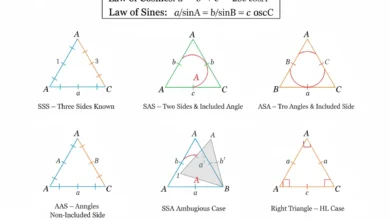
Law of Sines as a Trigonometric Relationship
The Law of Sines states:
a/sinA = b/sinB = c/sinC
It is not usually classified as an elementary identity because it relates the geometry of a particular triangle rather than holding for arbitrary independent variables.
However, its derivations rely heavily on sine relationships.
Law of Cosines Connection
The Law of Cosines:
c² = a² + b² − 2ab cosC
reduces to the Pythagorean theorem when:
C = 90°
because:
cos90° = 0
This illustrates how exact trigonometric values can transform general geometric formulas into special cases.
Polar and Rectangular Coordinates
The Polar and Rectangular Form relationships are:
x = r cosθ
y = r sinθ
Therefore:
x² + y² = r²(cos²θ + sin²θ)
Use:
cos²θ + sin²θ = 1
Then:
x² + y² = r²
The Pythagorean identity guarantees consistency between polar and rectangular distance.
Slope and Tangent Identity
For a line with direction angle θ:
m = tanθ
Using the quotient identity:
m = sinθ/cosθ
This relates vertical and horizontal components of a direction vector.
The Slope interpretation is therefore a direct geometric application of a trigonometric identity.
Regular Polygon Formulas
The Regular Polygon Area formula:
A = ns²/[4tan(π/n)]
contains tangent because central triangles are split into right triangles.
Identity transformations can convert the same geometry into circumradius or apothem forms involving sine and cosine.
For example:
s = 2R sin(π/n)
and:
a = R cos(π/n)
Product Identity in Polygon Geometry
Multiplying:
s = 2R sin(π/n)
and:
a = R cos(π/n)
and using:
2sinx cosx = sin2x
leads naturally toward:
A = nR²sin(2π/n)/2
Thus a double-angle identity connects two common regular-polygon area forms.
Periodic Modeling
Functions such as:
y = A sin(Bx + C) + D
or:
y = A cos(Bx + C) + D
model periodic behavior.
Identities allow equivalent wave expressions to be combined, shifted, or transformed.
For example, a linear combination:
a sinx + b cosx
can be rewritten as a single shifted sinusoid.
Combining Sine and Cosine
An expression:
a sinx + b cosx
can be written:
R sin(x + φ)
where:
R = √(a²+b²)
and φ is chosen so that:
R cosφ = a
R sinφ = b
This is a useful identity-based transformation in oscillation and signal problems.
Example of Combining Functions
Consider:
3sinx + 4cosx
Since:
R = √(9+16)
= 5
choose φ such that:
cosφ = 3/5
sinφ = 4/5
Then:
3sinx + 4cosx = 5sin(x+φ)
This immediately shows the expression’s maximum magnitude is:
5
Identity Strategy: Look for Squares
If you see:
sin²θ + cos²θ
replace it with:
1
If you see:
1 − sin²θ
replace it with:
cos²θ
If you see:
1 − cos²θ
replace it with:
sin²θ
This is often the fastest simplification step.
Identity Strategy: Look for 1 + tan²θ
Replace:
1 + tan²θ
with:
sec²θ
Likewise:
sec²θ − 1 = tan²θ
and:
csc²θ − 1 = cot²θ
Recognizing these patterns prevents unnecessary algebra.
Identity Strategy: Rewrite Quotient Functions
If an expression contains:
tanθ
or:
cotθ
rewriting them as:
sinθ/cosθ
or:
cosθ/sinθ
often allows cancellation with other sine and cosine factors.
Identity Strategy: Rewrite Reciprocals
If secant and cosine appear together:
secθ cosθ = 1
where defined.
Similarly:
cscθ sinθ = 1
cotθ tanθ = 1
These reciprocal pairs can make complicated-looking expressions collapse immediately.
Identity Strategy: Use a Common Denominator
Suppose:
sinθ/(1+cosθ) + sinθ/(1−cosθ)
A common denominator gives:
sinθ[(1−cosθ)+(1+cosθ)]/(1−cos²θ)
Simplify numerator:
2sinθ
Use:
1−cos²θ = sin²θ
Therefore:
2/sinθ
So:
= 2cscθ
on the common domain.
Identity Strategy: Factor First
Before applying a trig identity, ordinary algebraic factoring may help.
For example:
sin²θ − cos²θ
is already related to:
−cos2θ
But an expression such as:
sin⁴θ − cos⁴θ
factors as:
(sin²θ−cos²θ)(sin²θ+cos²θ)
Since:
sin²θ+cos²θ = 1
the expression becomes:
sin²θ−cos²θ
or:
−cos2θ
Common Trigonometric Identity Mistakes
A common mistake is treating an equation true for one angle as an identity.
Another is writing:
sin(A+B) = sinA + sinB
which is false in general.
The correct formula is:
sin(A+B) = sinAcosB + cosAsinB
Likewise:
cos(A+B)
is not:
cosA + cosB
Pay attention to domain restrictions when canceling sine or cosine factors.
When taking square roots from squared identities, include the:
±
possibility until the quadrant determines the sign.
Do not confuse reciprocal notation:
secθ = 1/cosθ
with inverse notation such as:
cos⁻¹x
Finally, remember that numerical testing supports a derivation but does not prove an identity.
Frequently Asked Questions
What are trigonometric identities?
They are equations involving trigonometric functions that are true for every value in their common domain.
What is the fundamental trigonometric identity?
sin²θ + cos²θ = 1
What are the reciprocal identities?
cscθ = 1/sinθ
secθ = 1/cosθ
cotθ = 1/tanθ
What are the quotient identities?
tanθ = sinθ/cosθ
cotθ = cosθ/sinθ
What are the three Pythagorean identities?
sin²θ + cos²θ = 1
1 + tan²θ = sec²θ
1 + cot²θ = csc²θ
Is sine odd or even?
Sine is odd:
sin(−θ) = −sinθ
Is cosine odd or even?
Cosine is even:
cos(−θ) = cosθ
Is tangent odd or even?
Tangent is odd:
tan(−θ) = −tanθ
What is the sine addition formula?
sin(A+B) = sinAcosB + cosAsinB
What is the cosine addition formula?
cos(A+B) = cosAcosB − sinAsinB
What is the tangent addition formula?
tan(A+B) = (tanA+tanB)/(1−tanA tanB)
What is the sine double-angle identity?
sin2θ = 2sinθcosθ
What are the cosine double-angle identities?
cos2θ = cos²θ − sin²θ
cos2θ = 2cos²θ − 1
cos2θ = 1 − 2sin²θ
What is the tangent double-angle formula?
tan2θ = 2tanθ/(1−tan²θ)
What are the power-reduction identities?
sin²θ = (1−cos2θ)/2
cos²θ = (1+cos2θ)/2
How do you prove a trigonometric identity?
Transform one side using known identities and algebra until it matches the other side on the common domain.
Why do domain restrictions matter?
Simplification cannot make an originally undefined expression valid at excluded angles.
How can I check a trigonometric identity?
Derive it algebraically from established identities, then optionally test several permitted angles as an additional numerical check.