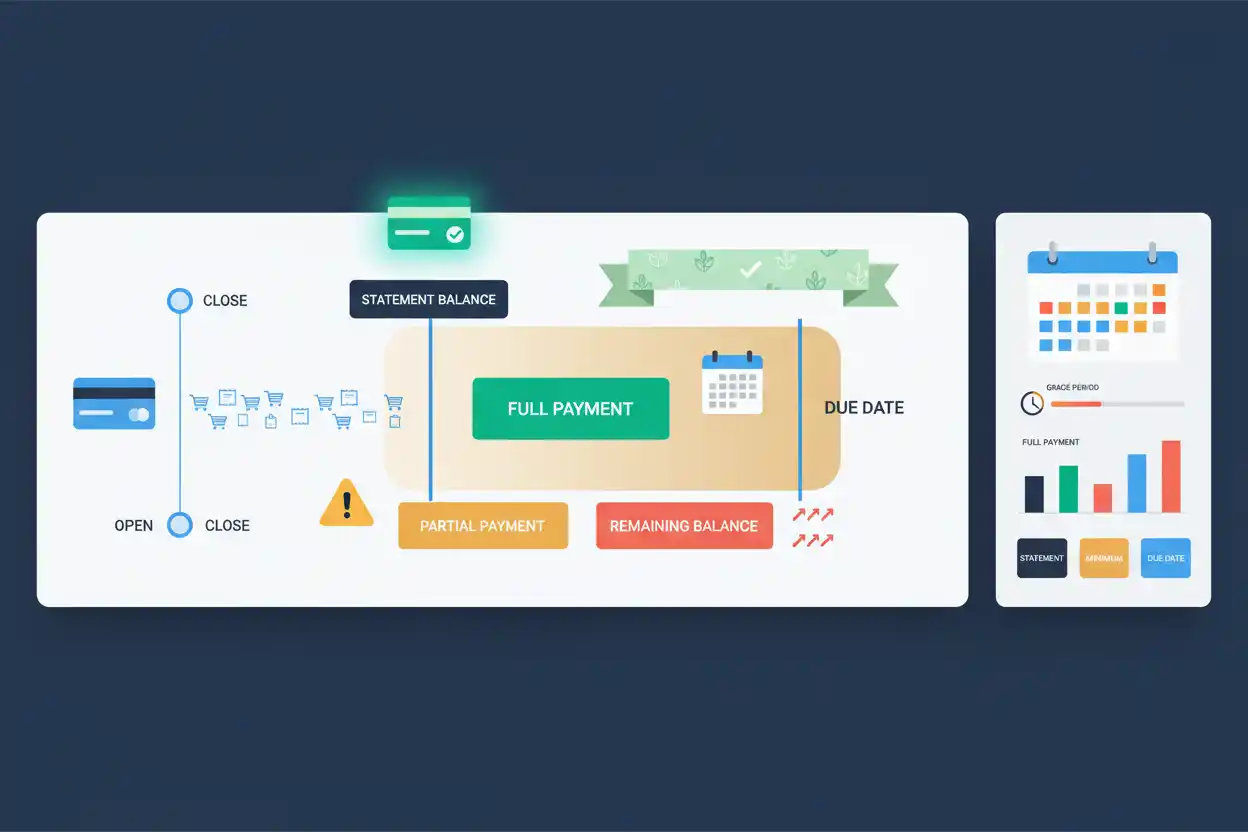

A credit card grace period is the period during which qualifying credit can be repaid without incurring interest from a periodic rate, assuming the card’s grace-period requirements are satisfied.
For purchases, the practical timeline usually runs from the end of a billing cycle to the payment due date.
A simplified way to measure the statement grace-period interval is:
Grace Period Length = Payment Due Date − Billing Cycle Closing Date
For example, if a billing cycle closes on June 3 and payment is due June 28:
Grace Period Length = June 28 − June 3
Grace Period Length = 25 Days
However, calculating the number of days is not enough. Whether a particular transaction actually receives interest-free treatment depends on the card agreement, balance type, and payment behavior.
What Is a Credit Card Grace Period?
A credit card grace period is an interest-free payment window that commonly applies to purchases when the required statement balance is paid according to the card’s terms.
Suppose your billing cycle closes with a statement balance of $1,800.
If your card provides a purchase grace period and you pay the required balance in full by the due date, you may avoid purchase interest on that statement cycle.
The grace period therefore creates an important distinction between:
using a credit card as a payment tool and using a credit card as ongoing debt.
Someone who consistently preserves the grace period can use a card without paying purchase interest.
Someone who carries balances can incur interest even though the same card has the same credit card APR.
Credit Card Grace Period Formula
There is no universal financial formula that determines whether a grace period applies.
The date interval itself can be calculated as:
Grace Period Days = Due Date − Statement Closing Date
Suppose:
Statement closing date = August 5
Payment due date = August 30
Then:
Grace Period Days = 25 Days
The card agreement determines what must be paid and when to maintain interest-free treatment.
Billing Cycle vs Grace Period
A billing cycle and grace period are different.
The billing cycle is the period during which transactions are grouped for a statement.
The grace period follows the cycle and gives the cardholder time to make the required payment without incurring periodic interest on qualifying credit.
A simplified timeline looks like this:
Purchase period → Statement closes → Grace period → Payment due date
A purchase made early in the billing cycle can therefore remain unpaid for considerably longer than the formal statement-to-due-date grace period before interest becomes due, assuming all grace-period requirements are satisfied.
Credit Card Grace Period Example
Suppose:
Billing cycle: May 4 through June 3
Statement closing date: June 3
Statement balance: $2,000
Payment due date: June 28
Purchase grace period applies
The statement-to-due-date interval is:
Grace Period = 25 Days
If the cardholder pays the full $2,000 statement balance by June 28 and satisfies the card’s terms, qualifying purchases may avoid interest.
If only $500 is paid and $1,500 is carried forward, the result can be very different.
The cardholder may lose grace-period treatment and begin incurring interest according to the card agreement.
Statement Balance vs Current Balance
This distinction matters greatly.
Your statement balance is the balance captured when the billing cycle closed.
Your current balance can include transactions that occurred after the statement date.
Suppose:
Statement balance = $2,000
New purchases after statement = $500
Current balance = $2,500
If the card’s grace-period terms require payment of the statement balance, paying $2,000 by the due date can satisfy that requirement even though the current balance is $2,500.
The additional $500 belongs to the newer billing cycle.
Always follow the exact terms shown by your issuer.
Minimum Payment vs Grace Period Payment
The credit card minimum payment is the minimum amount required to keep the account from being treated as unpaid according to the statement terms.
It is not normally the amount required to preserve an interest-free purchase grace period.
Suppose:
Statement balance = $3,000
Minimum payment = $90
Paying $90 can satisfy the minimum-payment requirement while leaving $2,910 unpaid.
That remaining balance can create interest charges and may affect grace-period eligibility.
Thus:
Minimum Payment ≠ Statement Balance
and:
Paying Minimum ≠ Necessarily Preserving Grace Period
Credit Card Grace Period and APR
A high credit card APR does not necessarily mean a cardholder will pay high interest.
If purchases qualify for a grace period and the required balance is paid in full every month, purchase interest may be avoided entirely.
For example:
Purchase APR = 25%
Statement balance = $2,000
Statement balance paid in full by due date
Interest on qualifying purchases can still be $0.
For someone carrying the same $2,000 balance, the 25% APR becomes highly relevant.
Losing a Credit Card Grace Period
A grace period can be lost when a cardholder carries a balance rather than satisfying the requirements for interest-free purchase treatment.
Once the grace period is lost, new purchases may begin accruing interest from the transaction date or according to the issuer’s calculation method.
This can create a costly cycle.
Suppose you already carry $4,000 of credit-card debt and then make $1,000 of new purchases.
Those new purchases may begin generating interest instead of receiving the interest-free window you were accustomed to.
That is why carrying a promotional or transferred balance can affect the economics of using the same card for new spending.
Balance Transfers and Grace Periods
A low-rate balance transfer can save interest on existing debt, but it can complicate purchase grace-period treatment.
For example, you might transfer $8,000 at a 0% promotional rate.
The transfer itself could also incur a balance transfer fee.
If carrying that transferred balance causes new purchases to lose a grace period under the account terms, using the same card for everyday spending can create purchase interest.
A balance-transfer card is often easiest to manage when the transferred debt and new spending are treated as separate financial decisions.
Cash Advances and Grace Periods
Cash advances commonly do not receive the same grace period as qualifying purchases.
A cash advance fee may apply immediately, and cash advance interest can begin accumulating from the transaction date.
Therefore:
Purchase Grace Period ≠ Cash Advance Grace Period
A cardholder should not assume that because purchases can be interest-free until the due date, withdrawing cash will receive the same treatment.
How Long Is a Credit Card Grace Period?
There is no single grace-period length for every card.
The actual number of days depends on the issuer, billing cycle, account agreement, and due date.
You can calculate the statement interval directly:
Grace Period Days = Due Date − Closing Date
For example:
Closing date = September 10
Due date = October 5
Grace Period = 25 Days
However, the number of days can change slightly between cycles because calendar months have different lengths.
Purchase Timing and Interest-Free Days
A purchase made just after a statement closes can potentially remain unpaid for much longer than a purchase made just before the closing date.
Suppose:
Previous statement closes: July 1
Next statement closes: August 1
Due date: August 26
A purchase on July 2 could appear on the August 1 statement and not need to be paid until August 26 to preserve applicable grace-period treatment.
That is approximately 55 days after the purchase.
A purchase on July 31 reaches the same statement but has only about 26 days until the due date.
The formal grace period is tied to the statement cycle, not a guaranteed fixed number of days after every individual purchase.
Grace Period and Credit Card Payoff
Someone carrying revolving debt may need a credit card payoff strategy before grace-period benefits become relevant again.
Paying the balance to zero can stop the cycle of carrying principal forward.
However, residual or trailing interest can sometimes appear after a payoff because interest accumulated between statement preparation and the date payment was received.
A cardholder trying to restore interest-free purchase treatment should verify the issuer’s requirements rather than assuming a single large payment immediately resets every aspect of the account.
Grace Period and Compound Interest
If an unpaid balance continues generating interest, compound interest loan mechanics can become relevant.
Interest can contribute to the balance used for later calculations.
Preserving a grace period on purchases prevents this interest process from beginning on those qualifying purchases in the first place.
Grace Period and Credit Limit
A credit limit establishes how much revolving credit the issuer makes available.
A grace period does not increase that limit.
Suppose:
Credit limit = $10,000
Current balance = $6,000
Available credit may be approximately:
Available Credit = $10,000 − $6,000 = $4,000
Paying the statement balance can restore available credit as the payment is processed, but the exact timing depends on issuer procedures.
Grace Period and Credit Utilization
Paying statement balances can also reduce the credit utilization ratio once the lower balance is reflected in reported account data.
However, grace-period eligibility and utilization are separate.
One affects interest treatment.
The other describes revolving balances relative to credit limits.
Grace Period and Credit Score Factors
The credit score factors page covers payment history, amounts owed, credit usage, account age, account mix, and applications for new credit.
A grace period itself is not a credit score.
Its main role is controlling whether qualifying balances incur interest.
Late Payments vs Losing the Grace Period
A late payment and loss of grace-period treatment are related but separate consequences.
Missing a due date may trigger account consequences under the agreement.
Carrying a balance can create interest even when the required minimum payment is made on time.
Therefore, you can pay on time and still incur interest if you do not satisfy the requirements for the grace period.
How to Use a Grace Period Effectively
A straightforward approach is to treat the statement balance as the amount that must be funded from existing cash rather than as optional future debt.
That means:
make purchases you can afford, monitor the statement closing date, verify the statement balance, and schedule payment before the due date.
Automatic payment of the statement balance can reduce the risk of accidentally carrying a balance, provided sufficient cash is available in the payment account.
Common Credit Card Grace Period Mistakes
One common mistake is believing the grace period begins on the purchase date.
Another is assuming paying the minimum preserves interest-free treatment.
A third is assuming every transaction receives a grace period.
Cash advances generally behave differently, and balance transfers can alter purchase-interest treatment.
Cardholders can also confuse statement balance with current balance.
Finally, losing a grace period can make new purchases more expensive even when an older balance has a promotional rate.
Frequently Asked Questions
What is a credit card grace period?
It is a period during which qualifying credit can be repaid without incurring periodic interest when the account’s requirements are satisfied.
How do I calculate the grace period?
A basic date calculation is:
Grace Period Days = Payment Due Date − Statement Closing Date
Do all credit cards have grace periods?
No. Card terms differ, although purchase grace periods are common.
Does the grace period apply to cash advances?
Usually not in the same way as purchases. Cash advances commonly begin accruing interest immediately.
Does the grace period apply to balance transfers?
Balance transfers generally follow their own promotional or regular APR terms.
Do I need to pay the minimum or statement balance to avoid purchase interest?
When a grace period requires payment in full, paying only the minimum is not enough. Follow the exact statement and account terms.
Is the statement balance the same as current balance?
No. The current balance can include transactions made after the statement closed.
Can I lose my grace period?
Yes. Carrying a balance can cause purchase grace-period treatment to be lost according to the card’s terms.
Can I get the grace period back?
Often, but requirements vary by issuer. Paying balances in full for the required period may be necessary.
Does APR matter if I always use the grace period?
APR becomes much less important for qualifying purchases if you consistently avoid purchase interest, although other transactions and fees can still carry costs.
Does a grace period affect my credit score?
The grace period itself is an interest feature rather than a scoring factor.
Can a 0% balance transfer affect my purchase grace period?
Yes. Carrying a transferred balance can affect the interest treatment of new purchases depending on the card terms.
Final Takeaway
A credit card grace period can allow qualifying purchases to be paid without interest when the required balance is paid by the due date.
The date interval can be expressed as:
Grace Period Days = Due Date − Statement Closing Date
If a statement closes on June 3 and payment is due June 28, that interval is 25 days.
However, the real value of the grace period comes from payment behavior, not merely the calendar.
Paying only the minimum can leave a balance subject to interest. Cash advances commonly receive different treatment, and carrying a balance can cause new purchases to lose their interest-free window.
Used correctly, a grace period can make a credit card function as a convenient payment method rather than expensive revolving debt.