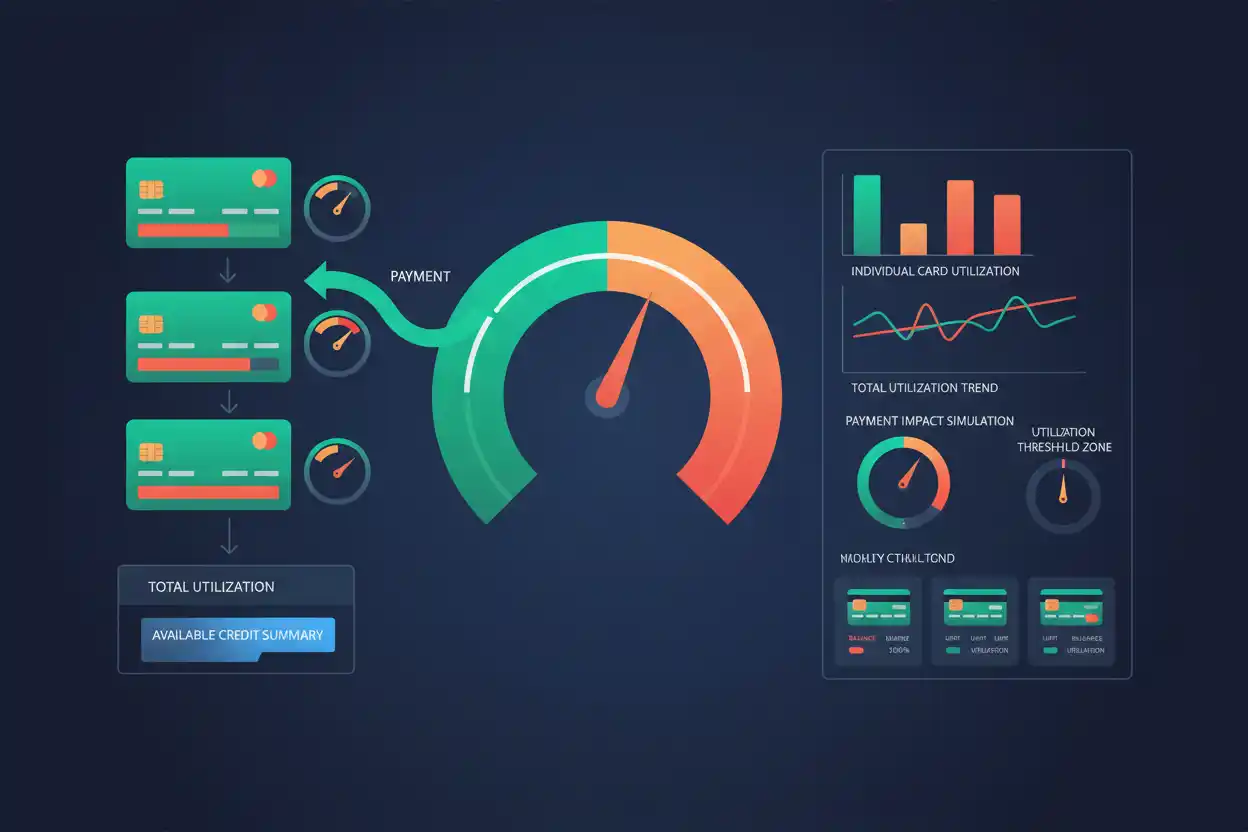

The credit utilization ratio measures how much revolving credit you are using compared with the amount available to you.
The standard formula is:
Credit Utilization Ratio = Revolving Credit Balance ÷ Revolving Credit Limit × 100
If a credit card has a $2,500 balance and a $10,000 limit:
Credit Utilization Ratio = $2,500 ÷ $10,000 × 100
Credit Utilization Ratio = 25%
You are using one-quarter of that card’s available revolving credit.
Credit utilization is important because credit scoring models can consider how close borrowers are to using all of their available revolving credit.
However, utilization is not a universal credit-score formula, and there is no single percentage at which every scoring model suddenly changes its treatment.
What Is Credit Utilization Ratio?
Credit utilization ratio is the percentage of available revolving credit currently represented by outstanding balances.
It is most commonly associated with credit cards and other revolving lines.
The ratio does not normally apply to installment loans in the same way because an installment loan does not provide a reusable credit limit after principal is repaid.
The basic relationship is:
Utilization = Balance ÷ Limit
A higher ratio means more of the available revolving credit is being used.
A lower ratio means more capacity remains unused.
Credit Utilization Ratio Formula
For one revolving account:
Individual Utilization = Card Balance ÷ Card Limit × 100
For multiple revolving accounts:
Overall Utilization = Total Revolving Balances ÷ Total Revolving Limits × 100
Both calculations can be useful.
A consumer can have low overall utilization while one individual card is close to its limit.
Individual Card Example
Suppose:
Credit limit = $8,000
Reported balance = $3,200
Then:
Credit Utilization Ratio = $3,200 ÷ $8,000 × 100
Credit Utilization Ratio = 40%
If the borrower pays $2,000 and the lower balance is subsequently reported:
New Balance = $3,200 − $2,000
New Balance = $1,200
New utilization:
New Utilization = $1,200 ÷ $8,000 × 100
New Utilization = 15%
The payment reduces the ratio by 25 percentage points.
Overall Credit Utilization Example
Suppose a consumer has three cards:
| Card | Balance | Limit |
|---|---|---|
| Card A | $1,000 | $5,000 |
| Card B | $2,000 | $10,000 |
| Card C | $3,000 | $15,000 |
| Total | $6,000 | $30,000 |
Overall utilization is:
Overall Utilization = $6,000 ÷ $30,000 × 100
Overall Utilization = 20%
Each card also has its own ratio:
Card A:
$1,000 ÷ $5,000 × 100 = 20%
Card B:
$2,000 ÷ $10,000 × 100 = 20%
Card C:
$3,000 ÷ $15,000 × 100 = 20%
In this example, both individual and total utilization equal 20%.
When Individual and Overall Utilization Differ
Now change the balances:
Card A = $4,500 / $5,000
Card B = $500 / $10,000
Card C = $1,000 / $15,000
Total balance still equals:
$4,500 + $500 + $1,000 = $6,000
Total limit remains:
$30,000
Overall utilization is still:
$6,000 ÷ $30,000 × 100 = 20%
But Card A utilization is:
$4,500 ÷ $5,000 × 100 = 90%
The overall ratio looks moderate while one account is nearly maxed out.
That is why examining only aggregate utilization can hide important details.
Credit Utilization Ratio and Credit Scores
The credit score factors page covers the broader scoring framework.
Utilization matters because it provides information about how much revolving credit a borrower is currently using.
However, it is only one factor.
Payment history, age of accounts, recent applications, total debt, and other credit-report information can also affect a score.
Therefore:
Credit Utilization Ratio ≠ Credit Score
The ratio is an input or characteristic that scoring systems can consider.
Is 30% Credit Utilization Good?
Thirty percent is frequently used as a practical guideline.
For example:
Limit = $10,000
Thirty percent utilization equals:
30% Utilization Balance = $10,000 × 30%
Balance = $3,000
However, consumers should not treat 30% as a magical scoring boundary.
Credit scoring does not operate like:
29% = good
30% = neutral
31% = bad
Generally, lower revolving utilization indicates less reliance on available revolving credit, provided other credit factors remain healthy.
Someone who can pay a balance in full does not gain a financial advantage by deliberately carrying debt merely to maintain a specific utilization percentage.
Can Credit Utilization Be 0%?
Yes.
If reported revolving balances are $0:
Utilization = $0 ÷ Credit Limit × 100
Utilization = 0%
This does not mean the account has to be inactive.
A person can use a card during the month and still have a zero or low reported balance after payments.
Scoring models can differ in how they evaluate specific credit files, so consumers should avoid inventing interest-bearing debt solely to produce a nonzero utilization number.
Can Credit Utilization Exceed 100%?
Mathematically, yes.
Suppose:
Credit limit = $5,000
Reported balance = $5,500
Then:
Utilization = $5,500 ÷ $5,000 × 100
Utilization = 110%
This could occur through interest, fees, transactions, or other account activity depending on the issuer’s rules.
A balance above the limit represents very high utilization and can also create account-management issues.
Credit Limit Changes and Utilization
The credit limit directly affects utilization.
Suppose:
Balance = $4,000
Limit = $10,000
Utilization = 40%
If the issuer cuts the limit to $5,000:
New Utilization = $4,000 ÷ $5,000 × 100
New Utilization = 80%
The consumer spent nothing additional, but utilization doubled because available credit fell.
Limit Increase Example
Now suppose:
Balance = $4,000
Old limit = $10,000
New limit = $20,000
Old ratio:
$4,000 ÷ $10,000 × 100 = 40%
New ratio:
$4,000 ÷ $20,000 × 100 = 20%
Again, the debt itself did not change.
The denominator changed.
This illustrates why paying down debt and increasing credit limits have different economic effects even when both reduce utilization.
Paying Down Debt Is Different From Raising the Limit
Suppose you have:
Balance = $5,000
Limit = $10,000
Utilization = 50%
Option A: Pay balance down to $2,500.
Utilization = $2,500 ÷ $10,000 × 100 = 25%
Option B: Increase limit to $20,000 while keeping $5,000 of debt.
Utilization = $5,000 ÷ $20,000 × 100 = 25%
Both produce 25% utilization.
But Option A reduces debt by $2,500.
Option B does not.
If the account is charging interest, the first approach also reduces future financing cost.
That distinction matters.
Credit Card Payoff and Utilization
A credit card payoff lowers revolving balances.
Suppose:
Total limits = $25,000
Balances = $15,000
Overall Utilization = 60%
If balances are reduced to $5,000:
New Utilization = $5,000 ÷ $25,000 × 100
New Utilization = 20%
The payoff simultaneously reduces debt, interest exposure, and utilization.
Daily Simple Interest and Utilization
Daily simple interest applies to interest calculations on certain loans.
It does not determine revolving utilization.
Installment principal does not normally enter the standard credit-card utilization equation.
This distinction is important because a $20,000 auto-loan balance and a $2,000 credit-card balance affect credit profiles differently.
Debt Avalanche and Credit Utilization
The debt avalanche prioritizes high-interest debt.
Suppose your highest-APR card is also highly utilized.
Paying it first can simultaneously:
reduce expensive interest and lower revolving utilization.
However, the avalanche method prioritizes interest cost rather than utilization percentage itself.
If another card has higher utilization but lower interest, an avalanche strategy may still direct extra cash to the more expensive debt.
Reported Balance vs Current Balance
Credit utilization used by a scoring model depends on the balance appearing in the credit report when the score is calculated.
That balance may not match what appears in your banking app today.
Suppose:
Statement-reported balance = $4,000
You pay $3,500 today
Current balance = $500
Until the issuer reports updated information, a credit report may still show $4,000.
The scoring model can therefore temporarily calculate utilization from the older figure.
Statement Date vs Due Date
A common misunderstanding is assuming the payment due date is always the only date relevant to utilization.
From an interest perspective, the due date is crucial.
For credit reporting, the issuer’s reporting schedule matters.
Some issuers report balances around the statement closing date, while practices can vary.
Therefore, someone trying to manage reported utilization should identify when the issuer generally reports rather than assuming every issuer works identically.
Credit Utilization and Grace Periods
A low utilization ratio does not tell you whether you are paying interest.
Suppose:
Limit = $20,000
Balance = $2,000
Utilization = 10%
If the cardholder carries that $2,000 balance at a high APR, interest can still accrue.
Conversely, someone could temporarily report a larger balance while maintaining the credit card grace period by paying the statement balance according to the account terms.
Utilization and interest treatment are therefore separate.
Credit Utilization and Minimum Payments
Paying only the credit card minimum payment may reduce utilization slowly.
Suppose:
Balance = $8,000
Limit = $10,000
Utilization = 80%
If a $240 payment is made but $150 of interest and new charges offset much of it, the reported balance may remain high.
Minimum-payment compliance does not guarantee rapid utilization improvement.
Credit Utilization and APR
The credit card APR affects borrowing cost rather than the utilization formula.
Still, the concepts interact.
High utilization generally means a larger revolving balance relative to the limit.
If that balance also carries a high APR, the dollar amount of interest can be substantial.
Reducing the balance can improve both the financing economics and utilization.
Closing a Credit Card
Closing an unused credit card can reduce total available revolving limits.
Suppose:
Card A limit = $10,000
Card B limit = $10,000
Total balances = $4,000
Before closing Card B:
Utilization = $4,000 ÷ $20,000 × 100 = 20%
After removing Card B’s $10,000 limit:
Utilization = $4,000 ÷ $10,000 × 100 = 40%
The outstanding debt is unchanged, but utilization doubles.
This does not mean every unused card should remain open forever. Fees, account management, fraud risk, and spending behavior can also matter.
Adding a New Credit Card
A new revolving account can increase total available credit.
Suppose:
Existing balances = $3,000
Existing limits = $10,000
Current Utilization = 30%
A new card adds a $5,000 limit with no balance:
New Utilization = $3,000 ÷ $15,000 × 100
New Utilization = 20%
However, applying for and opening new credit can affect other credit score factors.
Opening accounts solely to manipulate utilization is therefore not a complete credit strategy.
Credit Utilization and Debt Consolidation
Debt consolidation can change utilization depending on the structure.
If credit-card balances are paid off with an installment consolidation loan:
revolving balances can decline substantially.
That may reduce card utilization.
But the total debt has not disappeared—it has moved into an installment loan.
The transaction should therefore be evaluated based on cost, repayment term, and cash flow, not only its effect on utilization.
Common Credit Utilization Mistakes
One common mistake is thinking utilization equals total debt divided by income.
It does not.
Another is adding mortgages, auto loans, and student-loan balances to the numerator of the standard credit-card utilization calculation.
A third is treating 30% as a precise scoring cliff.
Consumers also sometimes assume utilization updates instantly after every payment.
Finally, increasing credit limits without reducing debt can improve the percentage while leaving the underlying financial obligation unchanged.
Frequently Asked Questions
What is the credit utilization ratio?
It is the percentage of available revolving credit represented by your revolving balances.
What is the credit utilization formula?
Credit Utilization Ratio = Revolving Balance ÷ Revolving Credit Limit × 100
What is 30% utilization on a $10,000 limit?
$10,000 × 30% = $3,000
Is 30% utilization ideal?
It is a commonly cited guideline, not a universal scoring threshold. Lower balances relative to limits generally reduce utilization further.
Is 0% utilization possible?
Yes. A reported balance of zero produces 0% utilization.
Can utilization exceed 100%?
Yes, mathematically, when a reported balance exceeds the account’s credit limit.
Does utilization include installment loans?
Not in the standard revolving-credit utilization formula.
Does paying a card reduce utilization immediately?
Your current balance can fall immediately, but credit reports update according to issuer reporting schedules.
Does increasing a credit limit lower utilization?
Yes, if the balance stays unchanged.
Does closing a credit card affect utilization?
It can. Removing an available credit limit can increase aggregate utilization.
Is individual card utilization important?
It can be. A consumer may have moderate total utilization while one card is heavily utilized.
Does utilization determine my entire credit score?
No. It is one of several credit score factors.
Final Takeaway
The credit utilization ratio measures revolving balances relative to available revolving credit.
The formula is:
Credit Utilization Ratio = Revolving Balance ÷ Revolving Credit Limit × 100
A $3,200 balance on an $8,000 limit produces 40% utilization.
Paying the balance down to $1,200 reduces utilization to 15%.
For multiple cards, calculate both individual account ratios and overall utilization because a moderate aggregate percentage can hide a nearly maxed-out individual account.
Most importantly, remember that improving utilization by paying debt down is financially different from improving it only by increasing available limits. The percentage may move similarly, but only principal repayment actually eliminates debt and reduces future interest exposure.