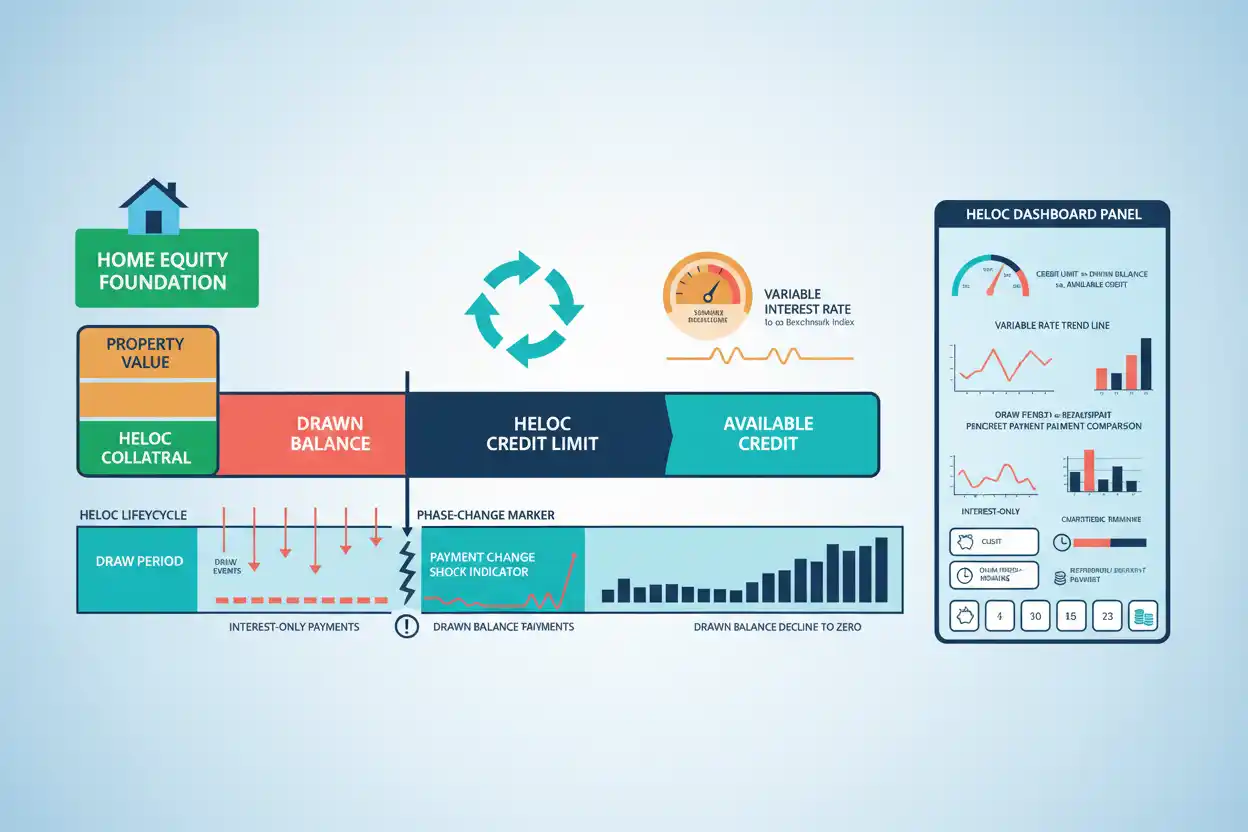

A HELOC, or home equity line of credit, is revolving credit secured by a borrower’s home.
Unlike a home equity loan that normally delivers one lump sum, a HELOC allows the homeowner to borrow repeatedly up to an approved credit limit during its draw period.
CFPB defines a HELOC as an open-end line of credit that allows repeated borrowing against home equity. It also notes that a HELOC usually has a draw period followed by a repayment period and that HELOC interest rates are commonly variable.
The basic available-credit formula is:
Available HELOC Credit = Credit Limit − Outstanding HELOC Balance
Suppose:
HELOC limit = $100,000
Amount drawn = $40,000
Then:
Available Credit = $100,000 − $40,000
Available Credit = $60,000
That revolving structure is what distinguishes the HELOC from a conventional home equity loan.
What Does HELOC Mean?
HELOC stands for:
Home Equity Line of Credit.
The loan is secured by home equity.
A simple equity estimate is:
Home Equity = Current Home Value − Property-Secured Debt
Suppose:
Home value = $500,000
Existing first mortgage = $300,000
Gross equity before the HELOC is:
$500,000 − $300,000
$200,000
That does not mean a lender will necessarily provide a $200,000 line.
The approved HELOC depends on underwriting, property value, existing liens, borrower qualifications, and lender policy.
HELOC Credit Limit Example
Suppose the lender approves:
HELOC Credit Limit = $100,000
The homeowner initially draws:
$40,000
Available line:
$100,000 − $40,000 = $60,000
If the borrower later repays $10,000 of principal and the line remains open:
Outstanding balance:
$30,000
Potential available credit:
$100,000 − $30,000 = $70,000
subject to the HELOC agreement and any lender restrictions.
CFPB notes that HELOC credit can generally be drawn repeatedly during the draw period, while significant changes in property value or borrower circumstances can affect access to additional funds under applicable conditions.
HELOC Interest Formula
For a simple monthly illustration:
Monthly Interest ≈ Outstanding HELOC Balance × Annual Interest Rate ÷ 12
Suppose:
Outstanding balance = $40,000
Annual rate = 8%
Then:
Monthly Interest ≈ $40,000 × 8% ÷ 12
Monthly Interest ≈ $266.67
If the plan permits an interest-only minimum payment during the draw period, approximately $266.67 would cover one simplified month of interest while leaving principal at $40,000.
Actual HELOC interest can be calculated using daily balances and specific contract conventions, so lender statements should control exact amounts.
What Happens If You Borrow More?
Suppose the borrower draws another $30,000.
New balance:
$40,000 + $30,000 = $70,000
At the same 8% rate:
Monthly Interest ≈ $70,000 × 8% ÷ 12
≈ $466.67
The payment burden rises because the borrower has used more of the credit line.
HELOC Draw Period
The draw period is the part of the HELOC during which the homeowner can generally borrow from the line.
CFPB notes that a draw period can last, for example, 10 years, although actual HELOC terms vary. Minimum-payment structures during the draw period also vary by lender.
A borrower should verify whether the required payment during the draw period is based on:
interest only, principal plus interest, a percentage of the balance, or another contractual formula.
HELOC Repayment Period
After the draw period ends, additional borrowing generally stops and the HELOC enters repayment.
CFPB notes that repayment can extend over years and that payments can increase significantly once the draw period ends.
Suppose:
Balance entering repayment = $40,000
Rate assumed constant for illustration = 8%
Repayment period = 10 years
Using the standard amortizing payment formula:
Payment = P × [r(1 + r)ⁿ] ÷ [(1 + r)ⁿ − 1]
the payment is approximately:
$485.31 per Month
Compare that with the simplified interest-only draw-period amount:
$266.67
Increase:
$485.31 − $266.67
$218.64 per Month
That is an increase of roughly:
82%
even though the rate remained 8% in the example.
The difference occurs because the repayment payment must now reduce principal as well as cover interest.
Variable HELOC Rates
HELOC rates are commonly variable.
A typical conceptual structure is:
HELOC Rate = Reference Index + Contractual Margin
Suppose:
Index = 5.5%
Margin = 2.5%
Then:
HELOC Rate = 8%
If the index rises to 7%:
New Rate = 7% + 2.5%
New Rate = 9.5%
A $70,000 balance now generates more interest even though the borrower has not drawn additional money.
HELOC Rate Increase Example
Balance = $70,000
At 8%:
Monthly Interest ≈ $466.67
At 9.5%:
Monthly Interest ≈ $554.17
Increase:
≈ $87.50 per Month
Variable-rate risk therefore compounds the effect of borrowing more.
HELOC and Fixed-Rate Mortgages
A HELOC can sit behind a fixed-rate mortgage.
Suppose:
First mortgage = $300,000 at fixed 4%
HELOC = $40,000 at variable 8%
The homeowner keeps the favorable first-mortgage rate rather than refinancing the entire $300,000 balance merely to obtain $40,000 of additional funds.
However, the HELOC creates a second lien and variable-rate exposure.
HELOC vs Home Equity Loan
CFPB distinguishes the products clearly: a home equity loan normally provides a lump sum, while a HELOC allows multiple draws from an available line; HELOCs also commonly have adjustable rates.
A home equity loan can be preferable when:
the borrower needs one known amount and values a fixed repayment schedule.
A HELOC can be preferable when:
the borrower needs flexible access to funds over time.
Neither is universally cheaper.
HELOC and Home Affordability
A homeowner evaluating home affordability should not treat unused HELOC capacity as income.
A $100,000 line does not make spending $100,000 affordable.
Any money drawn becomes debt secured by the home.
The question is whether household cash flow can support repayment even if rates increase.
HELOC and FHA Loans
An existing FHA loan can remain the first mortgage while a homeowner later explores separate home-equity borrowing, subject to lender and lien requirements.
The HELOC does not change the original mortgage into a conventional loan.
It simply creates another property-secured obligation.
HELOC and Down Payments
The mapped down payments relationship becomes important when a borrower considers using home equity from one property to help purchase another.
Borrowing against the existing home can provide cash, but it also creates another monthly obligation and reduces equity.
A larger down payment funded by new debt is not economically equivalent to a larger down payment funded from savings.
HELOC and Combined Loan-to-Value Ratio
Suppose:
Home value = $500,000
First mortgage = $300,000
HELOC balance = $40,000
Current combined secured debt:
$340,000
Current balance-based combined loan-to-value ratio:
CLTV = $340,000 ÷ $500,000 × 100
CLTV = 68%
If the full $100,000 HELOC were eventually drawn:
Total Secured Debt = $400,000
Potential leverage:
$400,000 ÷ $500,000 × 100 = 80%
The unused credit line therefore represents potential future leverage even though it is not currently outstanding debt.
HELOC and Cash-Out Refinance
A cash-out refinance replaces the first mortgage with a larger new mortgage.
A HELOC leaves the first mortgage in place.
This is a major distinction when the existing mortgage has a low fixed rate.
Suppose:
Existing first mortgage = 3.5%
New refinance available = 6.5%
Replacing the entire mortgage solely to obtain $50,000 can be expensive.
A HELOC may preserve the older rate, but its own variable pricing can be substantially higher.
HELOC and Mortgage Recast
A mortgage recast changes the payment on an eligible first mortgage after a large principal reduction.
It does not create a revolving credit line.
HELOC and recast therefore solve opposite problems:
HELOC gives access to equity.
Recast uses cash to reduce first-mortgage payment requirements.
HELOC and Mortgage Payoff Strategies
A homeowner following mortgage payoff strategies should be cautious about paying down a low-rate first mortgage while maintaining a much higher-rate HELOC balance.
If:
First mortgage rate = 4%
HELOC rate = 9%
directing additional principal toward the higher-rate HELOC generally produces greater immediate interest savings per dollar, all else equal.
HELOC and Refinancing
Refinancing becomes more complicated when a HELOC is present because multiple liens may need to be addressed.
A new first mortgage can require the HELOC lender to cooperate with lien-position arrangements or the HELOC may need to be paid off.
Exact requirements depend on the transaction.
HELOC and Mortgage Interest
Mortgage interest and HELOC interest should be tracked separately.
The HELOC balance can change frequently, so its interest cost can also move rapidly.
Borrowers who repeatedly draw, repay, and redraw should evaluate annual cash flows rather than looking only at the current balance.
HELOC Fees
CFPB notes that HELOC lenders can charge fees and that disclosures include information about draw and repayment periods, minimum payments, fees, and how the annual percentage rate may change.
Possible costs can include:
application, appraisal, annual, transaction, early-closure, or other contractually disclosed charges.
The interest rate alone therefore does not reveal the complete cost.
HELOC and Emergency Borrowing
A HELOC can provide access to substantial liquidity.
However, relying on it as the only emergency reserve introduces two risks:
the borrowing rate can change, and access to further draws can potentially be restricted under circumstances permitted by the agreement and law.
Cash reserves and credit availability should not be treated as identical resources.
Frequently Asked Questions
What is a HELOC?
A HELOC is an open-end line of credit that allows repeated borrowing against home equity.
What does HELOC stand for?
Home Equity Line of Credit.
How do you calculate available HELOC credit?
Available Credit = Credit Limit − Outstanding Balance
What is available on a $100,000 HELOC with $40,000 borrowed?
$60,000
How is HELOC interest calculated?
A simplified estimate is:
Interest ≈ Outstanding Balance × Annual Rate × Time
Actual calculations depend on the contract.
Are HELOC rates fixed?
HELOCs commonly use variable interest rates, although some products allow fixed-rate conversion features.
What is a draw period?
It is the period during which the borrower can generally draw funds from the line.
What happens after the draw period?
The HELOC enters repayment, and required payments can increase significantly.
Is a HELOC the same as a home equity loan?
No. A HELOC is revolving; a home equity loan normally provides one lump sum.
Can I lose my home if I do not repay a HELOC?
A HELOC is secured by the home, so failure to meet the obligation can put the property at risk.
Does an unused HELOC balance cost interest?
Ordinarily, interest is associated with amounts borrowed rather than merely the unused credit limit, subject to any separate fees in the agreement.
Should I use a HELOC or cash-out refinance?
Compare the amount needed, existing first-mortgage rate, HELOC rate, fees, repayment period, and whether you want revolving or lump-sum credit.
Final Takeaway
A HELOC turns home equity into a revolving line of secured credit.
The simplest operating formula is:
Available Credit = HELOC Limit − Outstanding Balance
A $100,000 HELOC with $40,000 drawn leaves:
$60,000 Available
At an illustrative 8% rate, $40,000 generates approximately:
$266.67 of Monthly Interest
If that $40,000 later must be amortized over 10 years at the same rate, the payment rises to approximately:
$485.31 per Month
The flexibility can be valuable, but the borrower should understand draw-period rules, repayment-period payment shock, variable-rate exposure, fees, home-equity risk, and the effect of HELOC borrowing on total property leverage.