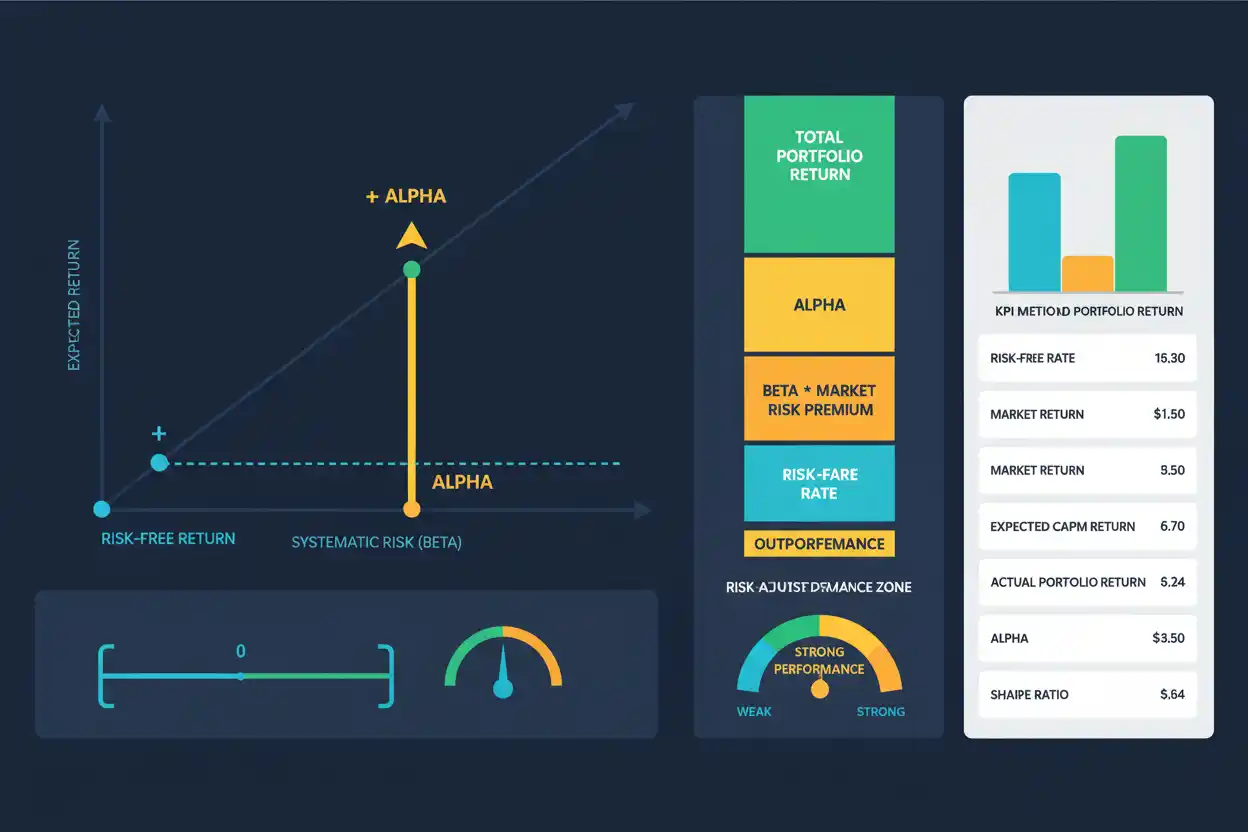
Alpha measures how an investment performed relative to the return expected from a specified benchmark or risk model.
In its common risk-adjusted form, alpha asks:
Did the portfolio earn more or less than its level of market risk would imply?
A common Jensen’s alpha formula is:
Alpha = Portfolio Return − [Risk-Free Rate + Beta × (Market Return − Risk-Free Rate)]
A positive alpha means the investment outperformed the return predicted by the model.
A negative alpha means it underperformed that modeled expectation.
Alpha belongs within the broader Savings & Investing framework, but it should not be confused with annualized return. Annualized return measures the rate earned over time. Alpha evaluates performance relative to an expected return benchmark.
Alpha Formula
The standard single-factor form is:
α = Rₚ − [R𝒇 + β(Rₘ − R𝒇)]
Where:
Rₚ = portfolio return
R𝒇 = risk-free rate
β = portfolio beta
Rₘ = market return
The quantity:
Rₘ − R𝒇
is the market risk premium.
The modeled expected return is:
Expected Return = R𝒇 + β(Rₘ − R𝒇)
Alpha is the amount by which actual portfolio return differs from that expectation.
Alpha Example
Suppose:
Portfolio return = 11%
Risk-free rate = 3.5%
Beta = 1.10
Market return = 9%
First calculate the market risk premium:
Market Risk Premium = 9% − 3.5%
Market Risk Premium = 5.5%
Adjust it for beta:
1.10 × 5.5% = 6.05%
Add the risk-free rate:
Expected Return = 3.5% + 6.05%
Expected Return = 9.55%
Now calculate alpha:
Alpha = 11% − 9.55%
Alpha = +1.45%
The investment generated:
1.45 Percentage Points of Positive Alpha
relative to this particular model and set of inputs.
What Does Positive Alpha Mean?
A positive alpha means actual return exceeded the model’s expected return.
In the example:
Expected return:
9.55%
Actual return:
11%
Difference:
+1.45%
That does not prove the investment manager possesses permanent skill.
Alpha can result from:
manager decisions, factor exposures not captured by the model, security selection, timing, leverage, luck, measurement error, or using an imperfect benchmark.
Alpha should therefore be interpreted as a performance statistic rather than a guarantee of future outperformance.
What Does Negative Alpha Mean?
Suppose the same portfolio generated only:
8%
Expected return remains:
9.55%
Alpha becomes:
8% − 9.55%
−1.55%
The portfolio underperformed the model-adjusted expectation by:
1.55 Percentage Points
A negative alpha does not necessarily mean the investment lost money.
The investment earned a positive 8% return.
It simply earned less than the model implied it should have earned for the assumed risk exposure.
Alpha Is Not the Same as Excess Return
A simpler benchmark comparison is:
Excess Return = Portfolio Return − Benchmark Return
Suppose:
Portfolio return = 11%
Benchmark return = 9%
Simple excess return:
11% − 9% = 2%
But Jensen’s alpha in the earlier example was:
1.45%
Why the difference?
Because alpha adjusted for:
risk-free return and beta.
Simple excess return did not.
Therefore:
Benchmark Outperformance ≠ Necessarily Risk-Adjusted Alpha
Alpha and Beta
The beta calculation is central to single-factor alpha.
Beta estimates how sensitive an investment is to movements in the selected market benchmark.
Suppose:
Beta = 1.0.
Then the modeled market-sensitive component resembles the benchmark’s excess return.
If:
Beta > 1,
the model expects greater sensitivity to market movements.
If:
Beta < 1,
the expected sensitivity is lower.
Alpha then measures the remaining difference between modeled and actual performance.
Alpha With Beta Below 1
Suppose:
Portfolio return = 8.5%
Risk-free rate = 3%
Market return = 9%
Beta = 0.70
Expected return:
3% + 0.70 × (9% − 3%)
3% + 4.2%
7.2%
Alpha:
8.5% − 7.2%
+1.3%
The portfolio earned less than the market’s 9% return but still generated positive modeled alpha because its assumed beta was only 0.70.
This demonstrates why alpha cannot be interpreted from raw return alone.
Alpha With Beta Above 1
Suppose:
Portfolio return = 11%
Risk-free rate = 3%
Market return = 9%
Beta = 1.50
Expected return:
3% + 1.50 × 6%
12%
Alpha:
11% − 12%
−1%
The portfolio beat the market’s raw 9% return by two percentage points.
Yet it generated negative alpha under this model because its higher beta implied a 12% expected return.
Alpha Depends on the Benchmark
Suppose a technology-focused portfolio is evaluated against:
a broad equity index.
The resulting alpha can differ substantially from alpha calculated against:
a technology-sector benchmark.
This is not a contradiction.
Alpha is model-relative.
A poorly chosen benchmark can create misleading alpha.
Therefore, the benchmark should reasonably represent the investment’s opportunity set and risk exposure.
Alpha and Annualized Return
The mapped annualized return page measures how a return translates into an equivalent annual compounded rate.
Suppose:
Investment A annualized return = 10%
Investment B annualized return = 8%
That alone does not tell you which generated more alpha.
If Investment A took much greater modeled market risk, its alpha can be lower.
Return answers:
How Much Did the Investment Earn?
Alpha asks:
How Much Did It Earn Relative to the Model’s Expected Return?
Alpha and Average Return
The average return can summarize periodic performance.
However, alpha should generally be calculated from returns measured consistently over comparable periods.
Mixing:
monthly portfolio return with annual market return
would produce a meaningless result.
Always align:
measurement period, benchmark period, and risk-free-rate period.
Alpha and Holding Period Return
Holding period return measures the total return earned between purchase and sale, including applicable income.
A three-year holding-period return should not be inserted directly beside an annual beta-model expectation without first putting the returns on compatible time bases.
This is one reason annualization matters.
Alpha and CAGR
Compound annual growth rate converts beginning-to-ending growth into a smoothed annual rate.
CAGR can be useful for reporting long-term investment growth.
Alpha remains different because it requires an expected-return framework.
A portfolio can have:
high CAGR but negative alpha,
or:
modest CAGR but positive alpha.
Alpha and 401(k) Growth
A 401(k) growth projection normally focuses on:
contributions, time, investment returns, fees, and employer matching.
Alpha is not usually necessary for estimating whether a retirement account can reach a future value.
It becomes more useful when evaluating whether an actively managed investment generated performance beyond what its benchmark and risk exposure would suggest.
Alpha and Asset Allocation
Asset allocation can influence portfolio beta and benchmark suitability.
A portfolio containing:
60% equities and 40% bonds
should not casually be judged against a 100% equity index without considering the resulting risk difference.
Otherwise, the calculated alpha can reflect benchmark mismatch rather than investment skill.
Alpha and Investment Fees
Suppose a portfolio earns:
Gross alpha = 2%
and annual fees reduce return by:
1.25%
Approximate net alpha, all else equal:
2% − 1.25%
0.75%
Fees therefore matter enormously when evaluating whether active management creates value for the investor.
SEC Investor.gov notes that investment fees reduce portfolio returns and can have substantial effects over long periods.
Alpha and Annuities
Annuities are insurance contracts rather than a single investment-performance category. Some variable annuities contain investment options whose returns can potentially be benchmarked, while fixed-annuity value is driven by the contract’s stated crediting terms.
Therefore, alpha should not be applied indiscriminately to every annuity product.
Alpha and Annuity Due
An annuity due is a financial-mathematics structure in which equal payments occur at the beginning of each period.
It has no direct conceptual relationship to investment alpha.
The internal link is useful because both appear in investment analysis, but their calculations answer entirely different questions.
Alpha and Amortization
Amortization describes repayment or allocation across time.
Alpha measures investment performance relative to an expected return.
A loan amortization schedule should therefore never be confused with an alpha calculation simply because both involve percentages.
Can Alpha Be Compared Across Funds?
Only carefully.
A meaningful comparison generally requires:
similar periods, suitable benchmarks, compatible return conventions, and comparable risk models.
Alpha calculated against one benchmark is not automatically comparable with alpha calculated against another.
Is Higher Alpha Always Better?
Holding all else equal, higher alpha indicates stronger performance relative to the model.
But all else is rarely equal.
Before choosing an investment from alpha alone, also consider:
fees, volatility, drawdowns, liquidity, diversification, tax effects, and whether the alpha calculation is statistically meaningful.
Frequently Asked Questions
What is alpha in investing?
Alpha measures investment performance relative to the return expected from a specified benchmark or risk model.
What is the alpha formula?
α = Rₚ − [R𝒇 + β(Rₘ − R𝒇)]
What does positive alpha mean?
Actual return exceeded the model’s expected return.
What does negative alpha mean?
Actual return fell below the modeled expected return.
Can an investment have positive returns and negative alpha?
Yes. It can earn money while still underperforming its risk-adjusted expectation.
Is alpha the same as beating the benchmark?
Not necessarily. Simple benchmark excess return does not always adjust for beta and the risk-free rate.
Why does beta matter?
Beta determines how much market-related return the model expects from the investment.
Does alpha predict future performance?
No. Historical alpha does not guarantee future alpha.
Can benchmark choice change alpha?
Yes, sometimes substantially.
Is alpha the same as annualized return?
No. Annualized return measures growth per year; alpha measures performance relative to an expected-return model.
Can fees eliminate alpha?
Yes. A strategy can generate positive gross alpha but little or negative net alpha after costs.
What was alpha in the main example?
+1.45%
Final Takeaway
Alpha is not simply investment return.
It measures:
Actual Return − Risk-Adjusted Expected Return
In the main example:
Portfolio return = 11%
Risk-free rate = 3.5%
Market return = 9%
Beta = 1.10
Expected return:
9.55%
Alpha:
11% − 9.55% = +1.45%
The number becomes meaningful only when the benchmark, beta, risk-free rate, return period, and fees are appropriate. A positive alpha can indicate outperformance relative to the model, but it should never be interpreted as guaranteed manager skill or guaranteed future excess return.