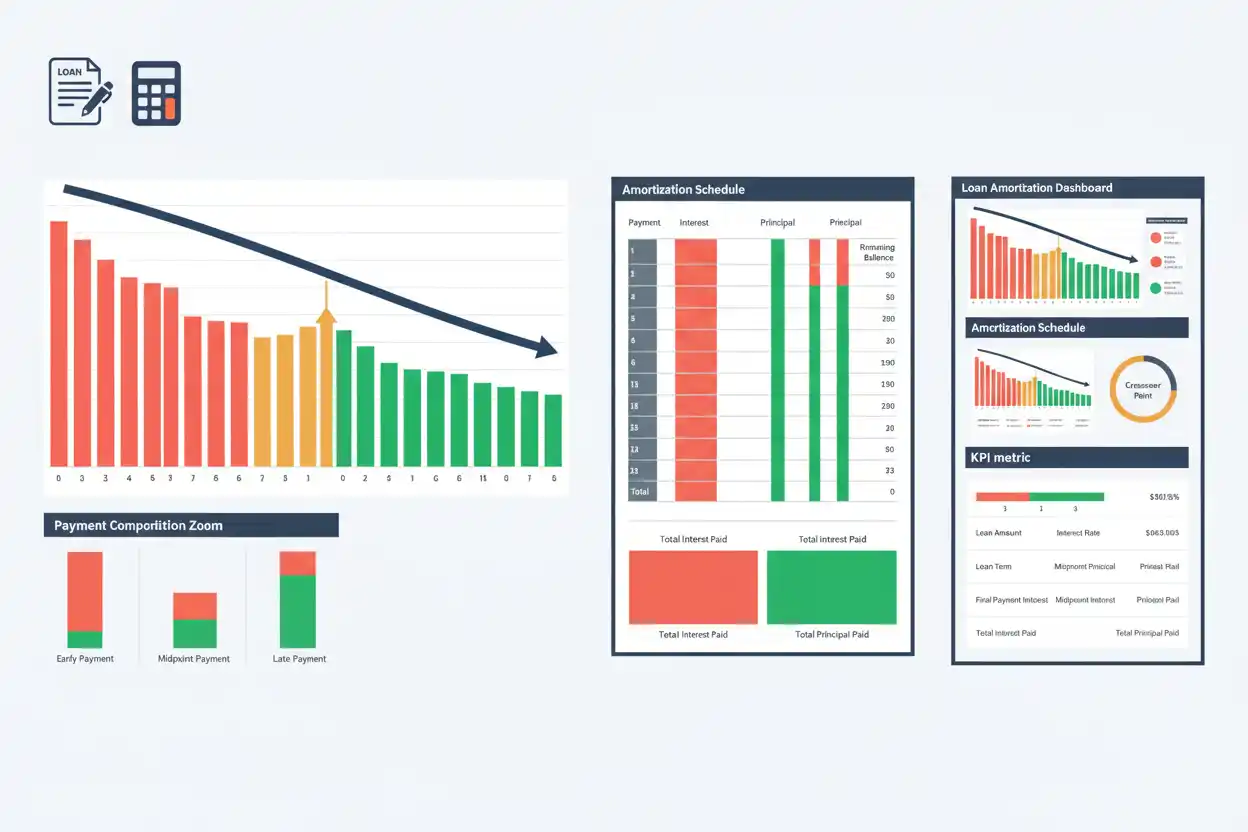

Amortization is the process of paying a debt down over time through scheduled payments.
In a standard amortizing loan, each payment contains:
interest on the outstanding balance and principal repayment that reduces the amount owed.
CFPB describes an amortization schedule as the table showing how each loan payment is divided between principal and interest. It also notes that on a typical amortizing loan, more of early payments goes toward interest while more of later payments goes toward principal.
The central formulas are:
Interest = Beginning Balance × Periodic Interest Rate
Principal Repaid = Payment − Interest
Ending Balance = Beginning Balance − Principal Repaid
That cycle repeats until the balance reaches zero.
Amortization Payment Formula
For a standard fixed-payment loan:
Payment = P × [r(1 + r)ⁿ] ÷ [(1 + r)ⁿ − 1]
Where:
P = original principal
r = periodic interest rate
n = total number of payments
Suppose:
Loan principal = $20,000
Annual interest rate = 8%
Term = 5 years
Payments = monthly
Monthly rate:
8% ÷ 12 = 0.666667%
As a decimal:
r = 0.00666667
Number of payments:
5 × 12 = 60
Monthly payment:
≈ $405.53
First Payment
Beginning balance:
$20,000
Interest:
$20,000 × 8% ÷ 12
$133.33
Principal:
$405.53 − $133.33
$272.19
Ending balance:
$20,000 − $272.19
$19,727.81
The borrower pays $405.53, but only about $272.19 reduces debt.
Second Payment
Beginning balance:
$19,727.81
Interest:
$19,727.81 × 8% ÷ 12
≈ $131.52
Principal:
$405.53 − $131.52
≈ $274.01
Ending balance:
≈ $19,453.80
Interest has fallen because the principal balance is smaller.
Principal repayment has increased because the payment remained fixed.
Third Payment
Beginning balance:
$19,453.80
Interest:
≈ $129.69
Principal:
≈ $275.84
Ending balance:
≈ $19,177.96
The pattern continues every month.
Amortization Schedule Example
| Payment | Beginning Balance | Payment | Interest | Principal | Ending Balance |
|---|---|---|---|---|---|
| 1 | $20,000.00 | $405.53 | $133.33 | $272.19 | $19,727.81 |
| 2 | $19,727.81 | $405.53 | $131.52 | $274.01 | $19,453.80 |
| 3 | $19,453.80 | $405.53 | $129.69 | $275.84 | $19,177.96 |
An amortization schedule simply repeats these calculations until the final payment.
Balance After One Year
After 12 payments:
Remaining Balance ≈ $16,611.20
Principal repaid:
$20,000 − $16,611.20
≈ $3,388.80
Total payments:
$405.53 × 12
≈ $4,866.33
The difference between payments made and principal reduction represents interest paid during that period.
Balance After Two Years
After 24 payments:
Remaining Balance ≈ $12,941.13
Principal repaid:
$20,000 − $12,941.13
≈ $7,058.87
Principal reduction accelerates because less of each later payment is needed for interest.
Total Interest
Total scheduled payments:
$405.5279 × 60
≈ $24,331.67
Total interest:
$24,331.67 − $20,000
≈ $4,331.67
Therefore:
Total Interest = Total Scheduled Payments − Original Principal
for this fully amortizing example.
Principal vs Interest
The most important amortization relationship is:
Payment = Principal Portion + Interest Portion
The principal portion reduces debt.
The interest portion compensates the lender for financing the outstanding balance.
CFPB similarly distinguishes principal as the amount borrowed from interest as the cost of borrowing.
Why Interest Is Highest at the Beginning
Interest is calculated from the outstanding balance.
At origination:
Balance = $20,000
Later:
Balance < $20,000
Therefore, with the same periodic interest rate:
Smaller Balance → Smaller Interest Charge
This automatically causes principal repayment to rise when the total payment remains fixed.
Remaining Balance Formula
You do not need to construct the entire schedule to calculate a balance after k payments.
For a fixed-payment loan:
Bₖ = P(1 + r)ᵏ − A[((1 + r)ᵏ − 1) ÷ r]
Where:
Bₖ = balance after k payments
P = original principal
A = payment
r = periodic rate
This formula is useful for:
payoff analysis, refinancing comparisons, and forecasting future debt.
Amortization vs Mortgage Amortization
General amortization applies to many installment loans.
Mortgage amortization focuses specifically on home-loan amortization.
The mathematics can be similar, but mortgage-specific analysis also needs to account for:
property taxes, insurance, mortgage insurance, escrow, and mortgage-specific rules.
This page remains the broader principal-versus-interest explanation.
Amortization and 401(k) Growth
The mapped 401(k) growth page moves in the opposite direction financially.
Amortization usually reduces a debt balance.
Investment compounding attempts to grow an asset balance.
Both involve time-value-of-money mathematics, but their economic purposes differ.
Amortization and Annualized Return
Annualized return converts investment performance into an annual rate.
Amortization converts a loan’s principal and interest obligations into a repayment schedule.
Using the loan APR as though it were an investment annualized return would mix unrelated concepts.
Amortization and Annuities
Annuities use a closely related time-value-of-money structure because they involve streams of periodic cash flows.
A loan payment can mathematically resemble an annuity payment.
The economic direction differs:
loan amortization repays borrowed capital.
An annuity can represent contributions, withdrawals, or contractual income payments.
Amortization and Annuity Due
An annuity due assumes payments occur at the beginning of each period.
Most standard loan amortization examples assume required payments at the end of each period.
Changing payment timing changes present value and future value.
Amortization and APY
APY measures annual yield after considering compounding.
An amortization schedule uses the loan’s contractual periodic rate and payment structure.
APY should not automatically be substituted for a loan’s periodic contractual interest rate.
Extra Principal Payments
Suppose after one year the balance is:
$16,611.20
The borrower makes an extra:
$2,000 Principal Payment
New balance:
$14,611.20
Future interest is calculated from a balance that is $2,000 smaller.
CFPB notes that paying principal down more quickly on simple-interest loans generally reduces the amount of interest ultimately paid.
What Is Negative Amortization?
Negative amortization occurs when a payment is too small to cover the interest that accrued.
CFPB defines negative amortization as a situation in which the amount owed increases even though payments are being made because unpaid interest is added to principal.
Suppose:
Beginning balance = $100,000
Monthly interest = $600
Required payment = $450
Unpaid interest:
$600 − $450
$150
New balance:
$100,000 + $150
$100,150
The debt increased despite the payment.
Fully Amortizing vs Partially Amortizing
A fully amortizing repayment schedule reduces the balance to approximately zero by the final scheduled payment.
A partially amortizing structure leaves a balance outstanding at maturity.
That remaining debt can create a balloon payment.
Therefore, a repayment schedule should always be checked for:
final balance—not just monthly payment.
Amortization vs Precomputed Interest
Some loans calculate finance charges differently from a simple declining-balance amortizing loan.
CFPB notes that precomputed-interest loans can calculate the interest amount in advance and allocate it across the repayment schedule, changing how extra payments affect interest compared with a simple-interest loan.
Do not assume every installment loan uses identical interest mechanics.
Common Amortization Mistakes
A common error is subtracting the entire payment from principal.
Another is calculating every month’s interest from the original balance.
Borrowers also assume half the payments means half the principal has been repaid.
That is usually false for a standard interest-bearing amortizing loan.
Finally, extra-payment benefits depend on the actual contract and how payments are credited.
Frequently Asked Questions
What is amortization?
Amortization is the gradual repayment of debt through scheduled payments.
What is an amortization schedule?
It is a table showing each payment’s principal, interest, and remaining balance.
What is the interest formula?
Interest = Beginning Balance × Periodic Rate
How is principal calculated?
Principal = Payment − Interest
Why does principal repayment increase?
Interest falls as the outstanding balance falls, leaving more of a fixed payment for principal.
What is the payment on $20,000 at 8% for five years?
Approximately:
$405.53 per Month
How much total interest is paid?
Approximately:
$4,331.67
under the example.
What is negative amortization?
It occurs when payments fail to cover accrued interest, causing the balance to increase.
Does every loan amortize the same way?
No. Contractual interest methods and payment structures vary.
Can extra principal reduce interest?
Generally yes on a declining-balance simple-interest loan because future interest is calculated from a smaller balance.
Is amortization the same as compounding?
No. Amortization reduces a debt through payments; compounding grows a balance by earning returns on prior amounts.
Is amortization only used for mortgages?
No. It applies to many installment loans and also has separate accounting uses outside this article’s principal-versus-interest intent.
Final Takeaway
Amortization explains exactly where every loan payment goes.
For a $20,000 loan at 8% over five years:
Monthly payment:
$405.53
First-month interest:
$133.33
First-month principal:
$272.19
After one year:
Balance ≈ $16,611.20
Total scheduled interest:
≈ $4,331.67
The core mechanics never change:
Interest = Balance × Rate
Principal = Payment − Interest
New Balance = Old Balance − Principal
Understanding those three equations makes an amortization schedule much easier to interpret and exposes how rate, term, extra principal payments, and payment structure affect the true cost of borrowing.