
Annuities can refer to two closely related ideas.
In financial mathematics, an annuity is a stream of equal payments made at regular intervals.
In consumer finance, an annuity is also an insurance contract designed to accumulate value, provide periodic income, or both.
Investor.gov describes an annuity as a contract between an individual and an insurance company that can be purchased with a lump sum or series of payments, with the insurer providing income immediately or in the future according to the contract.
The mathematics starts with the timing of cash flows.
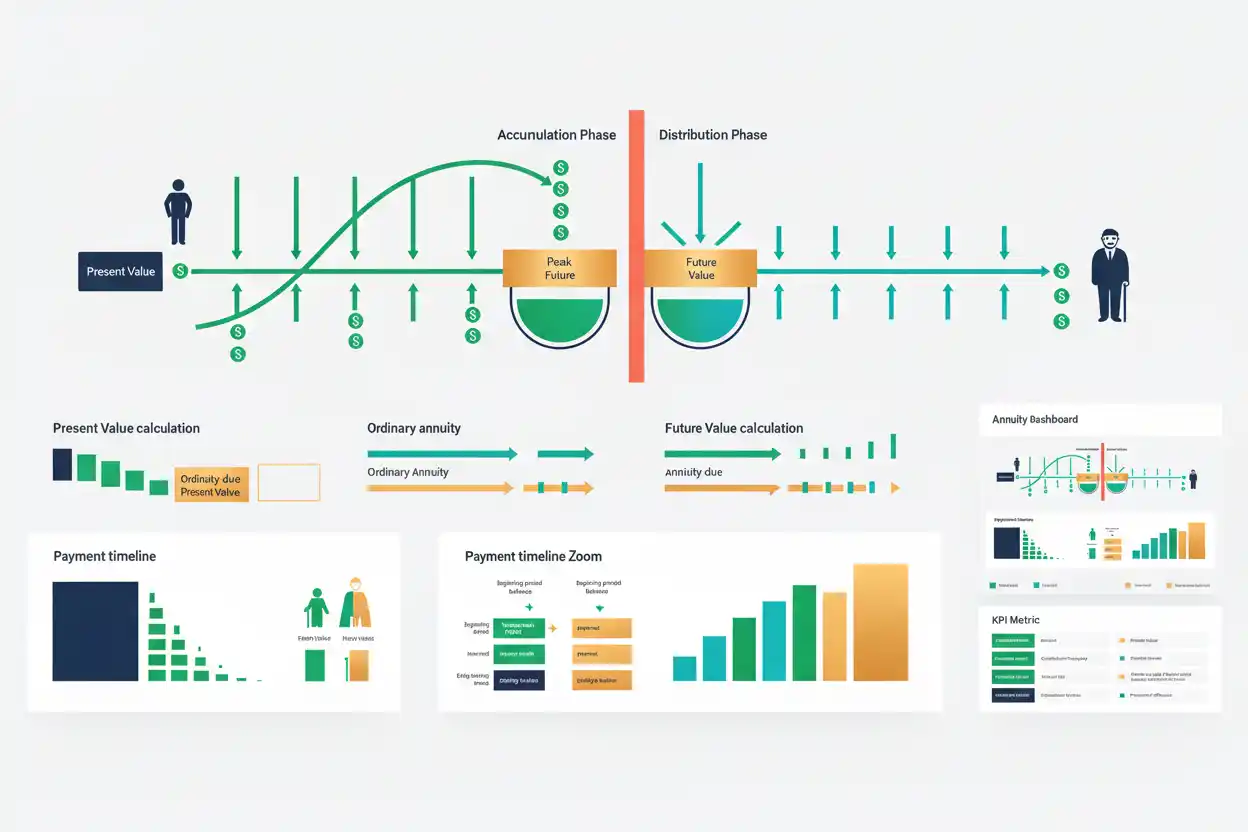
Ordinary Annuity vs Annuity Due
An ordinary annuity pays at the:
End of Each Period
An annuity due pays at the:
Beginning of Each Period
The timing difference matters because beginning-of-period money earns or discounts for one additional period.
Future Value of an Ordinary Annuity
The standard formula is:
FV = C × [((1 + r)ⁿ − 1) ÷ r]
Where:
C = periodic contribution
r = periodic return or interest rate
n = number of payments
Suppose:
Monthly contribution = $500
Annual assumed return = 7%
Time = 20 years
Payments occur at month-end
Monthly rate:
7% ÷ 12
Number of payments:
20 × 12 = 240
Future value:
FV ≈ $260,463.33
Total contributions:
$500 × 240
$120,000
Modeled investment growth:
$260,463.33 − $120,000
≈ $140,463.33
The 7% rate is an assumption, not a guaranteed investment return.
Future Value of an Annuity Due
Because each payment occurs one period earlier:
FV of Annuity Due = FV of Ordinary Annuity × (1 + r)
Using the same example:
FV Due ≈ $260,463.33 × (1 + 0.07/12)
≈ $261,982.70
Difference:
≈ $1,519.37
The same $120,000 of contributions produces a larger ending value simply because every payment receives one additional month of growth.
Present Value of an Ordinary Annuity
The present value of equal end-of-period payments is:
PV = C × [1 − (1 + r)⁻ⁿ] ÷ r
Suppose you want to value:
$2,000 paid monthly
for 20 years
using a 5% annual discount rate
Monthly rate:
5% ÷ 12
Number of payments:
240
Present value:
≈ $303,050.63
That means $303,050.63 today is mathematically equivalent to the modeled $2,000 monthly payment stream when discounted at 5% under the assumptions.
Present Value of an Annuity Due
If each $2,000 payment occurs at the beginning of the month:
PV Due = Ordinary Annuity PV × (1 + r)
≈ $304,313.34
Beginning-of-period payments have a greater present value because each cash flow arrives sooner.
Annuity Value Depends on the Rate
Take the $500 monthly contribution example.
At a higher assumed return:
future value increases.
At a lower return:
future value falls.
This is the same future value logic used throughout investment mathematics.
However, actual insurance-annuity growth depends on the contract rather than a generic future-value assumption alone.
Annuity Accumulation Phase
Many annuity products have an accumulation phase during which contract value grows according to the product’s terms.
Variable annuities can offer investment options whose value fluctuates with investment performance. Investor.gov notes that variable annuity contract value can rise or fall based on the selected investment options and that investors can lose money.
Fixed and indexed structures use different crediting mechanisms.
Annuity Payout Phase
The annuity payouts page focuses on how accumulated value may be converted into periodic payments.
Payouts can depend on:
contract value, payout option, interest assumptions, age or life-contingent factors where applicable, guarantees, and product terms.
A simple mathematical annuity-payment formula does not capture every insurance feature.
Immediate vs Deferred Annuity
An immediate annuity generally begins its income phase soon after purchase.
A deferred annuity provides an accumulation period before payouts begin.
Both can create periodic payments, but the timing and purpose differ.
Fixed Annuities
A fixed annuity uses contractual interest and guarantee provisions defined by the insurer.
The exact guarantee depends on the contract.
It should not be modeled as though it were a stock-market investment with a guaranteed long-term return.
Variable Annuities
Variable annuities are securities and insurance contracts whose account values can vary based on selected investment options. Investor.gov notes that they can grow tax-deferred and include insurance features, but performance can decline when the selected investments perform poorly.
This combination of investment and insurance features can also create substantial complexity.
Indexed Annuities
Indexed annuities generally link at least part of their credited return to a market index under a contract formula.
Investor.gov cautions that indexed annuities are complex and that not every indexed annuity is regulated by the SEC; fixed indexed annuities generally fall primarily under state insurance regulation.
An index-linked crediting formula is not the same as directly owning the index.
Annuity Fees
Possible annuity costs can include:
surrender charges, contract expenses, mortality-and-expense charges on applicable products, investment-option expenses, and fees for optional benefits.
These vary materially by contract.
Therefore:
Gross Contract Growth ≠ Investor’s Net Economic Return
Fees should be included when comparing annuities with other long-term investments.
Surrender Charges
An annuity can impose charges when substantial amounts are withdrawn during a contractual surrender period.
Investor.gov notes that surrender charges and tax consequences can apply when money is withdrawn from an annuity.
This means liquidity matters.
Money intended for a near-term need may be poorly matched with a contract carrying meaningful early-withdrawal costs.
Annuities and Annualized Return
Annualized return can measure accumulation performance in some circumstances.
However, annuities can contain guarantees, insurance benefits, fees, and tax characteristics that a simple annualized-return number does not capture.
Two contracts with identical annualized growth can still offer very different guarantees and costs.
Annuities and Alpha
Alpha is mainly useful for evaluating investment performance relative to a benchmark or risk model.
It can be relevant to investment options within a variable annuity.
It is not a meaningful universal metric for every fixed or income annuity contract.
Annuities and Amortization
The mapped amortization formula and annuity mathematics share a time-value-of-money foundation.
A level loan payment can be viewed mathematically as a stream of equal cash flows.
But the economic directions differ.
A borrower pays the annuity-like cash flow to eliminate debt.
An annuity owner can contribute to or receive cash from a financial contract.
Annuities and APY
APY measures effective annual yield after compounding.
A fixed annuity can quote rates using product-specific conventions.
Before comparing a bank account APY with an annuity crediting rate, verify that both percentages measure the same economic concept.
Annuities and Compound Interest
Compound interest explains why accumulated annuity value can grow faster over long periods when credited returns remain invested.
For example:
$100,000 compounding at 5% for 20 years:
FV = $100,000 × 1.05²⁰
≈ $265,329.77
However, actual annuity contract growth must use the contract’s applicable credited or investment return after relevant costs.
Annuities and Retirement Income
Annuities are often considered when an investor wants to convert accumulated assets into a defined income stream.
That can reduce certain longevity-related uncertainties when contractual lifetime guarantees apply.
However, guarantees depend on the issuing insurance company’s claims-paying ability and the specific contract terms.
Annuity vs Systematic Withdrawals
Suppose an investor has:
$300,000
One approach is to leave it invested and withdraw money periodically.
Another is to exchange some or all of it for an annuity contract.
A systematic withdrawal preserves more direct control of remaining assets but exposes the investor to investment and longevity risks.
A guaranteed annuity can transfer some risks to an insurer but can reduce liquidity and introduce contractual costs.
Inflation Risk
A fixed $2,000 monthly payment may lose purchasing power over a long retirement.
At 3% inflation, the real purchasing power of a fixed nominal amount declines over time.
Therefore, an annuity analysis should consider:
whether payments are fixed, variable, indexed, or include contractual increases.
Annuity Due in Real Life
Annuity-due structures occur when payments are made at the beginning of a period.
Examples can include:
certain rent payments, lease payments, or savings contributions made at the start of each month.
The mathematical difference is one extra compounding or discounting period.
Frequently Asked Questions
What is an annuity?
In financial mathematics, it is a stream of periodic equal payments. In consumer finance, it can also refer to an insurance contract designed for accumulation or income.
What is the future-value formula?
FV = C × [((1 + r)ⁿ − 1) ÷ r]
for an ordinary annuity.
What is the present-value formula?
PV = C × [1 − (1 + r)⁻ⁿ] ÷ r
What is an ordinary annuity?
Payments occur at the end of each period.
What is an annuity due?
Payments occur at the beginning of each period.
Why is an annuity due worth more?
Each payment occurs one period earlier, providing an additional compounding period or less discounting.
What does $500 monthly grow to at 7% for 20 years?
Approximately:
$260,463
for an ordinary end-of-month annuity under the assumed rate.
Are annuity returns guaranteed?
It depends on the contract. Variable annuity values can fluctuate and investors can lose money.
Are indexed annuities the same as index funds?
No. Indexed annuities use contractual index-linked crediting formulas rather than direct ownership of an index fund.
Can annuities have surrender charges?
Yes, depending on the contract.
Are annuities always appropriate for retirement?
No. Suitability depends on liquidity needs, costs, guarantees, taxes, other assets, and financial objectives.
What is the difference between annuity value and annuity payout?
Value measures accumulated or present contract economics; payout describes how value is converted into periodic income.
Final Takeaway
Annuities are built around the mathematics of recurring cash flows.
For an ordinary annuity:
FV = C × [((1 + r)ⁿ − 1) ÷ r]
A $500 monthly contribution earning an illustrative 7% for 20 years becomes approximately:
$260,463.33
If the same payments occur at the beginning of each month:
Annuity Due Value ≈ $261,982.70
In real insurance products, however, the calculation must go beyond textbook formulas. The final outcome depends on contract type, credited or investment returns, payout option, fees, surrender provisions, guarantees, liquidity, and payment timing.