
Percentages express a quantity as a share of 100. They make it easier to compare proportions, price changes, returns, discounts, interest rates, portfolio weights, and many other financial values that would otherwise have different scales.
For example, 25% means 25 out of every 100. It can also be written as the decimal 0.25 or the fraction 1/4.
Although percentage calculations are simple once the structure is clear, several common mistakes—especially confusing percentage changes with percentage-point changes—can produce materially incorrect financial answers.
What Is a Percentage?
The word percentage literally refers to a quantity “per hundred.”
Percentage = Part ÷ Whole × 100
Suppose 30 out of 120 items meet a condition.
Percentage = 30 ÷ 120 × 100
Percentage = 25%
Therefore, 30 represents 25% of 120.
Convert a Percentage to a Decimal
To use a percentage in most formulas, divide it by 100.
Decimal = Percentage ÷ 100
For example:
8% = 8 ÷ 100 = 0.08
Likewise:
0.5% = 0.005
125% = 1.25
A common calculation error is entering 8 into a formula when the intended rate is 8%. The correct decimal is 0.08.
Convert a Decimal to a Percentage
Multiply the decimal by 100.
Percentage = Decimal × 100
Examples:
0.35 × 100 = 35%
0.0075 × 100 = 0.75%
1.4 × 100 = 140%
A percentage can exceed 100%. For example, 150% means 1.5 times the reference amount.
Convert a Fraction to a Percentage
Divide the numerator by the denominator and multiply by 100.
Suppose the fraction is:
3 ÷ 8
First:
3 ÷ 8 = 0.375
Then:
0.375 × 100 = 37.5%
Therefore:
3/8 = 37.5%
How to Find a Percentage of a Number
Use:
Amount = Base Value × Percentage
Suppose you need 15% of $800.
Convert 15% to 0.15:
$800 × 0.15 = $120
Therefore:
15% of $800 = $120
This calculation appears throughout finance, including taxes, fees, investment allocations, interest, and benefit formulas.
How to Find What Percentage One Number Is of Another
Use:
Percentage = Part ÷ Whole × 100
Suppose $45 of a $300 budget goes to transportation.
$45 ÷ $300 × 100 = 15%
Transportation represents 15% of the budget.
Percentage Increase Formula
To measure an increase relative to the original value:
Percentage Increase = (New Value − Original Value) ÷ Original Value × 100
Suppose an investment rises from $80 to $100.
Increase:
$100 − $80 = $20
Percentage increase:
$20 ÷ $80 × 100 = 25%
The value increased 25%.
Percentage Decrease Formula
The same structure works for a decline.
Percentage Decrease = (Original Value − New Value) ÷ Original Value × 100
Suppose a price falls from $100 to $80.
($100 − $80) ÷ $100 × 100
$20 ÷ $100 × 100 = 20%
The price fell 20%.
Notice the asymmetry:
- $80 → $100 = 25% increase;
- $100 → $80 = 20% decrease.
The dollar change is $20 in both directions, but the denominator changes.
Why Equal Percentage Losses and Gains Do Not Cancel
Suppose $100 falls 20%.
$100 × 0.80 = $80
Now increase $80 by 20%.
$80 × 1.20 = $96
The result is not $100.
To recover from $80 to $100:
Required Gain = ($100 − $80) ÷ $80
Required Gain = 25%
A 20% loss requires a 25% gain to recover.
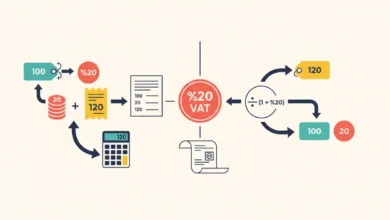
Reverse a Percentage Increase
Suppose a value is $120 after increasing 20%.
The original value is not:
$120 − 20% of $120
Instead:
Original Value = New Value ÷ (1 + Percentage Increase)
Original Value = $120 ÷ 1.20
Original Value = $100
The 20% increase was calculated from the original $100 base.
Reverse a Percentage Decrease
Suppose a sale price is $80 after a 20% reduction.
Original Value = Reduced Value ÷ (1 − Discount Rate)
Original Value = $80 ÷ 0.80
Original Value = $100
Again, simply adding 20% to $80 would produce only $96.
Percentage Points vs Percentage Change
This distinction is especially important in finance.
Suppose an interest rate rises from 4% to 6%.
The increase is:
6% − 4% = 2 percentage points
But the percentage increase in the rate itself is:
(6% − 4%) ÷ 4% × 100
2% ÷ 4% × 100 = 50%
So the rate rose:
- 2 percentage points, or
- 50% relative to its previous level.
Those statements describe different measurements.
Basis Points
Financial rates are often expressed in basis points.
1 Basis Point = 0.01 Percentage Point
Therefore:
25 basis points = 0.25 percentage points
50 basis points = 0.50 percentage points
100 basis points = 1 percentage point
If an interest rate rises from 5.00% to 5.75%, the increase is:
75 basis points
Percentages in Payment Calculations
Percentages frequently appear as interest rates when modeling how payment amounts are calculated.
For example, a 6% nominal annual rate must first be written as:
6% = 0.06
If monthly periods are used:
Monthly Rate = 0.06 ÷ 12
Monthly Rate = 0.005
That equals 0.5% per month under the nominal-rate assumption.
Failing to convert a percentage correctly can make a payment calculation wrong by orders of magnitude.
Percentages in Pension Calculations
A benefit multiplier used for pension payouts is another percentage application.
Suppose a hypothetical pension uses:
- multiplier = 1.5%;
- service = 30 years;
- pensionable compensation = $80,000.
First:
1.5% × 30 = 45%
Then:
$80,000 × 45% = $36,000
A 1.5% annual service multiplier across 30 years produces 45% of the compensation measure in this simplified example.
Percentages in Ordinary Annuity Math
An ordinary annuity calculation uses a periodic interest or discount rate.
If an annual nominal rate is 6% with monthly periods:
Periodic Rate = 6% ÷ 12 = 0.5%
In decimal form:
r = 0.005
The formula requires the decimal value, not the percentage symbol.
Percentages in Perpetuity Valuation
A perpetuity formula also depends on converting the discount rate correctly.
For example:
Present Value = Annual Cash Flow ÷ Discount Rate
If cash flow is $5,000 and the discount rate is 5%:
PV = $5,000 ÷ 0.05
PV = $100,000
Dividing by 5 instead of 0.05 would produce an obviously incorrect answer.
Percentages in Portfolio Rebalancing
Portfolio allocation is commonly expressed with percentages.
Suppose a target portfolio rebalancing policy specifies:
- 60% stocks;
- 40% bonds.
For a $200,000 portfolio:
Stock Target = $200,000 × 60% = $120,000
Bond Target = $200,000 × 40% = $80,000
The weights must total:
60% + 40% = 100%
Weighted Percentages
Not all percentages should simply be averaged.
Suppose:
- $80,000 earns 5%;
- $20,000 earns 10%.
A simple average gives:
(5% + 10%) ÷ 2 = 7.5%
But the investments are not equally sized.
Weighted return is:
($80,000 ÷ $100,000 × 5%) + ($20,000 ÷ $100,000 × 10%)
(80% × 5%) + (20% × 10%)
4% + 2% = 6%
The portfolio return is 6%, not 7.5%.
Percentage of a Percentage
Sometimes one percentage applies to another percentage.
Suppose 40% of a portfolio is in bonds, and 25% of the bond allocation is corporate bonds.
Corporate bonds represent:
40% × 25%
0.40 × 0.25 = 0.10
10% of the total portfolio
This is multiplication, not addition.
Successive Percentage Changes
Suppose an investment rises 10% and then another 10%.
Starting with $100:
$100 × 1.10 = $110
Then:
$110 × 1.10 = $121
Overall increase:
($121 − $100) ÷ $100 = 21%
Two successive 10% gains produce a 21% total increase, not 20%.
Negative Percentages
A negative percentage usually represents a decline relative to a reference amount.
If an investment return is −12%:
Ending Value = Starting Value × (1 − 0.12)
For $10,000:
$10,000 × 0.88 = $8,800
The loss is:
$1,200
Percentages Above 100%
A percentage above 100% simply means the measured amount exceeds the reference amount.
Suppose an investment rises from $50 to $125.
Gain:
$125 − $50 = $75
Percentage increase:
$75 ÷ $50 × 100
150%
The ending value is 250% of the original value, while the gain is 150%.
Those statements should not be confused.
Common Percentage Mistakes
One mistake is failing to convert percentages to decimals before using formulas.
Another is using the new value rather than the original value as the denominator in a percentage-change calculation.
People also frequently confuse percentage points with percentage changes.
Finally, equal percentage increases and decreases should not be assumed to cancel because they apply to different bases.
Frequently Asked Questions
What does percentage mean?
A percentage expresses a quantity as a share of 100.
What is the basic percentage formula?
Percentage = Part ÷ Whole × 100
How do I convert 7% to a decimal?
7% ÷ 100 = 0.07
How do I convert 0.35 to a percentage?
0.35 × 100 = 35%
How do I calculate 20% of $500?
$500 × 0.20 = $100
How do I calculate percentage increase?
(New − Original) ÷ Original × 100
Why does a 20% fall require a 25% recovery?
Because the recovery percentage is calculated from the smaller post-loss value.
What is the difference between percent and percentage points?
A percentage point measures the direct difference between two percentage values, while percentage change measures the difference relative to the original percentage.
What is one basis point?
One basis point equals 0.01 percentage point.
Can percentages exceed 100%?
Yes. A value can be more than 100% of a reference amount.
Should different percentages always be averaged equally?
No. When underlying amounts differ, a weighted average may be required.
Why are percentages important in finance?
They provide a common language for rates, returns, allocations, changes, and comparisons throughout Savings & Investing.