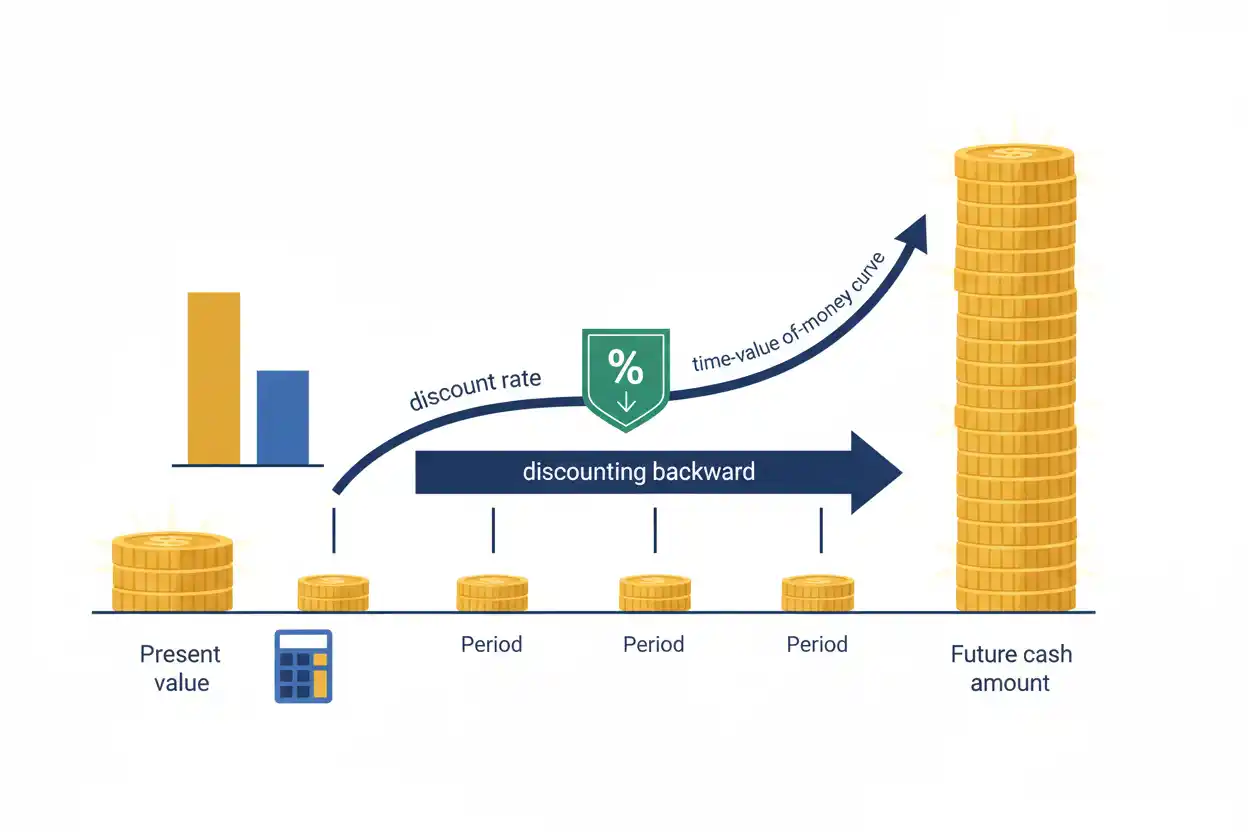
Present value measures what a future amount of money is worth today after applying a discount rate.
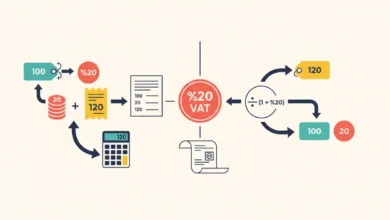
If you expect to receive $10,000 five years from now and use a 6% annual discount rate, its present value is approximately $7,472.58.
The logic is the reverse of compound growth. Future value moves money forward through time by multiplying by growth factors. Present value discounts future money backward by dividing by those factors.
This relationship is fundamental to loan pricing, bond valuation, retirement planning, investment analysis, and many other financial calculations.
What Is Present Value?
Present value, commonly abbreviated PV, answers:
What amount today is economically equivalent to a specified future amount under a chosen rate?
The discount rate represents the return required to make today’s money comparable with future money.
At a positive discount rate:
Present Value < Future Value
because money available today has more time to earn a return.
Present Value Formula
For one future cash flow:
Present Value = Future Value ÷ (1 + r)^n
Using symbols:
PV = FV ÷ (1 + r)^n
Where:
- PV = present value;
- FV = future value;
- r = discount rate per period;
- n = number of periods.
Present Value Example
Suppose:
- future amount = $10,000;
- annual discount rate = 6%;
- time = 5 years.
Use:
PV = $10,000 ÷ 1.06⁵
Calculate:
1.06⁵ ≈ 1.3382256
Then:
PV = $10,000 ÷ 1.3382256
PV ≈ $7,472.58
The present value is approximately $7,472.58.
Verify the Present Value
If $7,472.58 earns 6% annually for five years:
Future Value = $7,472.58 × 1.06⁵
Future Value ≈ $10,000
The present-value and future-value calculations are mathematical inverses.
What Discounting Means
Discounting reduces future cash flows according to:
- how far away they are;
- the discount rate applied.
A dollar one year from now is discounted once.
A dollar 10 years from now is discounted 10 times.
Therefore:
More Time → Lower Present Value
when the discount rate is positive.
How the Discount Rate Changes Present Value
Suppose $10,000 will be received in five years.
At 3%:
PV = $10,000 ÷ 1.03⁵
PV ≈ $8,626.09
At 6%:
PV ≈ $7,472.58
At 10%:
PV = $10,000 ÷ 1.10⁵
PV ≈ $6,209.21
Higher required returns reduce present value.
Discount Rate ↑ → Present Value ↓
Why Present Value Falls as Time Increases
Suppose the future amount remains $10,000 and the discount rate remains 6%.
One year away:
PV = $10,000 ÷ 1.06
≈ $9,433.96
Five years away:
≈ $7,472.58
Ten years away:
PV = $10,000 ÷ 1.06¹⁰
≈ $5,583.95
The longer you must wait, the less that future payment is worth today under a positive required return.
Present Value at a Zero Discount Rate
If:
r = 0
then:
PV = FV ÷ 1
Therefore:
PV = FV
Without a time-value adjustment, $10,000 received five years from now is valued at the same $10,000 nominal amount today.
Present Value With Monthly Periods
The rate and number of periods must be consistent.
Suppose:
- future amount = $12,000;
- nominal annual rate = 6%;
- monthly compounding;
- time = two years.
Monthly rate:
r = 0.06 ÷ 12 = 0.005
Number of periods:
n = 2 × 12 = 24
Then:
PV = $12,000 ÷ 1.005²⁴
PV ≈ $10,647.86
Using 6% directly with 24 monthly periods would be inconsistent.
Present Value With a Fractional Period
If the discounting convention permits fractional years, the same formula can use a noninteger exponent.
Suppose $10,000 is due in 2.5 years at a 5% effective annual discount rate.
PV = $10,000 ÷ 1.05²·⁵
PV ≈ $8,851.70
The timing convention should match the financial arrangement being analyzed.
Present Value vs Future Value
Future value asks:
What will today’s money become?
FV = PV × (1 + r)^n
Present value asks:
What is future money worth today?
PV = FV ÷ (1 + r)^n
They are two directions of the same time-value-of-money relationship.
Present Value and Finance Math
Basic quick finance math often begins with percentage conversions, compounding, and discounting.
Present value is one of the central building blocks because many more advanced financial formulas are simply combinations of discounted future cash flows.
Once the single-cash-flow formula is understood, bonds, annuities, and other instruments become easier to analyze.
Present Value of Multiple Cash Flows
When several different future payments occur, discount each one separately.
Suppose:
- $1,000 arrives in year 1;
- $1,500 in year 2;
- $2,000 in year 3;
- discount rate = 5%.
Then:
PV = $1,000 ÷ 1.05 + $1,500 ÷ 1.05² + $2,000 ÷ 1.05³
Calculate:
Year 1 PV ≈ $952.38
Year 2 PV ≈ $1,360.54
Year 3 PV ≈ $1,727.68
Total:
PV ≈ $4,040.60
The timing of every payment matters.
Present Value of an Annuity
If payments are equal and occur regularly for a finite number of periods, the present value of annuity formula provides a shortcut.
Instead of discounting each payment individually:
PV = PMT × [1 − (1 + r)^−n] ÷ r
The annuity formula is therefore built directly from the same discounting logic as ordinary present value.
Present Value vs Perpetuity
A perpetuity assumes equal cash flows continue indefinitely.
Its special formula is:
PV = C ÷ r
That does not replace the ordinary present-value formula for finite future amounts.
The perpetuity shortcut works only because the infinite discounted series converges under the model’s assumptions.
Present Value and Portfolio Risk
The discount rate used in valuation often reflects economic assumptions and risk.
However, portfolio risk is broader than simply selecting a discount rate.
An investment portfolio can experience volatility, drawdowns, liquidity constraints, and changing correlations even when a financial plan uses a stable discount rate for liability calculations.
Present value measures valuation; portfolio risk measures uncertainty.
Present Value and Portfolio Rebalancing
Suppose a future goal has a present value of $200,000.
The investment portfolio intended to fund that goal might later drift away from its target allocation.
Portfolio rebalancing addresses those asset weights.
Therefore:
- present value estimates how much a future financial need is worth today;
- rebalancing manages how the assets intended to fund it are allocated.
The calculations serve complementary but distinct purposes.
Present Value of a Future Purchase
Suppose you expect a purchase to cost $25,000 in 10 years and use an 8% discount rate.
PV = $25,000 ÷ 1.08¹⁰
PV ≈ $11,579.84
Under the 8% assumption, approximately $11,579.84 today is economically equivalent to $25,000 in 10 years.
This does not mean investing $11,579.84 guarantees the future purchase can be funded.
The 8% return is an assumption.
Solve for Future Value
Rearrange:
FV = PV × (1 + r)^n
If:
- PV = $8,000;
- r = 5%;
- n = 10;
then:
FV = $8,000 × 1.05¹⁰
FV ≈ $13,031.16
Solve for Discount Rate
If PV, FV, and time are known:
r = (FV ÷ PV)^(1/n) − 1
Suppose:
- PV = $10,000;
- FV = $15,000;
- n = 8 years.
r = (1.5)^(1/8) − 1
r ≈ 5.20%
A compounded rate of approximately 5.20% connects the two amounts.
Solve for Time
If PV, FV, and the rate are known:
n = ln(FV ÷ PV) ÷ ln(1 + r)
Suppose $10,000 must double at 7%.
n = ln(2) ÷ ln(1.07)
n ≈ 10.24 years
Under a constant 7% rate, the amount doubles in approximately 10.24 years.
Discount Rate vs Inflation
A discount rate is not automatically the same as inflation.
Depending on the problem, a discount rate can reflect:
- opportunity cost;
- investment return requirement;
- financing cost;
- risk;
- inflation expectations.
Using an inflation rate simply because the cash flow occurs in the future can produce an inappropriate valuation if the actual analytical question requires a different required return.
Nominal vs Real Present Value
If future cash flows are stated in nominal dollars, a nominal discount rate should generally be used consistently.
If the cash flows are expressed in inflation-adjusted real terms, a corresponding real discount rate may be more appropriate.
Mixing nominal and real assumptions can distort the result.
Present Value Does Not Guarantee Investment Results
Suppose a calculation says:
PV = $100,000
for a future financial goal.
That means $100,000 is the theoretical equivalent amount under the selected discount rate and timing assumptions.
It does not mean investing $100,000 today guarantees the exact future value.
Actual returns can differ from the discount-rate assumption.
Common Present Value Mistakes
One mistake is multiplying by the discount factor rather than dividing when moving a future amount backward in time.
Another is mixing annual rates with monthly periods.
People can also use a future value as though it were already worth the same amount today.
Finally, a discount rate should be chosen consistently with the cash flows and analytical purpose.
Frequently Asked Questions
What is present value?
Present value is what a future cash flow is worth today after discounting it at a specified rate.
What is the present value formula?
PV = FV ÷ (1 + r)^n
What does the discount rate mean?
It is the rate used to convert future value into today’s equivalent value.
Why is present value usually lower than future value?
At a positive discount rate, money available today has the opportunity to earn a return before the future date.
What happens when the discount rate increases?
Present value decreases.
What happens when the payment is further in the future?
At a positive rate, present value decreases because the cash flow is discounted for more periods.
What if the discount rate is zero?
Present value equals future value.
Can I calculate PV for several cash flows?
Yes. Discount each cash flow according to its own timing and add the results.
How is present value of an annuity different?
It is a shortcut designed for a finite series of equal recurring payments.
Is a perpetuity the same as present value?
No. A perpetuity is a special infinite cash-flow structure whose value is calculated using a specialized present-value formula.
Is the discount rate guaranteed to be earned?
No. It is a valuation or planning assumption unless a specific contract establishes the return.
Why is present value important?
It makes cash flows occurring at different dates comparable on the same present-day basis within broader Savings & Investing analysis.