Mathematics
-

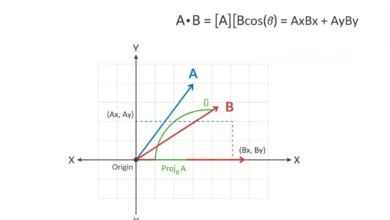
Dot Product: Definition, Formula & Example
The dot product combines two vectors and produces a single scalar value. For vectors with matching dimensions, it is calculated…
Read More » -
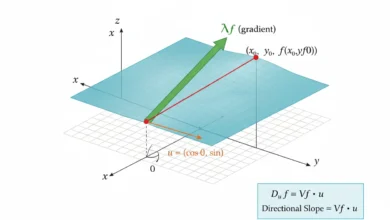
Directional Derivative: Formula, Rules & Examples
A directional derivative measures how quickly a multivariable function changes when you move from a point in a specified direction.…
Read More » -
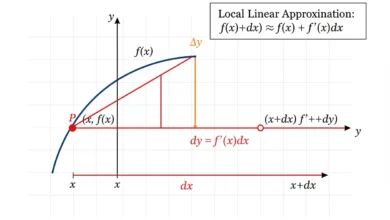
Differentials: Formula, Rules & Examples
Differentials describe how a small change in an input produces an estimated change in the output of a differentiable function.…
Read More » -
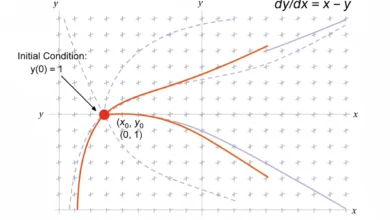
Differential Equations: Definition, Formula & Example
Differential equations are equations that relate an unknown function to one or more of its derivatives. Instead of asking only…
Read More » -
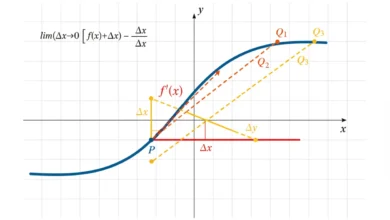
Derivatives: Definition, Formula & Example
Derivatives describe how functions change. A derivative can measure the slope of a curve, instantaneous velocity, acceleration, growth, decline, marginal…
Read More » -
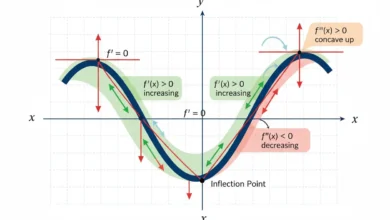
Derivative: Formula, Rules & Examples
A derivative measures how quickly a function changes with respect to its input. Geometrically, the derivative at a point is…
Read More » -
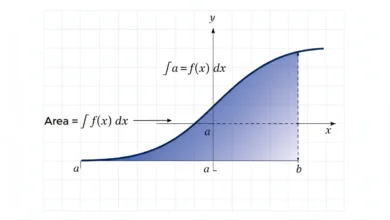
Definite Integral: Formula, Rules & Examples
A definite integral measures the accumulated net value of a function over a specified interval. It is written with a…
Read More » -
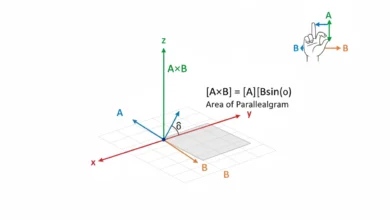
Cross Product: Definition, Formula & Example
The cross product is a vector operation that takes two three-dimensional vectors and produces a third vector perpendicular to both…
Read More » -
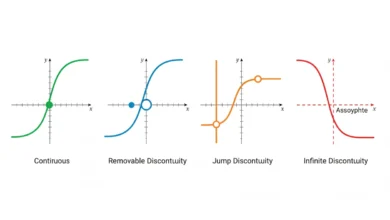
Continuity: Formula, Rules & Examples
Continuity describes whether a function behaves without a break, jump, or hole at a point or across an interval. Informally,…
Read More » -
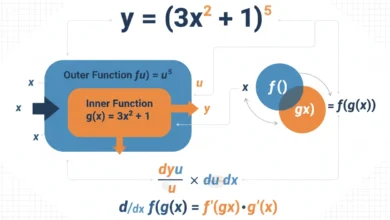
Chain Rule: Formula, Rules & Examples
The chain rule differentiates composite functions—functions placed inside other functions. If: y = f(g(x)) then: dy/dx = f′(g(x)) × g′(x)…
Read More »