Statistics & Probability
-

Skewness: Definition, Formula & Example
Skewness is a dimensionless measure of distributional asymmetry that indicates whether observations extend farther, or carry greater third-moment weight, on…
Read More » -
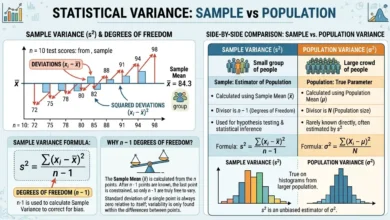
Sample Variance: Definition, Formula & Example
Sample variance is a measure of statistical dispersion that describes how widely observations in a sample are spread around their…
Read More » -
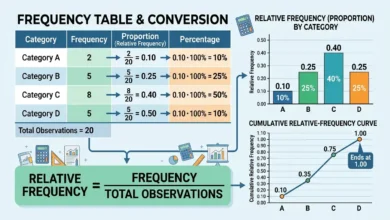
Relative Frequency: Definition, Formula & Example
Relative frequency is the proportion of a data set represented by a particular value, category, outcome, or class interval, calculated…
Read More » -
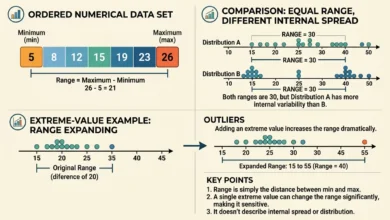
Range: Definition, Formula & Example
The range is one of the simplest measures of statistical dispersion, calculated as the difference between the largest and smallest…
Read More » -
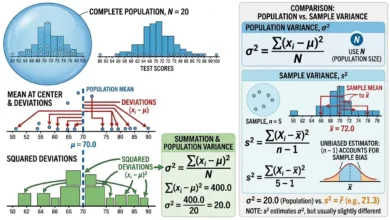
Population Variance: Definition, Formula & Example
Population variance is a measure of statistical dispersion that describes the average squared distance between every value in a defined…
Read More » -
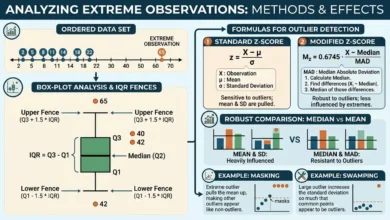
Outlier Detection: Definition, Formula & Example
Outlier detection is the process of identifying observations that are unusually distant from the central pattern of a data set…
Read More » -
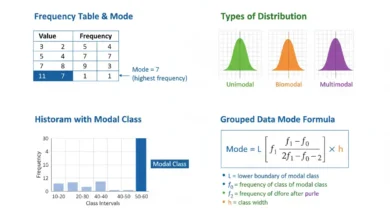
Mode: Definition, Formula & Example
The mode is a measure of central tendency that identifies the value, category, or region occurring most frequently in a…
Read More » -
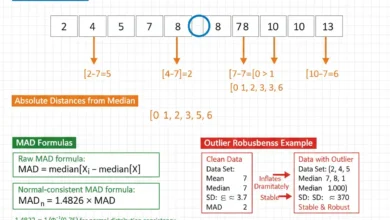
Median Absolute Deviation: Definition, Formula & Example
Median absolute deviation is a robust measure of statistical dispersion that describes the typical absolute distance of observations from the…
Read More » -
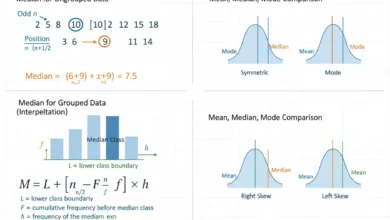
Median: Definition, Formula & Example
The median is a measure of central tendency that identifies the middle position of an ordered numerical data set, dividing…
Read More » -
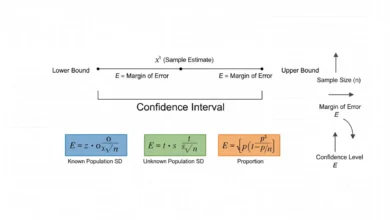
Margin Of Error: Definition, Formula & Example
The margin of error is a statistical quantity that measures how far an interval estimate extends from a sample-based point…
Read More »