Statistics & Probability
-

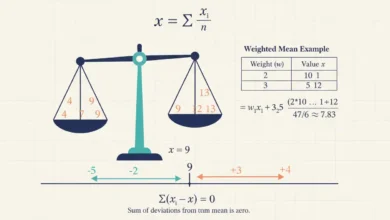
Arithmetic Mean: Definition, Formula & Example
The arithmetic mean is a measure of central tendency found by adding numerical values and dividing their total by the…
Read More » -
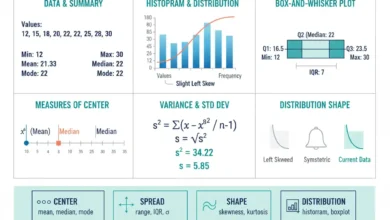
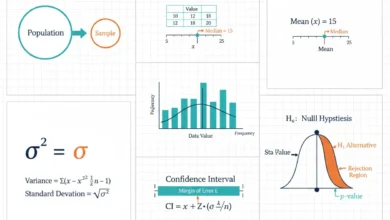
Descriptive Statistics: Complete Guide, Formulas & Examples
Descriptive statistics are methods used to organize, summarize, and present observed data so that its main characteristics can be understood…
Read More » -
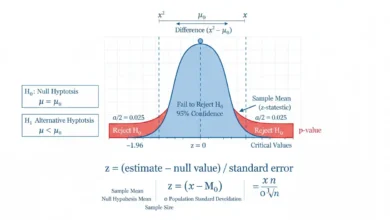
z-Test: Definition, Formula & Example
A z-test is a statistical hypothesis test that measures how far an observed sample estimate lies from a value specified…
Read More » -
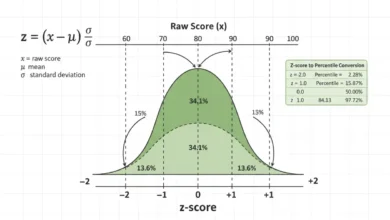
Z-Score: Definition, Formula & Example
A z-score is a standardized value that measures how far an observation lies from a distribution’s mean in units of…
Read More » -
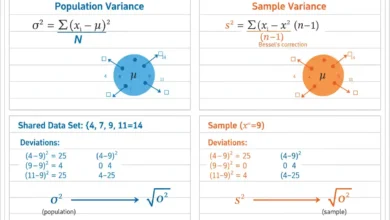
Variance: Population vs Sample
Variance measures how widely numerical values are dispersed around their arithmetic mean by averaging squared deviations from that mean, and…
Read More » -
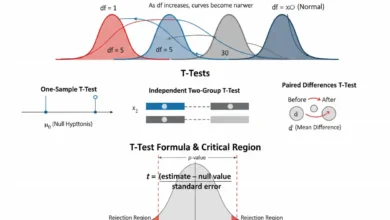
t-Test: Definition, Formula & Example
A t-test is a statistical hypothesis test used to evaluate whether a mean, a difference between means, or a mean…
Read More » -
Statistics Basics: Definition, Formula & Example
Statistics basics begin with a simple idea: data contain information about individuals, measurements, events, or processes, and statistical methods provide…
Read More » -
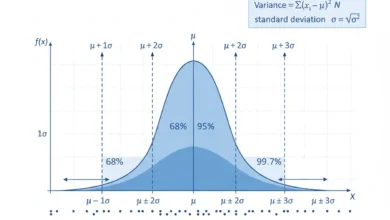
Standard Deviation: Definition, Formula & Example
Standard deviation is a measure of dispersion that describes how far observations typically lie from their mean, expressed in the…
Read More » -
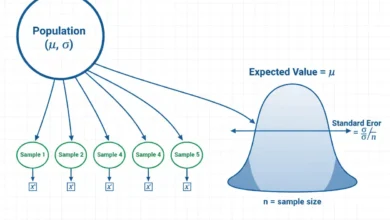
Sampling Distributions: Definition, Formula & Example
Sampling distributions describe how a statistic changes across repeated random samples drawn from the same population under the same sampling…
Read More » -
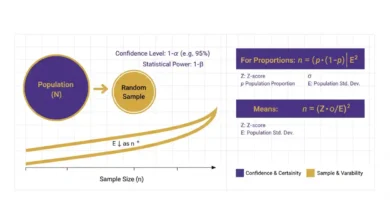
Sample Size: Definition, Formula & Example
Sample size is the number of observations, participants, measurements, experimental units, or other independent units included in a statistical analysis,…
Read More »