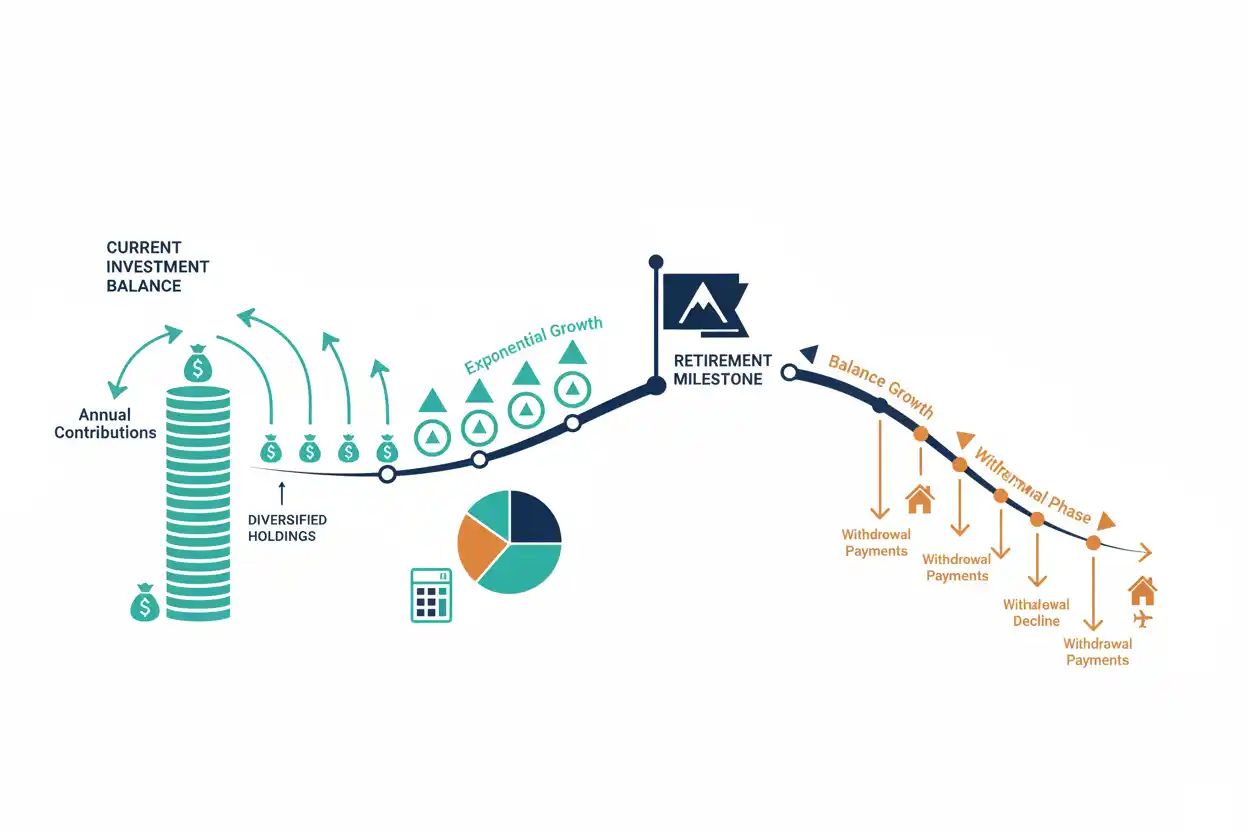

Retirement savings grow through a combination of current assets, future contributions, investment returns, and time.
Suppose someone already has $200,000 invested, contributes $15,000 at the end of each year, and earns a hypothetical 6% annual return for 20 years.
Under those assumptions, the existing $200,000 grows to approximately $641,427, while the annual contributions accumulate to approximately $551,784.
Combined retirement savings reach approximately $1.19 million.
That future balance is only one part of retirement planning. The next question is how much income the portfolio needs to produce and how withdrawals interact with investment risk, inflation, taxes, and retirement duration.
What Are Retirement Savings?
Retirement savings are financial assets accumulated to support future retirement spending.
They can include balances held in:
- retirement accounts;
- investment accounts;
- savings vehicles;
- other assets intentionally allocated to retirement.
A retirement-savings plan needs to answer two different questions:
- How much might the assets grow before retirement?
- How will those assets support spending after retirement begins?
Accumulation and withdrawal planning should be connected but not confused.
Basic Retirement Savings Growth Formula
For an existing lump sum:
Future Value = Current Savings × (1 + Return)^Years
Suppose:
- current savings = $200,000;
- assumed annual return = 6%;
- time = 20 years.
Then:
Future Value = $200,000 × 1.06²⁰
Future Value ≈ $641,427.09
Without any additional contributions, the current $200,000 grows to approximately $641,427 under the constant-return assumption.
Future Value of Annual Contributions
If equal contributions are made at the end of each year:
FV of Contributions = Annual Contribution × [(1 + r)^n − 1] ÷ r
Suppose:
- contribution = $15,000;
- return = 6%;
- years = 20.
Then:
FV = $15,000 × [(1.06)²⁰ − 1] ÷ 0.06
FV ≈ $551,783.87
The contributions accumulate to approximately $551,784.
Combined Retirement Savings
Add:
Existing Savings Future Value = $641,427.09
and:
Contribution Future Value = $551,783.87
Total:
Projected Retirement Savings = $641,427.09 + $551,783.87
Projected Retirement Savings ≈ $1,193,210.96
Under the assumptions, projected retirement savings reach approximately $1.19 million.
How Much Was Actually Contributed?
Starting assets:
$200,000
Future annual contributions:
$15,000 × 20 = $300,000
Total capital contributed:
$500,000
Projected ending balance:
$1,193,210.96
Modeled growth above contributed capital:
$1,193,210.96 − $500,000
≈ $693,210.96
More than half of the modeled ending balance comes from compounded investment growth rather than contributions.
Why Time Matters So Much
Suppose the same $200,000 grows at 6%.
After 10 years:
$200,000 × 1.06¹⁰ ≈ $358,169.54
After 20 years:
≈ $641,427.09
The second 10-year period adds:
$641,427.09 − $358,169.54
≈ $283,257.55
Compounding accelerates in dollar terms because returns are being earned on a larger accumulated balance.
Starting Later
Suppose someone waits 10 years and then invests the same $200,000 for only 10 years at 6%.
Ending value:
≈ $358,169.54
Compared with investing for 20 years:
≈ $641,427.09
Difference:
≈ $283,257.55
Time cannot guarantee higher returns, but it provides more periods in which compounding can occur.
Higher Contributions
Suppose the annual contribution increases from:
$15,000 → $20,000
at the same 6% rate for 20 years.
Future value of contributions:
$20,000 × [(1.06)²⁰ − 1] ÷ 0.06
≈ $735,711.82
Compared with the $15,000 contribution schedule:
$735,711.82 − $551,783.87
≈ $183,927.95
Increasing annual savings by $5,000 adds far more than $100,000 to the final modeled portfolio because the additional contributions also compound.
Contribution Rate Can Matter More Than Return Early On
Suppose a retirement account has only:
$25,000
A 6% return generates:
$25,000 × 6% = $1,500
If the saver contributes:
$15,000
during the year, the new savings contribution has 10 times the dollar impact of the annual investment return.
Early in the accumulation process, contribution behavior can dominate portfolio growth.
Investment Returns Matter More as the Portfolio Grows
Later, suppose the portfolio reaches:
$1,000,000
A 6% return equals:
$60,000
That can be much larger than the annual contribution.
As retirement savings grow, portfolio risk and return increasingly influence annual dollar changes.
Retirement Savings and Replacement Ratio
A retirement replacement ratio estimates how much retirement income may be desired relative to pre-retirement income.
Suppose:
- pre-retirement income = $100,000;
- target ratio = 75%.
Target income:
$75,000 per year
Retirement savings then need to support whatever portion of that $75,000 is not already covered by other income sources.
Retirement Savings and Income Gap
Suppose dependable retirement income provides:
$50,000
while target retirement income is:
$75,000
The retirement income gap is:
$75,000 − $50,000
= $25,000 per year
The retirement portfolio needs to help fund that $25,000 gap rather than necessarily funding the entire $75,000.
Retirement Savings and Required Rate of Return
Suppose projected retirement savings fall below the amount needed to fund the income gap.
The required rate of return can show how much investment growth would be necessary to close the shortfall.
However, if the required return becomes unrealistically high, the answer is not automatically to take more investment risk.
Other options include:
- increasing contributions;
- delaying retirement;
- reducing the income target;
- adjusting spending;
- increasing dependable retirement income.
Retirement Savings and Retirement Withdrawals
Retirement withdrawals determine how the accumulated portfolio is converted into spending.
Suppose retirement savings reach:
$1,193,211
and an initial withdrawal of:
$40,000
is planned.
Initial portfolio withdrawal percentage:
$40,000 ÷ $1,193,211
≈ 3.35%
That percentage alone does not determine whether the withdrawal is sustainable.
Future results depend on:
- investment returns;
- inflation adjustments;
- retirement length;
- taxes;
- future spending;
- market sequence.
Withdrawal Amount vs Account Return
Suppose the portfolio earns:
5%
while withdrawals equal:
4%
It may appear that assets must grow by 1%.
That conclusion can be wrong because:
- returns are not smooth;
- withdrawals occur through the year;
- inflation can raise future withdrawals;
- fees and taxes reduce returns;
- asset values fluctuate.
Retirement withdrawal planning should model sequences rather than relying only on average-rate subtraction.
Fixed-Dollar Withdrawal Example
Suppose a retiree begins with:
$1,000,000
and withdraws:
$40,000
during the year.
If the portfolio earns exactly 5% before the withdrawal under a simple year-end model:
Value Before Withdrawal = $1,000,000 × 1.05
= $1,050,000
After withdrawal:
$1,050,000 − $40,000 = $1,010,000
The account grows nominally by $10,000.
If the investment return were −10% instead:
$1,000,000 × 0.90 = $900,000
After the same $40,000 withdrawal:
$860,000
The interaction between withdrawals and market performance can be substantial.
Sequence-of-Returns Risk
Two retirees can experience the same average return over 20 years but different outcomes if the order of returns differs.
Large losses early in retirement are especially challenging because withdrawals remove assets from an already reduced portfolio.
Less capital remains to benefit from a later recovery.
This is why risk-adjusted return can matter when evaluating retirement portfolios rather than considering return alone.
Portfolio Risk Near Retirement
A saver 30 years from retirement and a retiree making monthly withdrawals have different liquidity needs.
As withdrawals approach, portfolio planning may need to account more explicitly for:
- market volatility;
- bond interest-rate risk;
- cash reserves;
- near-term spending;
- sequence risk.
There is no universal allocation appropriate to every retiree.
Inflation and Retirement Savings
Suppose retirement savings grow to:
$1,193,211
20 years from now.
That future nominal balance will not have the same purchasing power as $1.19 million today.
At an assumed 3% annual inflation rate:
Today’s Purchasing-Power Equivalent = $1,193,211 ÷ 1.03²⁰
≈ $660,700
The exact future inflation rate is unknown, but ignoring inflation can make retirement projections look stronger than they are in real terms.
Real vs Nominal Return Assumptions
If retirement spending is modeled in today’s dollars, a real return assumption can simplify comparisons.
If spending is inflated into future nominal dollars, a nominal return assumption should be used consistently.
Mixing:
- nominal returns;
- today’s uninflated expenses;
can distort projected retirement readiness.
Fees and Retirement Savings
Suppose gross portfolio return is:
6.5%
and recurring investment costs reduce the simplified net return to:
6%
That half-percentage-point difference compounds over decades.
For $200,000 over 20 years:
At 6.5%:
$200,000 × 1.065²⁰ ≈ $704,730
At 6%:
≈ $641,427
Difference:
≈ $63,303
Costs deserve attention because they reduce both current assets and future compounding.
Taxes and Retirement Accounts
Retirement savings can exist in accounts with different tax treatments.
Therefore, two accounts showing:
$500,000
may not produce identical spendable after-tax income.
Withdrawal taxes, tax-free qualified distributions, taxable accounts, and other structures can affect the net amount available for retirement spending.
A retirement balance is not automatically equivalent to after-tax purchasing power.
Retirement Savings and Debt
High debt payments can increase retirement spending needs.
Suppose someone enters retirement with:
$2,000 monthly mortgage payments
Annual requirement:
$2,000 × 12 = $24,000
If the debt were eliminated before retirement, the retirement-income target could potentially fall substantially.
The decision to pay debt early versus invest more should consider interest rates, taxes, liquidity, risk, and personal circumstances.
Retirement Savings and Emergency Reserves
Not every dollar available near retirement needs to be invested for maximum return.
Money required for near-term expenses may need greater liquidity.
A separate cash reserve can reduce the likelihood of selling volatile investments during a severe market decline.
The appropriate reserve size depends on spending and income stability.
Increasing Savings Rate
Suppose annual retirement contributions rise from:
$15,000 to $18,000
Difference:
$3,000 per year
Over 20 years, direct extra contributions equal:
$3,000 × 20 = $60,000
But when compounded at 6%, those extra end-of-year contributions would grow to approximately:
$3,000 × [(1.06)²⁰ − 1] ÷ 0.06
≈ $110,357
The long-term effect exceeds the cash contributed because of investment growth.
Delaying Retirement
An additional working year can improve the plan through several channels:
- one more year of contributions;
- one more year of portfolio growth;
- one fewer year of withdrawals;
- possibly higher retirement benefits;
- more time to reduce debt.
That combination can have a larger effect than changing one investment assumption slightly.
Retirement Savings Are a Range, Not One Exact Forecast
A projected balance of:
$1,193,211
depends entirely on the assumptions entered.
A more useful plan can calculate multiple return scenarios.
For example:
- conservative return;
- base return;
- stronger return.
The goal is to understand sensitivity, not to pretend one future balance is certain.
Common Retirement Savings Mistakes
One mistake is treating projected returns as guarantees.
Another is ignoring inflation.
People can also focus on the account balance without estimating how much retirement income it needs to support.
A further mistake is increasing portfolio risk aggressively simply because projected savings are below target instead of first examining contributions, retirement timing, and spending.
Frequently Asked Questions
What determines retirement savings growth?
Current savings, future contributions, investment returns, time, fees, taxes, and withdrawals all affect the result.
What is the formula for growth of current savings?
Future Value = Current Savings × (1 + Return)^Years
How do I calculate future value of annual contributions?
FV = Contribution × [(1 + r)^n − 1] ÷ r
for equal end-of-year contributions.
How much does $200,000 grow to at 6% for 20 years?
Approximately $641,427, assuming constant annual compounding and no withdrawals.
Why are early contributions valuable?
They have more time to compound.
Does a large retirement account guarantee enough retirement income?
No. Spending, taxes, inflation, retirement duration, and portfolio risk also matter.
How do I connect savings with retirement income?
Estimate target retirement income, subtract dependable income, then determine how much of the remaining gap the portfolio needs to support.
Is withdrawal rate the same as investment return?
No. One measures money leaving the portfolio; the other measures portfolio performance.
Why does sequence risk matter?
Poor returns early in retirement can be especially damaging when withdrawals are simultaneously reducing the portfolio.
Should retirement projections include inflation?
Yes. Either use real returns with today’s spending or nominal returns with future inflated spending consistently.
What if my required investment return looks unrealistic?
Consider increasing contributions, extending the time horizon, adjusting spending, or revisiting the retirement date before automatically increasing investment risk.
Why plan retirement savings and withdrawals together?
Accumulation determines how much capital reaches retirement, while withdrawals determine how that capital must support future spending throughout the broader Savings & Investing plan.