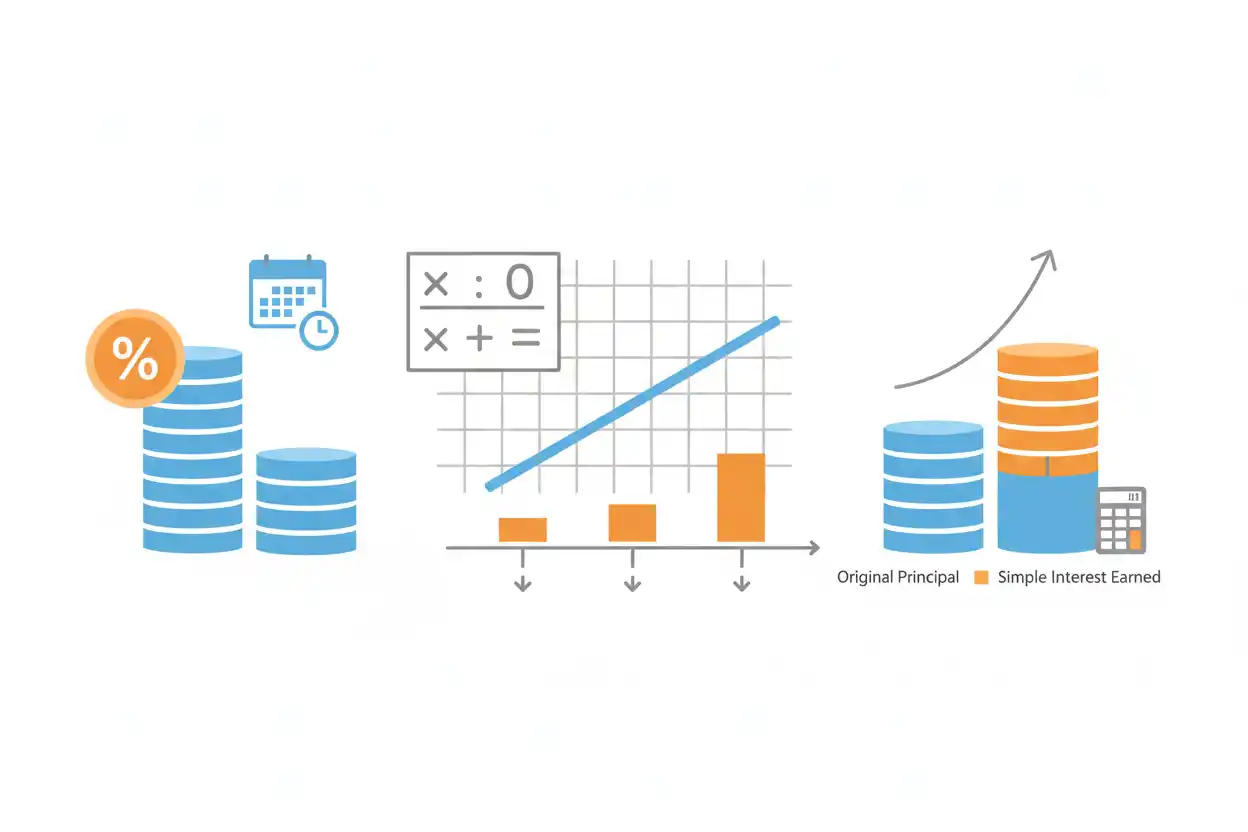

Simple interest calculates interest from the original principal rather than from a balance that grows through accumulated interest.
If $15,000 earns 6% simple interest for four years, the total interest is $3,600.
The account’s ending value is $18,600.
Unlike compound interest, the amount of interest earned each year remains the same because prior interest does not become part of the interest-bearing principal.
What Is Simple Interest?
Simple interest depends on three variables:
- principal;
- interest rate;
- time.
The formula assumes interest is calculated from the original principal for the entire measurement period.
If the principal remains unchanged:
Interest Earned per Year = Principal × Annual Rate
That annual dollar amount remains constant.
Simple Interest Formula
Simple Interest = Principal × Rate × Time
Using symbols:
I = P × r × t
Where:
- I = interest;
- P = original principal;
- r = interest rate per year as a decimal;
- t = time in years.
Ending amount:
Total Amount = Principal + Simple Interest
or:
A = P(1 + rt)
Simple Interest Example
Suppose:
- principal = $15,000;
- annual interest rate = 6%;
- time = 4 years.
Convert the percentage:
6% = 0.06
Calculate:
I = $15,000 × 0.06 × 4
I = $3,600
Ending value:
A = $15,000 + $3,600
A = $18,600
The investment or loan accumulates $3,600 of simple interest over four years.
Interest Per Year
Using the same example:
Annual Interest = $15,000 × 6%
Annual Interest = $900
Over four years:
$900 × 4 = $3,600
The interest amount does not increase from year to year under the simple-interest model.
Simple Interest Growth Table
| Year | Principal Used | Interest for Year | Cumulative Interest | Total Amount |
|---|---|---|---|---|
| 1 | $15,000 | $900 | $900 | $15,900 |
| 2 | $15,000 | $900 | $1,800 | $16,800 |
| 3 | $15,000 | $900 | $2,700 | $17,700 |
| 4 | $15,000 | $900 | $3,600 | $18,600 |
The calculation base stays at $15,000.
Example With a Shorter Period
Suppose:
- principal = $8,000;
- annual simple rate = 6%;
- time = 9 months.
Convert months into years:
Time = 9 ÷ 12
Time = 0.75 year
Then:
Interest = $8,000 × 0.06 × 0.75
Interest = $360
Ending amount:
$8,360
Example With Days
If a simple-interest contract uses a 365-day year:
Time in Years = Days ÷ 365
Suppose:
- principal = $20,000;
- annual rate = 5%;
- period = 90 days.
Then:
t = 90 ÷ 365
≈ 0.246575
Interest:
$20,000 × 0.05 × 90 ÷ 365
≈ $246.58
Actual financial contracts can use different day-count conventions, so the stated convention should be checked.
Solve for Principal
Starting from:
I = Prt
rearrange:
Principal = Interest ÷ (Rate × Time)
Suppose:
- interest = $2,400;
- annual rate = 8%;
- time = 3 years.
Then:
P = $2,400 ÷ (0.08 × 3)
P = $2,400 ÷ 0.24
P = $10,000
Solve for the Interest Rate
Rearrange:
Rate = Interest ÷ (Principal × Time)
Suppose:
- interest = $1,800;
- principal = $12,000;
- time = 3 years.
Then:
r = $1,800 ÷ ($12,000 × 3)
r = $1,800 ÷ $36,000
r = 0.05
Rate = 5%
Solve for Time
Rearrange:
Time = Interest ÷ (Principal × Rate)
Suppose:
- interest = $2,000;
- principal = $10,000;
- annual rate = 5%.
Then:
t = $2,000 ÷ ($10,000 × 0.05)
t = $2,000 ÷ $500
t = 4 years
Simple Interest vs Compound Interest
Simple interest:
A = P(1 + rt)
Compound interest:
A = P(1 + r)^t
for annual compounding.
Suppose $10,000 earns 5% for 10 years.
Simple Interest
A = $10,000 × (1 + 0.05 × 10)
A = $15,000
Annual Compound Interest
A = $10,000 × 1.05¹⁰
A ≈ $16,288.95
Difference:
$16,288.95 − $15,000
≈ $1,288.95
Compounding produces more because accumulated interest itself earns returns.
Simple Interest and Sinking Funds
A sinking fund normally involves recurring deposits accumulating toward a future target.
If the deposits earn compound interest, a sinking-fund annuity formula is appropriate rather than the simple-interest formula.
Simple interest can still be useful when the account or financing arrangement explicitly uses a simple-interest convention.
Simple Interest and Savings Rate
Your savings rate determines how much income is being directed into savings.
Simple interest determines how a specified principal might earn interest under a noncompounding arrangement.
For example:
Monthly Income = $5,000
Savings Rate = 20%
Monthly savings:
$1,000
If those recurring savings enter an account, the resulting balance requires a cash-flow model rather than treating the entire future contribution total as one initial principal.
Simple Interest and Sequence of Returns Risk
Sequence of returns risk generally concerns variable market returns combined with contributions or withdrawals.
A fixed simple-interest calculation does not have the same return-sequence problem because the rate is assumed constant and interest is calculated directly from original principal.
The underlying risk structure is different.
Simple Interest and Sharpe Ratio
The Sharpe ratio compares excess return with volatility.
If a simple-interest contract produces a fixed contractual return with no mark-to-market fluctuations, standard portfolio volatility may not be the main analytical concern.
Credit risk, liquidity, inflation, or default risk can still exist even when the interest formula itself is simple.
Simple Interest and Social Security Benefits
Social Security benefits are not calculated by applying simple interest to contributions.
Social Security retirement payments follow statutory benefit formulas and claiming-age adjustments.
The fact that payroll taxes were paid over a career does not make the eventual retirement benefit a simple-interest account.
Principal Reduction Loans
Some consumer loans may be described as simple-interest loans because periodic interest is calculated from the outstanding principal balance.
That is slightly different from the textbook formula:
I = Prt
applied to one unchanged original principal over the entire term.
If payments reduce principal, later interest charges can fall because the outstanding balance falls.
Always check the specific loan’s method.
Simple Interest on a Loan
Suppose a loan of $5,000 charges 8% simple interest for two years with no interim principal reduction.
Interest = $5,000 × 0.08 × 2
Interest = $800
Total repayment:
$5,800
If the loan instead amortizes monthly, interest calculations and payment timing can produce a different result.
Interest Rate vs Percentage Points
Suppose a simple interest rate rises:
5% → 6%
The increase is:
1 percentage point
The relative increase in the interest rate is:
(6% − 5%) ÷ 5%
= 20%
These are different measurements.
Simple Interest and Inflation
Suppose an account earns 4% simple interest annually while inflation averages 5%.
The nominal balance increases, but purchasing power can still decline.
The simple-interest calculation by itself does not adjust for inflation.
Long-term comparisons should distinguish nominal growth from real economic growth.
When Simple Interest Can Be Useful
Simple interest is useful when:
- a contract explicitly uses it;
- you need a quick noncompounding estimate;
- interest is calculated from an unchanged principal;
- a short time period makes compounding differences small.
For long-term investment growth, compounding is usually the more relevant mathematical framework.
Common Simple Interest Mistakes
One mistake is entering 5 instead of 0.05 for a 5% rate.
Another is using months as though they were years.
People can also apply simple interest to a compounding account.
A further mistake is assuming every loan advertised with an annual rate follows the textbook unchanged-principal simple-interest formula.
Frequently Asked Questions
What is simple interest?
Simple interest calculates interest from principal without earning interest on previously accumulated interest.
What is the formula?
I = P × r × t
What does P mean?
P is principal.
What does r mean?
r is the interest rate per year expressed as a decimal.
What does t mean?
t is time in years.
How do I calculate the ending amount?
A = P(1 + rt)
What is simple interest on $10,000 at 5% for three years?
$10,000 × 0.05 × 3 = $1,500
How do I calculate a partial year?
Convert the period into a fraction of a year, such as:
9 months ÷ 12 = 0.75 year
Does simple interest compound?
No.
Is simple interest always cheaper than compound interest?
Under otherwise identical positive rates and unchanged balances, simple interest grows more slowly, but actual financial-product costs depend on contract terms.
Does simple interest measure investment risk?
No.
Why understand simple interest?
It is a foundational finance calculation used alongside more advanced concepts throughout Savings & Investing.