
Taxes and pay calculations connect what you earn with what actually reaches your bank account.
An annual salary can be converted into monthly, biweekly, weekly, daily, or hourly equivalents. Bonuses can increase gross compensation but may produce a paycheck that looks different after withholding. Payroll deductions reduce gross pay, while income-tax calculations depend on taxable-income rules rather than one percentage applied blindly to every dollar earned.
This guide explains the core relationships and routes each specialized calculation to its dedicated Logic Library page.
The Basic Pay Flow
A simplified pay calculation follows this structure:
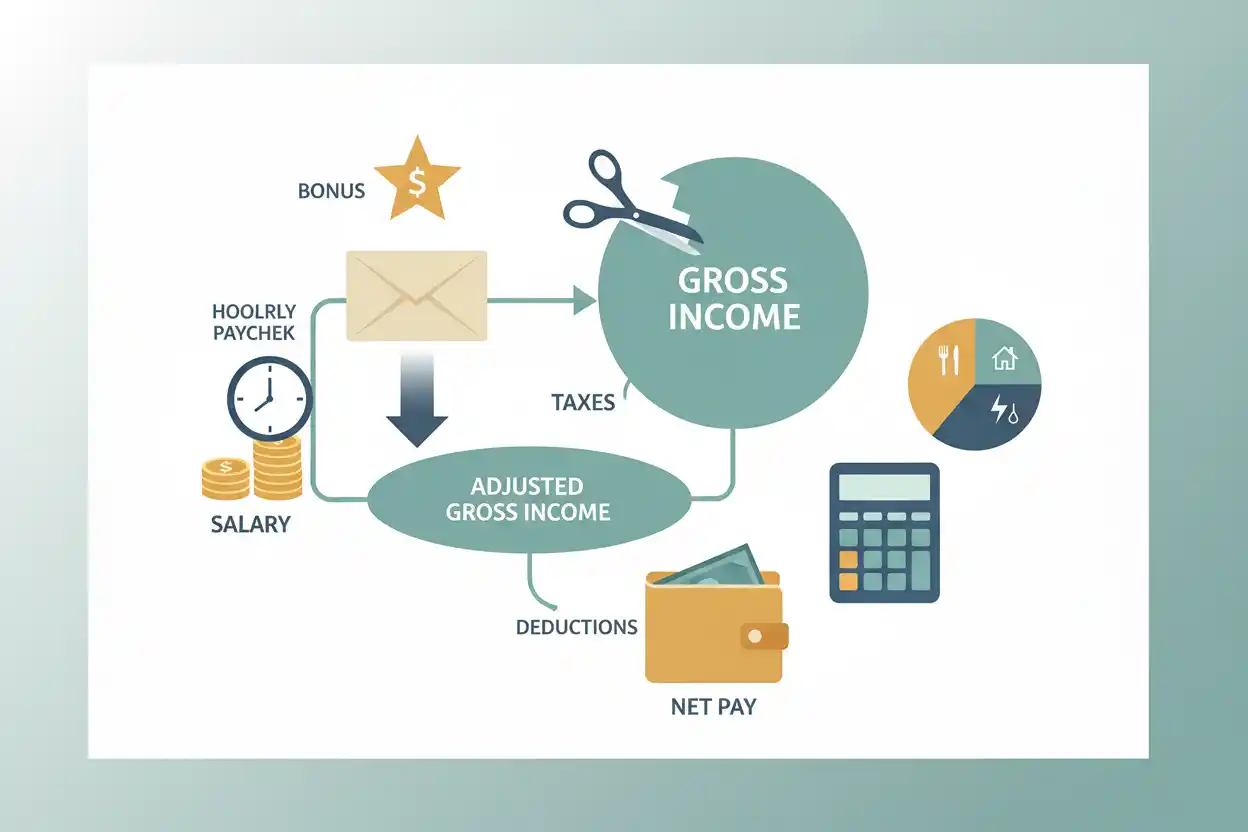
Gross Compensation → Payroll Adjustments and Deductions → Taxes and Withholding → Net Pay
The exact steps depend on:
- employment arrangement;
- jurisdiction;
- benefits;
- retirement contributions;
- tax filing circumstances;
- payroll schedule.
The most important distinction is that gross pay and take-home pay are not the same number.
What Is Gross Pay?
Gross pay is compensation before taxes and other paycheck deductions.
It can include:
- salary;
- hourly wages;
- overtime;
- commissions;
- bonuses;
- other taxable compensation.
Suppose someone earns:
$75,000 Annual Salary
and receives:
$5,000 Bonus
Simplified annual gross compensation:
$75,000 + $5,000
= $80,000
Whether every payment receives identical tax or withholding treatment is a separate question.
Annual Salary
An annual salary expresses compensation over a year.
Common conversions include:
Monthly Gross Pay = Annual Salary ÷ 12
Biweekly Gross Pay = Annual Salary ÷ 26
Weekly Gross Pay = Annual Salary ÷ 52
Suppose salary is:
$78,000
Monthly equivalent:
$78,000 ÷ 12 = $6,500
Weekly equivalent:
$78,000 ÷ 52 = $1,500
Biweekly equivalent:
$78,000 ÷ 26 = $3,000
These are gross-pay conversions.
Biweekly Pay
Biweekly pay means an employee is generally paid every two weeks.
That usually creates:
26 Pay Periods per Year
A common mistake is multiplying one biweekly paycheck by 24 because there are approximately two paychecks in a typical month.
For annualization:
Annual Pay = Biweekly Pay × 26
Suppose:
Biweekly Gross Pay = $2,500
Then:
Annual Gross Pay = $2,500 × 26
= $65,000
Biweekly vs Semimonthly Pay
These schedules are different.
Biweekly:
26 Paychecks per Year
Semimonthly:
24 Paychecks per Year
Suppose annual salary is $72,000.
Biweekly gross:
$72,000 ÷ 26 ≈ $2,769.23
Semimonthly gross:
$72,000 ÷ 24 = $3,000
The semimonthly check is larger because there are fewer checks.
Hourly Pay to Annual Pay
A simplified full-time annualization formula is:
Annual Pay = Hourly Rate × Hours per Week × Weeks per Year
Suppose:
- hourly rate = $25;
- hours = 40 per week;
- weeks = 52.
Then:
Annual Pay = $25 × 40 × 52
Annual Pay = $52,000
This assumes 40 paid hours every week for all 52 weeks.
Actual annual pay can differ because of unpaid time, overtime, variable schedules, or other factors.
Daily Pay
A simplified daily equivalent can be calculated from an assumed work schedule.
Suppose:
Annual Salary = $65,000
and the calculation uses:
260 Workdays
Then:
Daily Pay = $65,000 ÷ 260
= $250
This is a mathematical conversion, not necessarily the payroll method used by an employer.
Gross Pay From Hours Worked
For hourly compensation:
Gross Pay = Hourly Rate × Hours Worked
Suppose:
- hourly wage = $22;
- hours = 35.
Then:
Gross Pay = $22 × 35
= $770
Overtime, premiums, commissions, and other compensation can require additional calculations.
Bonus Pay
Bonus pay is compensation beyond ordinary base wages or salary.
Suppose:
- salary = $80,000;
- annual bonus = 10% of salary.
Then:
Bonus = $80,000 × 10%
Bonus = $8,000
Total gross compensation before considering other items:
$88,000
The amount deposited into the employee’s bank account can be lower because payroll withholding and deductions can apply.
Bonus Percentage From Dollar Amount
If salary and bonus dollars are known:
Bonus Percentage = Bonus ÷ Salary × 100
Suppose:
- salary = $90,000;
- bonus = $13,500.
Then:
$13,500 ÷ $90,000 × 100
= 15%
The bonus equals 15% of base salary.
Gross Pay vs Taxable Income
Gross compensation and taxable income should not be treated as identical by default.
Tax calculations can involve:
- exclusions;
- adjustments;
- deductions;
- other tax-law rules.
A simplified relationship is:
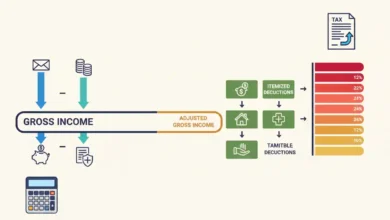
Gross Income − Applicable Adjustments = Adjusted Gross Income
Later calculations can further determine taxable income.
The exact rules depend on the relevant tax system.
Adjusted Gross Income
Adjusted gross income is an important U.S. tax concept.
Conceptually:
AGI = Gross Income − Qualifying Adjustments
The specific adjustments allowed are determined by tax law.
AGI can then influence various tax calculations and eligibility rules.
The dedicated AGI page should be used for that narrower tax concept rather than treating this hub as its replacement.
AGI Example for Math Structure
Suppose, purely as a simplified arithmetic example:
Gross Income = $85,000
and qualifying adjustments total:
$5,000
Then:
AGI = $85,000 − $5,000
= $80,000
This illustrates the arithmetic relationship.
It does not determine whether a particular $5,000 item legally qualifies as an adjustment.
Taxable Income Is Not Always AGI
A simplified progression can be thought of as:
Gross Income → AGI → Taxable Income → Income Tax
Taxable income can differ from AGI because additional deductions or tax rules may apply.
Therefore:
AGI ≠ Automatically Taxable Income
and:
Gross Salary ≠ Automatically Taxable Income
Marginal Tax Rate
A marginal tax rate is the rate applied to the next dollar within a progressive tax system.
It does not necessarily mean that all income is taxed at that rate.
Suppose a hypothetical system taxes portions of income at:
- 10%;
- 20%;
- 30%.
A taxpayer reaching the 30% band does not automatically pay 30% on every dollar of taxable income.
Different portions can be taxed at different rates.
Effective Tax Rate
A simplified effective tax-rate formula is:
Effective Tax Rate = Total Tax ÷ Relevant Income Measure × 100
Suppose:
- total income tax = $12,000;
- taxable income = $80,000.
Then:
Effective Tax Rate = $12,000 ÷ $80,000
= 15%
The effective rate can be substantially below the highest marginal rate applied to part of the income.
Marginal vs Effective Tax Rate
Suppose the highest rate affecting the taxpayer is:
24%
but total tax divided by taxable income equals:
15%
Both figures can be correct.
Marginal rate: rate affecting the next dollar within the applicable bracket structure.
Effective rate: average tax relative to the chosen income base.
They answer different questions.
Payroll Withholding vs Final Tax
The amount withheld from paychecks during the year is not necessarily identical to final annual tax liability.
Conceptually:
Tax Withheld During Year − Final Tax Liability = Refund or Amount Still Due
Suppose:
- withholding = $14,000;
- final liability = $12,500.
Difference:
$14,000 − $12,500 = $1,500
The simplified result is a $1,500 refund.
A refund represents excess payment relative to the final liability under the simplified example—not an additional bonus from the tax system.
Net Pay Formula
A practical paycheck structure is:
Net Pay = Gross Pay − Taxes Withheld − Employee Deductions
Suppose:
- gross paycheck = $3,000;
- tax withholding = $650;
- insurance and other employee deductions = $250.
Then:
Net Pay = $3,000 − $650 − $250
Net Pay = $2,100
The employee takes home $2,100.
Take-Home Percentage
You can compare net pay with gross pay:
Take-Home Percentage = Net Pay ÷ Gross Pay × 100
Using the $3,000 and $2,100 example:
$2,100 ÷ $3,000 × 100
= 70%
The employee receives 70% of gross pay as take-home cash in that simplified paycheck.
The remaining 30% includes the modeled withholding and deductions.
Why Paychecks Can Differ
Two employees with the same salary can receive different net pay because they may have different:
- tax elections;
- benefits;
- retirement contributions;
- insurance costs;
- other payroll deductions.
Gross salary alone does not determine take-home pay.
Salary Increase Example
Suppose annual salary rises:
$70,000 → $77,000
Dollar increase:
$7,000
Percentage raise:
$7,000 ÷ $70,000 × 100
= 10%
New monthly gross salary equivalent:
$77,000 ÷ 12
≈ $6,416.67
The increase in take-home pay will generally be smaller than the full gross increase because payroll deductions and taxes can also change.
Reverse a Raise
Suppose a current salary of $77,000 includes a 10% raise from the previous salary.
The previous salary is:
Previous Salary = $77,000 ÷ 1.10
= $70,000
Subtracting 10% from the new salary would incorrectly produce:
$69,300
because the 10% raise was based on the old salary, not the new one.
Overtime Pay Structure
Where an overtime premium applies, a simplified formula may be:
Total Gross Pay = Regular Pay + Overtime Pay
If:
- regular hourly rate = $20;
- overtime rate = 1.5 × regular;
- regular hours = 40;
- overtime hours = 5.
Regular:
$20 × 40 = $800
Overtime rate:
$20 × 1.5 = $30
Overtime pay:
$30 × 5 = $150
Total gross:
$950
Actual overtime eligibility and rules depend on employment law and the specific worker.
Commission Pay
Suppose a salesperson earns:
- $3,000 base monthly pay;
- 5% commission on $40,000 of eligible sales.
Commission:
$40,000 × 5% = $2,000
Gross monthly compensation:
$3,000 + $2,000
= $5,000
Commission plans can have tiers, thresholds, chargebacks, or other rules that make actual calculations more complex.
Payroll Deductions
Paycheck deductions can include amounts for:
- taxes;
- retirement contributions;
- insurance;
- other employee benefits;
- authorized deductions.
Not every deduction has the same tax treatment.
A payroll statement should therefore be read by category rather than subtracting everything and labeling the result “tax.”
Pre-Tax vs After-Tax Deductions
Some deductions can reduce income used for certain tax calculations, while others occur after taxes.
A simplified conceptual ordering is:
Gross Pay → Applicable Pre-Tax Deductions → Tax Calculations → After-Tax Deductions → Net Pay
The exact treatment depends on the specific benefit and tax rules.
Pay Frequency and Budgeting
Income may arrive:
- weekly;
- biweekly;
- semimonthly;
- monthly.
Household expenses often occur monthly.
This timing mismatch makes budgeting important.
A biweekly employee receives 26 checks annually, meaning two months in many years contain a third regular paycheck.
Those months can be useful for irregular expenses or savings when planned deliberately.
Monthly Income From Biweekly Pay
Suppose:
Biweekly Net Pay = $2,000
Annual net pay:
$2,000 × 26 = $52,000
Average monthly net income:
$52,000 ÷ 12
≈ $4,333.33
Simply multiplying:
$2,000 × 2 = $4,000
understates average monthly income because it ignores the two extra biweekly checks across the year.
Annual Compensation With Bonus
Suppose:
- salary = $75,000;
- bonus = $10,000.
Total:
$85,000
If budgeting uses only the salary and treats bonus income as uncertain, regular monthly planning can remain based on:
$75,000 ÷ 12 = $6,250 gross monthly
The bonus can then be handled separately.
This can be more conservative than assuming every bonus is guaranteed.
Gross Income and Budgeting
A household budget should generally be based on money actually available to spend rather than gross salary alone.
Suppose:
Gross Monthly Pay = $7,000
but:
Take-Home Pay = $5,100
Building recurring spending around $7,000 would create a serious mismatch.
For day-to-day planning, net cash flow is usually the more relevant starting point.
Pay Raises and Savings
Suppose take-home pay increases by:
$400 per month
If $250 of that increase is saved:
Annual Added Savings = $250 × 12
= $3,000
Directing part of each raise toward savings can improve long-term financial progress without requiring a reduction in existing spending.
Bonus Allocation Example
Suppose a net bonus received is:
$6,000
A household might choose, purely as an example:
- $3,000 to savings;
- $2,000 to debt reduction;
- $1,000 to discretionary spending.
The allocation totals:
$6,000
The right allocation depends on the household’s priorities.
The key is distinguishing gross bonus, net bonus, and how the final cash is used.
Paycheck Math Should Use the Right Period
A common source of error is mixing:
- annual salary;
- monthly deductions;
- biweekly withholding.
Convert all values to one consistent period before comparing them.
For example:
Annual Insurance Cost ÷ 26 = Biweekly Cost
if it is distributed equally across 26 biweekly paychecks.
Taxes & Pay as a Finance Foundation
Pay is often the starting point for broader financial planning.
Income funds:
- housing;
- bills;
- debt payments;
- savings;
- investing;
- taxes.
Understanding the path from gross compensation to spendable cash makes every later budgeting calculation more reliable.
Common Taxes & Pay Mistakes
One mistake is assuming annual salary divided by 12 equals take-home monthly pay.
Another is multiplying a biweekly paycheck by 24 instead of 26 when annualizing.
People also confuse marginal and effective tax rates.
A further mistake is treating payroll withholding as automatically equal to final tax liability.
Frequently Asked Questions
What is gross pay?
Gross pay is compensation before taxes and other paycheck deductions.
How do I convert annual salary to monthly gross pay?
Monthly Gross Pay = Annual Salary ÷ 12
How do I calculate biweekly gross pay?
Biweekly Gross Pay = Annual Salary ÷ 26
for a standard 26-pay-period biweekly schedule.
Is biweekly the same as semimonthly?
No. Biweekly generally produces 26 checks; semimonthly produces 24.
How do I estimate annual hourly pay?
Annual Pay = Hourly Rate × Hours per Week × Weeks per Year
using the appropriate work assumptions.
How do I calculate a percentage bonus?
Bonus = Salary × Bonus Percentage
Is gross income the same as AGI?
No. AGI reflects applicable adjustments to gross income under tax rules.
What is net pay?
Net Pay = Gross Pay − Withholding − Employee Deductions
Is my marginal tax rate my average tax rate?
Not necessarily. Marginal rate and effective rate are different measurements.
Is tax withholding the same as final tax liability?
Not necessarily.
Should I budget from gross or net income?
For day-to-day spending, actual take-home cash is usually more directly useful.
Where should I go next?
Use the specialist guides on adjusted gross income, annual salary, biweekly pay, bonus pay, and budgeting for the narrower calculations covered by the Taxes & Pay.