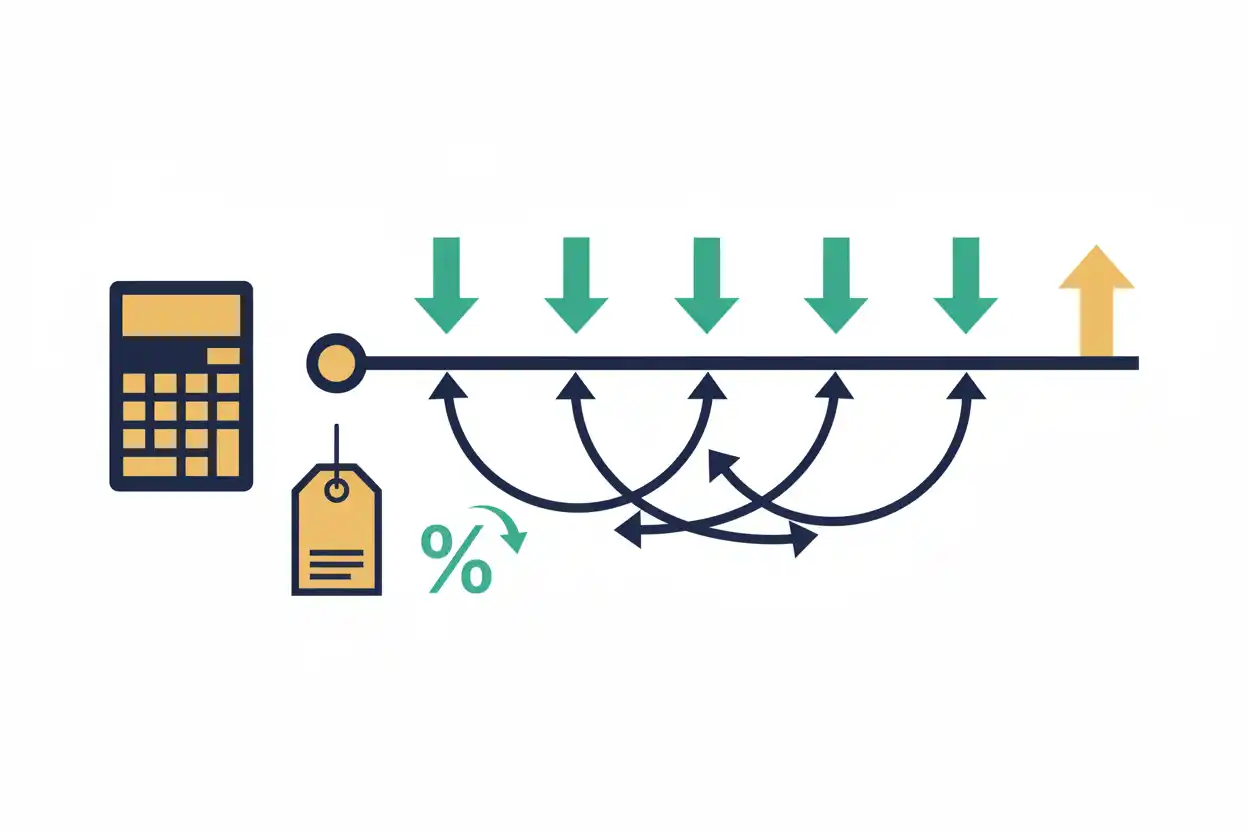

Yield to maturity estimates the annualized return implied by a bond’s current price and its promised cash flows if the bond is held until maturity.
Suppose a bond has:
- $1,000 face value;
- 6% annual coupon;
- five years remaining;
- market price of $950.
Its approximate YTM is about 7.18%, while solving the complete discounted-cash-flow equation produces approximately 7.23% under annual coupon assumptions.
The yield exceeds the 6% coupon rate because the investor receives both coupon income and a $50 gain if the bond is ultimately redeemed at $1,000.
What Is Yield to Maturity?
Yield to maturity, or YTM, is the discount rate that makes the present value of a bond’s remaining contractual cash flows equal to its current market price.
Those cash flows generally include:
- coupon payments;
- final principal repayment.
Conceptually, YTM asks:
What annualized return is embedded in today’s bond price if the promised cash flows occur and the bond is held to maturity?
Exact Yield to Maturity Equation
For annual coupons:
Bond Price = C ÷ (1 + y) + C ÷ (1 + y)² + … + (C + Face Value) ÷ (1 + y)^n
Where:
- C = annual coupon payment;
- y = YTM;
- n = years to maturity.
YTM is the unknown rate.
For most multi-period bonds, it is solved numerically.
Yield to Maturity Example
Suppose:
- face value = $1,000;
- coupon rate = 6%;
- annual coupon = $60;
- market price = $950;
- maturity = 5 years.
Cash flows are:
- Year 1 = $60;
- Year 2 = $60;
- Year 3 = $60;
- Year 4 = $60;
- Year 5 = $1,060.
Exact YTM Equation
$950 = $60 ÷ (1 + y) + $60 ÷ (1 + y)² + $60 ÷ (1 + y)³ + $60 ÷ (1 + y)⁴ + $1,060 ÷ (1 + y)⁵
Solving gives approximately:
YTM ≈ 7.23%
More precisely under these assumptions:
YTM ≈ 7.227%
Approximate Yield to Maturity Formula
A useful approximation is:
Approximate YTM = [Annual Coupon + (Face Value − Market Price) ÷ Years to Maturity] ÷ [(Face Value + Market Price) ÷ 2]
Using the example:
Capital gain spread across five years:
($1,000 − $950) ÷ 5
= $10 per year
Add coupon:
$60 + $10 = $70
Average of face and market values:
($1,000 + $950) ÷ 2
= $975
Then:
Approximate YTM = $70 ÷ $975
≈ 7.18%
This is close to the exact 7.23% result.
Why YTM Is Above Coupon Rate
Coupon rate:
6%
Current price:
$950
Face value:
$1,000
If held to maturity and repaid at face value, the investor receives:
$1,000 − $950 = $50
of capital appreciation in addition to coupons.
That pushes the yield above the coupon rate.
Premium Bond Example
Suppose the same $1,000 face-value, 6% coupon bond trades at:
$1,050
If it matures at $1,000, the investor loses:
$50
of principal value relative to the purchase price.
Therefore YTM would generally fall below the 6% coupon rate.
Bond at Par
If:
- market price = face value;
- no unusual features affect the cash flows;
then the coupon rate and YTM are generally equal under matching payment conventions.
For example:
Price = $1,000
Coupon = 6%
YTM ≈ 6%
Current Yield vs YTM
Current yield is:
Current Yield = Annual Coupon ÷ Market Price
For the $950 bond:
$60 ÷ $950
≈ 6.32%
Yet YTM is approximately:
7.23%
The difference exists because current yield ignores the $50 gain from $950 toward the $1,000 maturity value.
Yield to Maturity vs Yield to Call
A callable bond may be redeemed before maturity.
Yield to call evaluates the return under that earlier call scenario.
YTM assumes the bond reaches final maturity.
For callable bonds, both calculations can matter.
YTM and Turnover Ratio
A bond portfolio’s turnover ratio can indicate whether securities are frequently sold before maturity.
If a manager regularly trades bonds rather than holding them to maturity, the portfolio’s realized return can differ substantially from the bonds’ purchase-date YTMs.
YTM is a conditional holding-to-maturity yield, not a promise of realized portfolio performance.
YTM and Treynor Ratio
The Treynor ratio relates excess portfolio return to systematic risk.
YTM is based on a bond’s discounted contractual cash flows.
A bond may have an attractive YTM but still carry:
- credit risk;
- interest-rate risk;
- liquidity risk.
Yield and portfolio risk-adjusted performance should therefore be analyzed separately.
YTM and Total Return
Total return measures the actual gain or loss over the investor’s real holding period.
Suppose a bond is purchased at $950 and sold one year later at $900 after receiving a $60 coupon.
One-year total return:
($900 − $950 + $60) ÷ $950
= $10 ÷ $950
≈ 1.05%
That realized one-year result differs sharply from the original 7.23% YTM because the bond was sold before maturity at a lower market price.
YTM and Time-Weighted Return
A portfolio containing many bonds can report time-weighted return based on actual portfolio performance.
Individual bond YTMs are input characteristics of securities.
TWR measures the realized performance of the combined strategy through time.
Reinvestment Assumption
A common interpretation of YTM assumes interim coupon payments can be reinvested at a rate consistent with the calculated yield to achieve that yield as a realized compound return.
If coupons are reinvested at lower rates, the investor’s realized compound return can be below the original YTM.
This creates reinvestment risk.
Credit Risk
The YTM calculation assumes the promised bond cash flows occur.
If the issuer:
- misses coupons;
- restructures debt;
- defaults;
the realized return can be much lower.
A high quoted YTM can sometimes reflect higher perceived credit risk rather than a free opportunity for greater return.
Interest-Rate Risk
Bond prices generally move inversely with market yields.
Suppose a bond’s YTM is 5%.
If comparable market yields later rise to 7%, the bond’s market value can fall.
An investor holding to maturity may still receive contractual principal if the issuer performs, but an investor selling early can realize a loss.
Time to Maturity Matters
The longer the remaining maturity, the more sensitive many bond prices can be to changing yields, all else equal.
A 20-year bond and a two-year bond with the same coupon and YTM do not necessarily have the same interest-rate risk.
Duration provides additional information about that sensitivity.
Coupon Rate Matters
Higher coupons return more cash to the investor earlier.
Lower-coupon and zero-coupon bonds place more of the total value in the final maturity payment.
This changes both:
- cash-flow timing;
- price sensitivity.
YTM summarizes the yield but does not fully describe that timing risk.
Zero-Coupon Bond YTM
For a zero-coupon bond:
Price = Face Value ÷ (1 + YTM)^n
Therefore:
YTM = (Face Value ÷ Price)^(1/n) − 1
Suppose:
- price = $750;
- maturity value = $1,000;
- time = 5 years.
Then:
YTM = ($1,000 ÷ $750)^(1/5) − 1
≈ 5.92%
No coupon payments need to be included.
Semiannual Coupon Bonds
If a bond pays twice each year:
- divide the annual coupon into semiannual payments;
- use twice as many periods;
- solve for the six-month yield;
- convert to the appropriate annual quoted convention.
Using annual cash flows for a semiannual-pay bond can create an inaccurate result.
Accrued Interest
Between coupon dates, bond settlement can include accrued interest.
A precise YTM calculation should distinguish:
- quoted clean price;
- dirty or invoice price;
- accrued interest.
Simplified educational examples often assume a coupon-date purchase to avoid this additional complexity.
Price and Yield Move Inversely
Holding the contractual cash flows constant:
Bond Price ↑ → YTM ↓
Bond Price ↓ → YTM ↑
Suppose a bond’s market price falls because required market returns rise.
The same coupons are now being purchased at a lower price, increasing the implied yield.
YTM Is Not the Coupon Rate
Coupon rate is determined from:
Annual Coupon ÷ Face Value
YTM is determined from:
- current market price;
- all remaining coupons;
- face value;
- time to maturity.
They can be equal, but often are not.
YTM Is Not Current Yield
Current yield ignores:
- maturity value gain or loss;
- time value of principal repayment.
YTM incorporates both.
This is why YTM generally provides a more complete hold-to-maturity yield measure.
YTM Is Not Guaranteed
Realized return can differ because of:
- default;
- sale before maturity;
- reinvestment rates;
- call provisions;
- transaction costs.
Therefore:
Calculated YTM ≠ Guaranteed Investor Return
Common Yield to Maturity Mistakes
One mistake is treating coupon rate as YTM.
Another is ignoring a premium or discount to face value.
People may also use the approximation when a more precise numerical result is needed.
A further mistake is assuming a callable bond will necessarily remain outstanding through maturity.
Frequently Asked Questions
What is yield to maturity?
It is the annualized discount rate implied by a bond’s current price and remaining promised cash flows through maturity.
What cash flows are included?
Remaining coupons and final face-value repayment.
What is the approximate YTM formula?
Approximate YTM = [Coupon + (Face − Price) ÷ Years] ÷ [(Face + Price) ÷ 2]
Why is YTM higher than coupon rate for a discount bond?
Because the investor can receive both coupon income and a capital gain toward face value.
Why is YTM lower for a premium bond?
Because part of the coupon income is offset by a decline from purchase price toward face value.
Is current yield the same as YTM?
No.
Is yield to call the same as YTM?
No. YTC assumes early redemption; YTM assumes final maturity.
Does YTM guarantee my return?
No.
Why can realized return differ?
The bond may be sold early, default, be called, or coupons may be reinvested at different rates.
How is a zero-coupon bond’s YTM calculated?
YTM = (Face Value ÷ Price)^(1/n) − 1
What happens to YTM when price rises?
YTM generally falls when contractual cash flows remain unchanged.
Why calculate YTM?
It provides a comprehensive bond-yield comparison for hold-to-maturity analysis within broader Savings & Investing decisions.