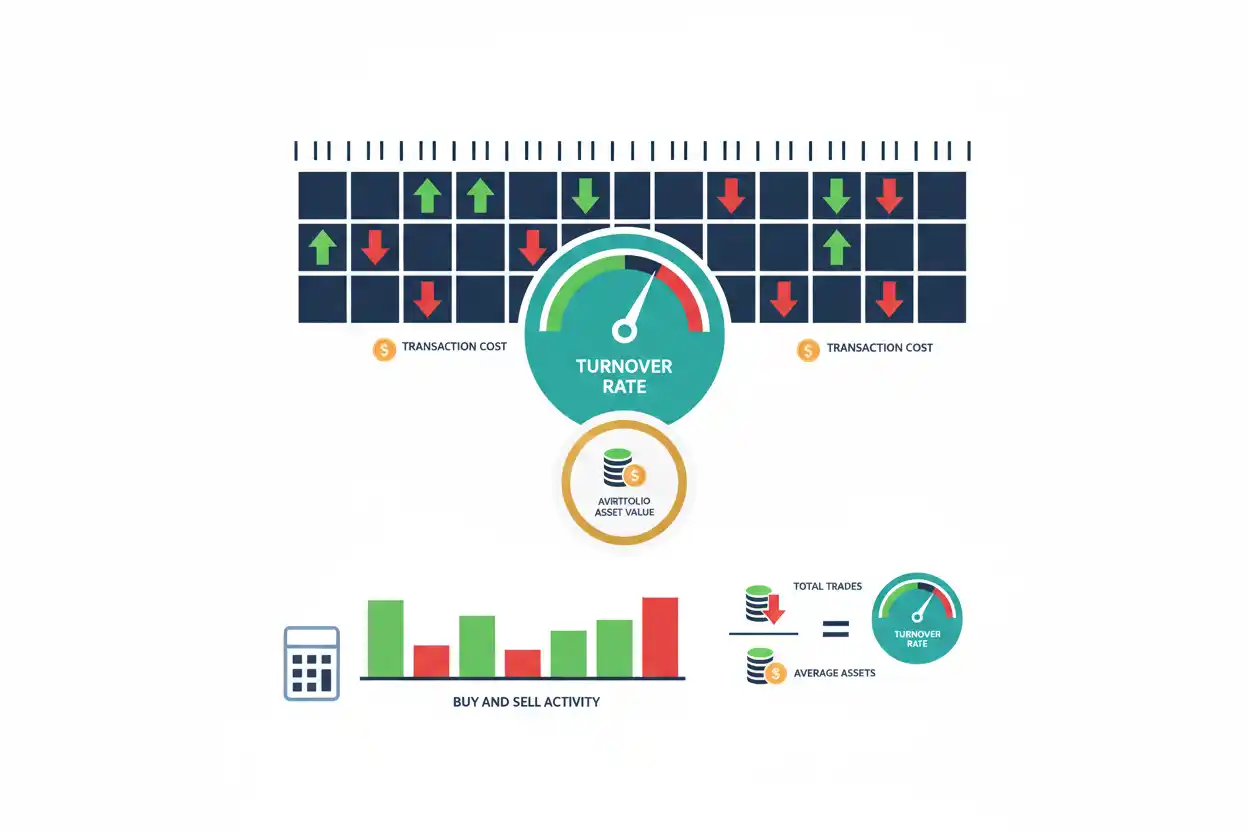

Turnover ratio measures how actively securities are bought and sold within an investment portfolio over a period.
For a fund with $120 million of purchases, $90 million of sales, and $500 million of average net assets, a common portfolio-turnover calculation uses the lower of purchases or sales.
That produces:
$90 million ÷ $500 million = 18%
An 18% turnover ratio means trading activity measured under the formula equaled approximately 18% of average net assets during the period.
Turnover does not tell you whether the trading was profitable. It measures activity, not investment quality.
What Is Portfolio Turnover Ratio?
Portfolio turnover ratio estimates how frequently a portfolio’s holdings are replaced through trading.
A lower ratio generally indicates less buying and selling.
A higher ratio generally indicates more active trading.
The metric can be useful when evaluating:
- investment funds;
- managed portfolios;
- trading activity;
- potential transaction costs;
- tax efficiency in taxable accounts.
Turnover Ratio Formula
A common portfolio-fund formula is:
Turnover Ratio = Lesser of Purchases or Sales ÷ Average Net Assets × 100
The use of the lower of purchases or sales helps focus the measure on portfolio replacement rather than allowing one-sided cash flows to dominate the result.
Specific published turnover figures can follow applicable reporting conventions, so methodology should be checked when precision matters.
Turnover Ratio Example
Suppose a fund reports:
- securities purchased = $120 million;
- securities sold = $90 million;
- average net assets = $500 million.
Use the lower amount:
Lesser of Purchases or Sales = $90 million
Then:
Turnover Ratio = $90 million ÷ $500 million × 100
Turnover Ratio = 18%
The fund’s portfolio turnover ratio is 18%.
Why Use the Lower of Purchases or Sales?
Suppose a fund receives large new investor inflows.
It may purchase many securities simply because new cash entered the fund.
Using purchases alone could make the portfolio appear more actively traded than it really was.
Using the lower of purchases or sales reduces some of that distortion.
What Does an 18% Turnover Ratio Mean?
A simple interpretation is that trading measured under the turnover formula represented about 18% of average portfolio assets during the year.
It does not mean:
- exactly 18% of every security was replaced;
- every holding stays for 5.56 years;
- 18% of investors sold their shares.
The ratio summarizes portfolio trading activity at the fund level.
Approximate Holding-Period Intuition
A rough reciprocal can provide intuition:
Approximate Holding Period ≈ 1 ÷ Turnover Rate
For 20% turnover:
1 ÷ 0.20 = 5 years
For 100%:
1 ÷ 1 = 1 year
This is only a rough interpretation.
Real portfolios can have some positions traded frequently and others held for decades.
10% Turnover Example
Suppose:
- purchases = $50 million;
- sales = $40 million;
- average assets = $400 million.
Use $40 million:
Turnover Ratio = $40 million ÷ $400 million
= 10%
This indicates relatively low trading activity under the formula.
100% Turnover Example
Suppose:
- purchases = $600 million;
- sales = $500 million;
- average assets = $500 million.
Then:
Turnover Ratio = $500 million ÷ $500 million
= 100%
A 100% turnover ratio indicates trading volume equivalent to the portfolio’s average net assets under the selected methodology.
It does not require every individual holding to have been sold once.
Turnover Above 100%
Portfolio turnover can exceed 100%.
Suppose:
- lower of purchases or sales = $750 million;
- average net assets = $500 million.
Then:
Turnover Ratio = $750 million ÷ $500 million
= 150%
This indicates substantial trading relative to portfolio size.
Turnover Ratio and Transaction Costs
More trading can create more:
- commissions where applicable;
- bid-ask spread costs;
- market impact;
- operational costs.
Suppose additional trading costs equal 0.40% of portfolio assets.
If gross investment return is:
8%
a simplified net result after those costs would be:
8% − 0.40% = 7.60%
The exact effect depends on the actual cost structure.
Turnover Ratio and Taxes
In taxable accounts, frequent realization of gains can potentially accelerate taxable events.
A low-turnover strategy can sometimes defer realization of gains for longer.
However, turnover alone does not determine tax liability.
Results also depend on:
- whether trades create gains or losses;
- holding periods;
- account type;
- jurisdiction;
- investor circumstances.
Turnover Ratio and Total Return
Total return measures investment performance.
Turnover ratio measures activity.
A fund can have:
Turnover = 150%
and:
Total Return = −5%
Another could have:
Turnover = 10%
and:
Total Return = 12%
Turnover by itself does not indicate whether buying and selling added value.
Turnover Ratio and Treynor Ratio
The Treynor ratio measures excess return relative to systematic risk.
If high turnover raises costs without increasing gross return enough to compensate, net Treynor performance can deteriorate.
That makes turnover an implementation metric rather than a substitute for risk-adjusted performance.
Turnover Ratio and Time-Weighted Return
Time-weighted return can evaluate the portfolio’s investment performance independently of external investor cash-flow timing.
Internal portfolio trades contribute to the strategy’s performance but are not external contributions or withdrawals.
Turnover measures how much trading occurred inside the portfolio.
TWR measures how that portfolio performed.
Turnover Ratio and Yield to Call
A bond portfolio may trade securities before they mature or are called.
Yield to call estimates a callable bond’s return under a specified call assumption.
Turnover ratio instead measures how actively the portfolio itself trades.
A portfolio can have low turnover while holding bonds with many different yield-to-call profiles.
Turnover Ratio and Yield to Maturity
Yield to maturity assumes a bond is held through maturity under the calculation’s assumptions.
A portfolio with high turnover may regularly sell bonds before maturity.
In that case, quoted YTM values can remain useful valuation measures, but realized portfolio returns can differ because the securities were not actually held until maturity.
Turnover Ratio and Trading Style
Turnover can reflect the investment process.
A long-term buy-and-hold strategy might naturally have lower turnover.
A strategy based on:
- short-term signals;
- tactical allocation;
- security rotation;
can have higher turnover.
The correct level depends on whether trading creates sufficient expected value after costs.
Low Turnover Is Not Automatically Better
Low turnover can reduce trading costs.
But it can also occur because a manager holds poor investments for too long.
A 5% turnover ratio does not guarantee:
- strong security selection;
- diversification;
- low risk;
- high return.
It only indicates relatively little portfolio replacement.
High Turnover Is Not Automatically Bad
High turnover may be justified if:
- the strategy is designed for shorter holding periods;
- trading opportunities are substantial;
- transaction costs are low;
- realized results compensate for the additional activity.
The issue is whether turnover improves net investor outcomes.
Comparing Two Funds
Suppose:
Fund A
- gross return = 10%;
- estimated trading drag = 0.20%;
- turnover = 20%.
Approximate result:
9.80% before other costs
Fund B
- gross return = 10.5%;
- estimated trading drag = 1%;
- turnover = 180%.
Approximate result:
9.50% before other costs
Fund B had the higher gross performance but the lower simplified return after assumed trading costs.
Activity should be evaluated net of its consequences.
Turnover and Fund Size
Large funds can experience different market-impact costs from smaller funds because trading large positions may move prices.
Therefore, the same turnover percentage can have different economic consequences across portfolios.
The ratio does not reveal transaction-cost quality by itself.
Turnover and Portfolio Rebalancing
Normal portfolio rebalancing can create turnover.
Suppose stocks rise and become overweight.
Selling stocks and buying bonds increases trading activity.
That does not mean the manager has abandoned a long-term strategy.
Some turnover can simply reflect maintaining the intended asset allocation.
Turnover From Investor Cash Flows
Investor inflows and outflows can also require portfolio transactions.
This is one reason turnover methodology matters.
Not every purchase or sale reflects a deliberate investment-view change.
Turnover and Index Funds
Passive index-oriented portfolios can have turnover because of:
- index constituent changes;
- corporate actions;
- cash flows;
- rebalancing.
“Passive” does not mean “zero trading.”
The turnover ratio provides a way to quantify the actual activity.
Turnover and Active Funds
Active funds may trade more frequently because managers are making:
- valuation decisions;
- tactical adjustments;
- security selections.
But active management can also follow long holding periods.
The label “active” does not determine one fixed turnover ratio.
Turnover Does Not Measure Investor Trading
Portfolio turnover refers to trades inside the portfolio.
Investor turnover refers to investors buying or selling fund shares.
These are different concepts.
A fund can experience heavy investor inflows while maintaining low internal portfolio turnover.
Common Turnover Ratio Mistakes
One mistake is assuming turnover equals investment return.
Another is assuming 100% turnover means every security was replaced exactly once.
People may also label all high turnover as bad without considering strategy and net results.
A further mistake is comparing published turnover ratios without checking whether the calculations use consistent definitions.
Frequently Asked Questions
What is portfolio turnover ratio?
It measures how actively securities are bought and sold within an investment portfolio.
What is a common formula?
Turnover Ratio = Lesser of Purchases or Sales ÷ Average Net Assets × 100
What does a 20% turnover ratio mean?
Trading activity measured by the formula equaled about 20% of average net assets during the period.
Can turnover exceed 100%?
Yes.
Does high turnover mean high return?
No.
Does low turnover guarantee better results?
No.
Can turnover increase costs?
Yes. More trading can increase spreads, commissions, market impact, and other transaction costs.
Can turnover affect taxes?
Potentially, especially when trading realizes taxable gains in taxable accounts.
Is portfolio turnover the same as investor redemptions?
No.
Why use the lower of purchases or sales?
It helps reduce distortion from one-sided cash flows such as large investor inflows.
How is turnover different from total return?
Turnover measures activity; total return measures investment performance.
Why track turnover ratio?
It helps evaluate implementation efficiency and trading intensity within a broader Savings & Investing strategy.